European commercial vehicles in Q1 2026: the recovery is real, and so is the electrification gap
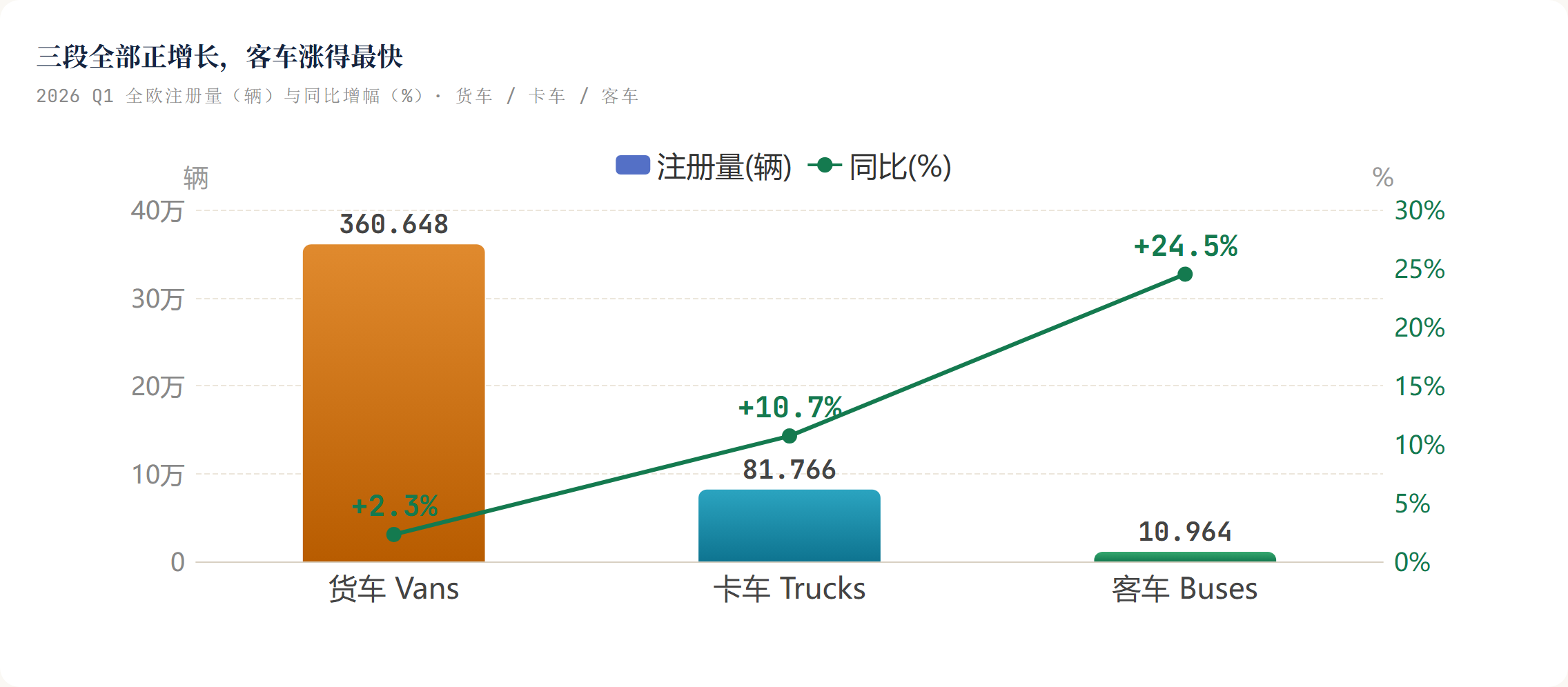
In Q1 2026, all three EU commercial vehicle segments grew. Vans (light commercial vehicles ≤3.5 t) rose 2.3% to 360648 units in the EU-27 (454545 units including EFTA and the UK; figures below refer to the EU-27 unless stated otherwise); trucks rose 10.7% to 81766 units; buses rose 24.5% to 10964 units. The numbers look good, but ACEA itself poured cold water on them in its press release: growth in vans and trucks is more of a "recovery from a low base", and buses are the only segment with real momentum. As for electrification, shares are rising, but "progress is too slow, and market uptake remains constrained by insufficient enabling conditions".
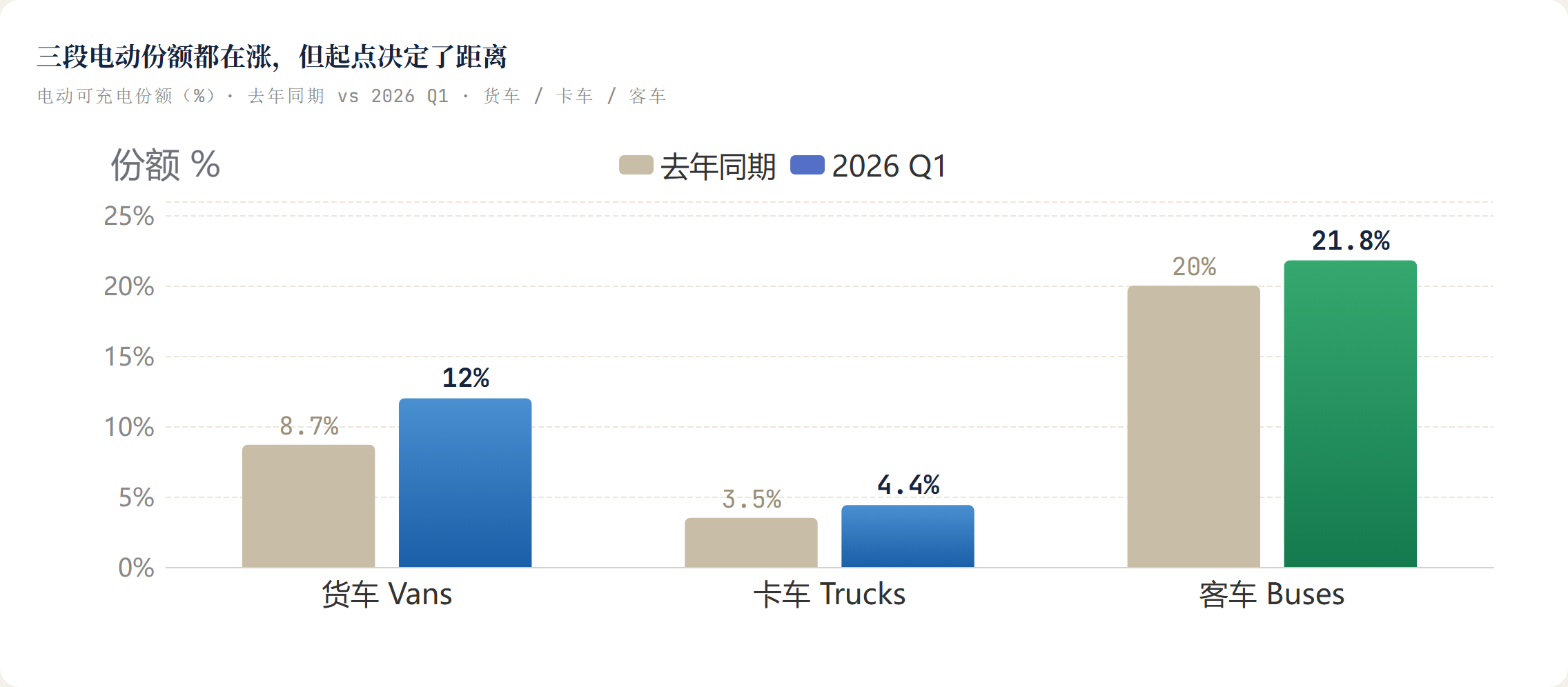
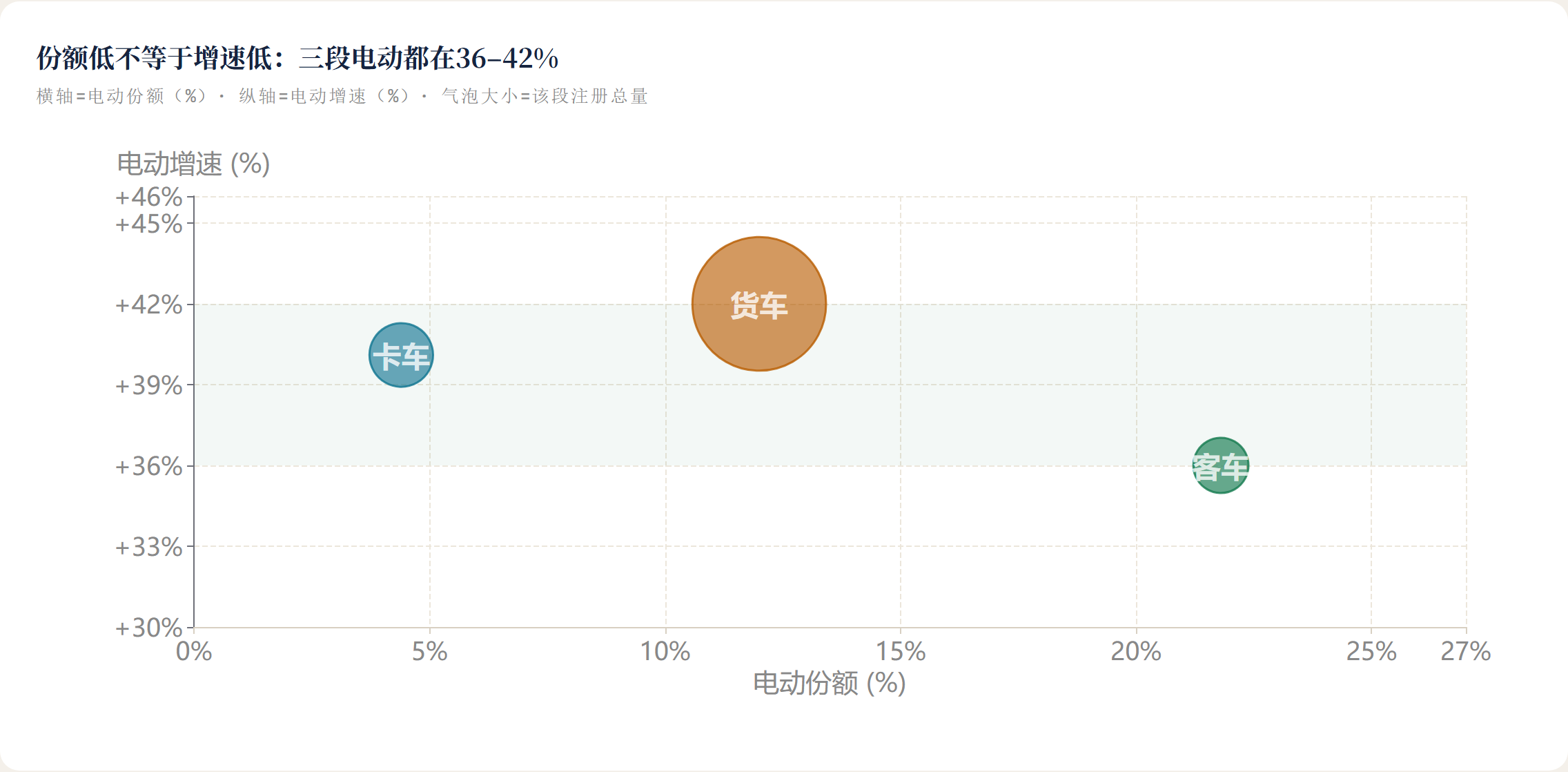
Growth rates can be deceptive. What is truly worth reading in this quarterly report is a "tiered fault-line table" of electrification shares: vans at 12%, trucks at 4.4%, buses at 21.8%. Same EU, same carbon regulation, yet electrification progress differs by three full tiers. This is not "a matter of time" but a structural difference between three procurement logics.
The rise is a recovery, not a surge in demand
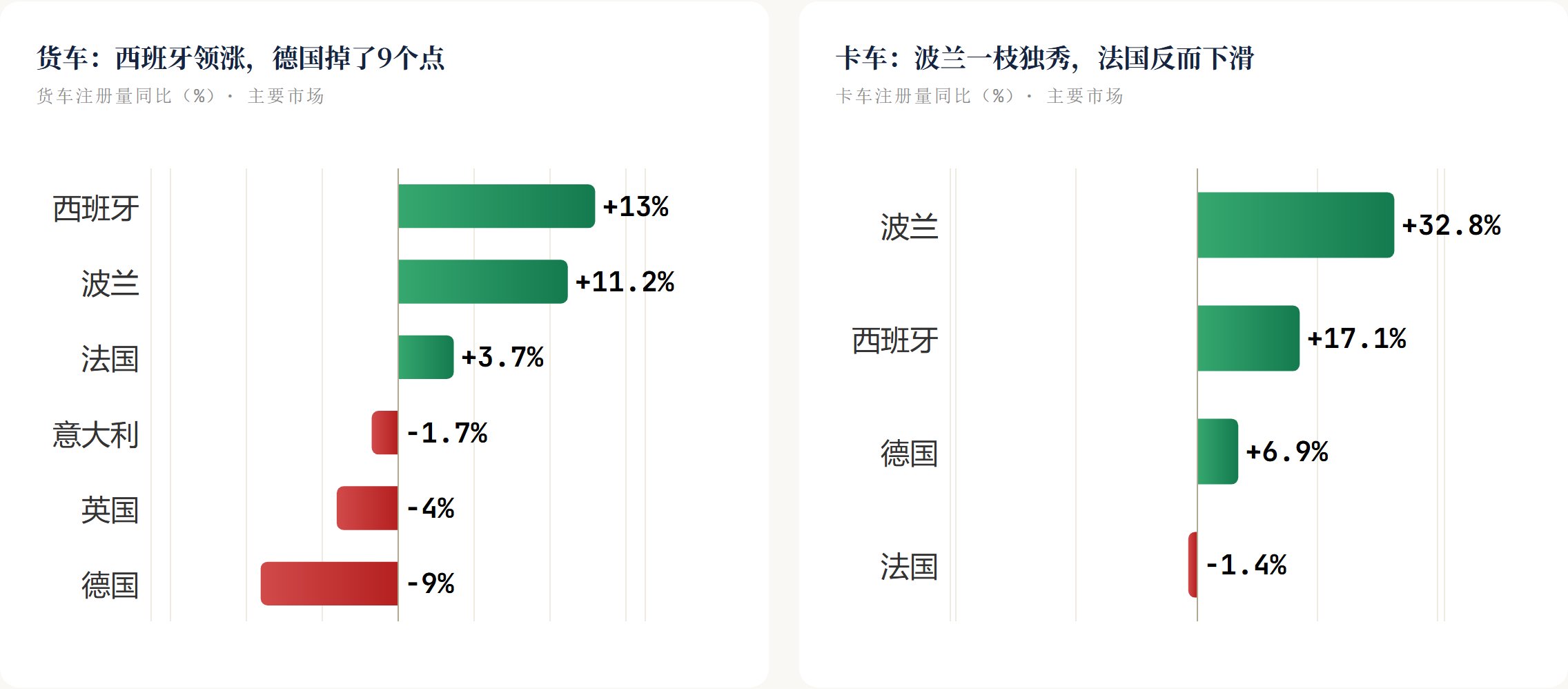
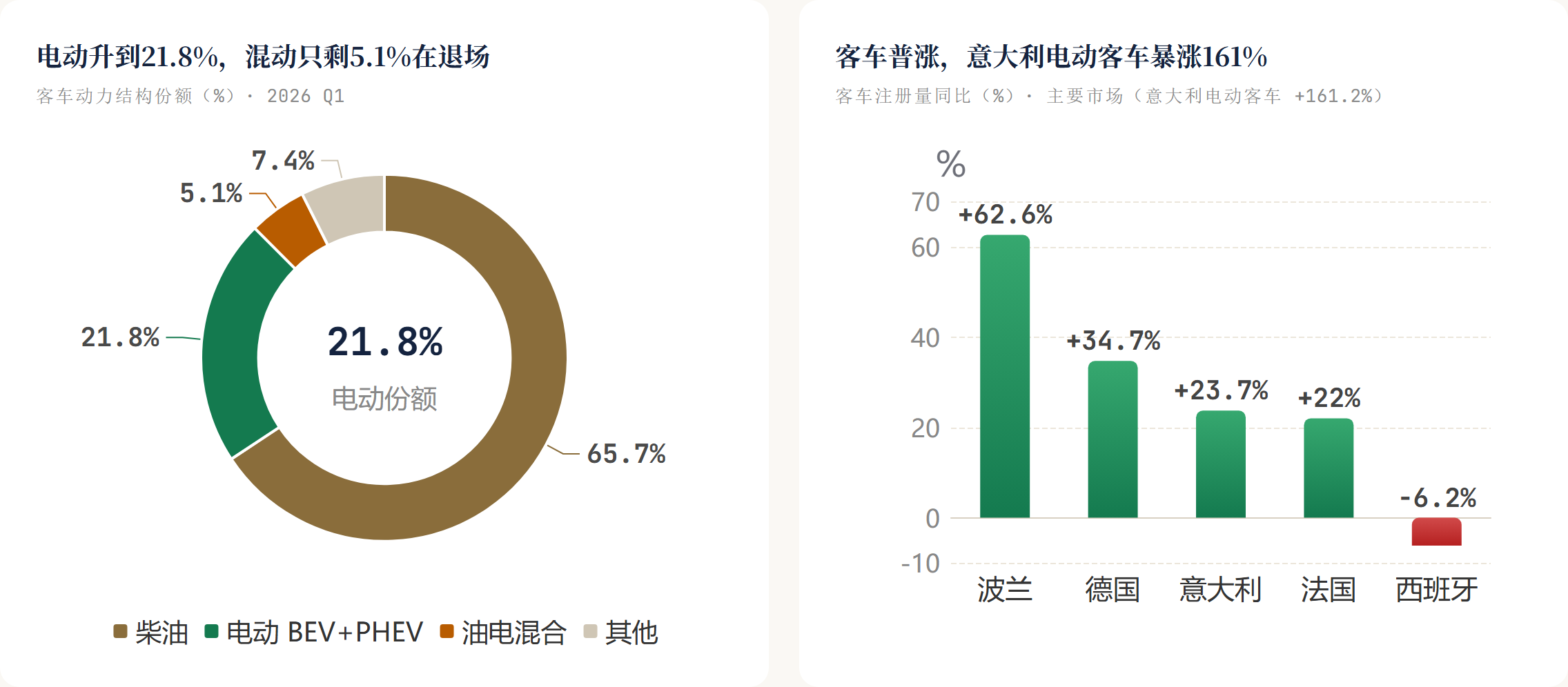
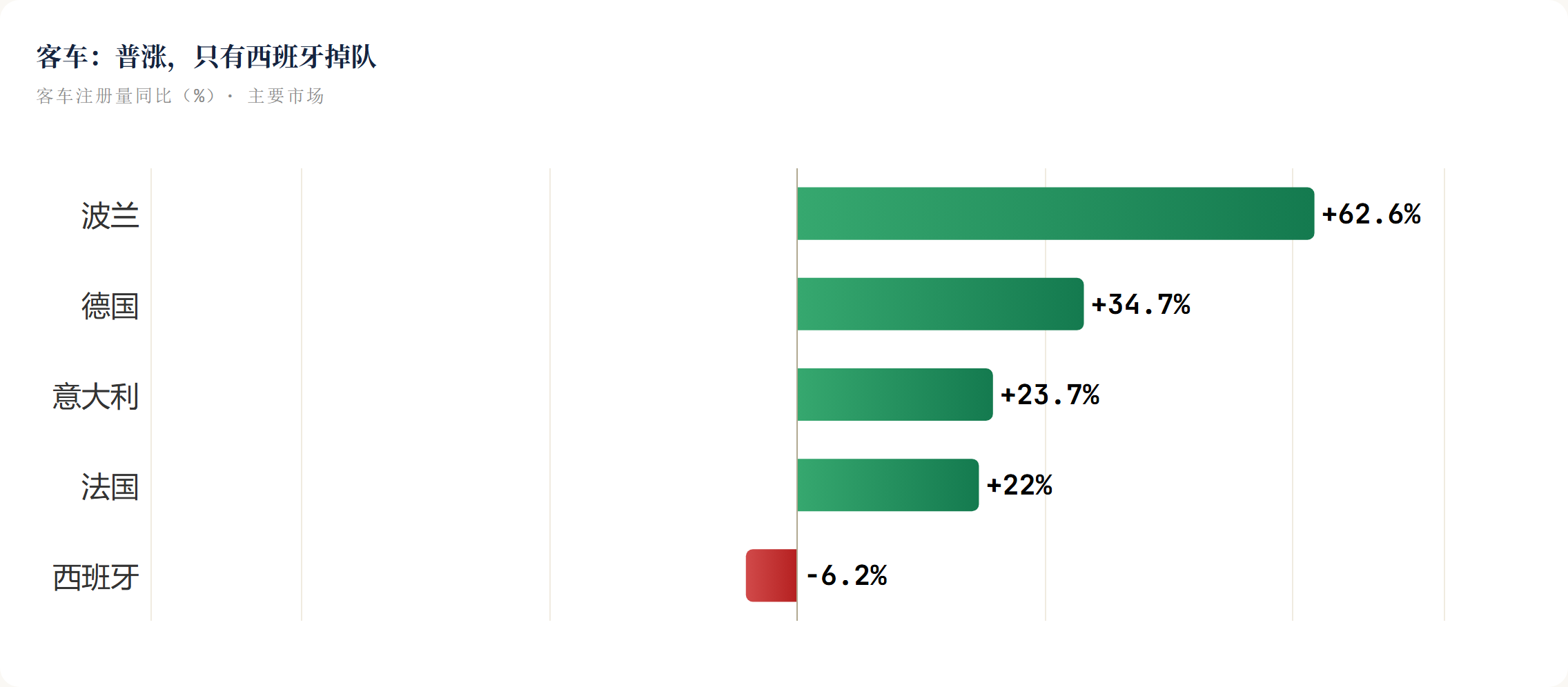
First, let's be clear about the "growth". Within vans' +2.3%, the four major markets diverged sharply: Spain was strongest at +13.0%, France recovered moderately at +3.7%, while Germany fell -9.0% and Italy -1.7%. Trucks' +10.7% was driven by heavy trucks (+12.6%), while medium trucks barely moved (+0.7%). By market, Poland (+32.8%), Spain (+17.1%) and Germany (+6.9%) led gains, while France instead fell -1.4%. Buses were strongest at +24.5%, with broad gains in Germany (+34.7%), Italy (+23.7%), France (+22.0%) and Poland (+62.6%). Only Spain lagged at -6.2%.
One comparison is telling: in the non-EU UK, truck registrations fell 4.0% this quarter, the exact opposite of the strength in Spain and Poland within the EU. Europe has never been a synchronised market; it is a patchwork of a dozen-plus sub-markets moving at different speeds. In short, the recovery is real, but it rests on last year's low base and depends heavily on a few markets (Spain, Poland, German buses), rather than a Europe-wide rise in demand. Treating year-on-year gains as a signal that "the market is warming up and volumes can be ramped" is a trap.
The real watershed: a three-tier gap in electrification
Beyond the growth itself, the more structural shift is in the powertrain mix. Plug-in (BEV + PHEV) share across the three segments ranks: buses 21.8% > vans 12% > trucks 4.4%.
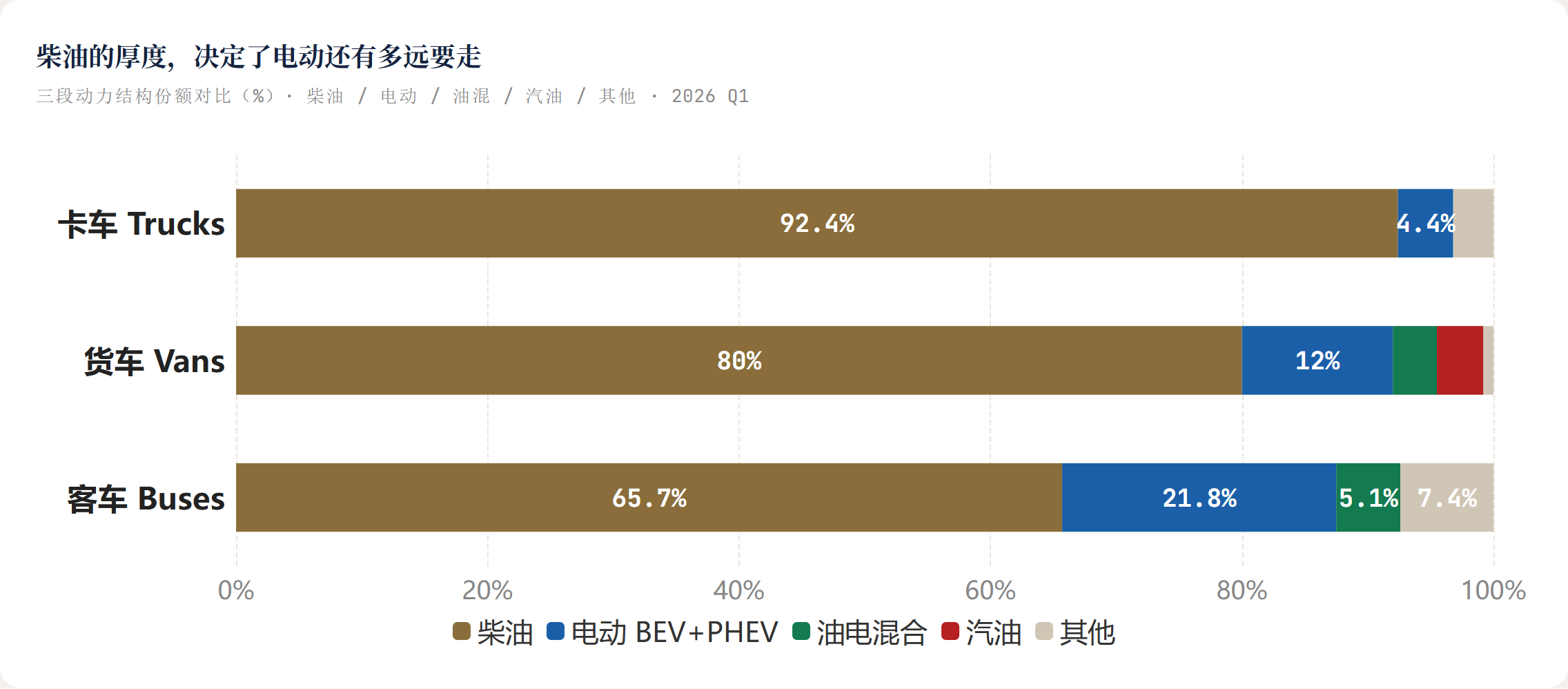
This fault line is essentially a ranking of how fully the enabling conditions are in place. Bus procurement is naturally suited to electrification: buses are bought by governments and municipalities, backed by subsidies and zero-emission zone mandates, and run fixed routes with overnight depot charging, so they depend least on range and public fast charging. That is why buses have passed 20%. Trucks are the opposite: the trunk-route charging network has not taken shape, purchase costs are high, and residual values and warranties are uncertain. If any one of these remains unresolved, the fleet's lifecycle numbers do not add up, hence only 4.4%. Vans sit in between: in light urban service applications, some fleets can already break even, so they land at 12%.
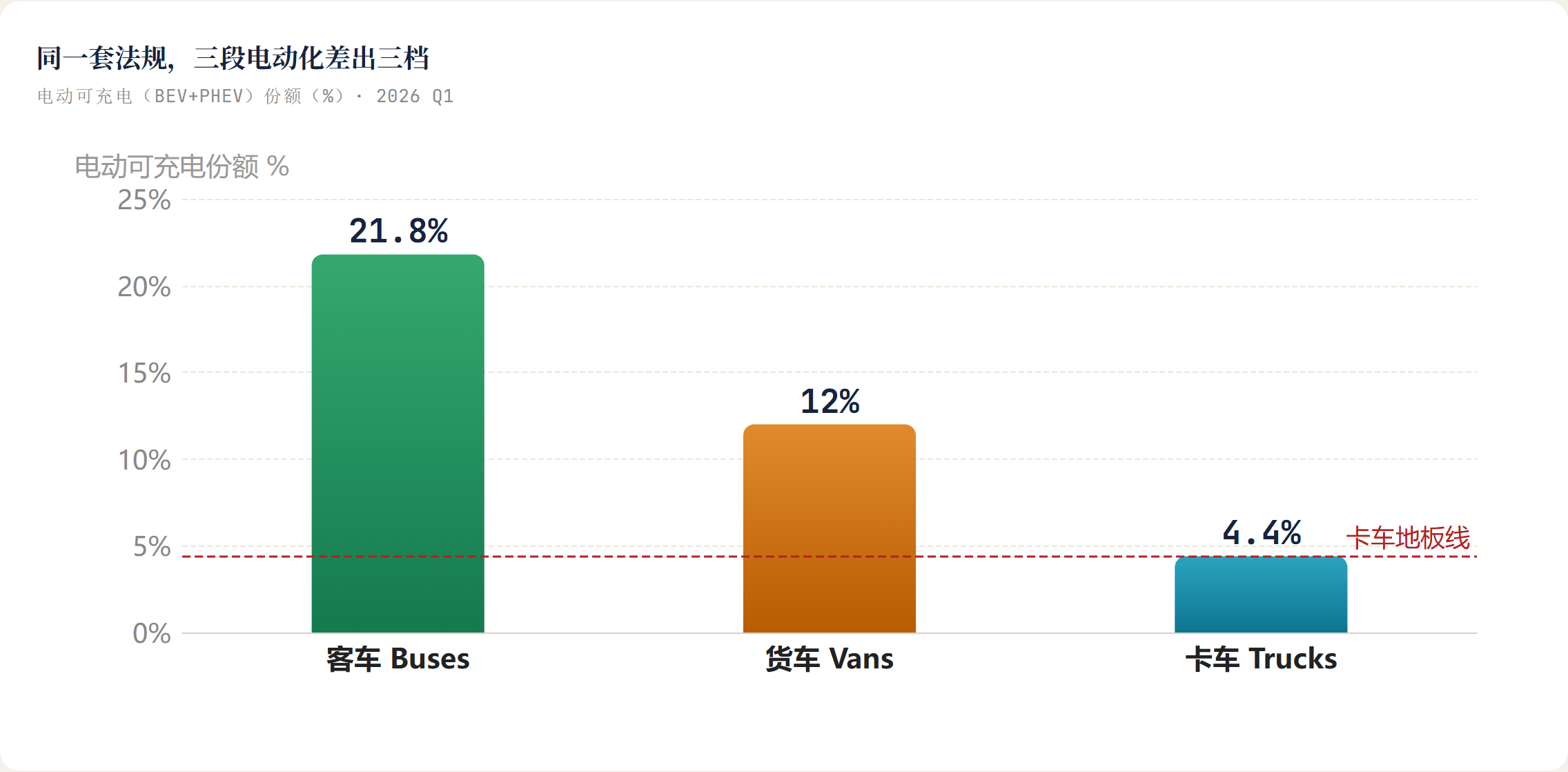
ACEA's repeated warnings about "insufficient enabling conditions" are not a complaint that automakers aren't trying hard enough. They point to bottlenecks outside the vehicle: charging infrastructure, purchase costs, residual-value financing and policy certainty. The cars have long been good enough; what is holding back market share is the system around them.
In urban light-service use cases some fleets can already break even on TCO, but for many small fleets and owner-operators the numbers do not yet force a switch.
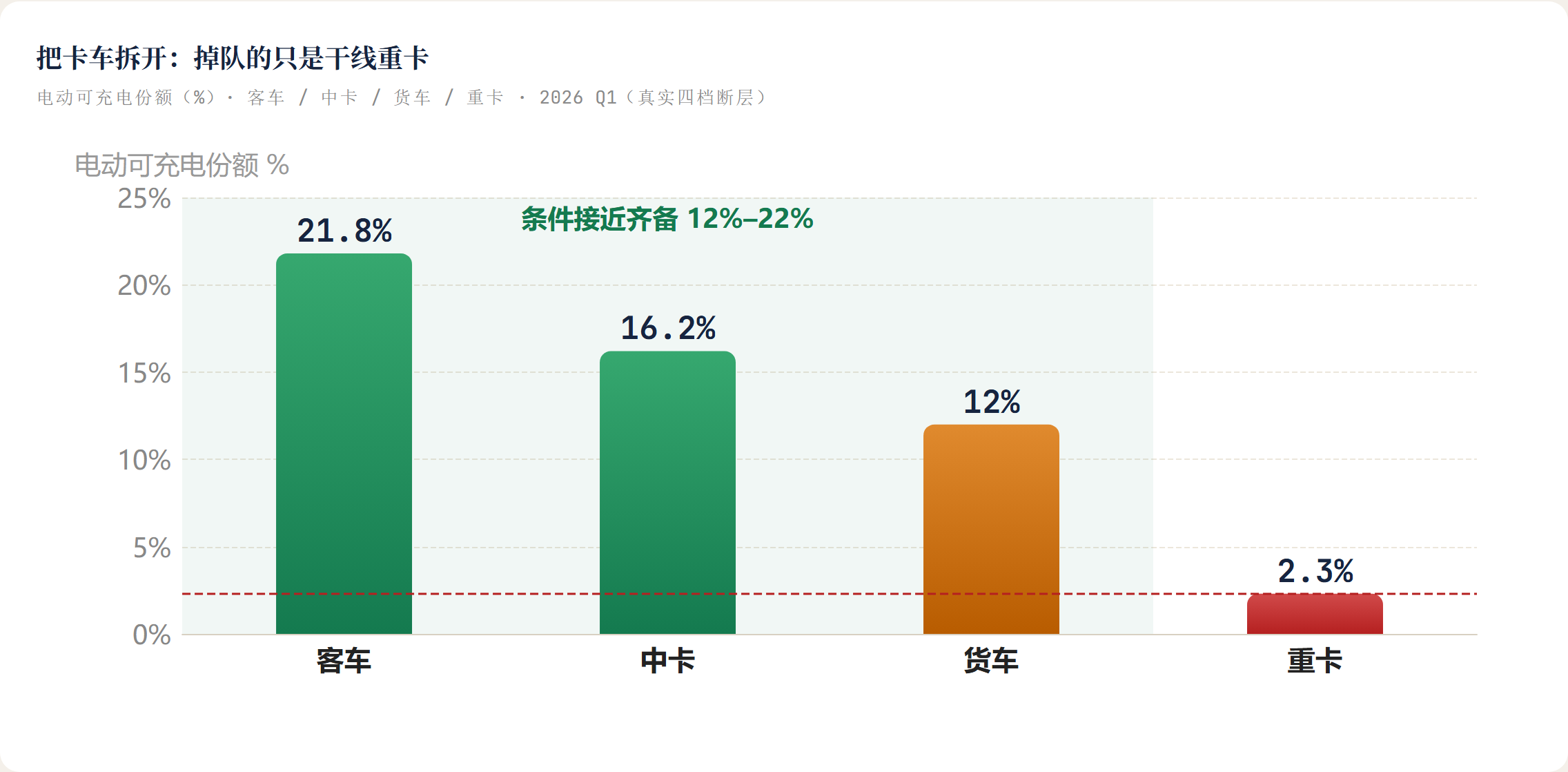
But 4.4% is an average: medium trucks in urban/regional use are already 16.2% electric. The real bottleneck is long-haul heavy trucks (2.3%), as long-haul fast charging has yet to take shape.
Buses: the electric top performer at 21.8%
Buses are the model case for commercial vehicle electrification in Europe. Electrically chargeable buses rose +36%, lifting their share from 20% last year to 21.8%. Italy, the second-largest market by volume, surged +161.2%. More importantly, hybrids are exiting: hybrid-electric buses fell -10.6% and their share is down to just 5.1%, showing that in the bus segment BEVs are skipping hybrids as a transition technology altogether. Diesel buses also grew +24.8% and still hold 65.7%, but the direction of electric substitution is clearest here.
Buses have proved one thing: when subsidies, fixed routes and depot charging are all in place, electrification can move fast. The technology is no more advanced; the conditions were simply in place first.
Trucks: 4.4% is an average; broken down, the gap is an order of magnitude
Electrically chargeable trucks grew 40.1%, which looks decent, yet their share is only 4.4% (3.5% last year), the lowest of the three segments. But the 4.4% figure is misleading: it is an average diluted by heavy trucks.
Split trucks into medium trucks (3.5 to 16 t) and heavy trucks (above 16 t), and the conclusion reverses: electric medium trucks total 1975 units with a share already at 16.2%, the same order of magnitude as vans at 12% and buses at 21.8%. Electric heavy trucks number only 1624 units, a 2.3% share; despite surging 80.6% year on year, the base is too small. The heavy-truck market is more than five times the size of the medium-truck market, dragging the overall segment share down to 4.4%. In other words, it is long-haul heavy trucks that are truly lagging; medium trucks used for urban and regional distribution have long kept pace with vans in electrification.
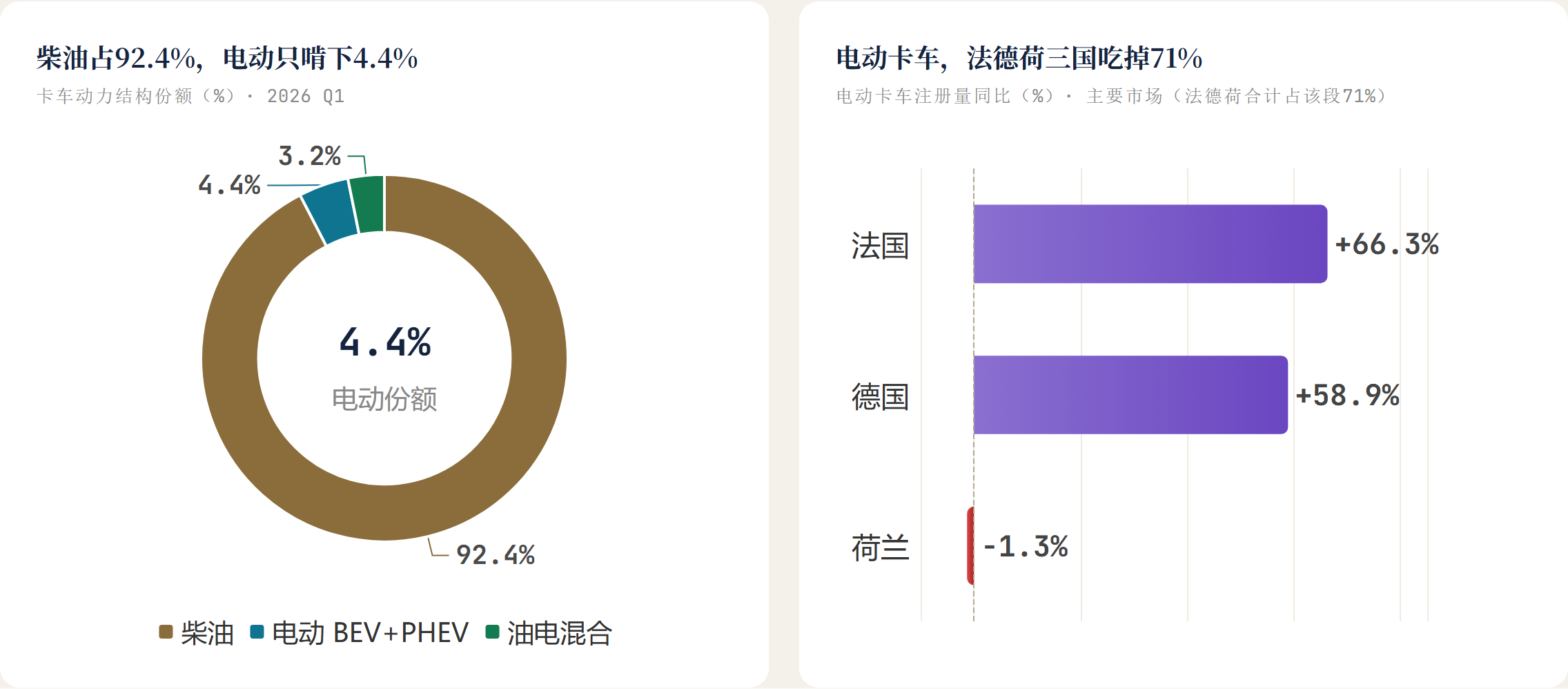
Diesel remains overwhelmingly dominant in trucks, with a 92.4% share and registrations still up 11%. Electric trucks are also highly concentrated. By growth rate, France (+66.3%) and Germany (+58.9%) lead, while the Netherlands (-1.3%) is in decline. By volume, Germany (1387 units) ranks first, the Netherlands (624 units) second and France (552 units) third; together the three account for 71% of the electric truck segment.
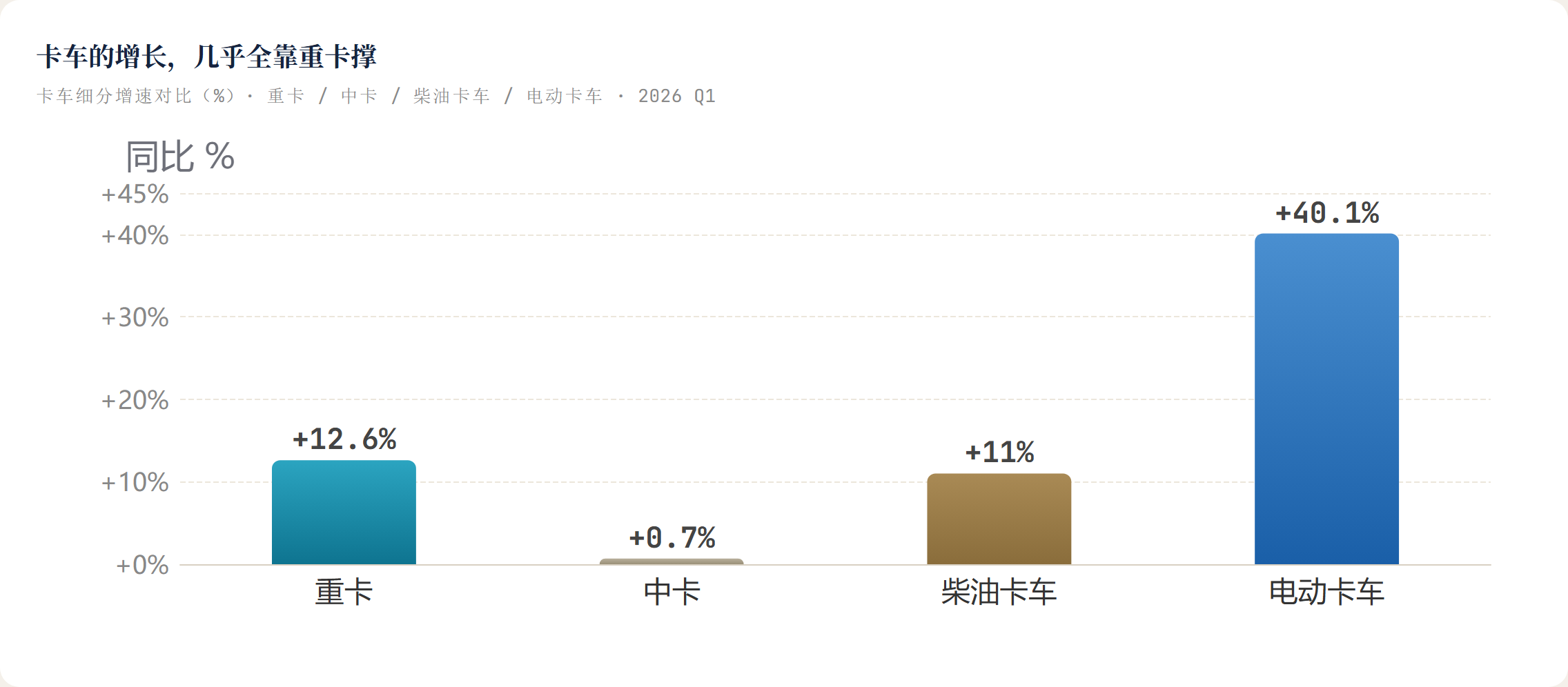
What is holding heavy trucks back? The enabling conditions: a long-haul fast-charging network, purchase cost, residual values and warranties. If any one of these is missing, the fleet's total lifecycle economics don't add up. Medium trucks can reach 16% precisely because, in their urban and regional use cases, these conditions are already close to those for vans and buses. Pushing heavy trucks' 2.3% higher will require a bundled package of long-haul charging, purchase financing and residual value guarantees. This is the hardest segment, but also the one with the deepest profit pool.
Vans: squeezing out petrol, slowly eating into diesel
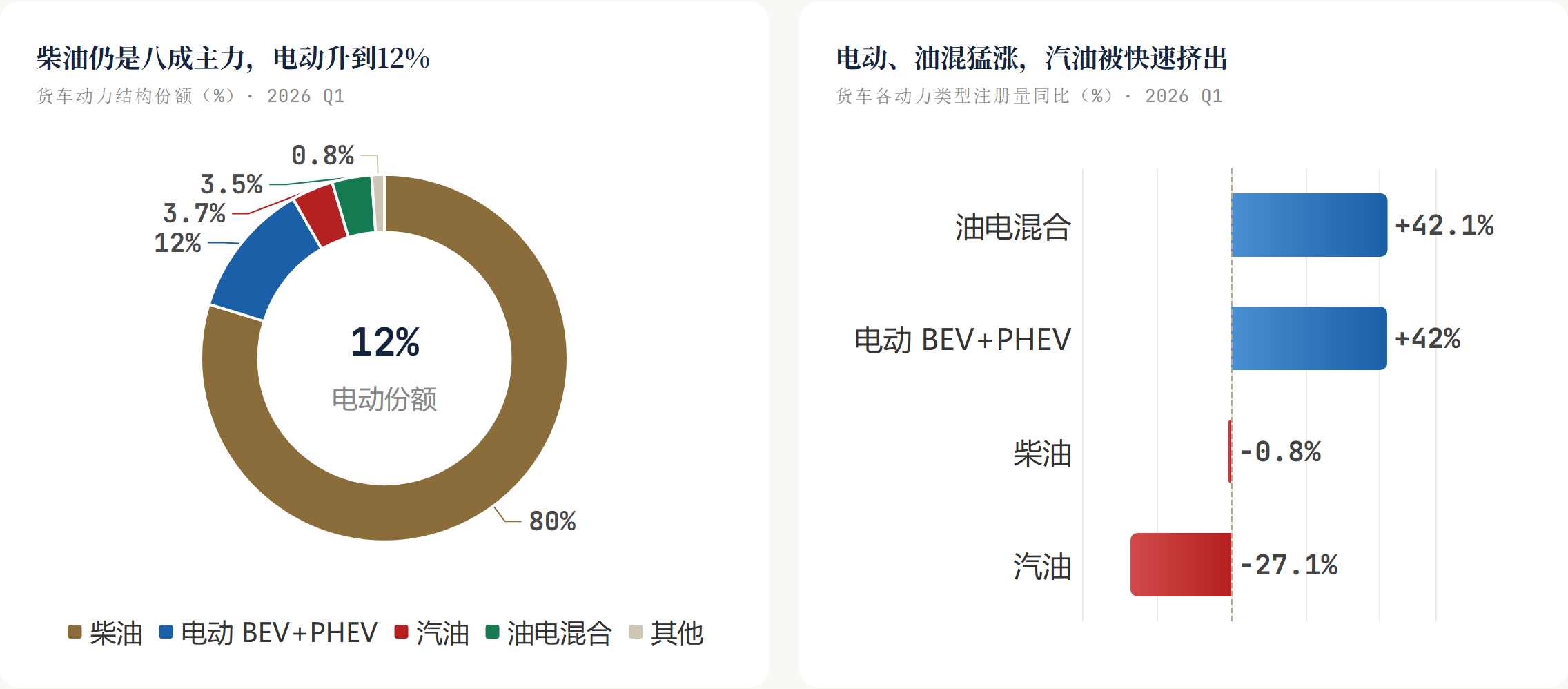
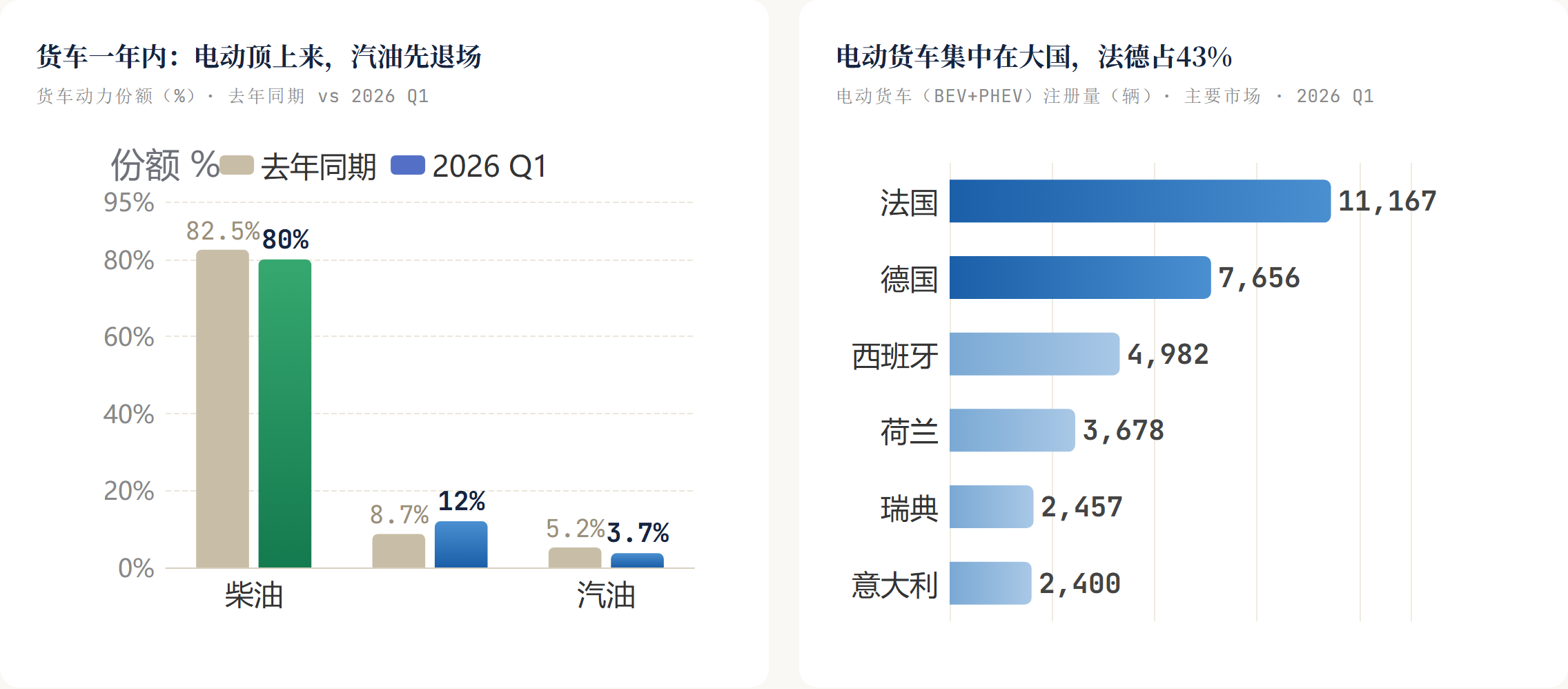
The powertrain shift is clearest in the van segment. Diesel vans fell 0.8% (288484 units), with share dropping from 82.5% to 80%; they remain dominant but are slowly giving ground. Plug-in electric vans rose 42.0% (43441 units), with share jumping from 8.7% to 12%. Petrol vans fell 27.1%, with share slipping from 5.2% to 3.7%.
The reading is a two-track advance: electric first squeezes out the small petrol segment, then slowly erodes diesel's core base. A 12% share has already moved electric from "symbolic" to "an everyday option". But a diesel share of around 80% also shows that for many small fleets and owner-operators, the TCO case for switching is not yet compelling enough to force the move — which is exactly why light urban service niches, where the numbers already work out, are breaking through first.
For Chinese automakers, this is a scenario-by-scenario roadmap
Put the three pieces together and, for Chinese commercial vehicle makers looking at Europe, you get an entry map ranked by maturity.
Broken down by segment, electric penetration falls into four tiers: buses 21.8%, medium trucks 16.2%, vans 12% and heavy trucks 2.3%. The first three are urban/regional or fixed-route applications where the enabling conditions are largely in place, making them markets that can be contested head-on today. In buses, the battle is over product strength, reliability and local service networks; in vans and medium trucks, it is over TCO in urban/regional distribution, and the key is to have local bodybuilding, service and residual-value financing in place. The 2.3% in heavy trucks is the earliest-stage and the hardest, but whoever can package "vehicle + charging corridor + service + finance" and fill in the enabling conditions for customers will be first to stake out a position in the largest and most profitable slice of the market.
Keep one more point in mind: even in segments where conditions are in place, electrification is concentrated in a few large countries — France and Germany alone account for 43% of electric vans, and Germany, the Netherlands and France for 71% of electric trucks. Target the use cases where conditions are ready first, then the countries where they are ready: that is the common playbook this quarter points to.
The Q1 recovery will bring a wave of optimism, but what decides the winners is not this quarter's gain. It is who understands the differing conditions behind the gap and sequences their moves according to how mature each use case is.
Ramping up fast; urban light services and TCO are the most direct entry point, and the key is lining up local upfitting, service and residual value financing.
Earliest-stage and hardest, but with the deepest profit pool. Whoever can bundle "vehicle + charging corridor + services + finance" will lock in position first.