EU eases heavy truck emission rules: who falls behind first?
The European Parliament recently passed a targeted amendment to the heavy-duty vehicle CO2 rules by 473 votes to 81, with 9 abstentions, and the Council of the EU has since adopted it. On the surface, it buys Europe's truck industry some breathing room, but in practice it only changes how credits are calculated for 2025–2029: OEMs that beat their own annual CO2 target can bank credits, rather than being held to the steeper linear reduction trajectory.
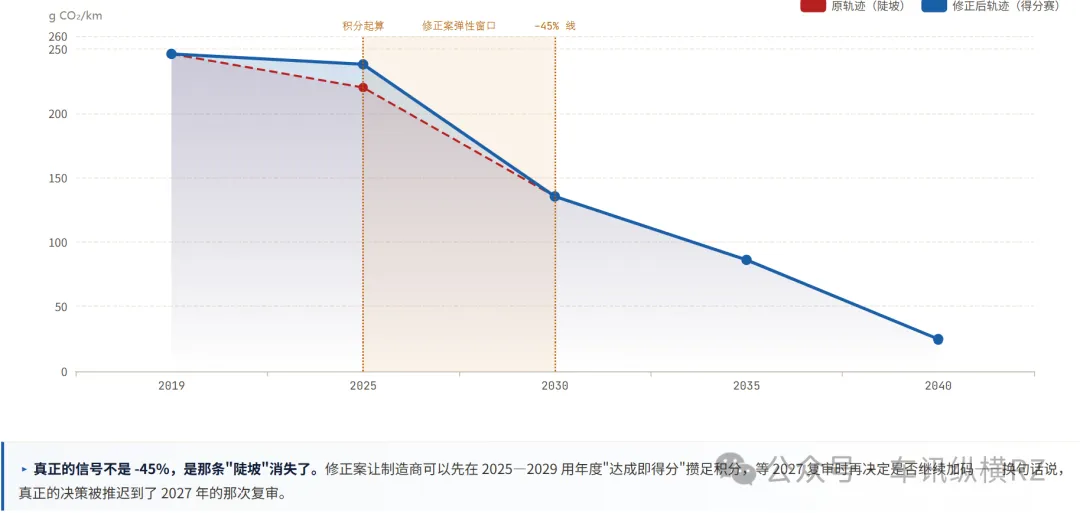
The pace changes, not the target
The amendment's long-term target remains one of the EU's toughest industrial policies, directly constraining a segment, heavy trucks, that makes up about 2% of road vehicles yet produces more than 1/4 of road greenhouse gas emissions. Only the steeper compliance curve in the middle stretch has been rewritten. Previously, even if a company ultimately met the 2030 target, it would be fined for deviating from the annual trajectory along the way. The amendment scraps these "process penalties" and replaces them with a more flexible approach in which beating the annual target earns credits.
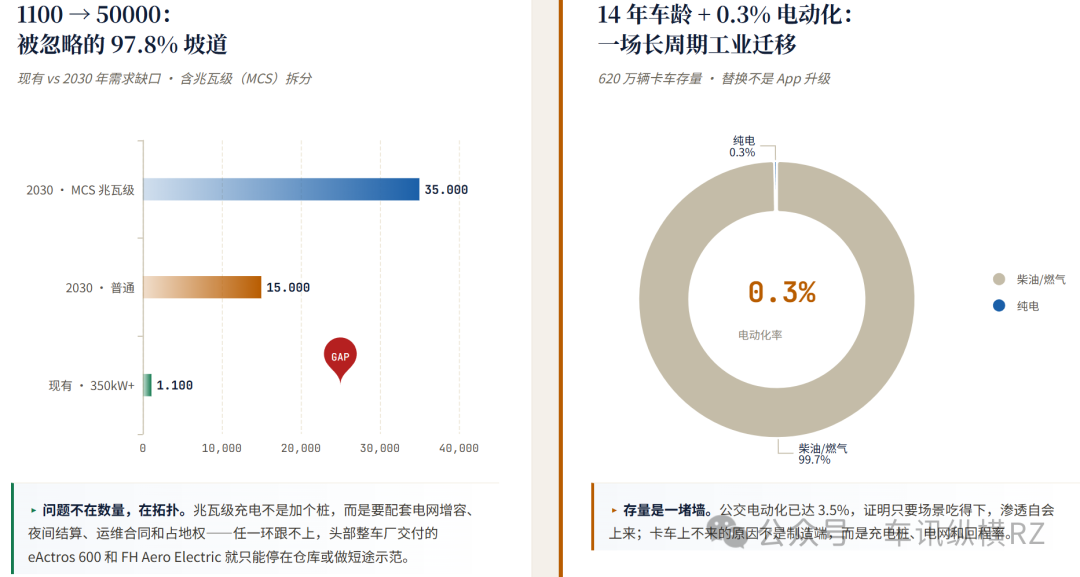
It is not that EU lawmakers don't want electrification; rather, they have acknowledged two things they were previously unwilling to say outright. First, the 6.2 million trucks on EU roads average 14 years old with an electric share of 0.3%, and a fleet structure like that cannot be forcibly turned around within five years by working backward from a target trajectory. Second, electrification among the 700,000 buses has already reached 3.5%, proving that where the use case can absorb it, penetration rises on its own; trucks lag because the downstream conditions are not in place.
Charging points, the grid and backhaul rates are the real issues
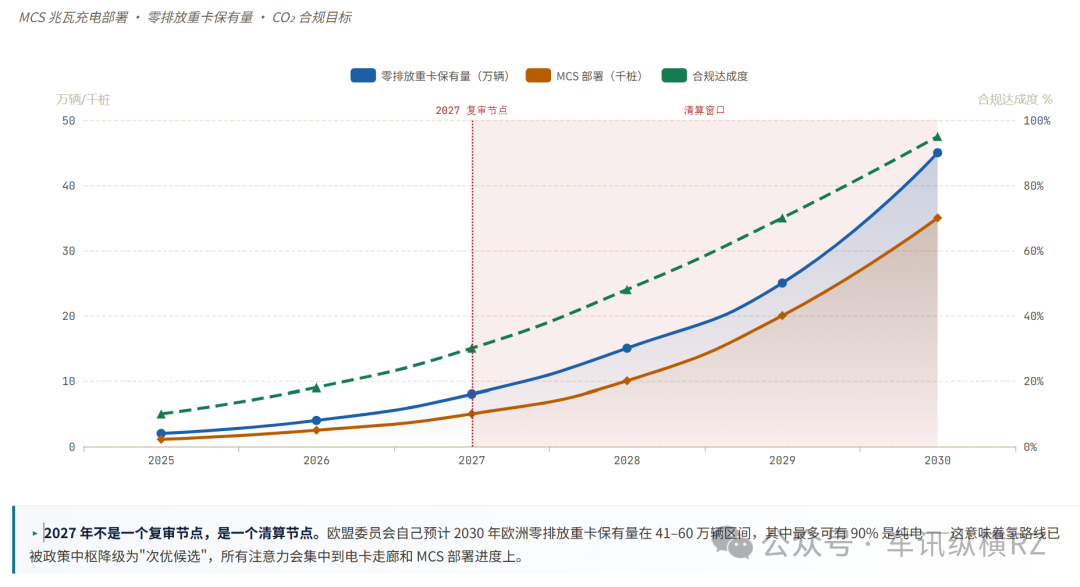
In H1 2025, zero-emission vehicles made up 3.6% of new medium and heavy truck registrations in the EU, and the downstream infrastructure figures are frankly absurd. Europe currently has only about 1,100 public charging points of 350 kW or more suitable for heavy trucks. By 2030 it will need around 50,000 public heavy truck chargers, about 35,000 of them megawatt-level (MCS) fast chargers, plus at least 700 hydrogen refuelling stations with a daily capacity of 6 tonnes. Without policy support, infrastructure on this scale simply cannot be built before 2030. That is why the European Commission, in its own 2025 market maturity assessment, narrowed its expectation for Europe's 2030 zero-emission heavy truck fleet to between 410,000 and 600,000 vehicles, stating explicitly that "up to 90%" of them could be battery-electric.
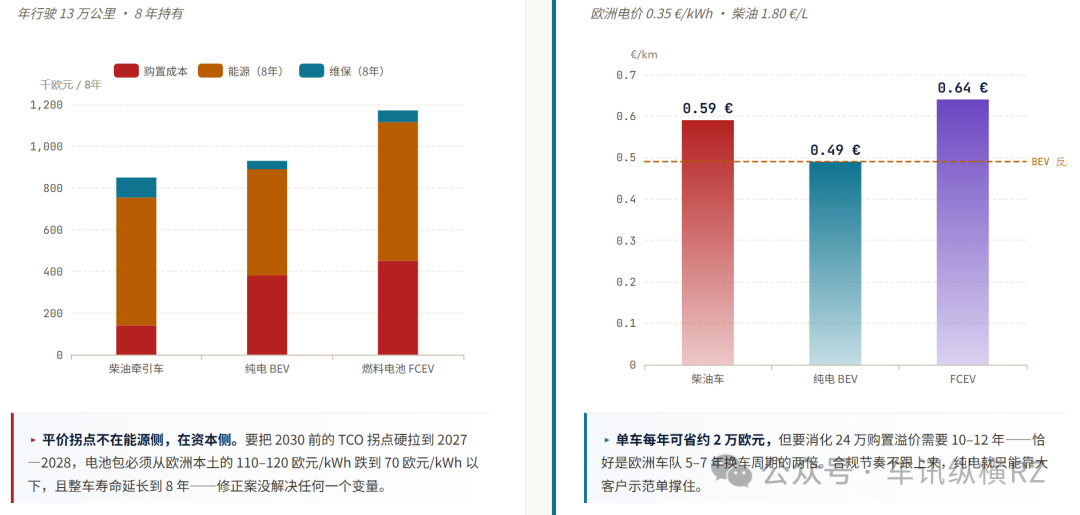
A European-built 4×2 long-haul battery-electric tractor with a 400–500 kWh battery costs €350,000–400,000 to buy, against €120,000–150,000 for an equivalent diesel, a premium of 130%–160%. Even with European electricity prices at a relatively high €0.35/kWh, a battery-electric heavy truck's energy cost of about €0.49 per km is already below diesel's €0.59; adding a maintenance saving of around €7,000 a year, each truck saves €20,000 annually. But using that margin to absorb a €240,000 upfront premium would in theory take 10–12 years, while European logistics fleets typically replace vehicles every 5–7 years. The only credible way to bring parity forward to 2027–2028 is for battery pack costs to fall from the current €110–120/kWh for European production to below €70/kWh, and for vehicle life to be extended to eight years. The amendment resolves none of these variables; it merely acknowledges that they are not yet in place.
Who really benefits
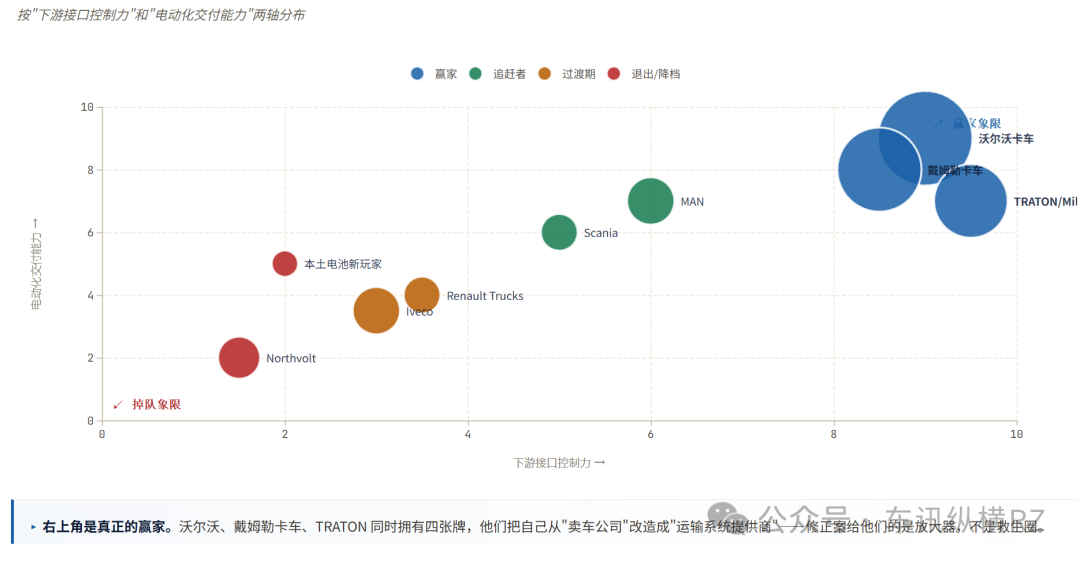
The amendment is in essence structurally biased. Only companies that have all four capabilities at once, cash flow, products, customers and a charging network, will really benefit.
In 2025, the Volvo FH Aero secured nearly 33,000 orders in Europe, with Volvo claiming fuel efficiency about 7% better than the previous generation. Under the new credit calculation, high-efficiency diesel trucks not only still make money but also improve the fleet-average emissions line, a double efficiency gain. Meanwhile, the new-generation FH Aero Electric has range extended to 600 km and 20%–80% charging cut to about 40 minutes, giving it the hardware to enter long-haul trunk routes. Volvo held a 47% share of Europe's electric heavy truck market above 16 tonnes in 2024, with 1,970 registrations; in 2025 its share of Europe's overall heavy truck market rose to 19.0%.
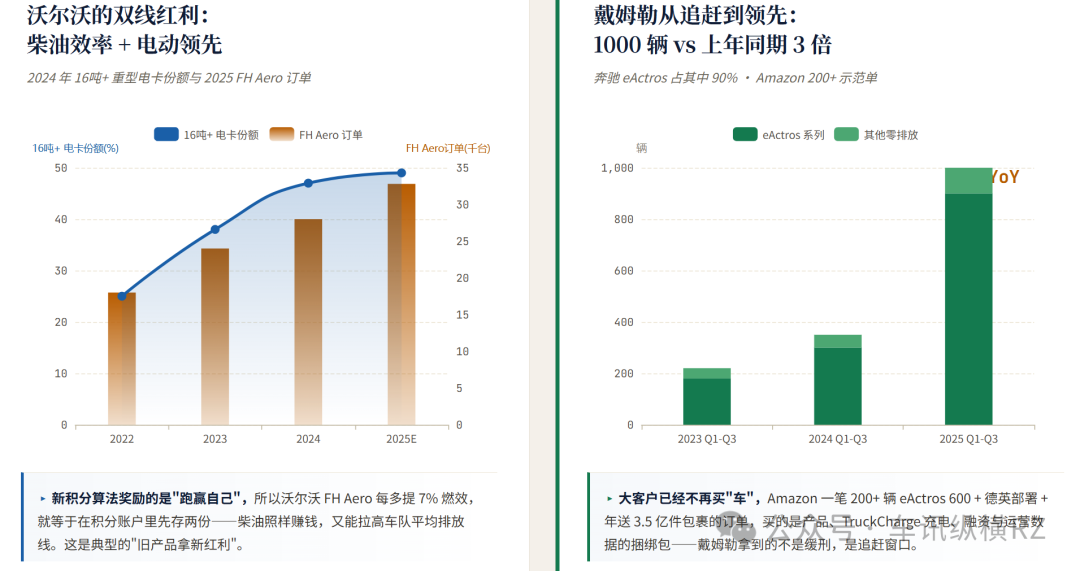
According to Daimler Truck, in the first three quarters of 2025 Mercedes-Benz became Europe's top-selling manufacturer of zero-emission heavy trucks, with around 1,000 units, three times the figure a year earlier. The eActros accounted for 90% of these. In 2025 Amazon placed a single order for more than 200 eActros 600 trucks for deployment in Germany and the UK, which are expected to carry more than 350 million parcels a year. Leading logistics firms stopped buying just the eActros 600 itself long ago. They buy a four-part bundle of "product + charging + service + financing", which Daimler's TruckCharge and the eActros 600 ecosystem must deliver together. What the amendment gives Daimler is not just lower fines, but a window to build out this ecosystem properly at a healthier pace of capital spending.
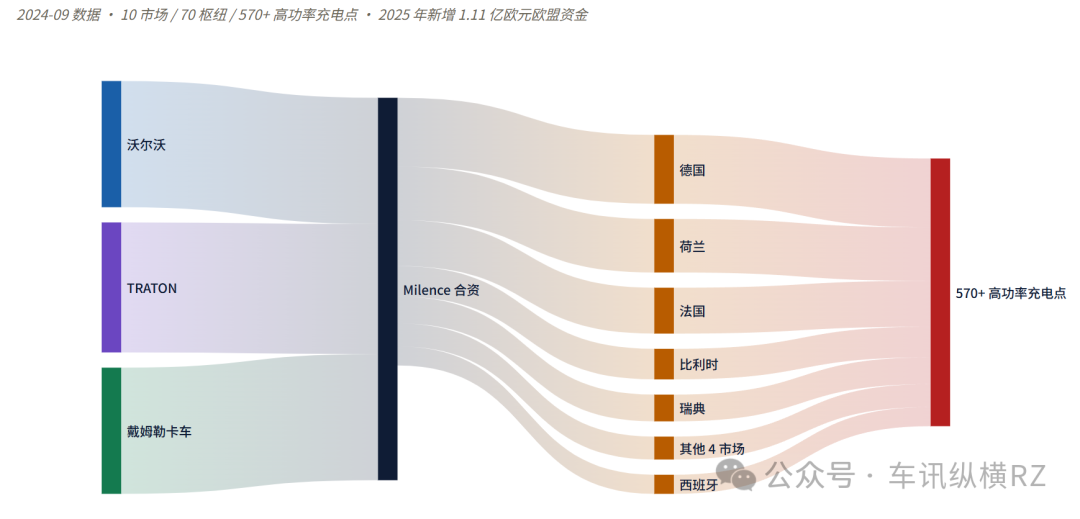
The moats of MAN and Volkswagen's commercial vehicle arm TRATON are less visible. MAN builds diesel and electric heavy trucks on the same production line, with daily output of up to 100 units, giving it markedly higher capital efficiency than rivals that set up "fully separate new plants". Customer field data shows the eTGX covering 650 km a day in certain use cases at 80–90 kWh per 100 km, moving it from showroom to operating ledger. TRATON jointly owns Milence with Daimler and Volvo. As of Sep 2024, Milence planned 70 hubs and more than 570 high-power charge points across 10 key European markets; in 2025 it secured more than EUR 111 million in EU funding and has deployed MCS megawatt charging in the Netherlands, Sweden and elsewhere. The real battle for position among Europe's three big heavy-truck groups is not over truck sales but over the ownership structure of public heavy-truck charging networks.
Three kinds of laggards hidden from view
The more the amendment benefits manufacturers, the harder things get for the parts of the chain that were counting on "rigid regulation" to turn into orders quickly.
The first group to fall behind is Europe's domestic battery makers. Northvolt filed for bankruptcy in Sweden on Mar 12, 2025, coincidentally almost at the same time as the vote on the amendment. Heavy-vehicle electrification has concentrated customers, long validation cycles and slow ramp-up, which makes it hard for local battery makers even under normal conditions; with the amendment pushing back OEMs' compliance deadlines, orders for local battery plants will only shrink further. OEMs will of course continue electrifying, but they now have more incentive to squeeze purchase prices, diversify supply sources and slow the push for localisation. The problem facing Europe's battery supply chain today is not technology but a change in the density of mid-stream demand.
The second group in trouble is OEMs in strategic transition. Iveco's 2025 results show weaker EBIT and cash flow from continuing operations than the prior year. Meanwhile, its prospective owner, India's Tata Motors, offered about EUR 3.8 billion in July 2025 for Iveco's commercial vehicle business, and the deal is still in progress. For an asset like Iveco that is being acquired, the amendment's side effects may outweigh its benefits. It eases worries about near-term fines, but it also lowers the urgency of internal decisions, and resource allocation is likely to drift in a more conservative direction.
Last come the small and mid-sized fleets with no bargaining power. Easing the regulation will not automatically get them cheaper electric heavy trucks. Quite the opposite: the leading OEMs will manage capacity and pricing more carefully and will not start an all-out price war for a 2026–2027 compliance window. For small logistics operators, the buying decision has never been just about the truck price. They also have to deal with depot power capacity, grid upgrades, night-time electricity rates, access to public fast charging, backhaul rates on their routes, driver scheduling, CO2-based toll classes, and residual values and leasing. Each of these takes specialist expertise. Large European logistics customers such as Amazon, Kuehne+Nagel and Jacky Perrenot can use their order volumes to get complete packages, while small fleets have to bear the cost of trial and error on their own.
Regional divergence
Looking only at EU-level aggregate targets gives the false impression that the whole market is transitioning in step. In reality, demand is highly regional and use-case specific. In the first half of 2025, nearly 4/5 of new zero-emission medium and heavy truck registrations in the EU were concentrated in five markets: Sweden, the Netherlands, Austria, Denmark and France. Non-EU Norway and Switzerland even offer better supporting conditions than most EU countries. The Netherlands introduced zero-emission zones in 15 cities from 2025, directly lifting electrification of light and medium trucks, with the electric share exceeding 80% in the first quarter. The demand levers that actually work are not EU aggregate targets but local zero-emission zones, urban delivery rules, port hubs and corridor charging.
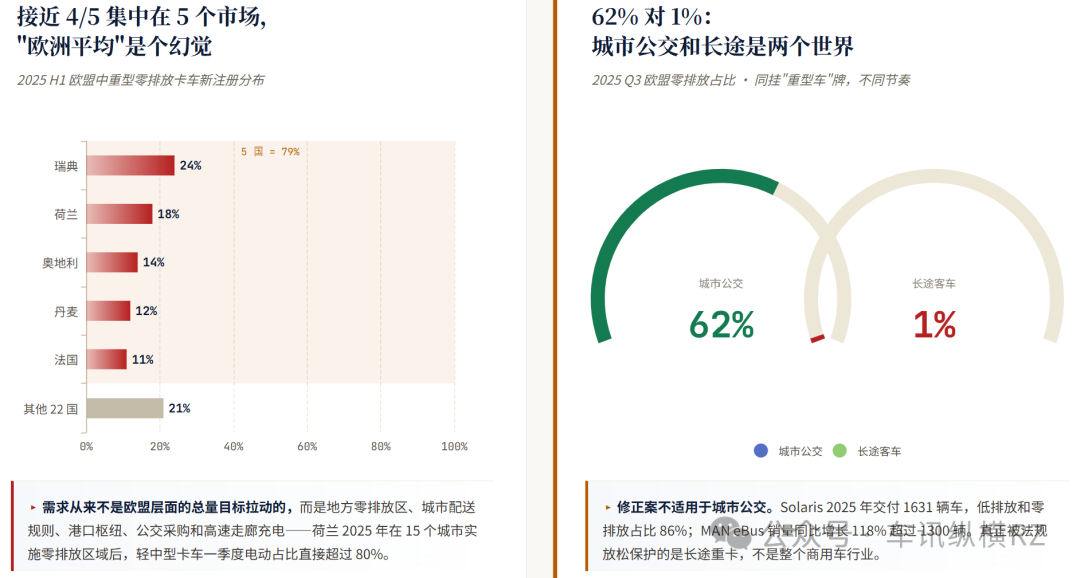
The amendment does not apply to city buses, because their electrification is already well under way and does not depend on motorway charging. In the first three quarters of 2025, zero-emission vehicles accounted for 23.0% of EU bus and coach sales; city buses reached a zero-emission share of about 62% in Q3, while intercity buses and coaches remained at only about 1%. Solaris delivered 1631 vehicles in 2025, including 916 electric buses and 306 hydrogen buses, with low- and zero-emission models making up 86% of deliveries. MAN's eBus sales grew 118% year on year in 2025 to more than 1300. Though both carry the "heavy-duty vehicle" label, the city bus chain and the long-haul truck chain are now moving at completely different speeds.
The 2027 review
The EU has made clear that the heavy-duty vehicle CO2 rules will undergo a substantive review in 2027. If over the next 18 months public truck charging networks, megawatt charging standards, grid connections and toll incentives continue to progress more slowly than expected, the credits built up today will be only a temporary buffer, not a long-term solution. The policy debate could then sharpen, with industry lobbying continuing to push for "flexibility" and "technology openness", and hardline environmentalists arguing the rules have already been watered down too far.
Once fleet customers conclude that "the European Commission will keep giving ground at critical moments", their purchasing mindset tilts toward waiting: lower bids, longer pilots, later orders. In the short term this eases pressure on OEMs' financial statements, but it actually slows order confirmation and makes scale harder to achieve. What will really decide the shape of Europe's heavy-vehicle market before 2030 is not this amendment itself, but who can tie regulation, charging, financing and operating data into a closed loop. Volvo, Daimler Truck and TRATON look more secure because they are turning themselves from "truck sellers" into "transport system providers". The amendment slows the pace, not the target. When the next hand is dealt, the positions at the table will only be more unequal.