Europe's freight charging war: only 3,000 of 1.2 million charge points count – so what is DKV's card really selling?
By 2030, the EU's heavy-truck charging gap will reach 4,000 to 5,300 megawatt-class sites. Europe will have only around 330 1 MW MCS chargers built by autumn 2028, and even if the current AFIR regulation is fully implemented, it is expected to meet only 50% to 70% of public charging demand by then. What these figures show is not that "progress is too slow", but that "structural shortage has been written into policy". Over this long
By 2030, the EU's heavy-truck charging gap will reach 4,000 to 5,300 megawatt-level sites. Europe will only have about 330 1 MW MCS chargers in place by autumn 2028, and even if the current AFIR regulation is fully implemented, it is expected to meet just 50% to 70% of public charging demand at that point. These figures do not show that "progress is too slow" but that "structural shortage has been written into policy." In this long period of hardware deficit, DKV Mobility launched the DKV Card +Charge Truck in 2026, targeting precisely this gap: using a software layer to reprice a fragmented existing network and turn scarce "available charging capacity" into a tradable, reliable service. 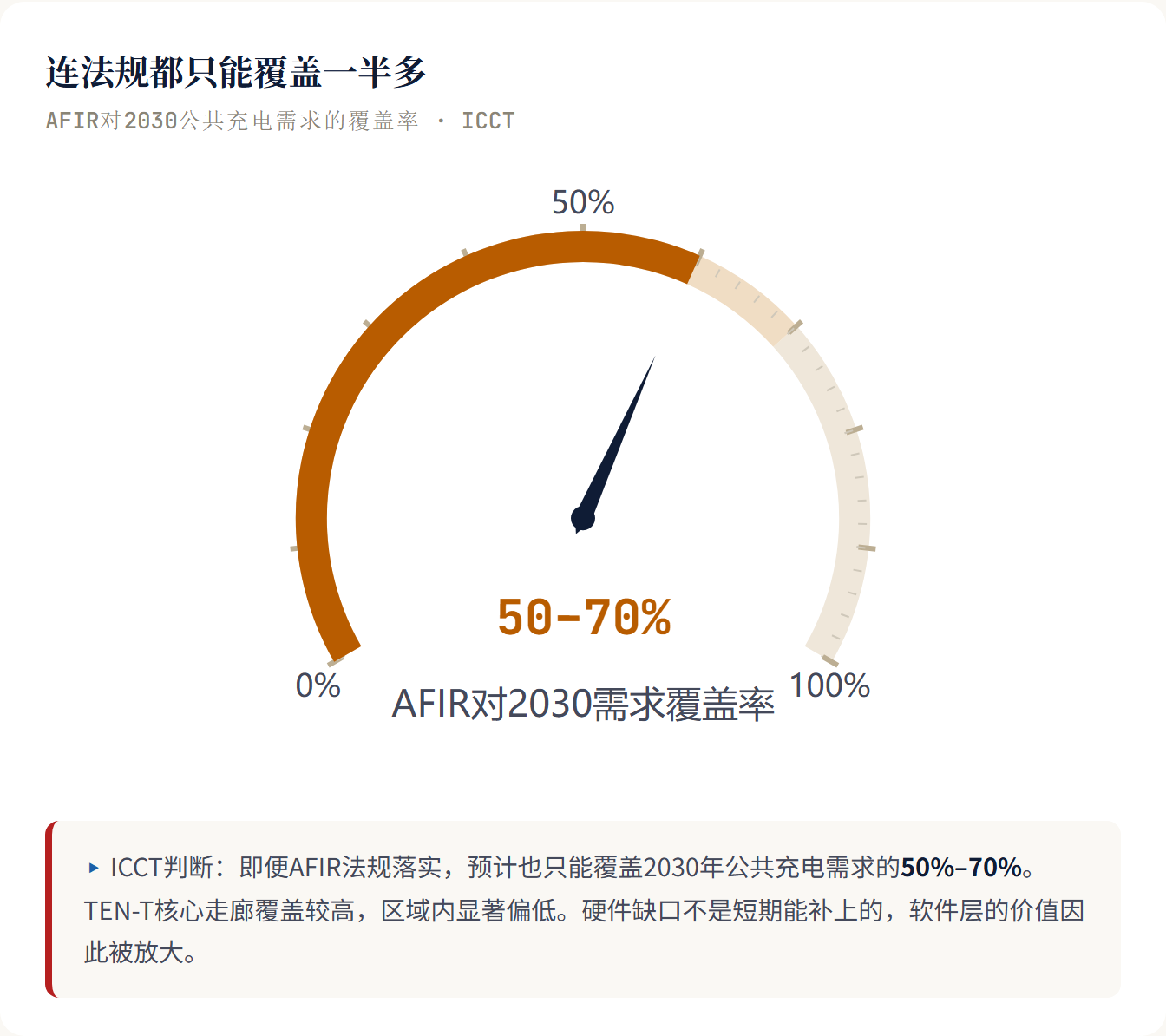 Effective supply: from 1.2 million to 3,000, a filter of three orders of magnitude Few people put these two numbers side by side: DKV's overall network covers about 1.2 million charging points, but only just over 3,000 of them, spread across more than 17 European countries, have now been labelled "truck-suitable". That is a gap of about 400 times. Underlying it is a set of physical thresholds that are irrelevant to passenger car charging networks but critical for heavy truck operations. 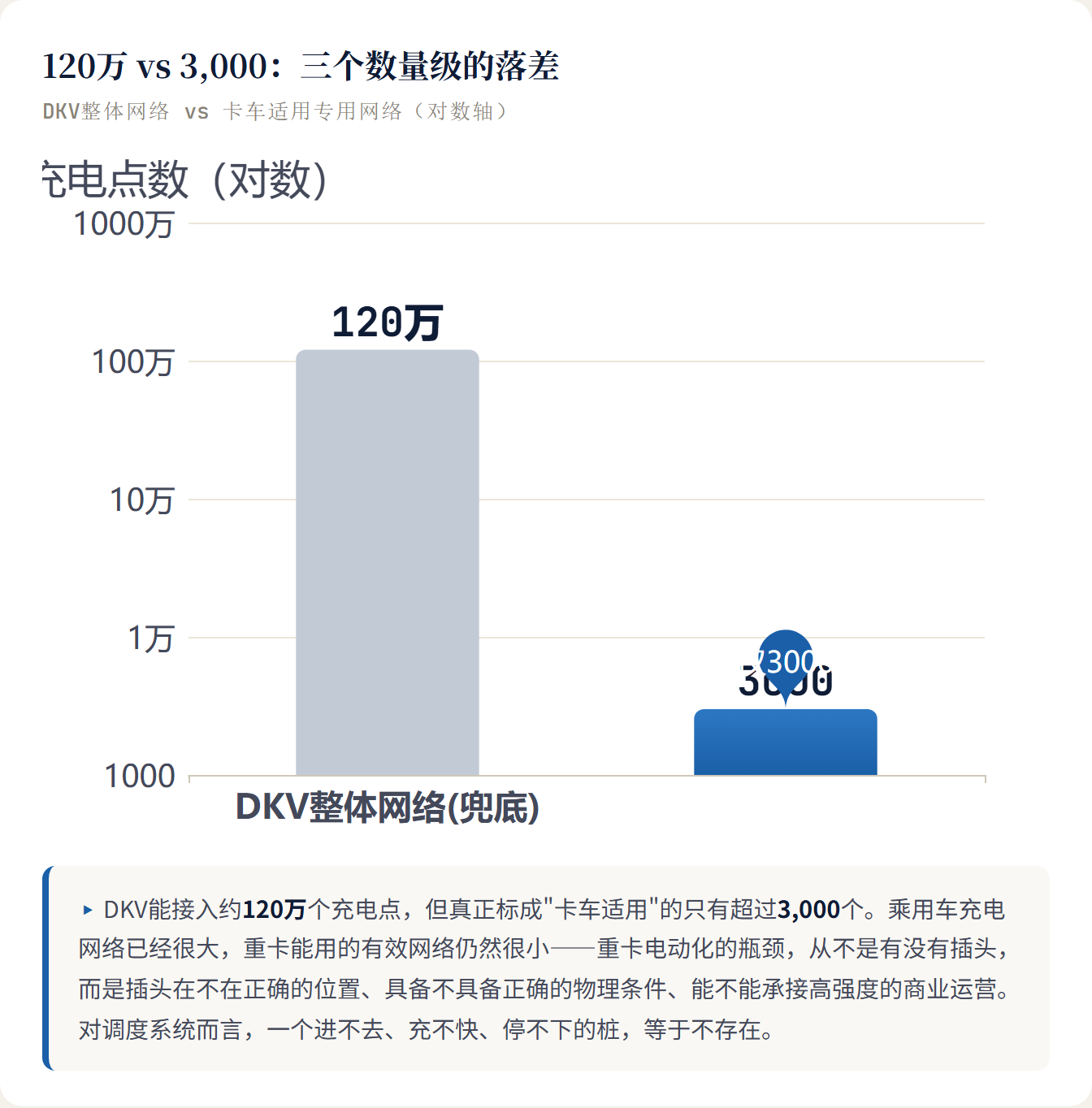 The access criteria are specific: clearance height of at least 4 metres, matching the cab height of a fully loaded heavy truck; lane width of at least 2.7 metres, leaving the minimum margin for semi-trailers to turn in and out; bays able to accommodate vehicles over 9 metres long; and more than 80% of stations with output above 300 kW. With these four filters combined, the vast majority of charging stations planned and built for passenger cars are ruled out. 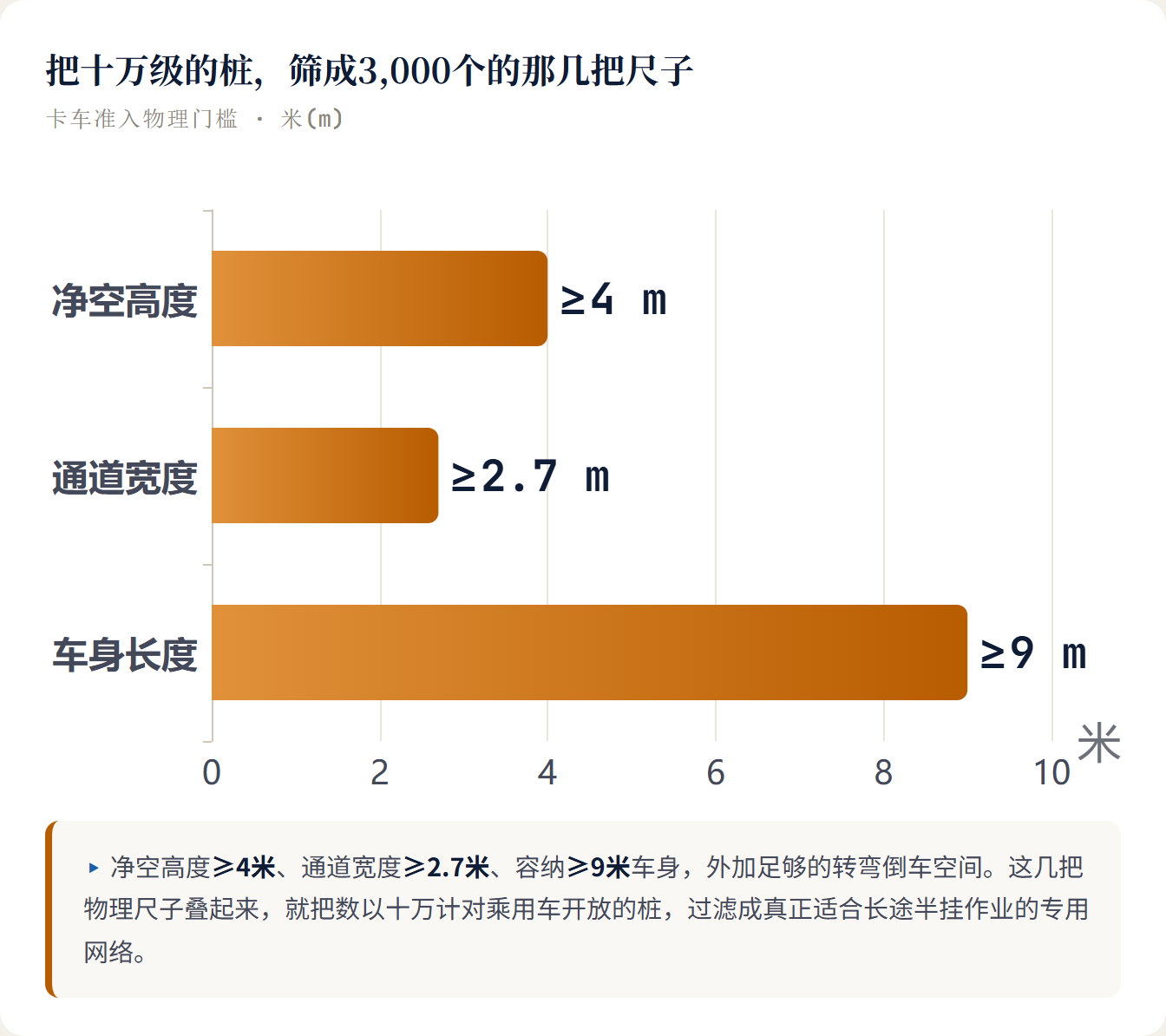 "A charger nearby" is enough for an electric car, but means almost nothing for a Class 8 electric heavy truck. The EU's mandatory 45-minute driving break is the only charging window on the entire trip, and enough energy has to go in during that time. A charger that is too slow, inaccessible or occupied is the same as "no charger". What DKV is really selling is moving "can I charge?" from a driver's on-the-spot judgement to a structured, actionable parameter in dispatch and procurement systems. 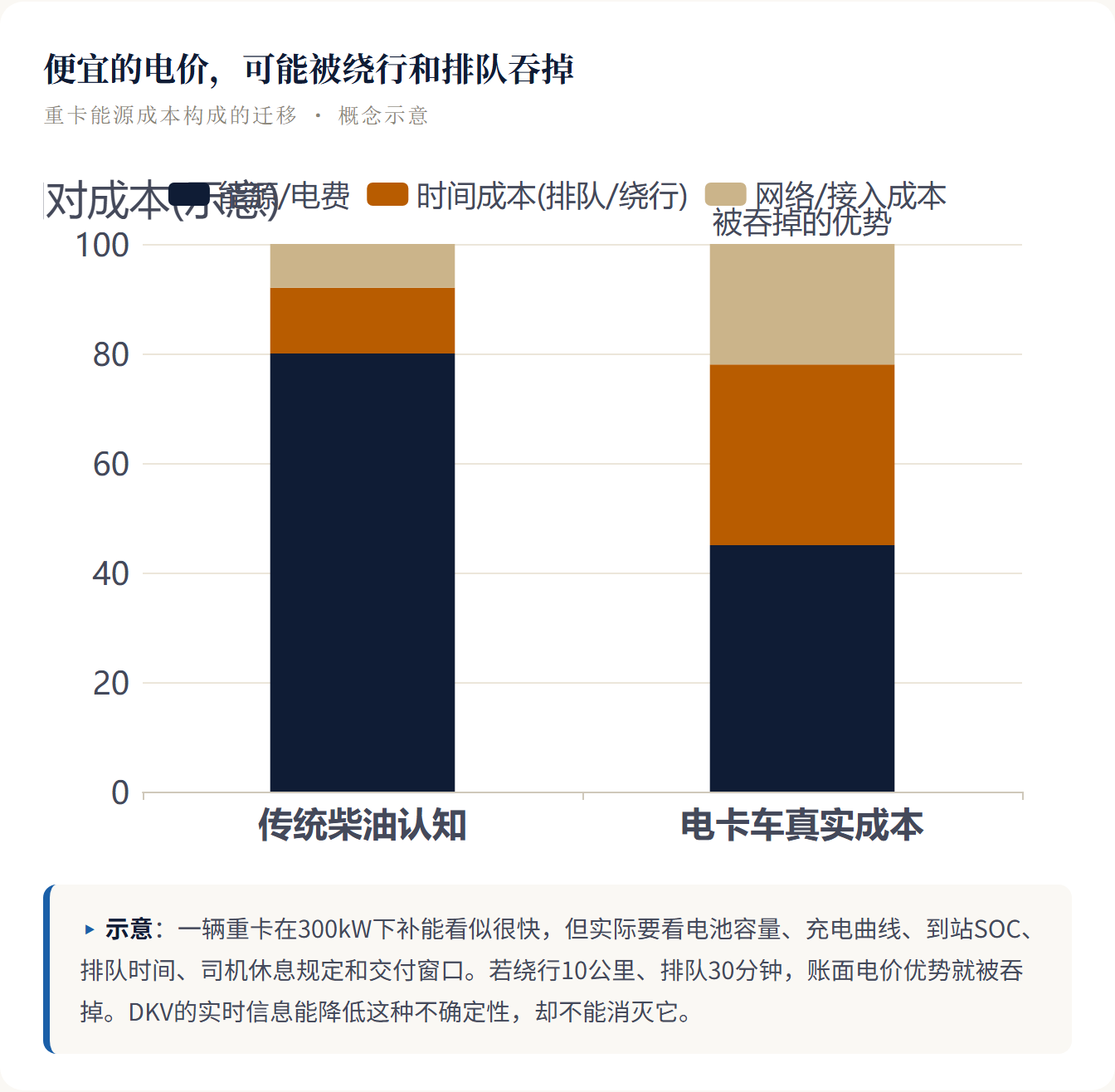 The MSP arbitrage play: no chargers, just the software layer Faced with a severe shortage of charging hardware, there are in theory two business paths: build your own charging network, or become the middle layer for data aggregation and settlement. DKV chose the latter, and the profit logic behind it is clear. Building chargers is an asset-heavy game. Procurement of 300 kW+ equipment, grid upgrades, site agreements and reworking parking layouts make capital expenditure per site extremely high. With the electric heavy-truck fleet at an early stage and daily station visits unstable, a self-built network needs a long time to generate returns through utilization. Milence, the charging operator jointly owned by Daimler and Volvo, plans to invest EUR 500 million to build 1,700 sites by 2027. That is an OEM-scale capital bet, not an MSP play. 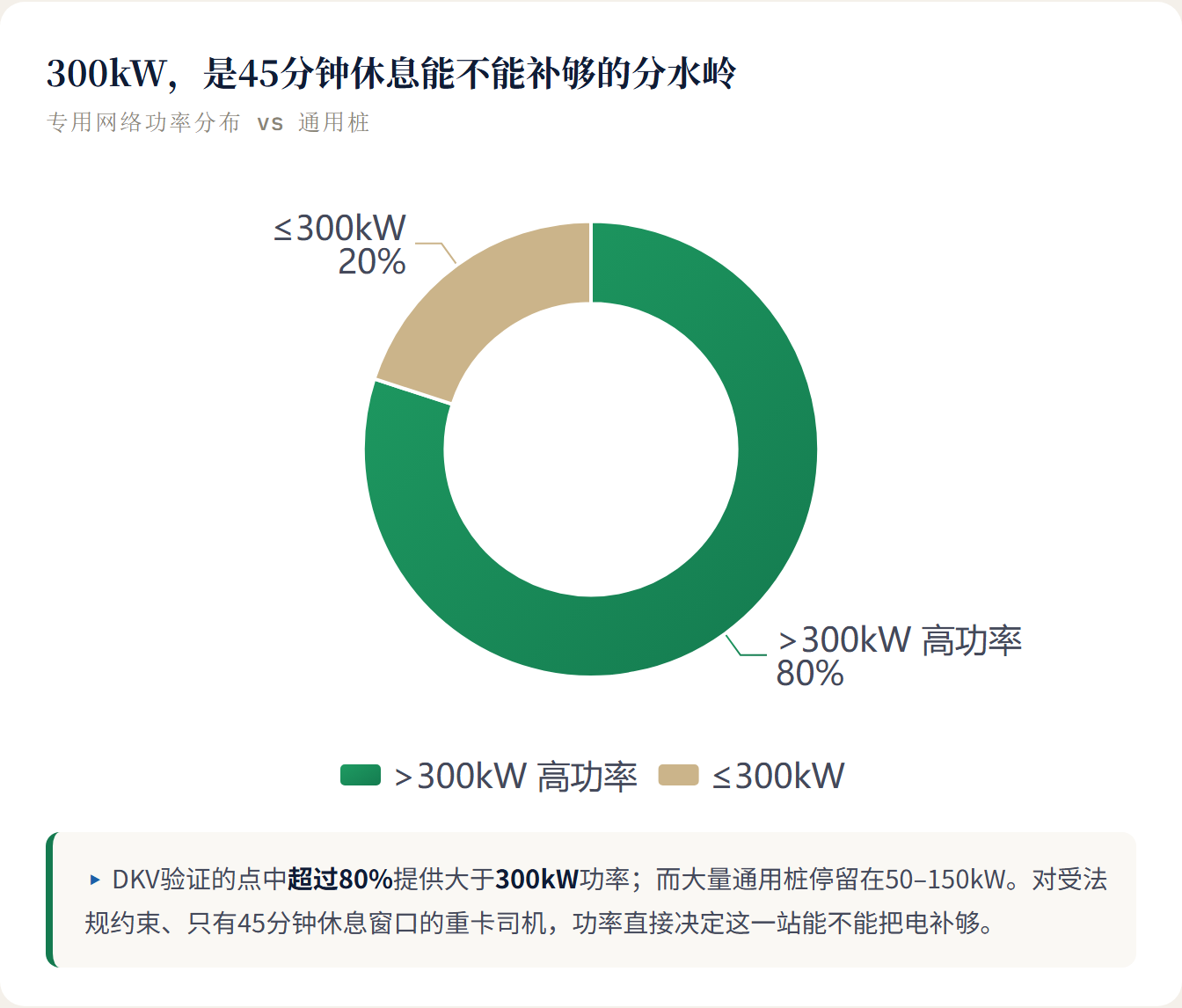 MSP works on a different logic. It links existing charging points spread across 17 European countries, each with different currencies and payment standards, through a single data interface and settlement protocol, with marginal investment mostly in software. When hardware shortages make "truly usable charging capacity" a scarce resource, the software layer that aggregates and allocates that capacity could well earn higher margins than building chargers. Product lead Tim Dambor positions the service as "reliability": pricing the uncertain risk of recharging into a guaranteed service. DKV's real asset is not how many chargers it owns but its data-interface capability: connecting different charge point operators (CPOs) and roaming platforms and syncing prices and availability in real time. The app shows live prices, estimated charging time, energy use per kWh and instant availability. What dispatchers and fleet buyers need is not a map of "where the chargers are" but operating parameters they can model, plan routes with and use to calculate TCO in advance. Unified billing and green power compliance: hitting two key corporate pain points To understand this card's market positioning, you cannot look at charging alone. Managing director Sven Mehringer's summary, "all drive types, all services, one invoice", targets the real nightmare facing fleet finance departments during the mixed-powertrain transition. A fleet running both diesel and electric trucks has to process, within each billing period, invoices from multiple charging operators, fuel station receipts from several countries, cross-border currency conversions and expense records under different tax regimes. DKV puts charging and fuelling, along with car washes, repairs, tyres and parking at some sites, onto a single invoice. What it saves is the hidden labour cost of an entire cross-border financial reconciliation process. For a fleet's finance director, this is not "one more service" but "turning accounting work that can't be finished today into work that no longer needs doing". 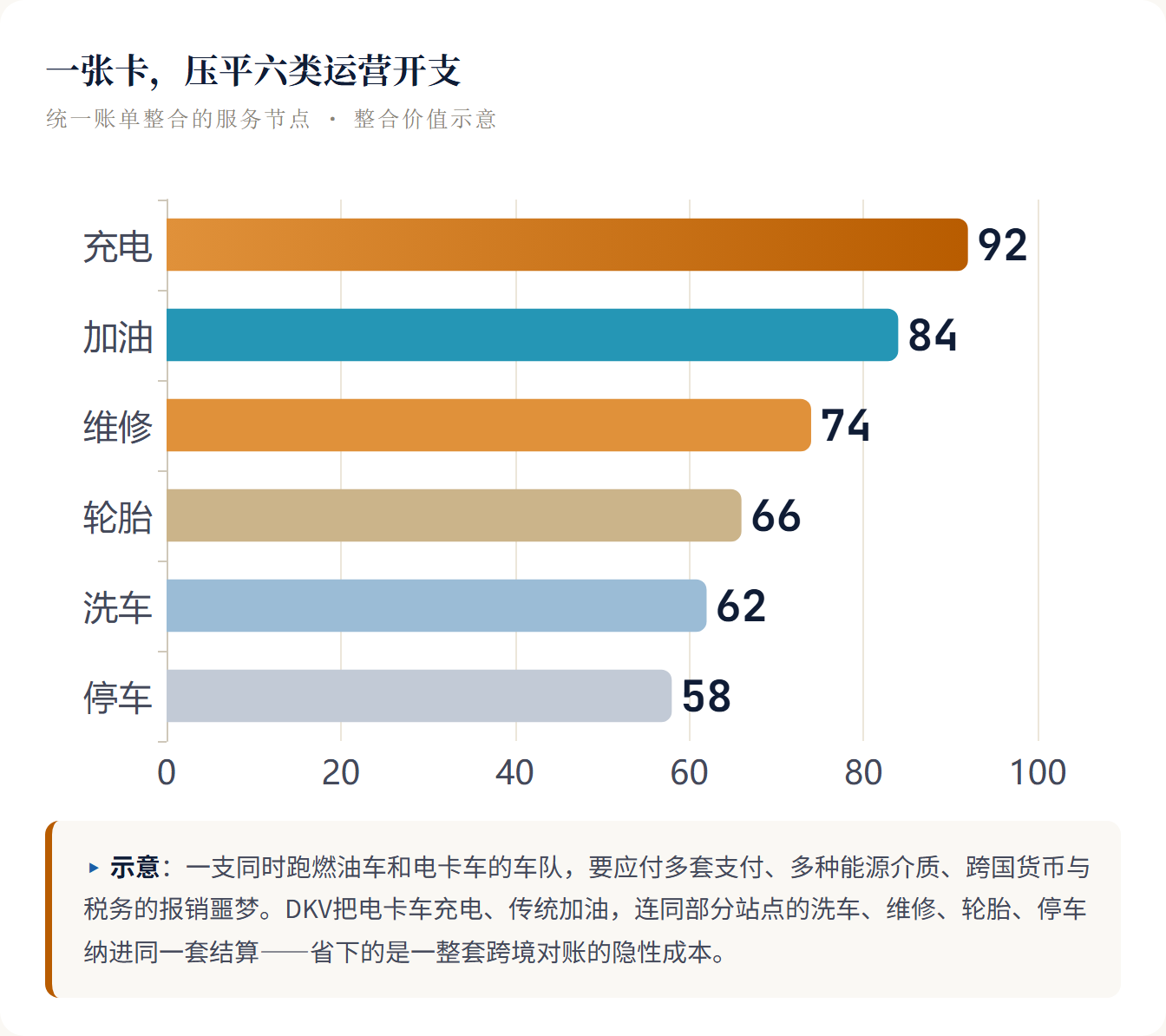 Another thread is green power compliance. DKV promises that 100% of every kWh on its own charging network comes from renewable sources. As the Carbon Border Adjustment Mechanism (CBAM) and the Corporate Sustainability Reporting Directive (CSRD) tighten one after another, Scope 3 CO2 emissions accounting for logistics firms is shifting from a bonus point in ESG reports to a hard entry requirement in tender contracts. Turning green power into traceable, auditable proof of delivery means charging is no longer just an operating cost but an asset that can go on the compliance ledger. 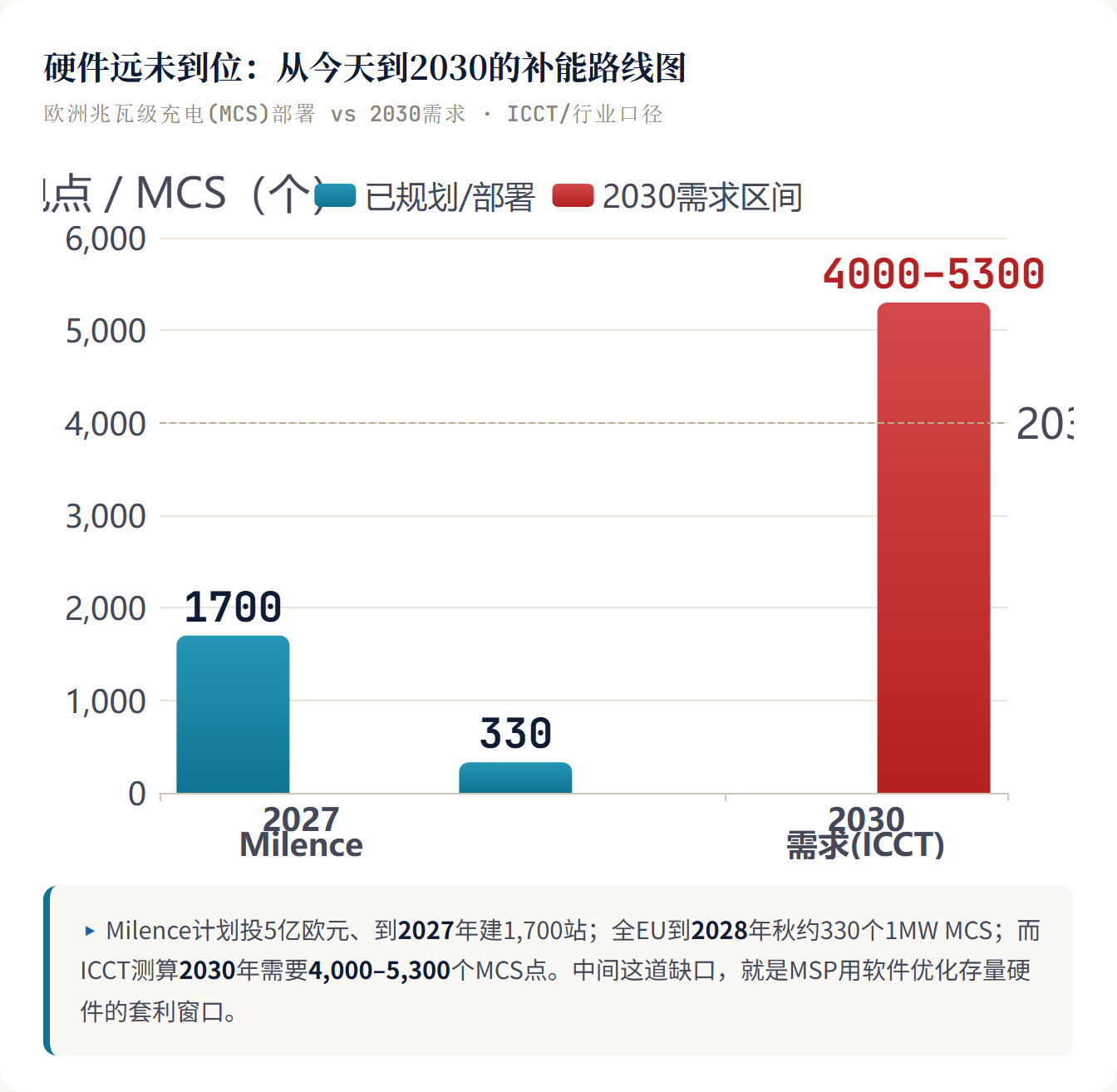 Profit pools reshuffled: who wins and who gets sidelined Once DKV Card +Charge Truck rolls out, profit distribution across the value chain will be reshuffled, and the winners will not be evenly spread. 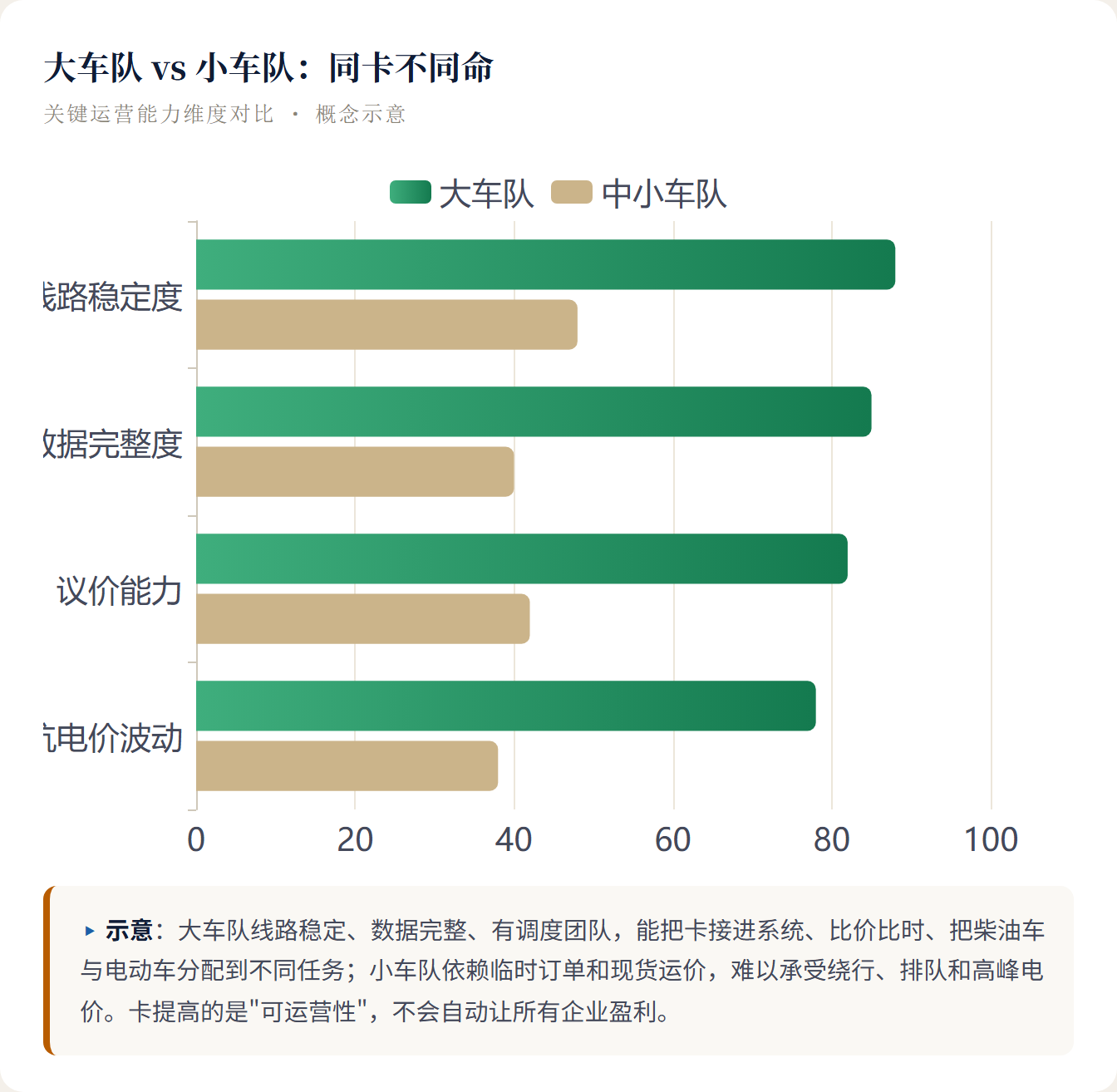 **Certified charging stations are the direct beneficiaries.** High-power heavy truck charging infrastructure requires heavy investment and pays back slowly, and the limited early electric truck fleet makes organic traffic unstable. Joining DKV puts a site within view of international haulage companies' dispatch systems, giving it a stable entry point for B2B fleet traffic while making it more bankable in the eyes of banks and energy investors. Conversely, sites that lack sufficient clearance or cannot be upgraded to a high-power grid connection still count in public charging point statistics but are effectively shut out of high-value freight traffic. **Heavy truck OEMs gain a short-term buffer but face long-term dilution of customer relationships.** For MAN, Mercedes-Benz Trucks, Volvo Trucks, Scania and DAF, a mature third-party charging network answers the hardest questions in selling electric heavy trucks: how customers will keep the trucks running after purchase, and whether TCO calculations can go into contracts. The price, however, is that whoever holds vehicle charging data gets closer to the core of the customer's operations. If MSPs take that position, the bond between OEMs and their customers will gradually weaken. 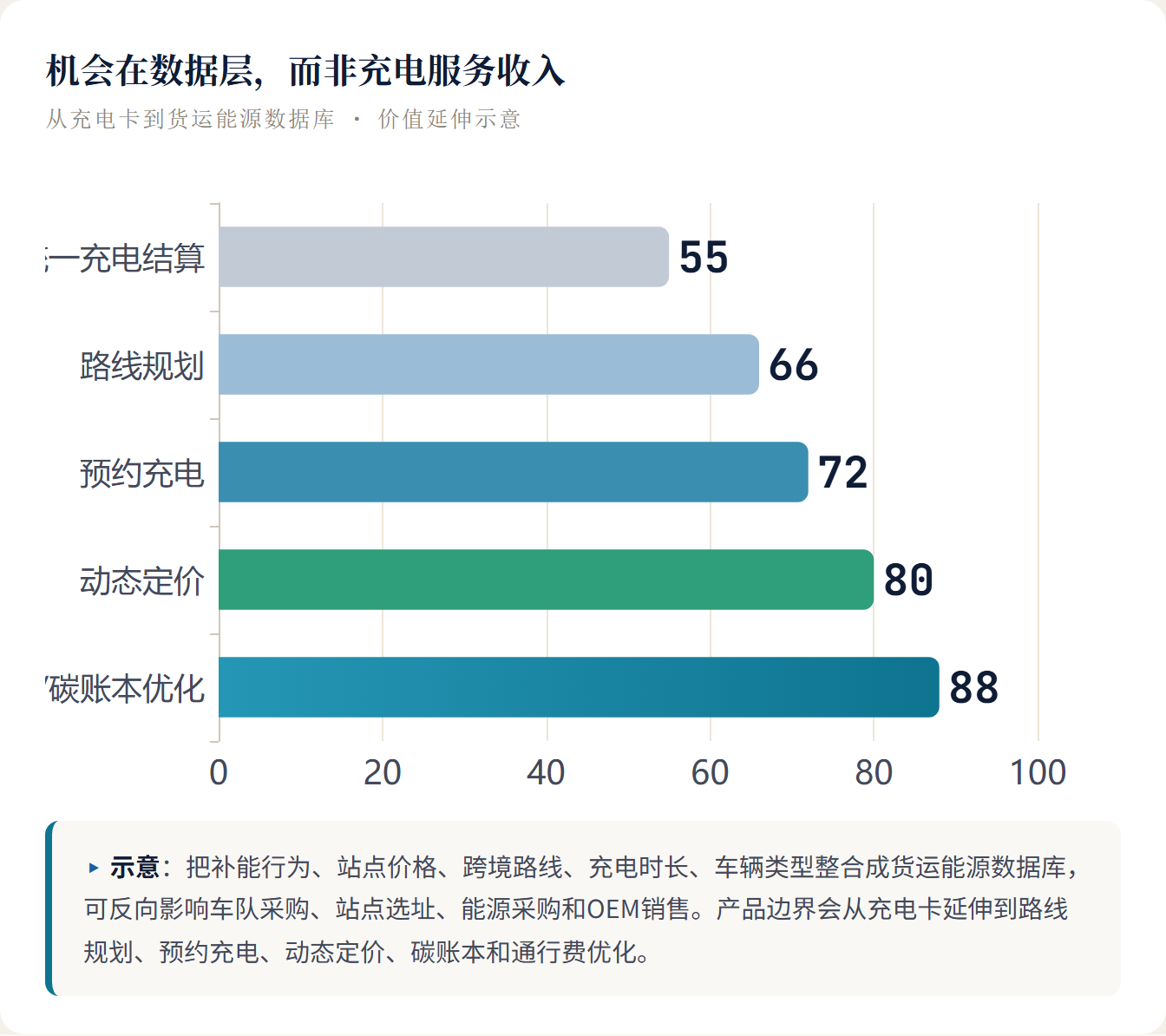 **Large and small fleets are heading in different directions.** Large fleets with stable routes and dispatch teams can feed DKV's real-time pricing and availability data into their dispatch models, assign diesel and electric trucks to the best-suited jobs, and turn information into operating efficiency. Small and mid-sized fleets that rely on spot orders and flexible dispatch struggle to absorb detour costs, queuing time and peak electricity price swings when routes are uncertain. Scaling up electric trucks will not lower the operating threshold for every fleet. Instead, it will sort out the real winners by data capability and route stability. 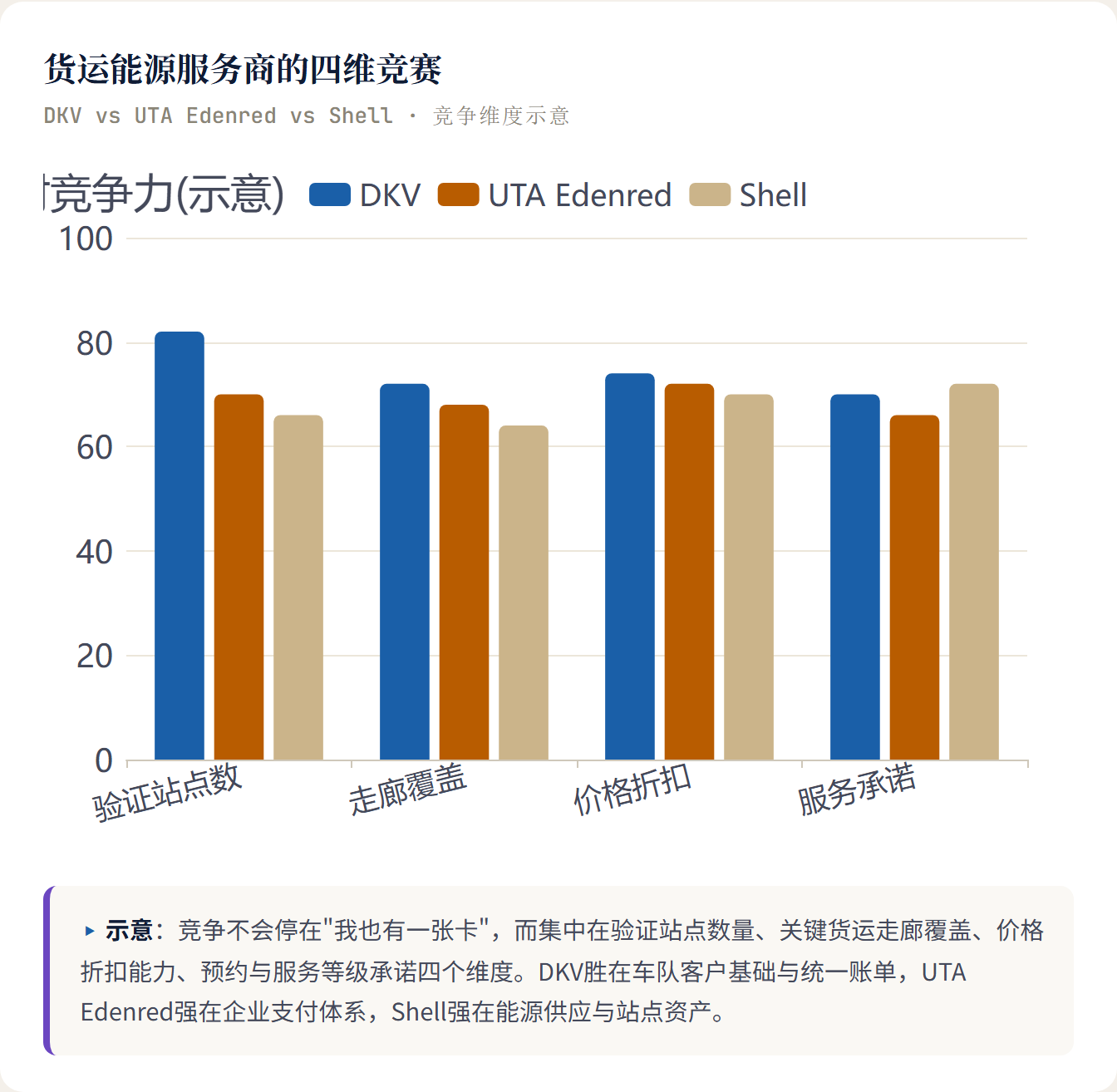 Limits of the moat: how long can data interfaces hold? DKV's business model has structural weaknesses. Its real moat is not the 3,000 chargers, which are other companies' assets, but its data interface capability that links multiple CPOs and roaming platforms and syncs charging parameters in real time. That capability is being eroded from several directions. First, the hardware gap will gradually narrow. As operators such as Milence keep rolling out MCS, the intermediary value of "screening scarce charging points" will decline as hardware becomes widespread. Second, large CPOs and OEMs have an incentive to bypass MSPs: Milence itself is a product of OEMs' strategy of "owning the charging data", and UTA Edenred and Shell are also building truck charging in parallel. Future competition will play out across the board on the number of verified sites, coverage density along key freight corridors and service-level commitments. 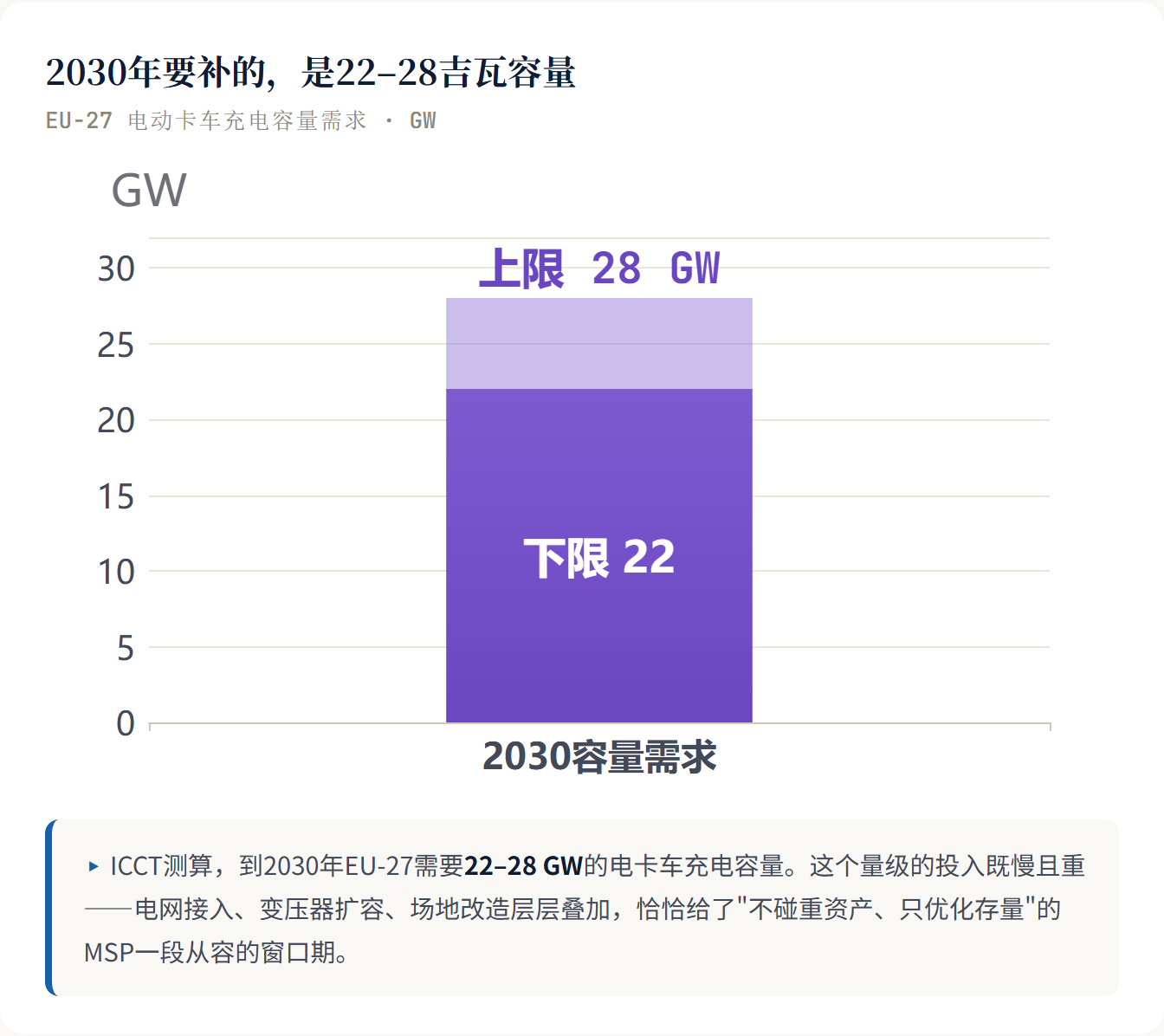 Two physical constraints remain that a payment card cannot solve: corridor density and grid capacity. With 3,000 sites spread across 17 countries, if a key trunk-route node has only one or two usable stations, any outage or grid power-curtailment event will affect the entire route. The combined grid load from several heavy trucks charging at high power at the same time is an infrastructure-level constraint that middleware software cannot work around. 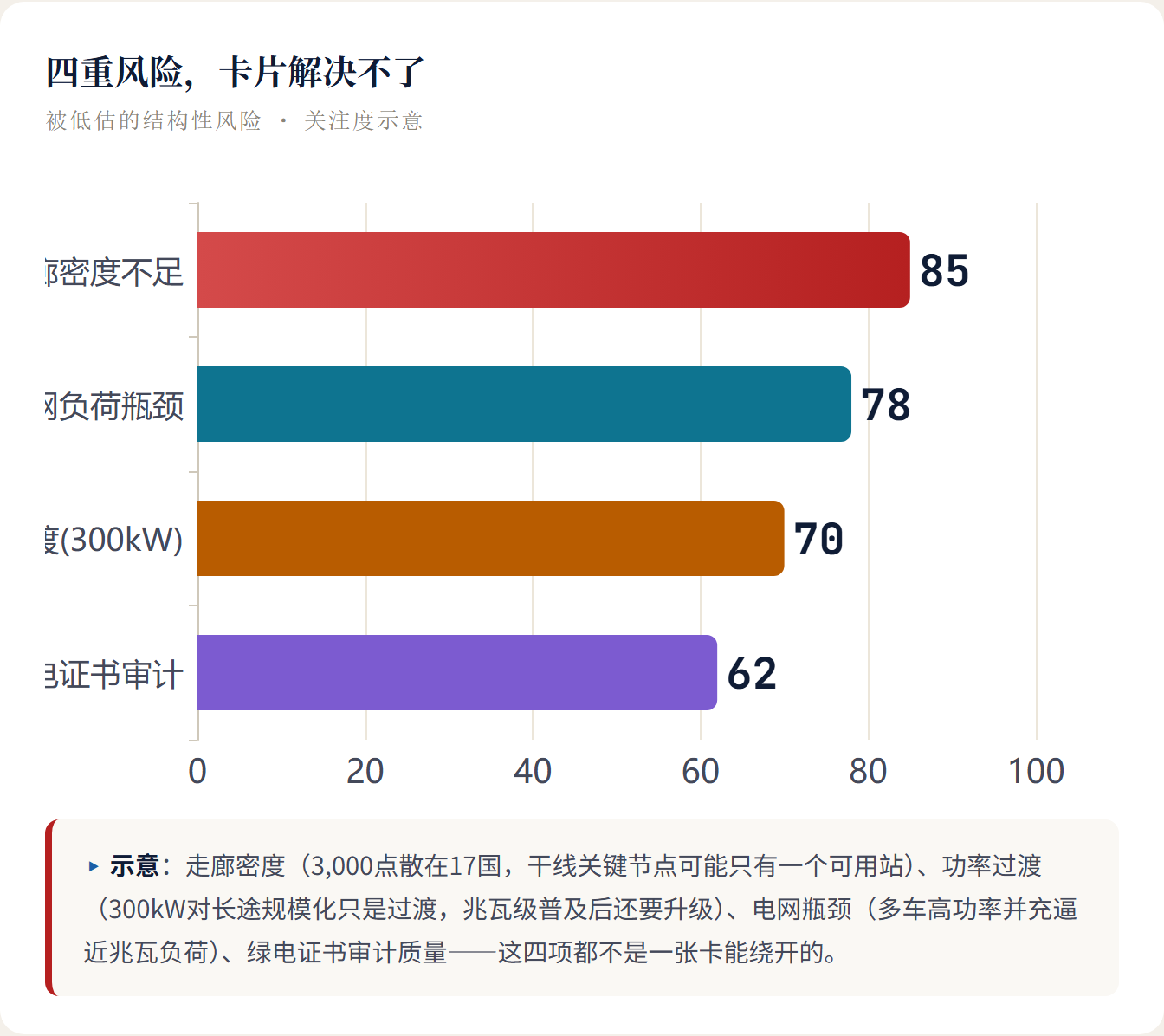 The real significance of DKV Card +Charge Truck is not that Europe has one more card, but that competition in freight energy is shifting from "asset scale" to "access control". In the toughest transition period for heavy truck electrification, the winner will not be whoever owns the most chargers, but whoever can link physical infrastructure, payment and settlement, dispatch data and customer contracts into a closed loop. That is precisely where an MSP's value lies during a hardware shortage. 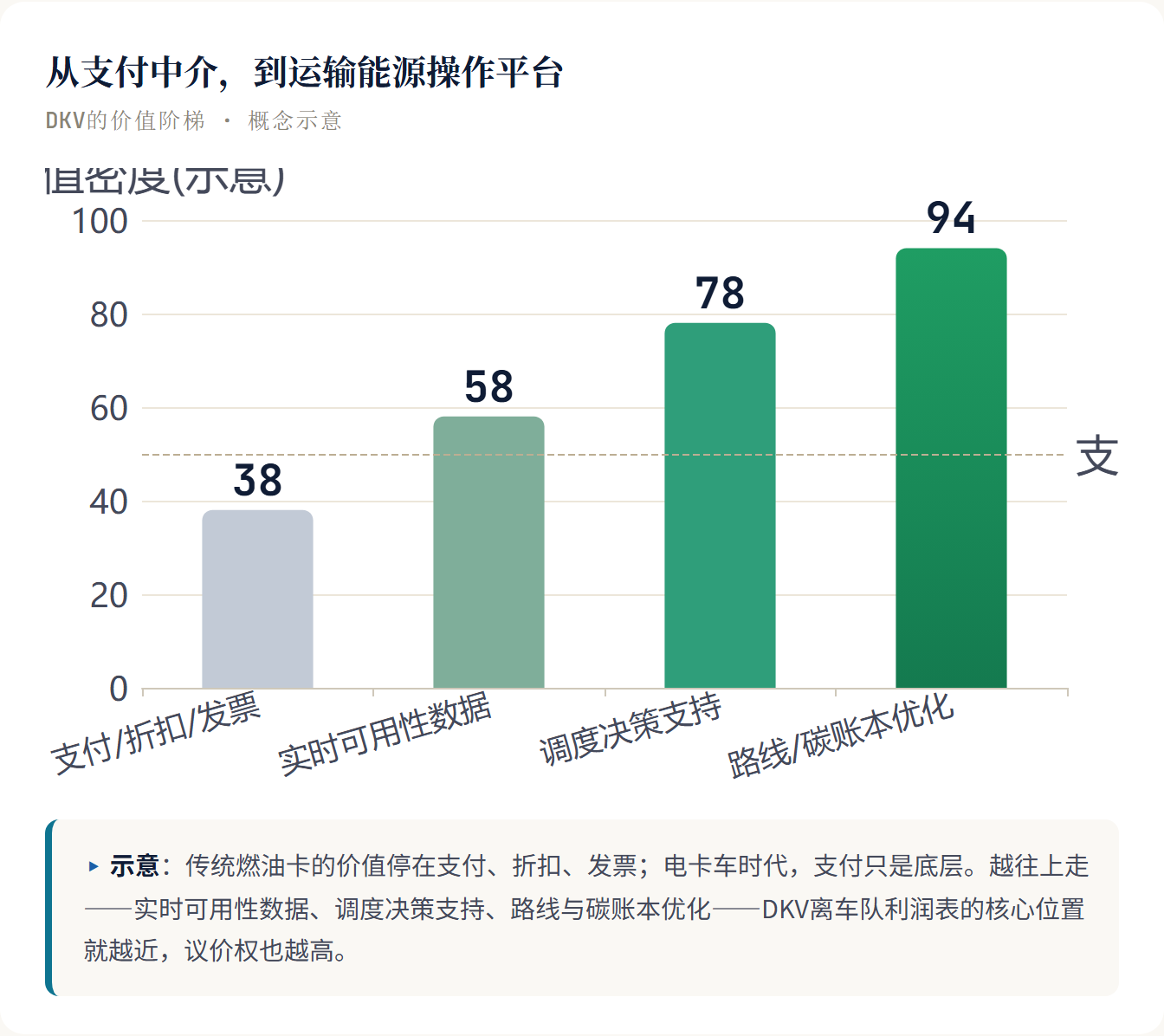 As Europe's MCS network rolls out, do you think intermediary MSPs like DKV will be consolidated or remain independent? Share your view in the comments. #Electric heavy trucks#DKV fuel card#FreightElectrification#HeavyTruckChargingNetwork#CVElectrification#EuropeanFreight#Charging infrastructure#MobilityServiceProviders#FleetManagement#GreenLogistics |