Leapmotor registers 30048 units in Italy in first ten months: T03 still imported from China
Leapmotor registered 30048 units in Italy in the first ten months, and the T03 is Italy's cumulative best-selling BEV, but the model is still imported from China. The B10 only entered production last month at Stellantis' Zaragoza plant, while the other models enter the EU bearing a 30.7% border duty burden.
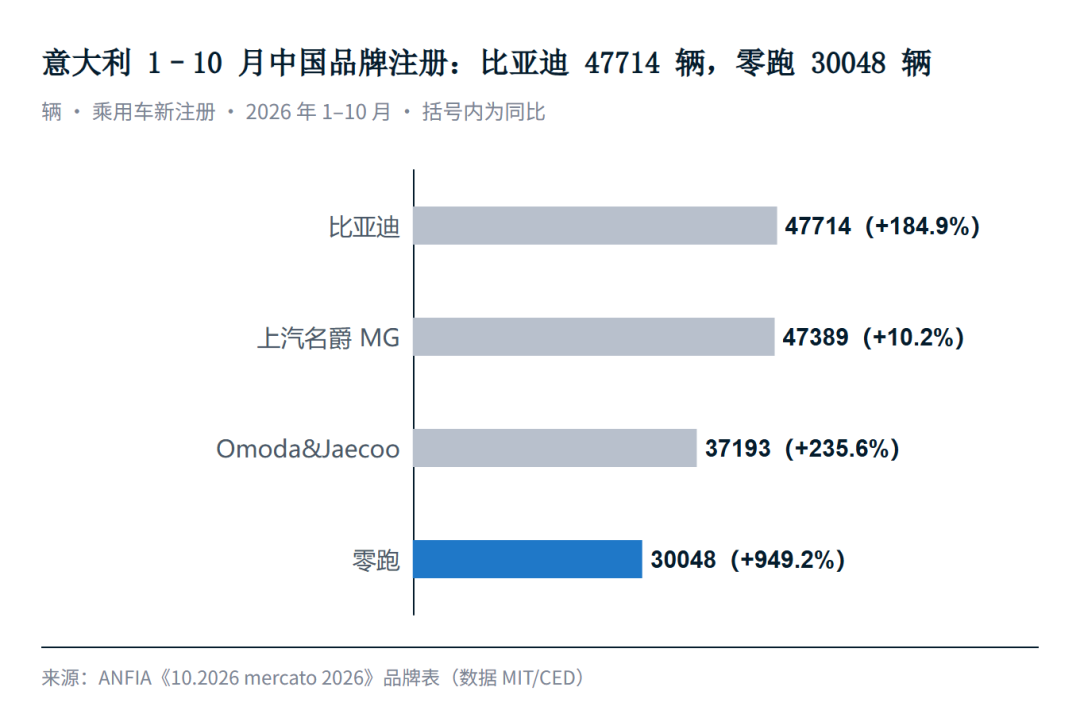
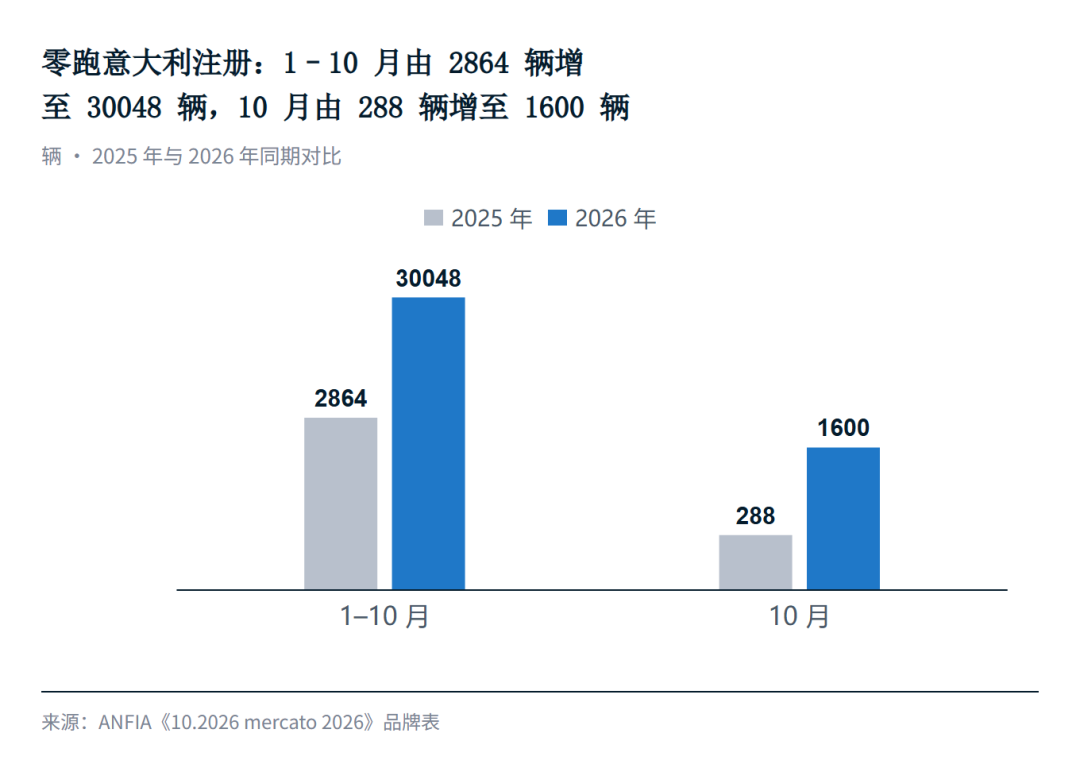
On Nov 2, Italian automotive industry association ANFIA released October new-car registration data. Leapmotor registered 30,048 units in Italy in the first ten months, a 2.1% share, up from just 2,864 a year earlier. In the ten-month cumulative ranking of battery-electric passenger cars, the Leapmotor T03 ranked first and the B10 tenth. Two weeks earlier, on Oct 16, Stellantis held an official start-of-production event for the Leapmotor B10 at its Zaragoza plant in Spain. Most of the 30,000 units in Italy were shipped from China, and the T03, top of the BEV ranking, is still imported.
Leapmotor's sales growth in Europe relies on cars built in its Chinese plants and on Stellantis dealerships; production in Spain has so far changed the origin of only one model, the battery-electric B10.
Italy's 30,000 units
ANFIA's data comes from the Italian transport ministry's registration records. The T03 ranks first in the year-to-date BEV ranking and eighth in the year-to-date ranking for A- and B-segment cars (the European size classes for mini and small cars). In the first ten months, these small cars accounted for 31.1% of Italy's passenger car market, and seven of the top ten models, including the T03, belong to Stellantis.
On Leapmotor's Italian website, the T03 is listed at €18900, with a promotional price of €15900 for contracts signed by the end of month 11. The B10 Life is listed at €30900; the site also shows a financing offer at €25900, conditional on private customers trading in or scrapping an old car and passing credit approval.
Registrations in month 10 were lower than in previous months. Leapmotor registered 1600 units that month, a 1.2% share. Its monthly average over the first ten months was about 3005 units, so month 10 came in at only around half the average. In the same month, BEVs took a 5.9% share of the overall Italian market, below the 7.8% cumulative share for the first ten months.
ANFIA also tracks Chinese-made vehicles by place of production. In the first ten months, more than 215,000 passenger cars produced in China were registered in Italy, accounting for 15.4% of the Italian passenger car market, including models built in China by non-Chinese brands; nearly half of BEVs were made in China.
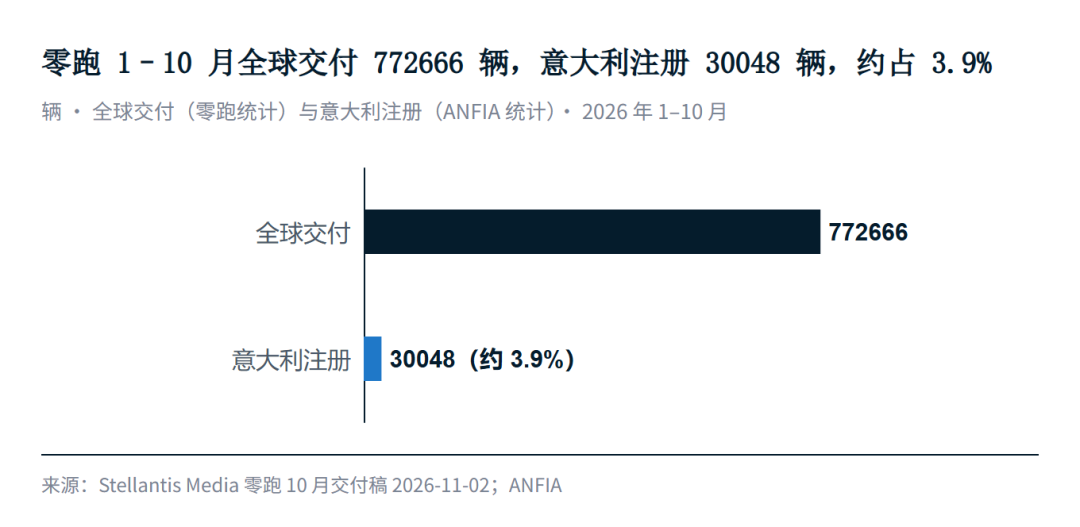
Italian registrations account for only a small share of Leapmotor's global deliveries. Leapmotor delivered 106127 units globally in month 10, up 51% year on year, and 772666 units in the first ten months; the 30048 registrations in Italy are equivalent to about 3.9% of that total. The two figures use different bases and are compared only to show scale.
For Italian dealers, Leapmotor's best-selling BEV is a small car imported from China and priced under EUR 20,000.
Leapmotor's contribution to Stellantis
ANFIA's brand table lists Leapmotor separately from Stellantis. Excluding Leapmotor, Stellantis registered 381137 units in Italy in the first ten months, up 4.2%, below the overall Italian market's 8.3% growth, with its share falling from 28.3% to 27.2%. In month 10 alone, registrations were 30285, down 9.5%.
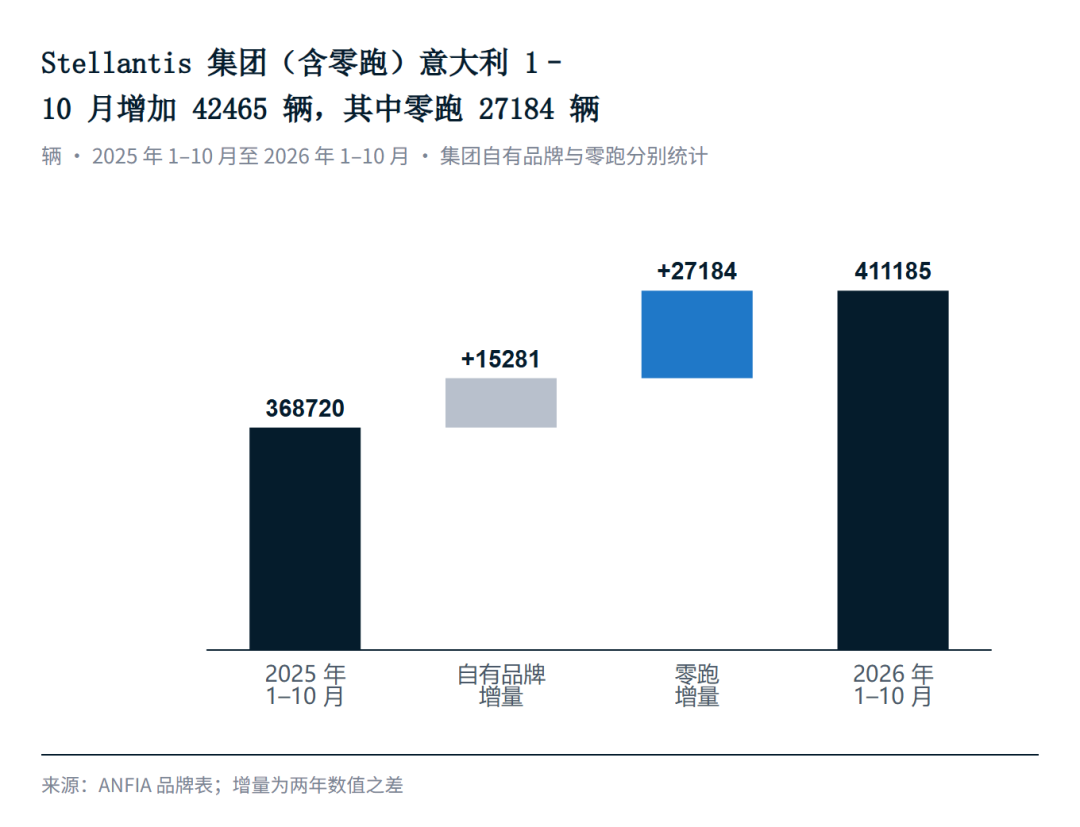
Including Leapmotor, the group sold 42,465 more units in the first ten months than a year earlier, of which Leapmotor contributed 27,184, or about 64%. Combined, the group including Leapmotor sold about 411,000 units in the first ten months, with Leapmotor accounting for about 7.3%. ANFIA puts the group's share including Leapmotor at 29.3%, about 2 percentage points higher than without it.
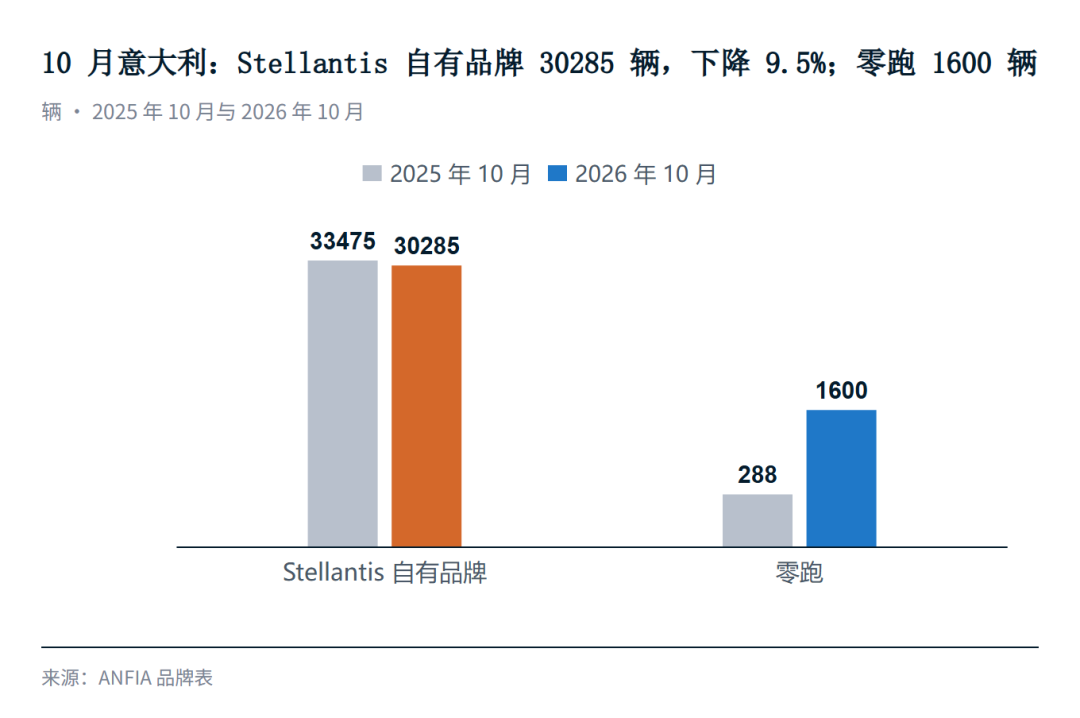
Both ANFIA and the Italian news agency ANSA count Leapmotor within the Stellantis group, since Leapmotor's overseas business is controlled by Stellantis:
The network is expanding fast. In May this year Stellantis said Leapmotor International shipped more than 40,000 vehicles in Europe in 2025 and had over 850 sales and service outlets; in September it said Leapmotor had 1,020 retail outlets across 36 European countries.
There is also a direct transaction between the two companies. On March 31 this year, Leapmotor announced on the Hong Kong Stock Exchange that it would transfer all CO2 credits generated by Leapmotor-brand BEVs and EREVs sold and registered in Europe and the UK in 2026 to a Stellantis subsidiary, with an annual transaction cap of RMB 2.8 billion. For Leapmotor this is revenue; for Stellantis it is a compliance purchase. The cap does not equal the actual transaction value. Leapmotor has not stopped Stellantis's own brands from underperforming the market in Italy, but it has kept the group's combined share at 29.3% and given Stellantis emissions credits it can buy.
Two production sites
The shift in where Leapmotor's European models are built falls into two phases:
According to German media, the Zaragoza line is initially planned for annual output of 40,000 vehicles, with chassis supplied by Lieder Automotive in nearby Borja; Stellantis's CEO has said the group's European plants ran at about 60% utilisation in 2025.
Country of origin determines the tax burden on entry into the EU. At the end of Oct 2024, the EU imposed five-year anti-subsidy duties on battery-electric passenger cars originating in China under Regulation (EU) 2024/2754. Leapmotor is on the list of cooperating companies, with a rate of 20.7%, plus the 10% import tariff, for a total of 30.7%, calculated on the customs value. The regulation's definition of battery-electric vehicles includes models with a combustion range extender, so the B10 range-extender version imported from China pays the same rate.
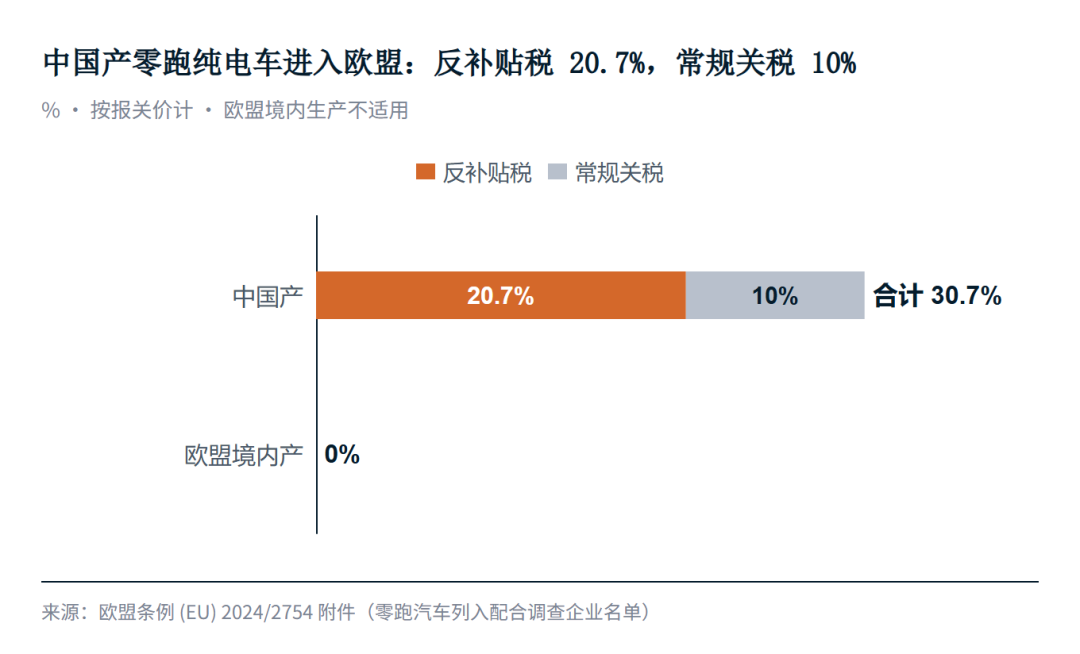
The T03, B05, B10 range-extender and the remaining models are still taxed at this rate. Based on published production locations, all Leapmotor models registered in Europe come from China, except the T03 once assembled in Tychy and the BEV B10 just entering production in Zaragoza. The 30.7% is the duty rate on imported vehicles, not the reduction in retail price. For Leapmotor, whether local production can beat importing on cost depends on whether the line's actual output can absorb the added labour, component and production line costs.
Three-country share
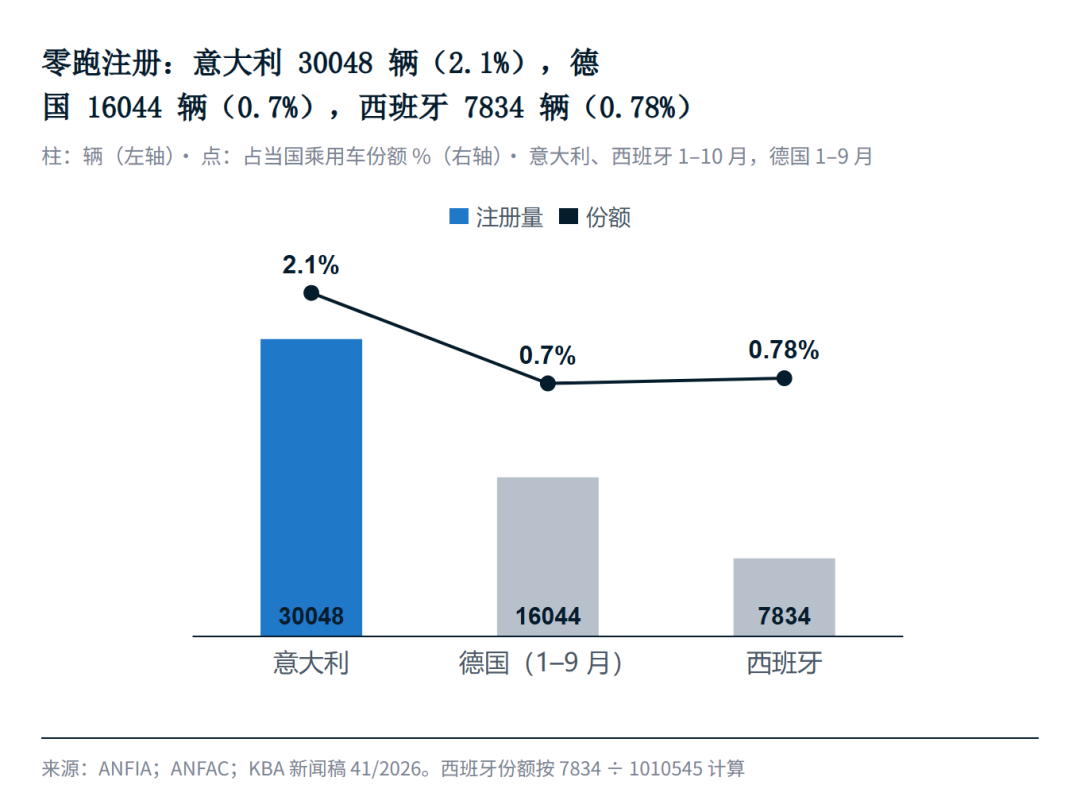
Leapmotor sells through Stellantis outlets throughout Europe, yet its share varies widely across the three major markets:
Italy's registrations are 3.8 times Spain's. In month 10 alone, however, Spain came out slightly ahead, with Leapmotor registering 1698 units in Spain versus 1600 in Italy.
Pricing terms for the T03 differ across the three countries' official websites. In Spain, after deducting the national Plan Auto+ incentive of EUR 3375 and the CAE energy-saving certificate worth EUR 900, the T03 starts at EUR 13300, with the offer valid until Oct 31. In Italy the promotional price is EUR 15900. In Germany the recommended retail price starts at EUR 18900, and buyers can also apply for a government purchase subsidy based on household income.
Data from ANFAC, the Spanish automobile manufacturers' association, show Ebro registered 21787 units in the first ten months, about 2.8 times Leapmotor's total. Ebro is a Spanish domestic brand in a joint venture with Chery, with Ebro holding 60% and Chery 40%, and assembles vehicles at the former Nissan plant in Barcelona. The S700 and S800 both come in ICE and PHEV versions, a different product mix from Leapmotor, which sells only BEVs and range extenders.
According to local media, Ebro vehicles were previously shipped from China as kits and assembled at the plant. Spain's investment promotion agency said in July that welding and painting were being tested, and the new line would have a capacity of 50,000 units a year by year-end.
Dongfeng and Great Wall
Stellantis wants to apply its Leapmotor partnership model to Dongfeng. On 20 May this year, Stellantis announced it had signed a non-binding memorandum with Dongfeng to set up a Stellantis-led European joint venture with a 51:49 shareholding. The JV would sell Voyah vehicles in selected European markets through Stellantis' network, and the partners are considering building Dongfeng new energy vehicles at Stellantis' Rennes plant in France. Leapmotor International covers all markets outside Greater China; the scope of the Dongfeng plan is much narrower. In April 2024, Dongfeng also held talks with the Italian government about building a plant with planned annual capacity of more than 100,000 units.
For Great Wall Motor, this is the second time it has used a local plant. On Feb 21, 2012, Great Wall and local company Litex opened a kit assembly plant in Bahovitsa near Lovech, Bulgaria, with a designed annual capacity of 50,000 units. The plant halted operations in Jan 2016, and Litex filed for bankruptcy in Feb 2017.
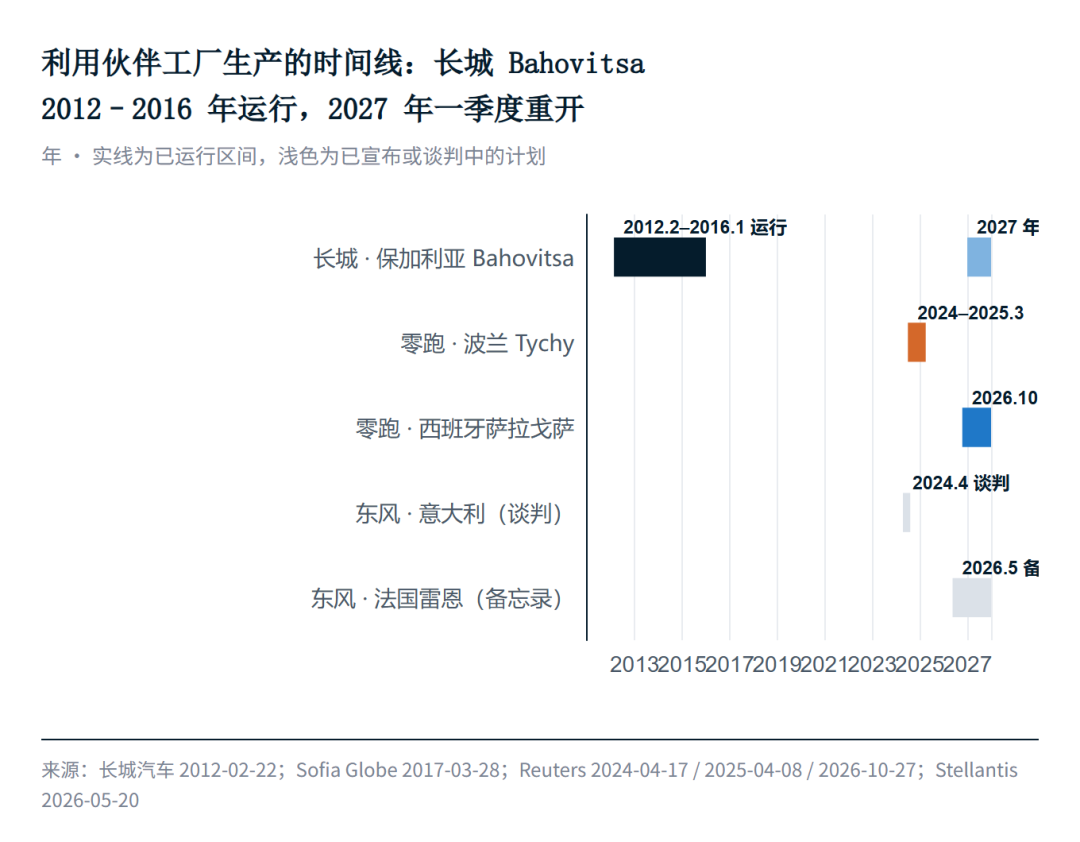
Source: Chart by AutoMusic based on the public sources listed in the article; first published on the AutoMusic WeChat account.
In October, Great Wall announced it will return to the same plant from Q1 2027, with current owner Bulgarian Automotive Industries (BAI) assembling the Ora 5 under contract. Planned annual capacity remains 50,000 units, starting with SKD kits shipped from China. Great Wall sold only about 3,500 vehicles in Europe in 2025; the planned 50,000-unit capacity is roughly 14 times that.
Dongfeng's plan is still at the memorandum stage; for Great Wall to get an idled plant running, it first needs to lift its European sales beyond a few thousand units.
Final thoughts
No official delivery date has yet been given for the Zaragoza-built B10. So far, Leapmotor's registrations in Italy, Spain and Germany have mainly come from China-built cars sold through Stellantis outlets.