Geely takes €221 million stake in Ford plant: Chinese automakers' European manufacturing in five tiers
Geely is taking a 34% stake in Ford's Spanish company for EUR 221 million; the joint venture will do contract manufacturing only, with first vehicles in 2028. The Leapmotor B10 is already in volume production in Zaragoza and the XPeng G9L has just completed trial production, while Leapmotor in Madrid and Chery in Italy are still at the evaluation and statement stage.
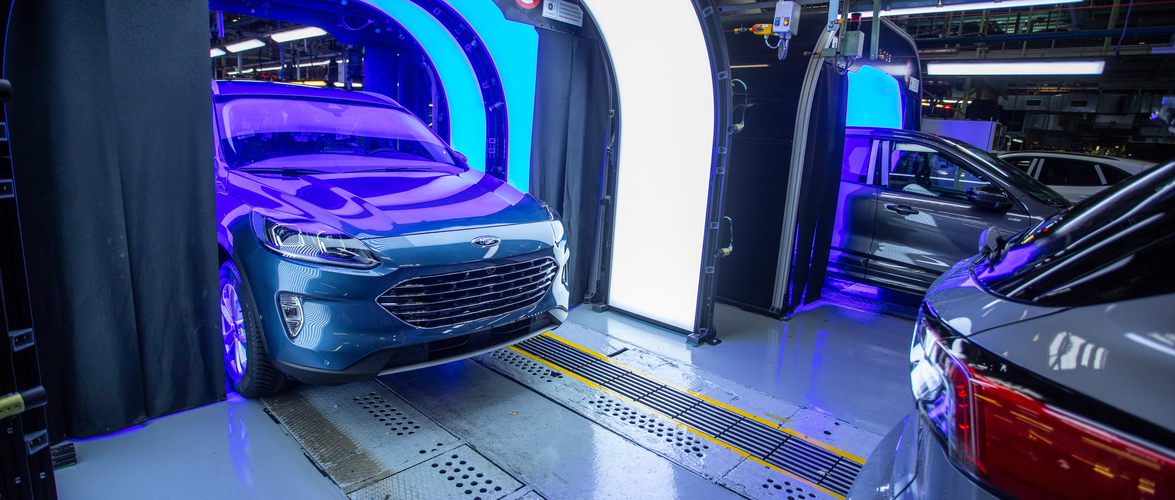
On Jul 23, Geely Automobile announced on the Hong Kong Stock Exchange that it had signed an agreement to acquire a 34% stake in Ford España for EUR 221 million, forming a joint venture with Ford at its Almussafes plant in Valencia; completion is subject to approvals and an asset carve-out. Three months later, the Leapmotor B10 officially entered production at Stellantis' Zaragoza plant, and the XPeng G9L completed trial production at Magna's Graz plant. The prevailing view is that Chinese automakers have started building cars in Europe. Broken down by progress, however, the differences are substantial.
Valencia contract
After closing between Geely and Ford, the target company will operate mainly as a contract manufacturer building vehicles for both Ford and Geely. It will have no independent sales function and will not handle product design, R&D, branding, sales or distribution, which remain the responsibility of each shareholder outside the joint venture.
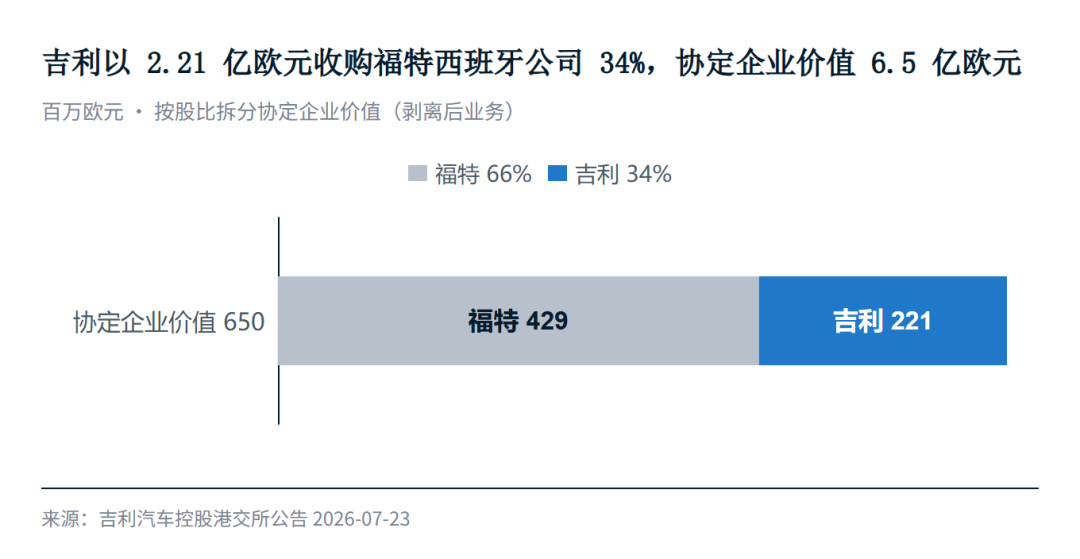
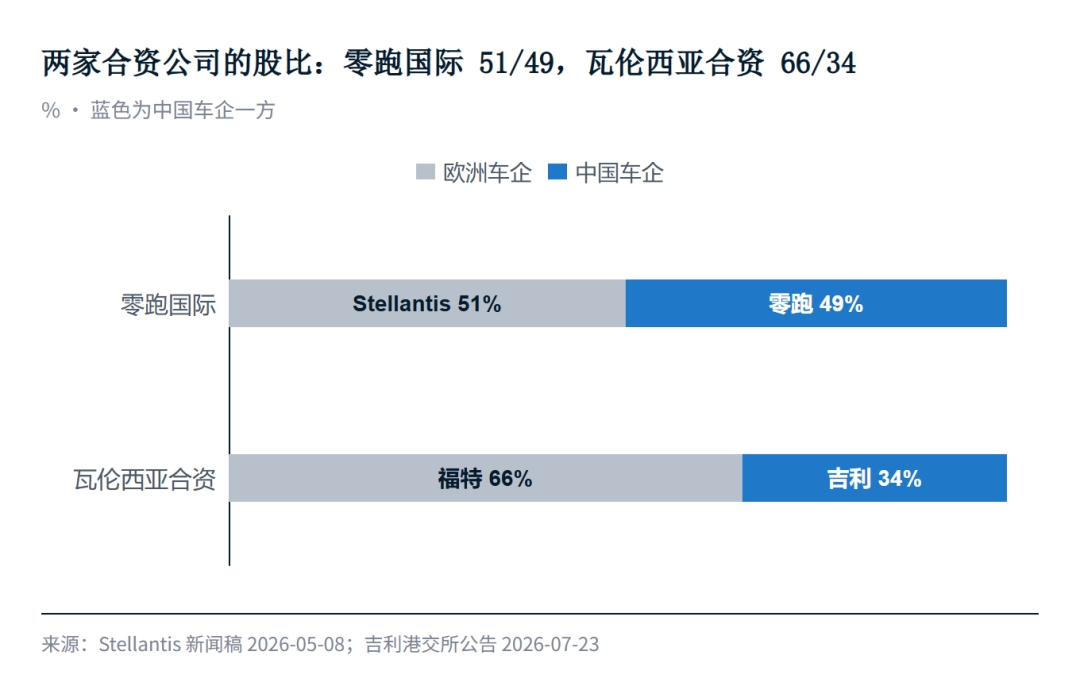
Ford holds the majority stake. Ford owns 66% and Geely 34%, so the joint venture will not become a Geely subsidiary. On funding, if external financing is unavailable or its terms are unreasonable, the two partners provide shareholder loans in proportion to their stakes; the agreement sets no fixed capital commitment for shareholders. The agreement also contains a set of options exercisable only in special circumstances, one of which bears directly on the plant's future: if someone proposes closing the Valencia plant and the two sides deadlock, the party wishing to continue operations can buy all of the other's shares at 70% of book value.
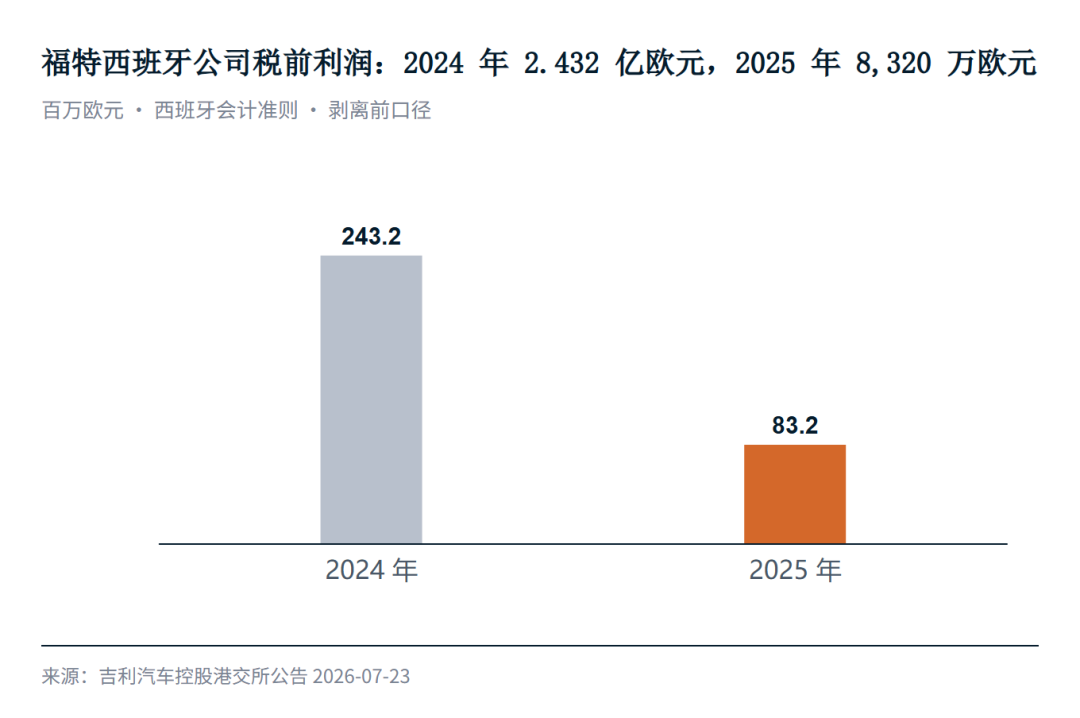
The announcement also disclosed the company's profits for the past two years. On a pre-carve-out basis, Ford Spain posted pre-tax profit of EUR 243.2 million in 2024, falling to EUR 83.2 million in 2025, about 34% of the previous year's level. The carved-out joint venture will operate under a long-term contract manufacturing arrangement. Geely stated in the announcement that even at full plant utilization and assuming the highest margin, revenue and profit are not expected to be large enough to reach the threshold requiring separate disclosure under listing rules. The plant can produce about 500,000 units a year, and Ford says the joint venture is meant to fill that capacity and lower per-unit costs. Under the plan, Kuga production continues, and from 2028 the plant will add a compact SUV from the Bronco family, a crossover designed by Ford and co-developed with Geely, and two Geely battery-electric SUVs. The joint venture is scheduled to start operations in H1 2027.
For EUR 221 million, Geely has bought the production lines of a large European plant, along with its existing workforce and supplier network; R&D, brand and sales all remain outside the joint venture. The return on this investment will depend mainly on how many Geely vehicles are scheduled on those lines.
Mazda has already tried this once
A non-Ford brand has been built at Almussafes once before. According to material Ford Spain compiled for the plant's 50th anniversary, the plant built its first car on Oct 18, 1976. For the next 27 years it built only Ford models, until it began producing the Mazda2 on Jan 20, 2003. The Mazda2 was built until Jun 22, 2007, totaling 161,962 units. Over roughly 4 years and 5 months, that works out to about 37,000 units a year. At the time, Ford was Mazda's largest shareholder, holding 33.4% from 1996.
2004 was the plant's peak year, with output of 449,101 vehicles, roughly 90% of the approximately 500,000-unit annual capacity Ford now cites. These included 257,267 Focus, 78,642 Ka, 71,783 Fiesta and 41,409 Mazda2, the last accounting for about 9.2% of that year's output.
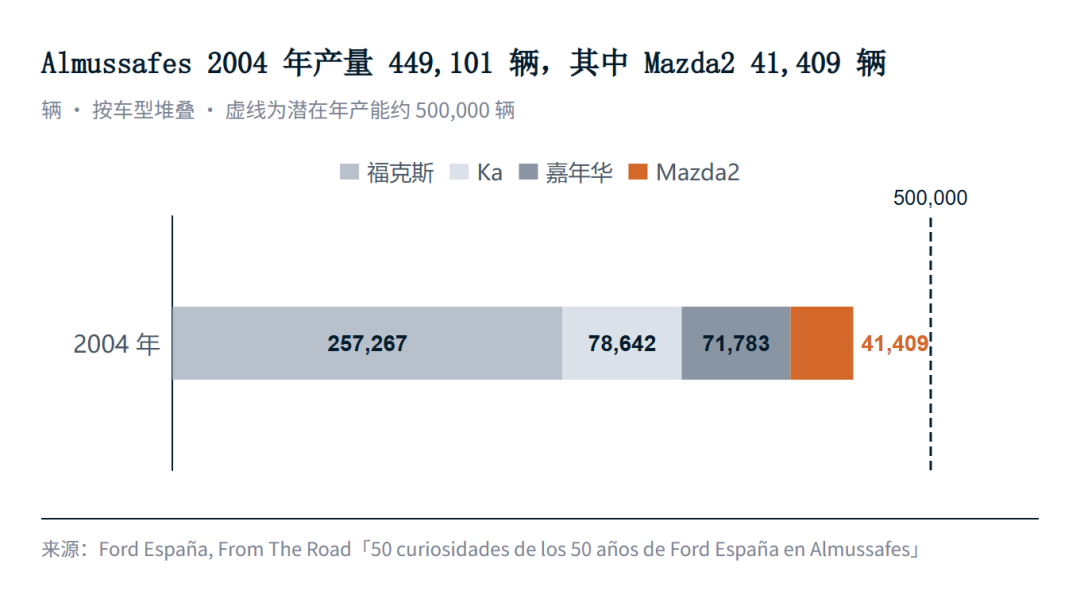
Like the Mazda2 back then, Geely's two BEV SUVs are an outside brand occupying part of a Ford plant's capacity. The difference is that Mazda, behind the Mazda2, was partly owned by Ford, whereas this time Geely is taking a stake in a Ford plant. How many Geely vehicles end up on the line will depend on orders once the joint venture is operational.
Five stages of vehicle-making progress
Based on official information, the vehicle-building projects fall into five tiers:
The top four projects all use existing factories in Europe. The Zaragoza plant already builds the Opel Corsa, Peugeot 208 and Lancia Ypsilon, and the Leapmotor B10 is its fourth model. The operator, Leapmotor International, is 51% owned by Stellantis and 49% by Leapmotor. Graz is Magna's contract vehicle assembly plant, where XPeng and GAC carry out final assembly. The G9L is the fourth XPeng model built in Europe, after the G6, G9 and P7+. The Barcelona site is a former Nissan plant, now 60% owned by Ebro and 40% by Chery, and phase one covers assembly only. Spain's investment promotion agency said in July that the body and paint shops were still in testing and expected to be fully operational in the autumn, with cumulative investment already above EUR 150 million.
The Leapmotor B05 is described only as Zaragoza's next model. Once the Citroën C4 is discontinued as planned, the plant may be allocated a new Leapmotor model from the first half of 2028, and transferring ownership of the plant to Leapmotor International's Spanish subsidiary is under discussion. Chery has told European and Italian media that it has set up a design company in Turin, but this is a statement, not yet a project. BYD, not included in this table, is taking a different route.
Tariffs and origin
Contract manufacturing also bears on the question of origin. EU Regulation (EU) 2024/2754 imposes anti-subsidy duties on battery-electric passenger cars originating in China. BYD, Geely and SAIC Motor, which were sampled in the investigation, each have individual rates of 17.0%, 18.8% and 35.3% respectively. Cooperating companies that were not sampled pay a uniform 20.7%, and Leapmotor, XPeng and Chery are all on that list; non-cooperating companies pay 35.3%. The two models Geely plans to build in Valencia are battery-electric SUVs, which fall squarely within the vehicle category covered by the duty.
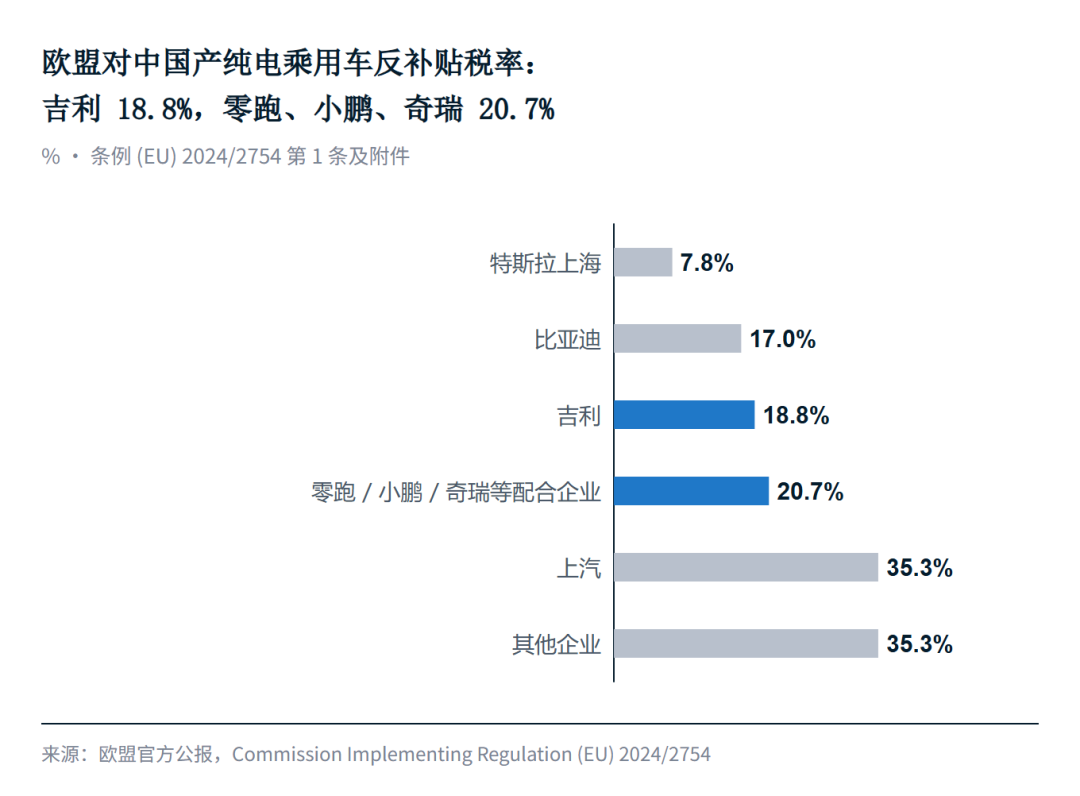
Source: Chart by AutoMusic based on the public sources listed in the article; first published on the AutoMusic WeChat account.
Rolling off a line in Europe does not automatically make a vehicle European in origin. According to the European Commission's guidance on non-preferential rules of origin, when two or more countries are involved in production, origin is determined by where the last substantial transformation took place. Certain minimal operations can never confer origin, and processing carried out solely to circumvent tariff measures is deemed economically unjustified. Which operations the local plant performs will directly determine the origin under which these vehicles are ultimately declared at customs.
Beyond vehicle production, components are also moving to Europe. In June, Leapmotor International opened a battery plant in Mallén near Zaragoza, with about 34,000 m² of floor space, assembling battery modules; its first output supplies two LFP batteries for the B platform built in Zaragoza. Stellantis is evaluating adding a line in Zaragoza for an Opel battery-electric C-SUV, possibly starting production in 2028; this Opel would use parts sourced by Leapmotor International to cut vehicle costs.
For Chinese brands, borrowing an existing plant is faster than building their own, but the plant is run by someone else, and whether anti-subsidy duties can be avoided depends on whether local processing is deep enough. For Stellantis and Ford, Chinese partners bring production line orders and cheaper components.
Final thoughts
The Geely-Ford joint venture in Spain plans to start operating in the first half of 2027, with two Geely BEV SUVs and two new Ford models all scheduled for 2028. Leapmotor models at the Villaverde plant in Madrid are due in the first half of 2028 at the earliest, and Opel's new C-SUV line in Zaragoza also points to 2028. Whether body and paint shops in Barcelona are fully running on schedule this autumn is the nearest checkpoint this year. To judge how far Chinese automakers have come in localising in Europe, start-of-production dates and the processes carried out locally are more reliable than signed agreements and statements.