Scania expands Angers plant: heavy-truck electrification at only 2%
In 2025, the EU share of electrically chargeable trucks rose to 4.2%, but only 2.0% for heavy trucks over 16 tonnes. Scania is investing EUR 70 million in its Angers plant while keeping diesel trucks on the assembly line; this shared line reflects its view on the pace of heavy truck electrification.
- EU rechargeable trucks over 3.5 tonnes, 2025
- 12,858 units
- Plug-in share
- 4.2%
- Rechargeable share above 16 tonnes
- 2.0%
- Angers plant investment
- 70 million euros
In 2025, sales of plug-in models among newly registered trucks over 3.5 tonnes in the EU reached 12,858 units, up 71.3% year on year, with their share rising from 2.3% to 4.2%. In the same period, Scania announced a EUR 70 million investment in its plant in Angers, France, nominally to expand electric truck capacity, yet the upgraded assembly line continues to build combustion-engine trucks. The market is accelerating, while manufacturers are building lines that can switch back to diesel at any time.
Expanding capacity and keeping diesel are not contradictory. Most of that 4.2% comes from a market segment Scania rarely competes in.
Heavy trucks only 2%
ACEA splits trucks into two classes. In medium trucks of 3.5 to 16 tonnes, 2025 saw 7867 units of electrically chargeable models, 14.9% of the class; in heavy trucks above 16 tonnes, chargeable models totalled 4991 units, just 2.0%. Medium trucks made up 60% of all chargeable trucks for the year. Vehicles used for urban delivery and short-haul distribution cover short daily distances and charge overnight at the depot, so the battery fits and the numbers work.
Heavy trucks are a completely different business. Long-haul tractors cover hundreds of kilometres a day, battery weight eats into payload, and high-power charging stations along the routes have yet to form a network. Scania's core products are heavy trucks above 16 tonnes, where the electrification level is 2.0%, not 4.2%. Angers' customers are mainly in France: in 2025, rechargeable models accounted for 861 units of French heavy trucks, a 2.2% share, roughly in line with the EU average.
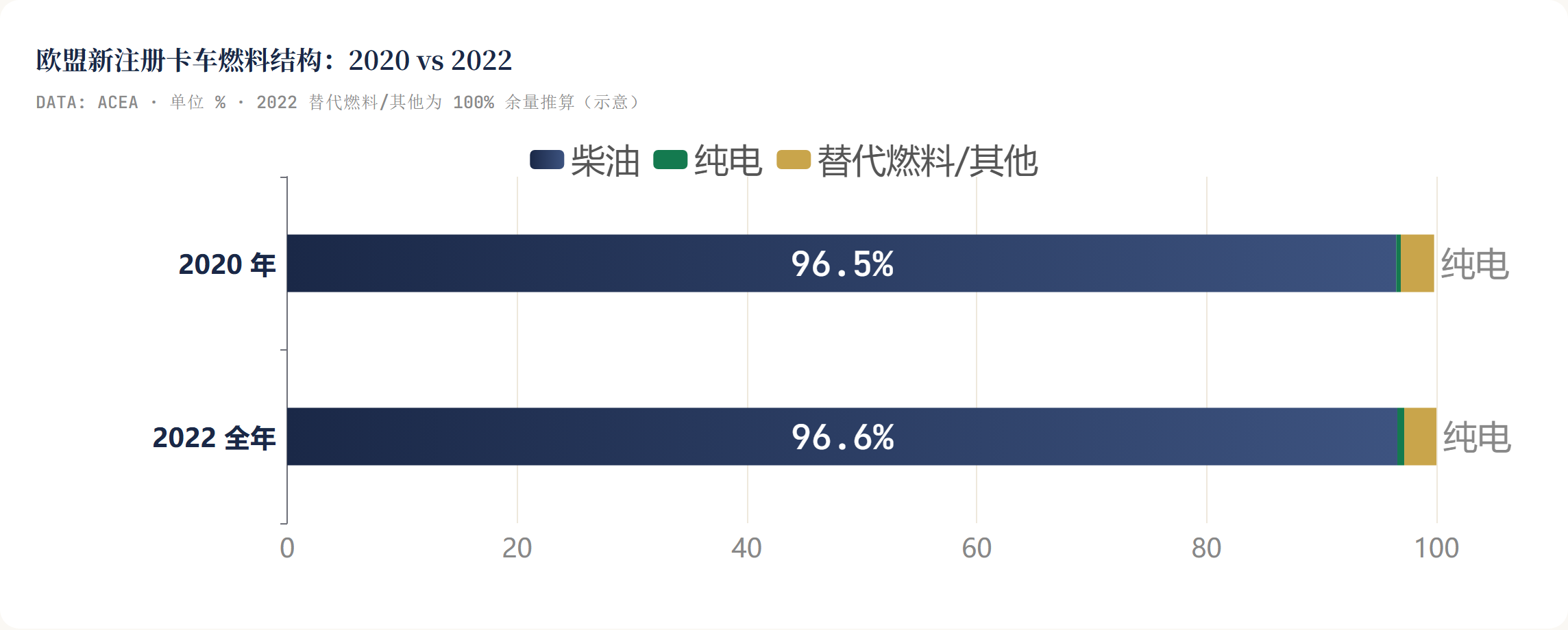
Compared with 2020 to 2022, the pace has indeed changed. The BEV share of new trucks in the EU was 0.4% in 2020 and 0.6% for full-year 2022, while diesel went from 96.5% to 96.6% over the same period, unchanged in two years. Extrapolating the compound annual growth rate of about 22% from those two years, the share in 2025 would only have just exceeded 1%. The actual result was 4.2% for all trucks and 2.0% for heavy trucks, both more than double the old pace. Diesel's share fell to 93.2%, and diesel truck sales fell 8%.
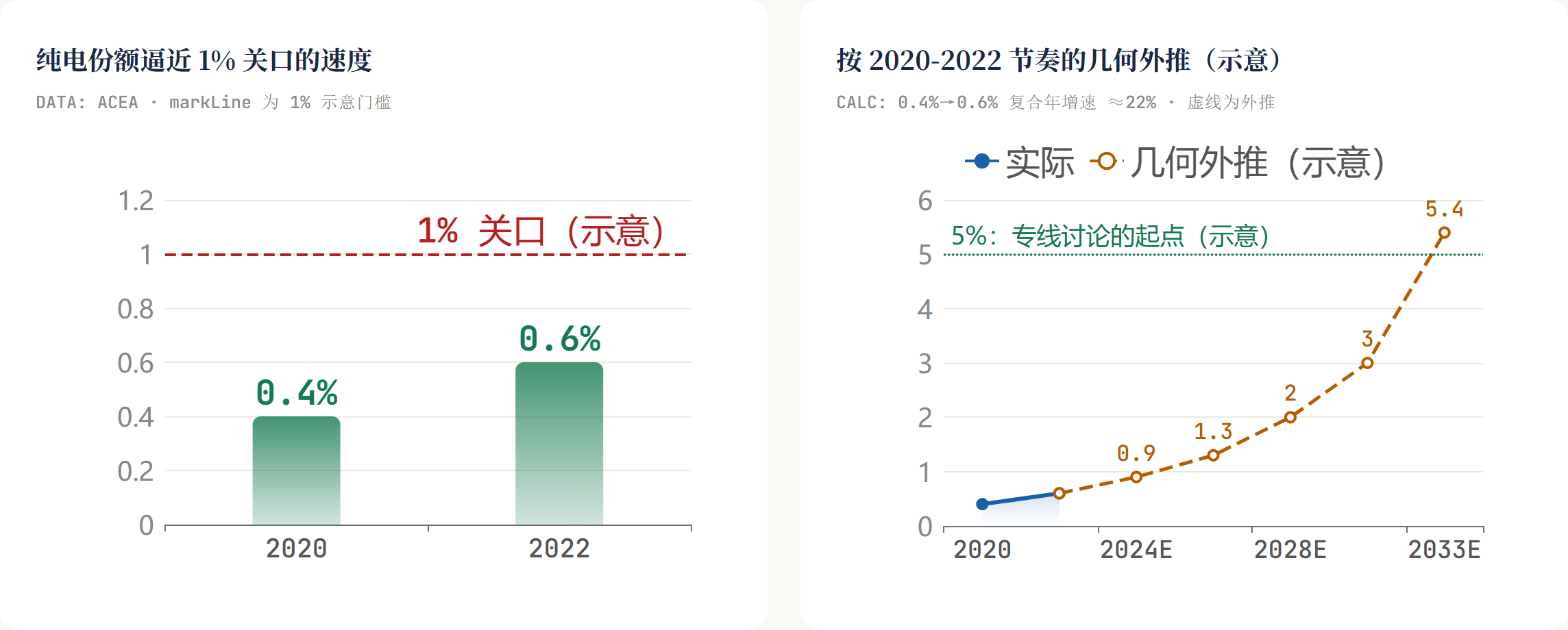
Growth is fast, but from a small base. Filling a dedicated electric heavy truck line requires double-digit penetration. Plug-in heavy trucks grew 51.1% in 2025; if that pace were sustained every year, their share would not pass 10% until around 2029 (assuming a starting point of 2.0%). ACEA's plug-in definition includes both BEVs and PHEVs and is not fully consistent with the BEV-only definition used for 2020 and 2022, but this does not affect the order-of-magnitude assessment.
Shared production lines are a volume forecast
The Angers investment will go toward expanding the existing plant and retrofitting assembly lines; no dedicated electric line is being built. Petrus Sundvall, president of the Angers production company, put it plainly: the plant must prepare for the future and must also be able to adapt to changes in volumes and markets. It can build trucks with either powertrain and handle however customer demand shifts.
The benefit of a shared line is utilization. In months with few electric orders, the line builds diesel trucks, so the plant and workforce stay busy; as electric orders grow, the production mix shifts. The cost is efficiency: a line that handles both high-voltage battery packs and diesel powertrains is worse than a dedicated line on station design, takt time and unit cost. Once electric orders make up most of the volume, this flexibility becomes a capacity bottleneck and another round of investment will be needed.
For suppliers, the implications are concrete. Since OEMs have not committed a dedicated line's output to electric heavy trucks, orders for battery packs, e-axles and high-voltage harnesses will be released month by month in line with end sales, and large long-term volume commitments will be hard to secure. Suppliers who build up stock in anticipation of an "electric heavy truck boom" are taking on risk the OEMs themselves are unwilling to bear.

Customers' numbers don't add up yet
Scania President and CEO Christian Levin set out three conditions: hauliers need the confidence to invest, infrastructure has to be rolled out at scale, and the regulatory framework must support long-term planning. ACEA's full-year 2025 data lists almost the same obstacles: inadequate infrastructure, high energy prices, unfavourable total cost of ownership (TCO) and an inconsistent policy framework.
Hauliers run on thin margins and evaluate a heavy truck purchase over a five- to eight-year total cost horizon. Electric tractors cost considerably more to buy, there is no established benchmark for used residual values, charging waits eat into operating time, and financiers raise interest rates because of residual value uncertainty. If any one of these fails to beat diesel, orders get pushed back.
The gaps between countries show that policy and infrastructure can change the numbers outright. In the Netherlands, total truck registrations fell 40.4% in 2025, yet chargeable trucks grew 205.4%. Germany grew 39.6% and France 30.5%. These three countries account for two-thirds of the EU chargeable truck market. With demand concentrated in a handful of markets, manufacturers can hardly use it to gauge the pace across Europe as a whole.
Lobbying is a fight over timing
Around the time of the expansion announcement, Scania's parent Traton, together with Daimler Truck and Volvo Group, filed a joint motion supporting the US Environmental Protection Agency (EPA) in rescinding the 2009 greenhouse gas endangerment finding and all motor vehicle climate standards. Scania is also lobbying the EU to water down emission rules intended to encourage electric truck production.
The lobbying effort and the joint position expressed in Angers point the same way: electrification will come, but its pace should be set by customers' economics, not unilaterally by regulation. The EU heavy truck CO2 standard requires average new fleet emissions in 2030 to be 45% lower than in 2019. If the regulatory deadline arrives before the customer business case adds up, manufacturers can only push electric trucks out through price cuts and low-interest financing, squeezing the margins premium brands value most. The fact that three leading heavy truck makers co-signed shows this is a shared industry position, not just Scania's view.
This judgement could also prove wrong. Growth in 2025 has already broken away from the old pace of 2020 to 2022. If the rechargeable share of heavy trucks keeps growing by more than 50% in 2026 and regulations do not loosen, the capacity ceiling of shared lines will be exposed first, and rivals that built dedicated lines early will instead gain a per-unit cost advantage. In that case, Scania will have paid extra for a slow pace that never materialised.
A gap for Chinese manufacturers
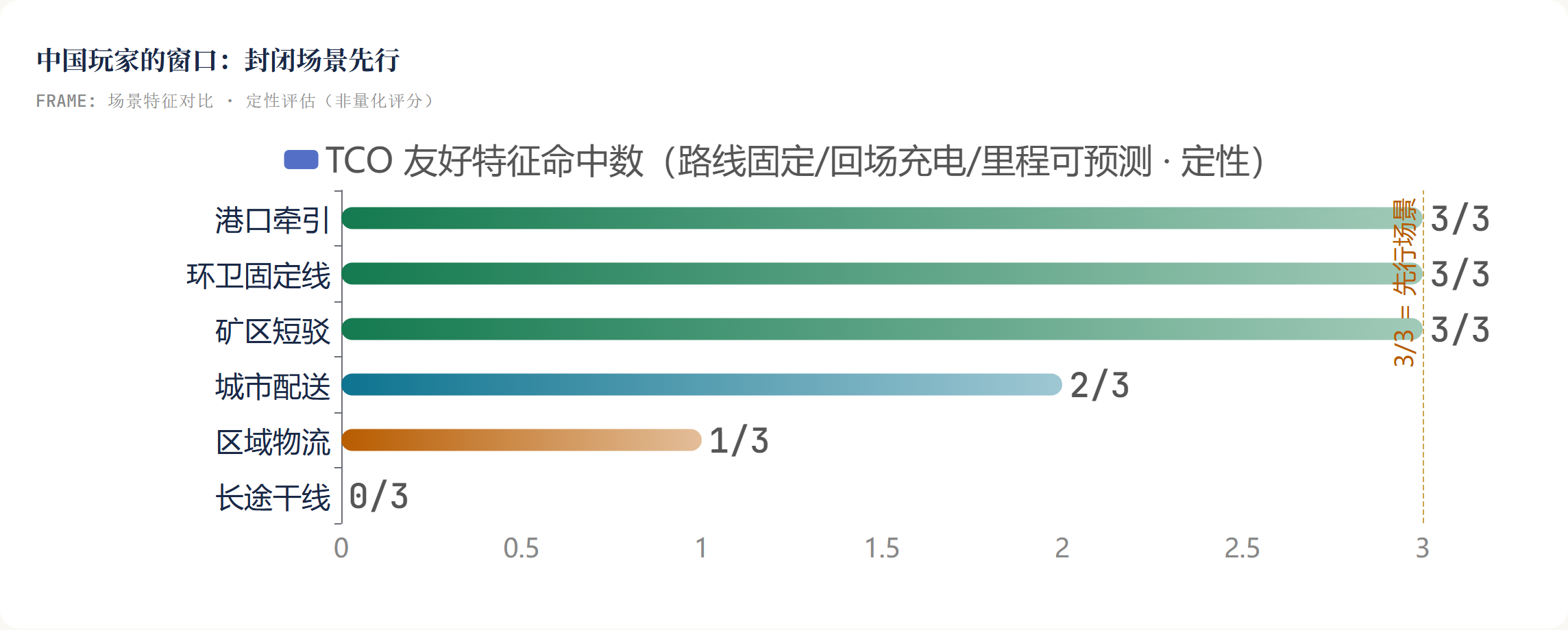
As Scania, Daimler Truck and Volvo Group slow their pace on heavy trucks, the openings are in applications with fixed routes and return-to-base charging: port drayage, refuse collection, urban distribution and short-haul mining shuttles. These vehicles have predictable daily mileage and charge at the depot, so their TCO breaks even first. This is also why the chargeable share of medium trucks could reach 14.9% in 2025. China's electric heavy truck supply chain has built up large amounts of operating data in these applications, and SANY's e263 completed its first deliveries in Germany this year.
The window will not stay open. Scania can raise the electric share on its shared production lines at any time. Once heavy truck penetration passes 5%, domestic brands' service networks and residual value systems will catch up quickly, and latecomers will struggle to find a way in.

Over the next year, three numbers will arrive earlier than any statement: whether ACEA's rechargeable share of heavy trucks in 2026 passes 3%, the share of electric vehicles in total output once Angers starts production, and whether the EU relaxes the 2030 target when it reviews heavy truck CO2 standards in 2027. If the first two rise and the third is not relaxed, Scania will have to build a dedicated electric line in addition to its shared lines.