Europe's robotaxi start: London goes for scale, Luxembourg writes the rules
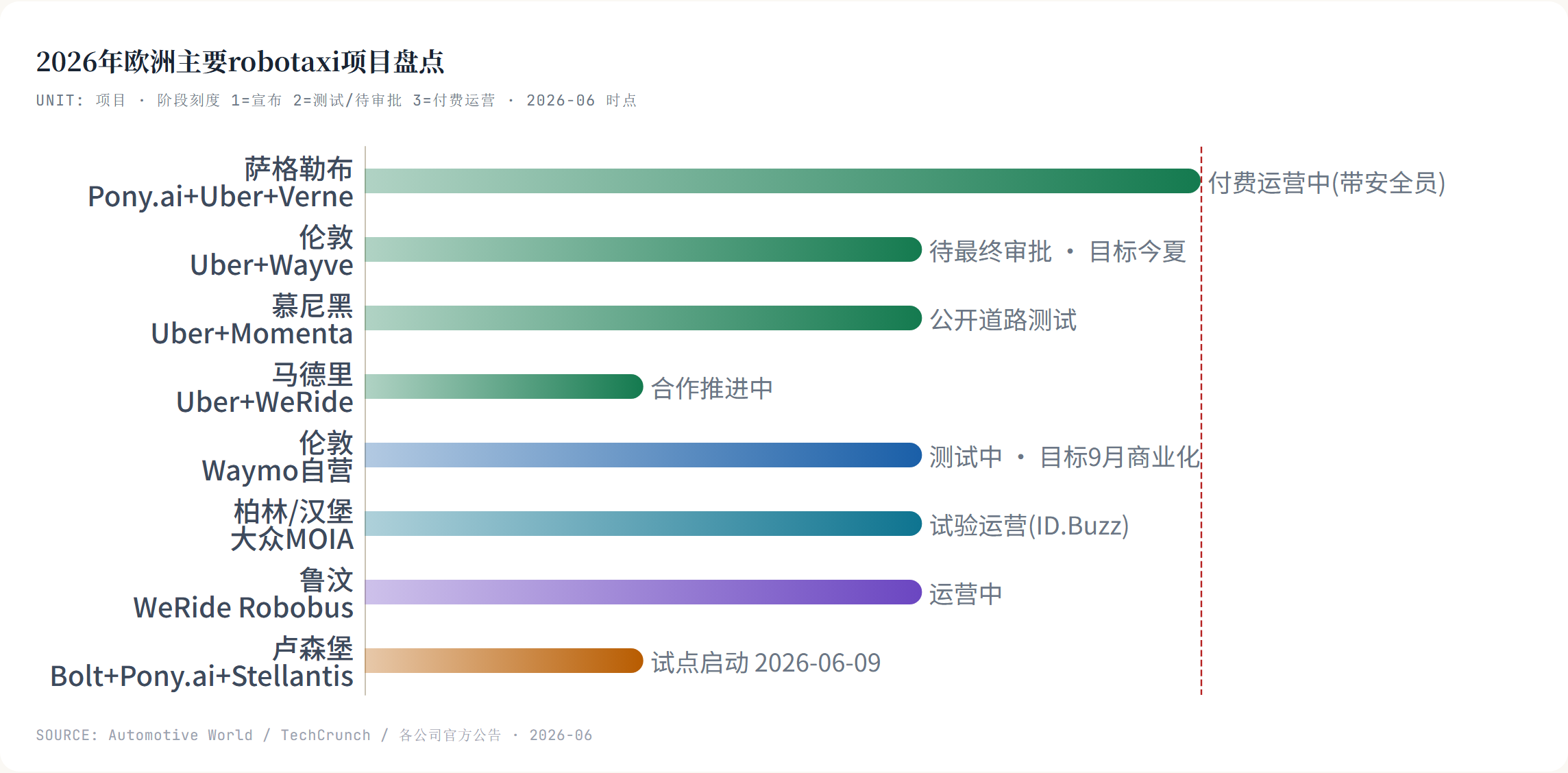
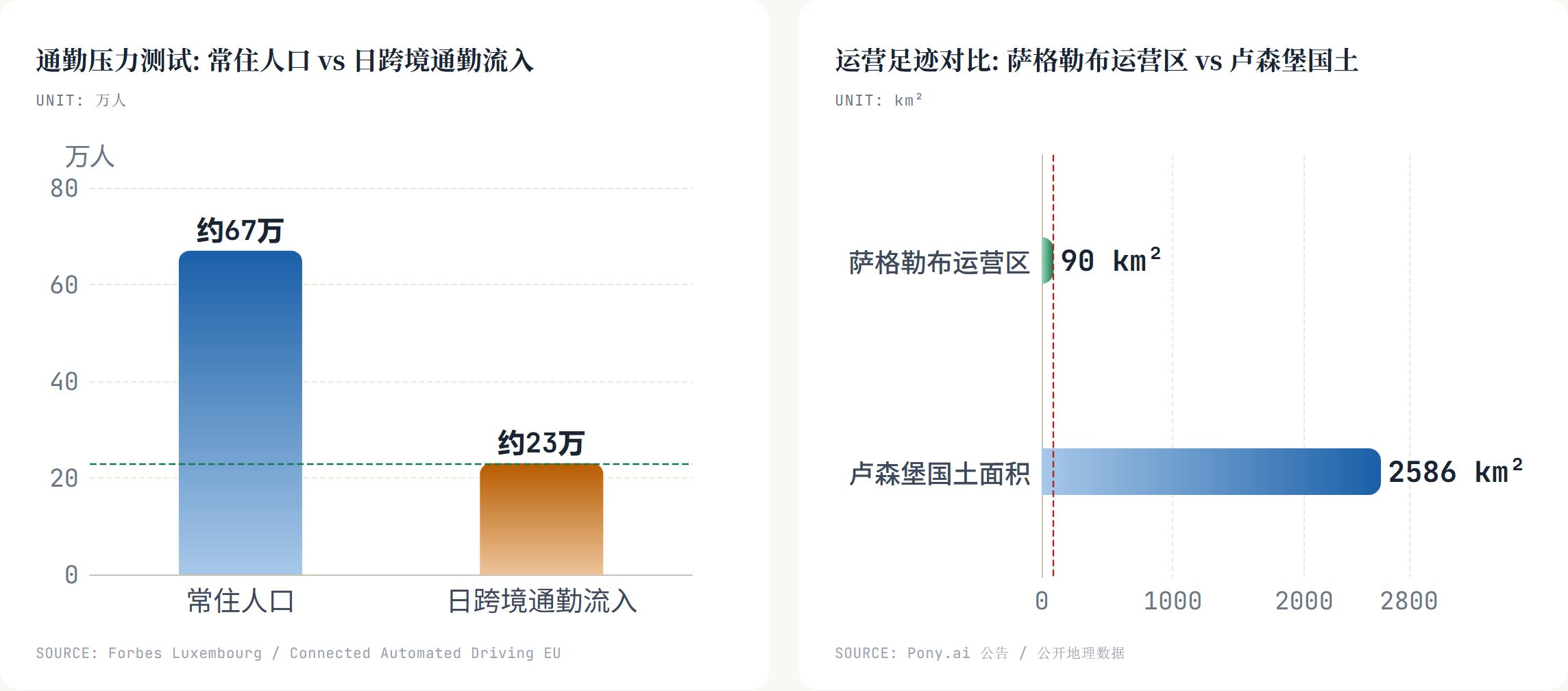
In Jun 2026, autonomous driving in Europe is running along two tracks. London is racing for the first commercial launch: the Uber-Wayve service is in the final stage of approval, and Waymo's fleet of about 100 Jaguar I-Paces has been testing for two months, targeting paid rides from September. Luxembourg is doing something else: on Jun 9, Bolt, Pony.ai and Stellantis announced a pilot in the country of 670,000 people, using Stellantis's L4-ready midsize vans, Pony.ai's Gen-7 system and Bolt's ride-hailing app as the entry point. London's story is about scale, Luxembourg's about rules; the latter will generate no revenue in the short term but may determine who qualifies to operate at scale on the European continent after 2028.
The institutional value of small jurisdictions
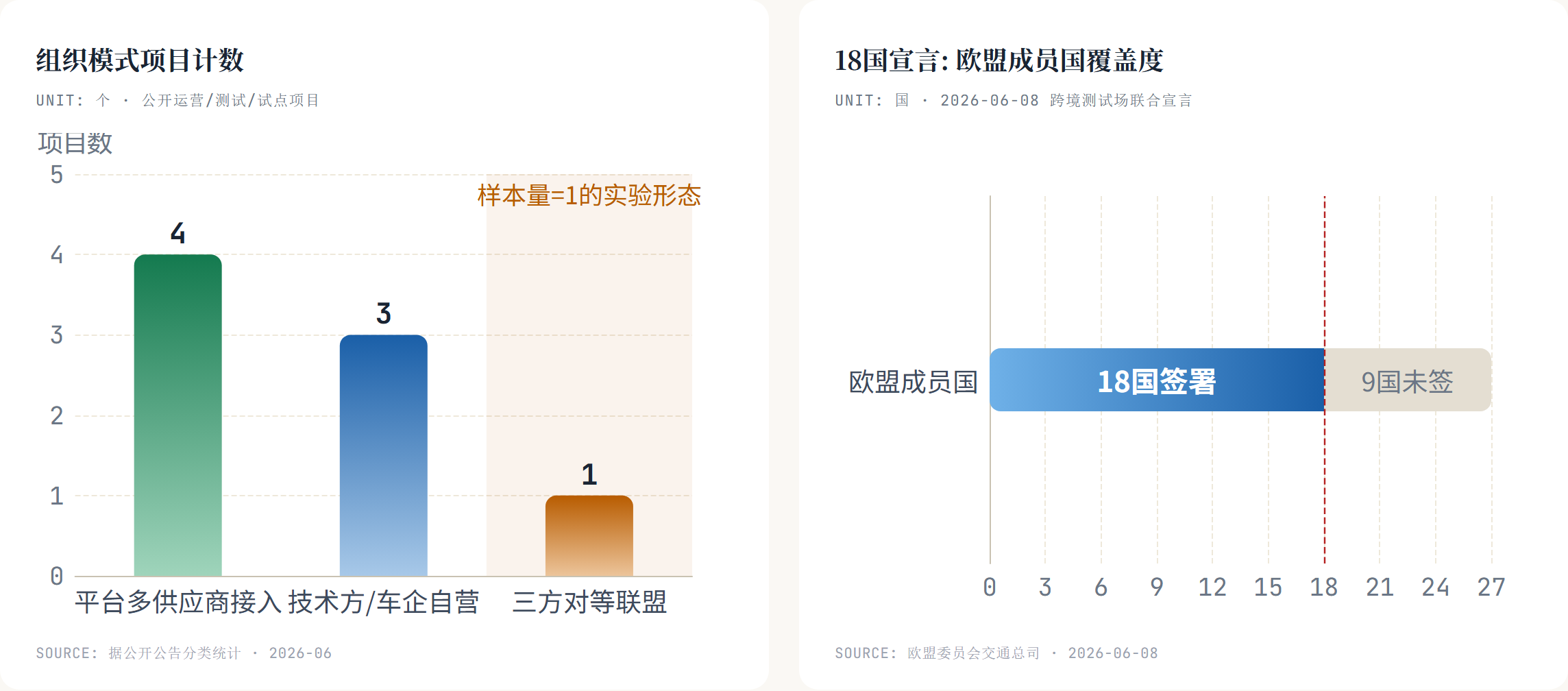
Why Luxembourg is worth a simultaneous bet by three companies lies in its institutional setup. Public transport has been free nationwide since 2020, so the ceiling on the local ride-hailing market is extremely low and commercial returns were ruled out as a motive from the start. That leaves only one motive: a regulatory channel. Twenty-four hours before the pilot was announced, 18 EU member states had just signed a joint declaration on cross-border automated driving test corridors. Luxembourg is a signatory, and the EU has earmarked EUR 20 million in the 2026 Connecting Europe Facility budget for the supporting digital infrastructure. The declaration sets up two workstreams: one coordinating permit approval procedures, the other clustering deployment use cases. Placing the pilot inside a signatory state, in the very first week the declaration takes effect, effectively plugs the project straight into the timeline of an EU-level coordination mechanism.
Geography is a plus. Luxembourg, Metz in France and Merzig in Germany share a tri-national cross-border digital test field. Around 230,000 cross-border commuters a day push peak-hour traffic close to big-city density, and the area has both border road sections and tunnels. For L4 systems that need to prove to regulators that "complex conditions are under control", it is a compact proving ground: small enough that a large fleet is not needed, yet with conditions varied enough to support a safety case.
Expectations for the payback period on this regulatory pathway should be kept low. Between the EU's principles for harmonised approval and mutual recognition of permits lie member states' road safety laws, insurance regimes and remote operation standards; the EU spent more than twenty years on a far less difficult matter, a unified driving licence format. In the near term, what first movers gain from Luxembourg is safety case documentation and procedural fluency in dealing with regulators; only in the longer term can they reuse those materials once a harmonised framework takes shape. The discount period on this investment is measured in years, and companies betting on it need the capital to wait.
The three parties' next moves
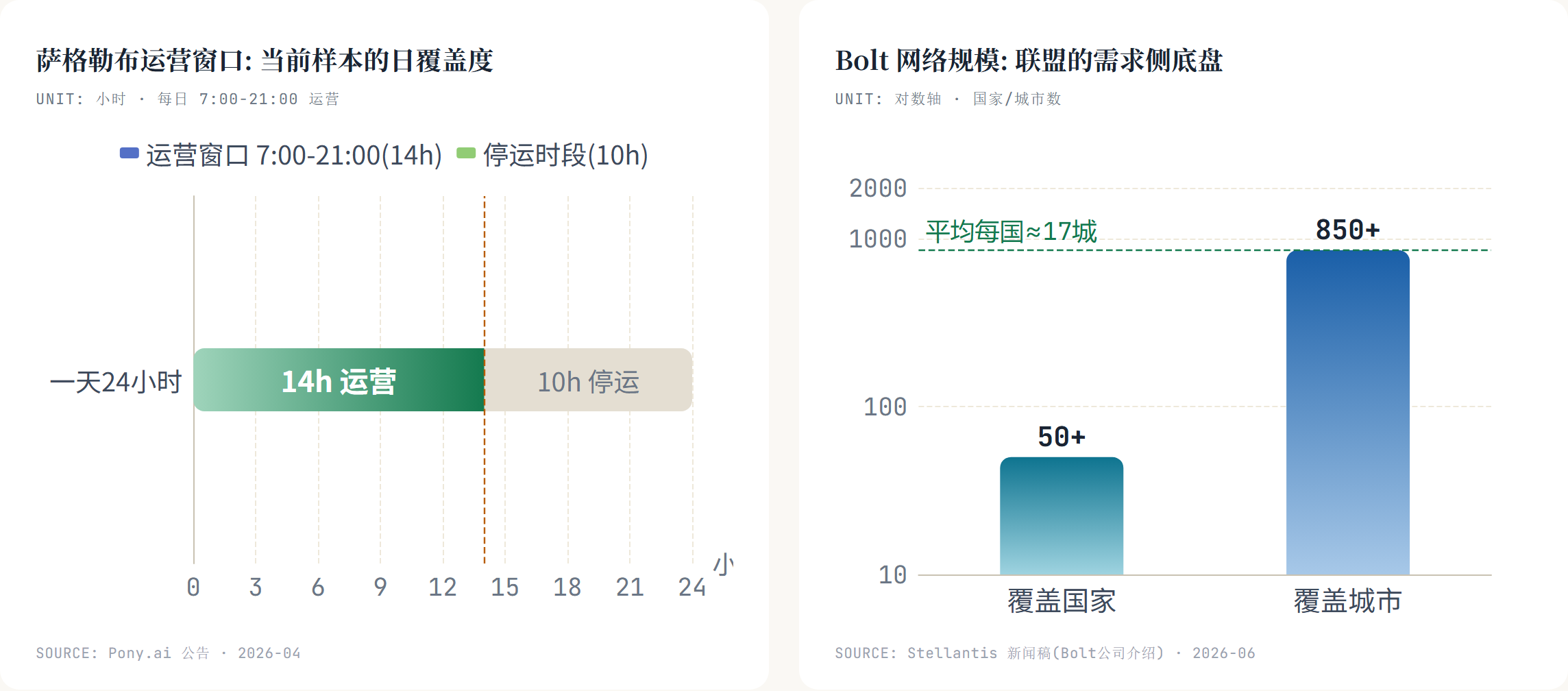
Bolt's situation means it will not stop at one pilot. The platform, which covers more than 50 countries and over 850 cities, has 200 million users and more than 4.5 million drivers, but zero in-house autonomous driving technology. Its most logical route is to copy Uber's multi-supplier playbook: Uber works with Wayve in London, Momenta in Munich, WeRide in Madrid and Waymo in the US, never tying itself to a single technology provider. For Bolt, Pony.ai should be a first interface rather than an exclusive partner. If Bolt announces a second technology supplier within 6 to 12 months, it will show it is following Uber's platform logic; if not, it will suggest its bargaining power within the alliance is weaker than outsiders estimate.
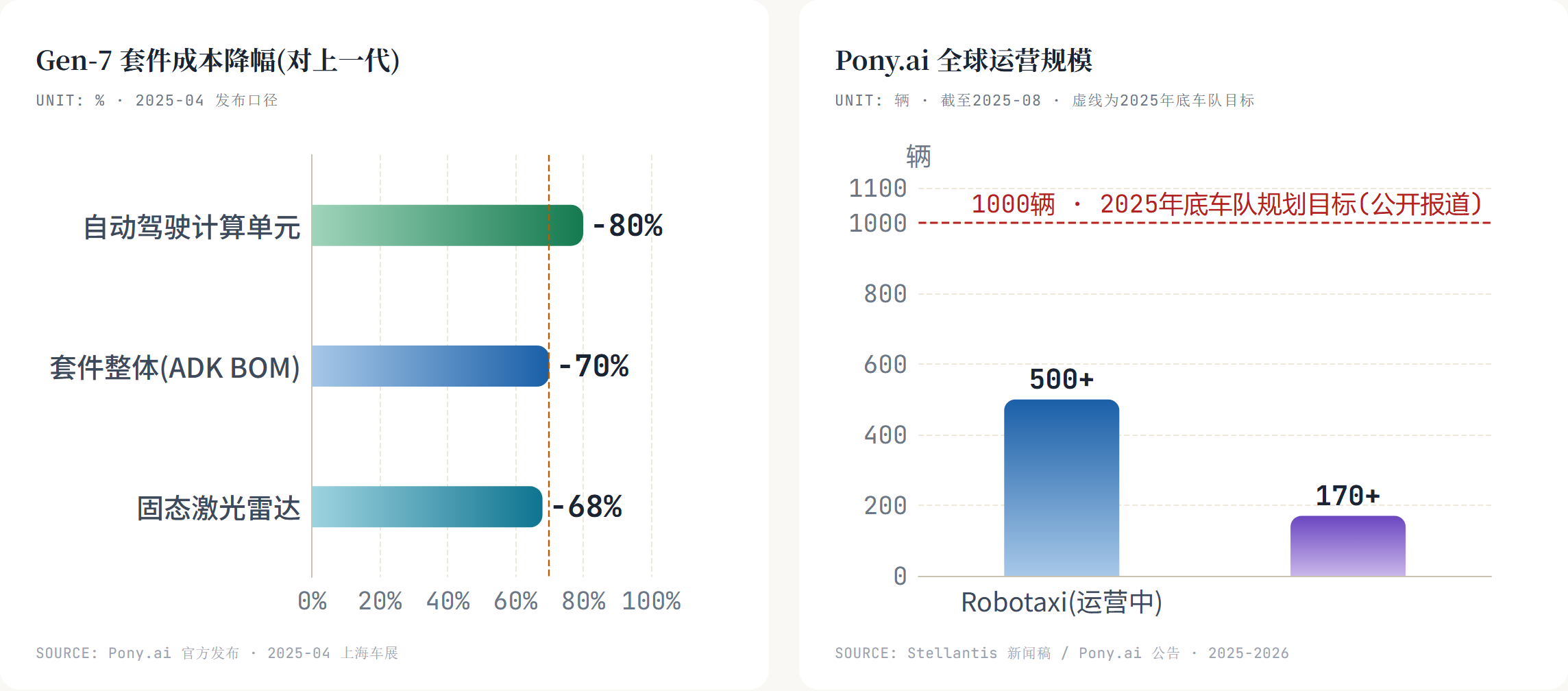
Pony.ai's next step is not in Luxembourg but in bigger cities. Zagreb gave it its first paid operation in Europe (launched Apr 8, 2026, covering 90 square kilometres, running daily from 7:00 to 21:00, with safety drivers on board), and Luxembourg gives it a second jurisdiction and a second platform partner. Behind the pace of two cities in two months is the Gen-7 cost curve: kit BOM cost down 70% from the previous generation, the computing unit down 80% and solid-state lidar down 68%, with the GAC and BAIC versions entering mass production one after the other in mid-2025. What would really change its standing in Europe, though, is winning an operating permit for a defined zone in Germany or France, or bringing a European configuration of the K0-segment van to production readiness. Until then, its identity in Europe remains that of "a foreign technology provider packaged by local partners", and the three hurdles of data governance, cybersecurity review and local legal-entity liability will rise as its operating cities grow larger.
Stellantis's hand is widely underestimated. Its partnership with Pony.ai began with a non-binding memorandum of understanding on Oct 17, 2025, with the Peugeot e-Traveller, seating up to 8, as the first test vehicle. MoUs in the auto industry have a poor track record of being honoured, but Stellantis is only committing marginal cost: Pro One is already a leading manufacturer of light commercial vehicles in Europe, and its van engineering, service network and parts supply are all existing assets. The scenario it is betting on is the moment, 2027 years from now, when a European city or airport issues its first tender for a driverless fleet. Buyers will then compare total cost per kilometre, downtime, service radius and residual value, and vehicle platforms with a track record of operating data will become the default choice. The warning signs to watch are equally clear: in Zagreb Pony.ai uses BAIC's Arcfox, in China it works with GAC, BAIC and Toyota, and Stellantis is just one line on its vehicle list. If Pony.ai's next European city project again uses someone else's vehicles, Stellantis's "platform" narrative will need rewriting.
How alliances of equals die
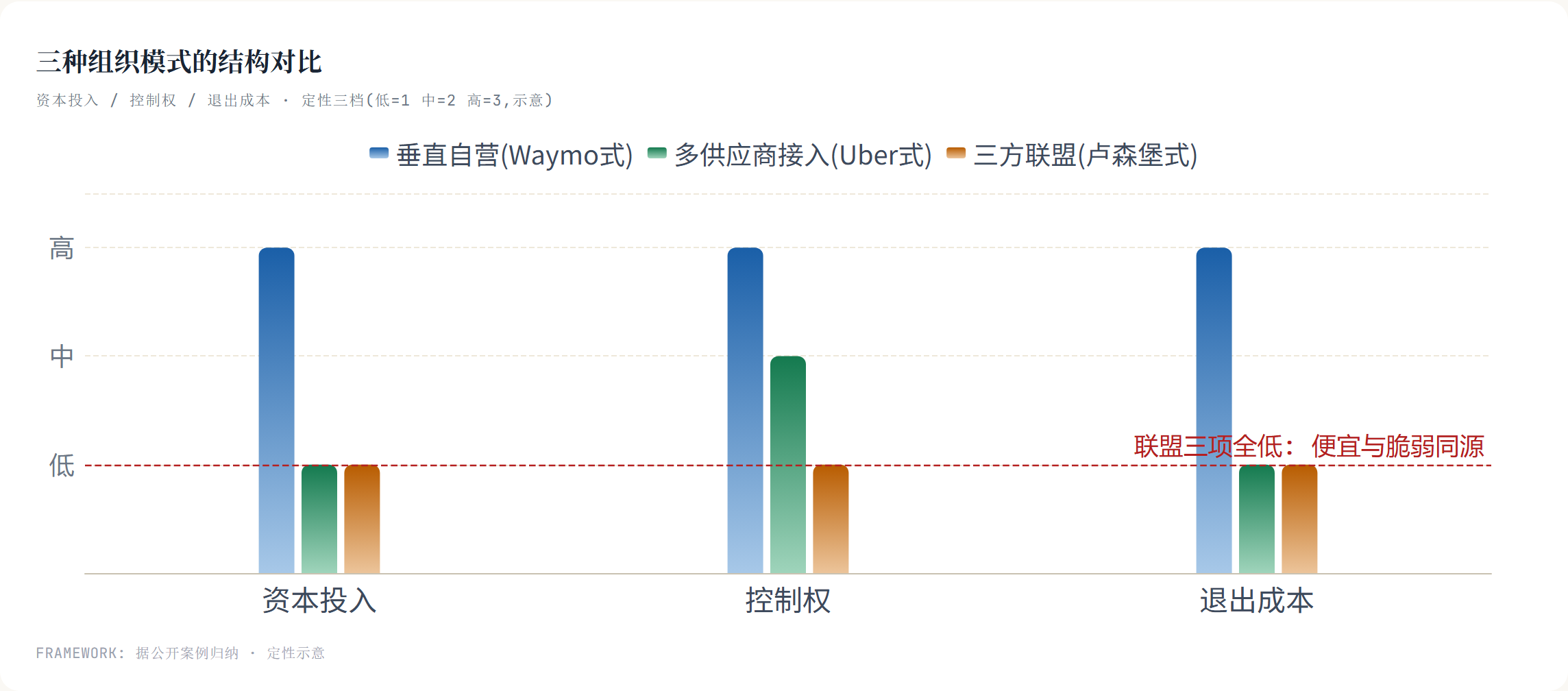
Such equal-partner structures have failed repeatedly over the past eight years, with enough cases to fill a post-mortem report. Argo AI, backed by both Ford and Volkswagen, shut down in Oct 2022; GM stopped funding Cruise's robotaxi business in Dec 2024; BMW and Mercedes-Benz ended their joint development in 2020; Uber offloaded its ATG unit to Aurora in Dec 2020; and Motional, the Hyundai–Aptiv venture, was restructured and slimmed down in 2024. Broken down, the causes of death cluster around three mechanisms. Automakers expect returns on a quarterly earnings cadence while L4 technology matures on a ten-year scale, and the timing mismatch means investors lose patience first. Equal-partner structures have no final decision-maker, so disputes over technology direction can drag a project to death. And a single serious accident can flip the political environment; Cruise's experience in San Francisco is the textbook case.
The Luxembourg partnership avoids the first cause of death: it has no joint venture, nobody is pouring in tens of billions in capital, and the three parties pool existing assets to run operations, so losses are naturally capped. But the flip side of low investment is low commitment: the cost of any party walking away is close to zero. How long this structure lasts depends on whether pilot data can quickly prove the marginal gains for each party, and the Living Lab's four validation stages (vehicle deployment, platform integration, fleet operations, regulatory coordination) are designed precisely so that "each party's gains can be measured separately". The designers have clearly read their predecessors' post-mortems.
The per-kilometer cost lever
The business case comes down to one calculation. Going driverless removes the cost of the driver but adds redundant vehicle hardware, a remote operations centre, HD map updates, cleaning and maintenance, insurance and compliance audits. Whether the numbers add up depends on the denominator: average daily passenger hours per vehicle. For every 10% drop in utilisation, the per-kilometre share of all fixed costs rises noticeably. The Zagreb model still uses safety operators, so it has not fully eliminated driver costs yet carries the full overhead of driverless operation. At this stage every operation runs at a negative gross margin. The contest is over who has the cash flow to keep burning longest and who can remove safety operators fastest.
The utilisation logic points directly to use-case selection. City-wide on-demand hailing requires the strongest generalisation capability and the largest fleet redundancy. Narrow use cases such as airport shuttles, campus commuting and fixed corridors have high demand density and highly repetitive routes, and allow long-term contracts with airport operators or employers, giving vehicle utilisation a built-in floor. Luxembourg's cross-border commuter corridors are a ready-made template. The first profitable robotaxi income statement in Europe will most likely come from a fixed route, not a city-wide network.
Watch list for the next 12 months
Five variables are enough to judge where this game is heading: first, whether Waymo launches commercially in London on schedule in month 9 — it sets the benchmark pace for the vertically integrated, self-operated model; second, whether Bolt brings in a second technology supplier — it shows how exclusive the alliance really is; third, whose vehicles Pony.ai uses in its next European city — a direct test of Stellantis's platform narrative; fourth, whether the permit workflow under the 18-country declaration produces its first harmonised approval document within the year — it determines when a "compliance track record" can be monetised; fifth, when Zagreb removes safety operators — it will be Europe's first real sample of unit economics.
For Europe's robotaxis, 2026 has no final — only qualifying rounds. London is racing on speed to commercialisation, Luxembourg on the thickness of its regulatory dossier, and both tracks converge at the same point: when major European cities start issuing geofenced operating permits after 2027, whose safety case, operating data and local governance structure will pass review straight away. Only then will the full value of today's pilots be priced.