2026 outlook for new energy passenger cars in Europe
If Europe's EV debate in 2023–2024 was still about "policy targets" and "penetration curves", then in 2026 the market…
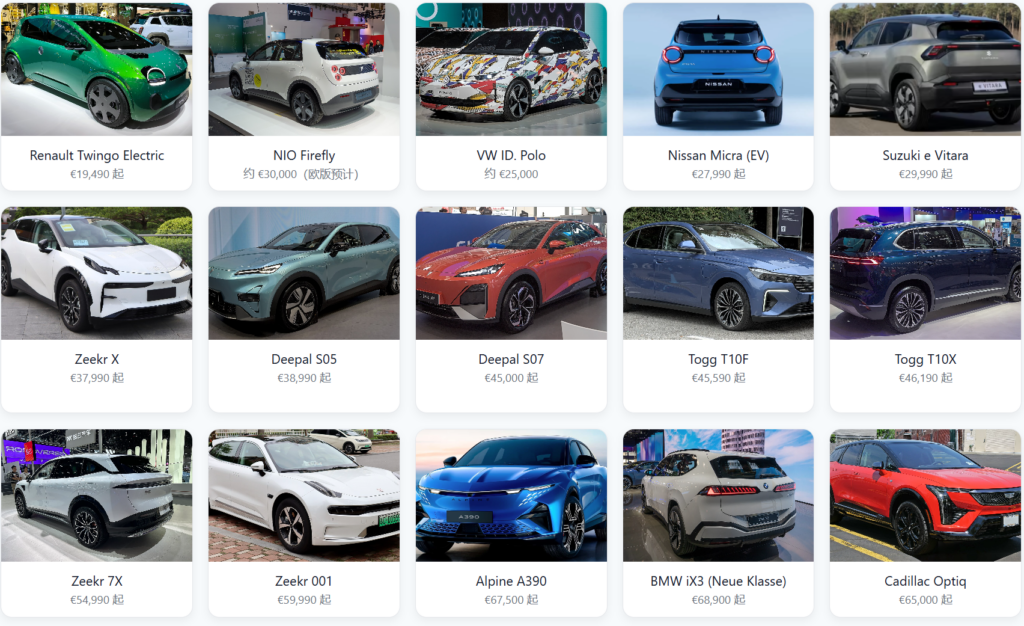
If Europe's EV debate in 2023–2024 was still about "policy targets" and "penetration curves", by 2026 the market's focus has clearly shifted to a more practical question: across price segments in Europe, what do EVs actually offer consumers?
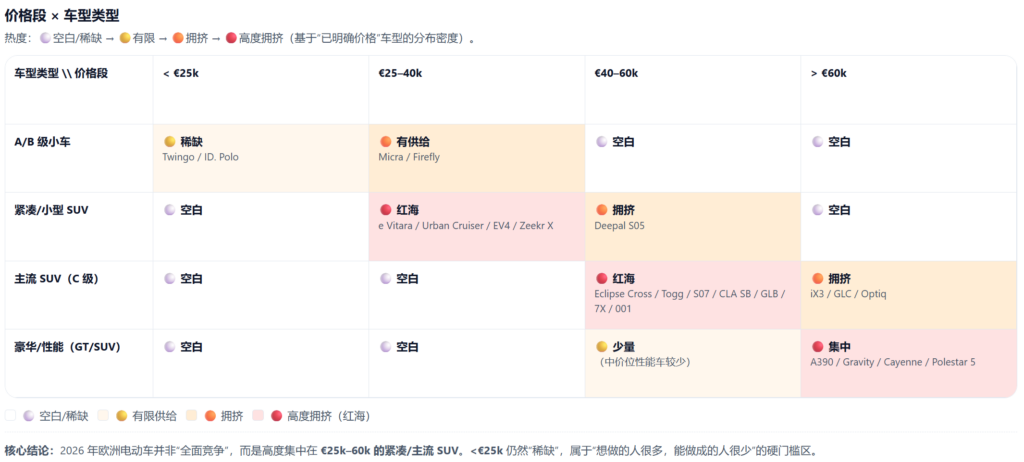
Judging by the models already confirmed for launch around 2026, the European EV market is forming a very clear price–specification–model structure, and it is within this structure that Chinese brands are gradually revealing their positioning.
Under €25,000: the scarce entry-level EV
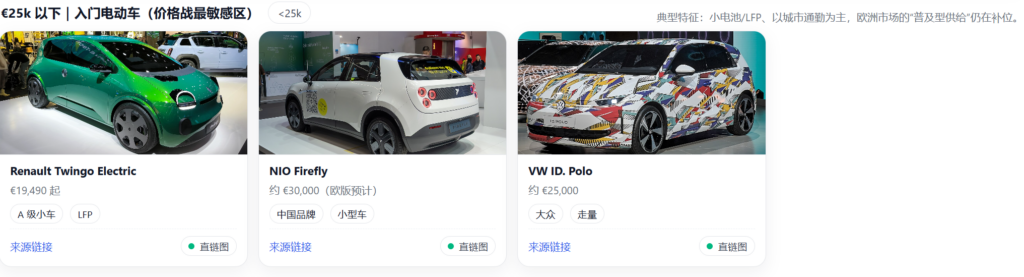
In Europe, this price band remains the segment with the least supply and the most discussion. Few models have been confirmed so far:
- Renault Twingo Electric
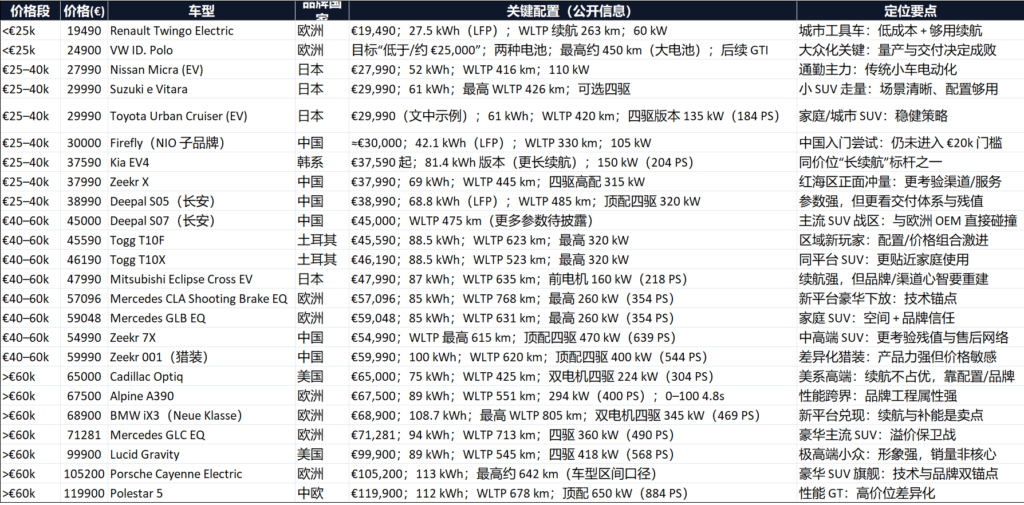
Starting price approx. €19,490, 27.5 kWh LFP battery, WLTP range approx. 263 km, 60 kW motor
Clear positioning: a city runabout, not an "all-round family car" - Volkswagen ID. Polo (
target price around €25,000, two battery options, up to about 450 km WLTP, with a GTI version to follow)
This is the key product in Volkswagen's attempt to "bring EVs back to the mass market"
Yet Chinese brands are almost entirely absent from this price segment. The only clear attempt so far is NIO's Firefly, but its price is still around €30,000, not truly in the €20k range.
It is not that "nobody wants to build" sub-€25000 models for Europe; rather, under the triple constraints of European compliance, cost and mass production, they are extremely hard to pull off.
€25,000–40,000: the main battleground in 2026
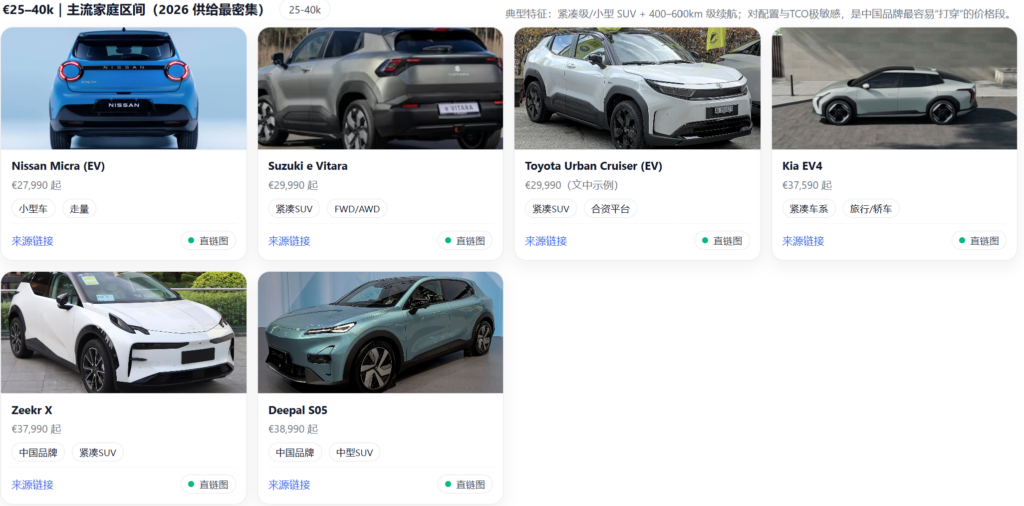
This is the price band with the highest model density and the fiercest competition, and the one closest to the "typical family's first EV". European, Japanese and Korean brands are heavily represented:
- Nissan Micra Electric: from €27,990, 52 kWh battery, 416 km WLTP
- Suzuki e Vitara: from €29,990, 61 kWh battery, optional AWD, 426 km WLTP
- Toyota Urban Cruiser: from €29,990, 61 kWh, 420 km WLTP
- Kia EV4: from €37,590, 81.4 kWh battery, up to 590 km WLTP
Chinese brands are starting to appear noticeably in this price segment:
- Zeekr X: from €37,990, 69 kWh, 445 km WLTP, top AWD trim 315 kW
- Deepal S05: from €38,990, 68.8 kWh LFP, 485 km WLTP, top-trim AWD 320 kW
- NIO Firefly: approx. €30,000, 42.1 kWh, 330 km WLTP
**This is the price range where Chinese brands and European OEMs clash most directly. In this segment, **the marginal benefit of spec-sheet advantages is shrinking fast, and consumers are paying more attention to insurance, residual values, after-sales networks and financing.
€40,000–60,000: cutthroat competition among mainstream SUVs
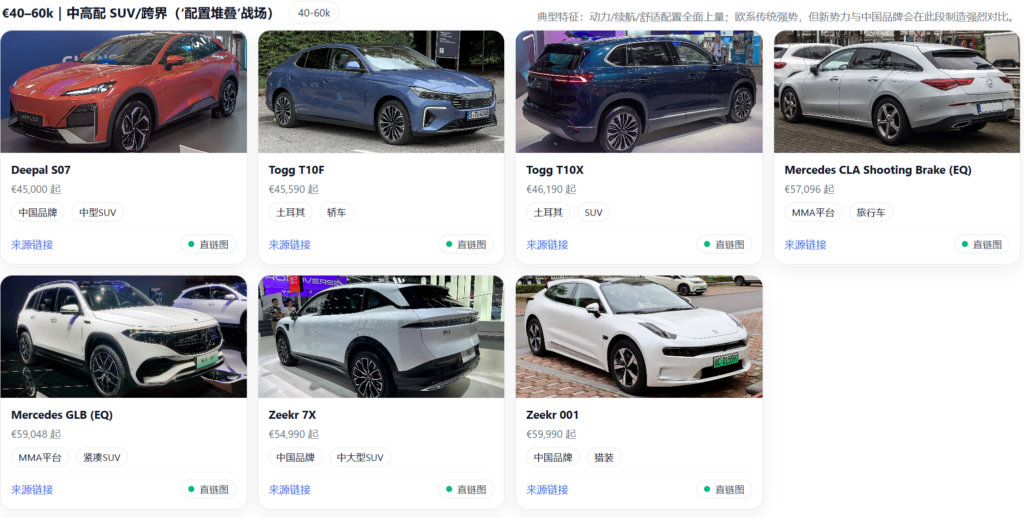
In this price band, models cluster markedly in C-segment SUVs, crossovers and shooting brakes.
Representative models include:
- Mitsubishi Eclipse Cross Electric: from €47,990, 87 kWh, 635 km WLTP
- Togg (Turkey) T10F / T10X: from €45,590 / €46,190, 88.5 kWh, 523–623 km WLTP
- Deepal S07: from €45,000, 475 km WLTP
- Mercedes CLA Shooting Brake (BEV): from €57,096, 85 kWh, 768 km WLTP
- DeepalZeekr 7X: from €54,990, up to 470 kW, 615 km WLTP
This is the segment where everything "looks strong but won't necessarily sell well". In reality, prices are approaching those of traditional premium brands, user expectations have risen significantly, and brand trust is starting to outweigh spec sheets.
Above €60,000: luxury, performance and brand
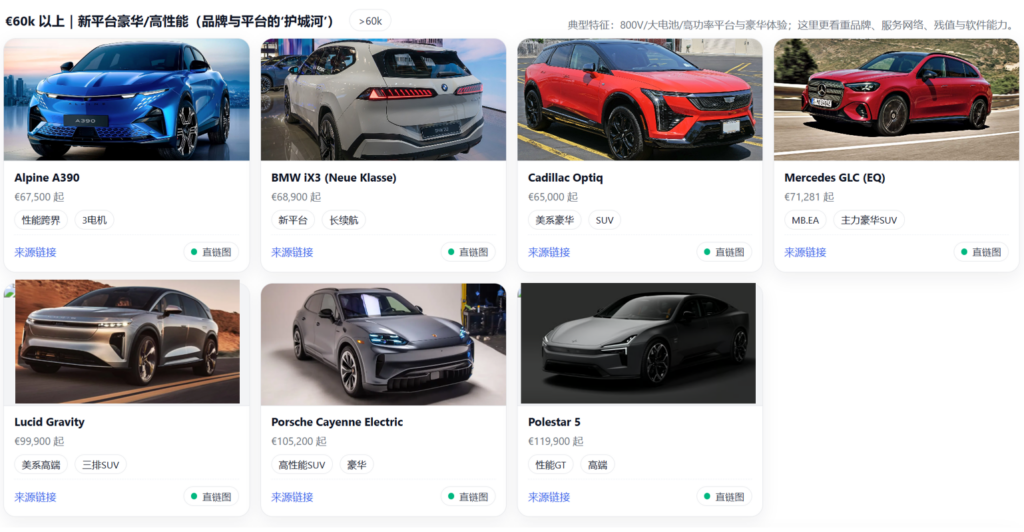
Models in this price segment are not meant to drive mass adoption. What is known so far:
- BMW iX3: from €68,900, 108.7 kWh, up to 805 km WLTP
- Mercedes GLC EQ: from €71,281, 94 kWh, 713 km WLTP
- Porsche Cayenne Electric: from €105,200
- Polestar 5: from €119,900
- Lucid Gravity: from €99,900
- Alpine A390: from €67,500
Chinese brands are present here too (e.g. Denza Z9GT, top-spec Zeekr), but they serve more as brand showcases and technology anchors than as volume drivers.
EV competition in 2026
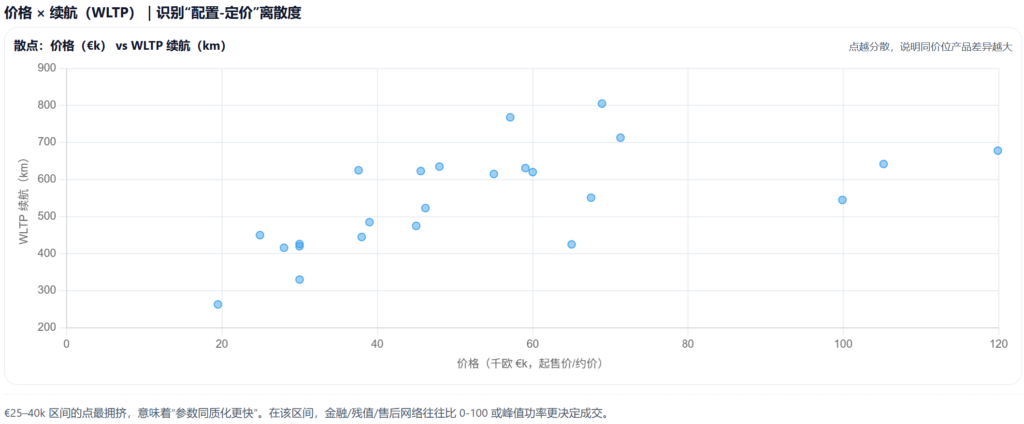
By price segment and model, the European EV market in 2026 shows three very clear trends:
- What really drives penetration is the €25000–40000 segment, not premium models
- Chinese brands are not "sweeping the market on price"; they are heavily concentrated in the most crowded mid-priced SUV segment
- Entry-level EVs and utility models are, by contrast, a structural opportunity, but an extremely difficult one
2026 won't lack new EVs. What it lacks are "ordinary models" that make product, delivery and business model work together at the right price point.
Reproduction or excerpting without permission is strictly prohibited. Questions and comments are welcome. Follow us for ongoing analysis of the latest developments in China and abroad.