Europe's battery industry shake-out: are the home players the first to go?
A counterintuitive story is playing out in Europe's battery industry: localization policies meant to protect European companies are eliminating Europe's own battery makers first. Meanwhile, Chinese companies, cast as a foreign "threat", have gained market share rather than lost it.
A counterintuitive reality is playing out in Europe's battery industry: localisation policies were meant to protect European companies, yet the first to be eliminated are Europe's own battery makers. Chinese companies, long treated as a foreign "threat", have gained rather than lost ground. From Northvolt's bankruptcy filing in Sweden in Mar 2025, to Stellantis booking a EUR 2.1 billion loss in Feb 2026, to the successive bankruptcies of Morrow Batteries and Enerpoly in May, the pace of elimination is still accelerating.
The flagship didn't fall for lack of money
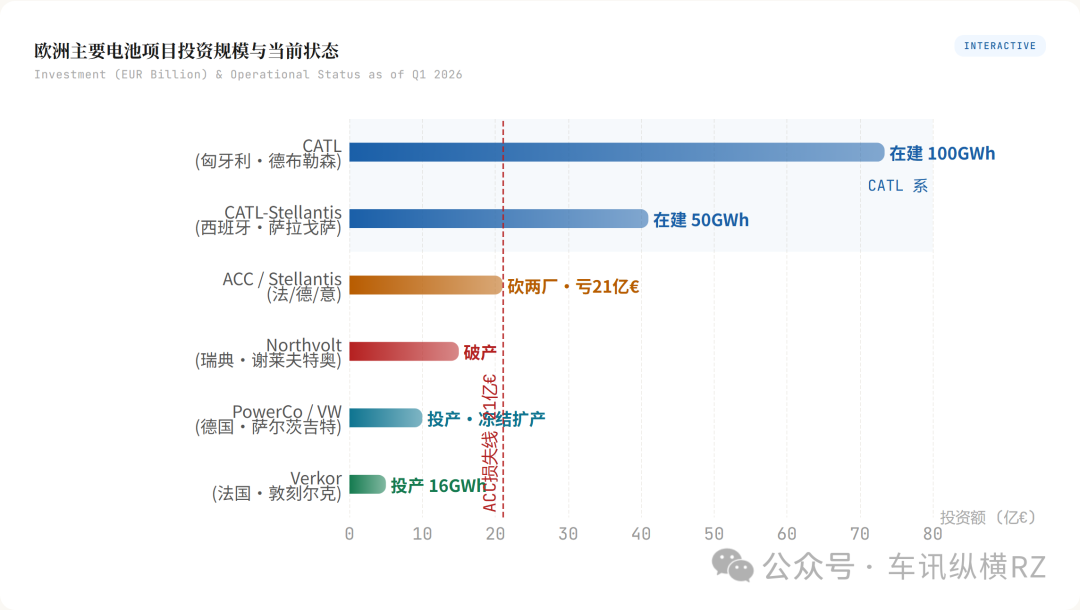
Northvolt's bankruptcy was the most symbolic event in European industry in 2025. The Swedish company had been hailed as Europe's "battery champion", raised more funding than any European peer, and counted investors from Volkswagen to Goldman Sachs to the European Investment Bank. Yet in Mar 2025 it filed for bankruptcy in Sweden. Five months later, US start-up Lyten took over all its remaining assets in Sweden and Germany at a low price.
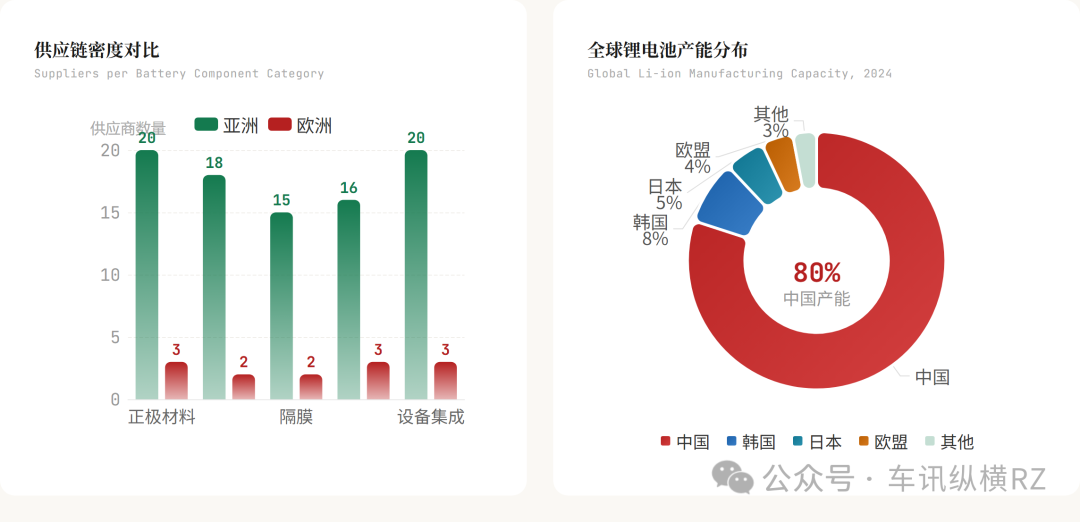
Northvolt's own post-mortem revealed key details: production line yield improved by 50% from Sep 2024, and operating cash outflow was cut by 55%, but progress could not keep pace with the cash burn. The problem was that Europe's battery supply chain is far less dense than Asia's.
On Feb 27, 2026, US start-up Lyten announced it had completed its full acquisition of Northvolt Sweden for about USD 500 million (SEK 4.5 billion), taking over assets including the main Northvolt Ett plant, Ett Expansion and the Labs R&D building. Lyten then set up the "Lyten Industrial Hub" in Skellefteå, pledging 600 new jobs within 12 months, and announced it would restart commercial cell sales in the second half of 2026. Initial capacity of 16 GWh will supply its own BESS energy storage plant in Gdańsk, Poland (formerly Northvolt Dwa). In March, Lyten went on to acquire the Revolt battery recycling assets and announced it would launch a new plant in Heide, Germany (the site Northvolt had originally chosen) in 2028.
However, Lyten is betting on lithium-sulfur batteries, a completely different chemistry from Northvolt's existing NCM technology, and the existing production equipment and processes have not been carried over wholesale. In essence, this is a fresh start after liquidation.
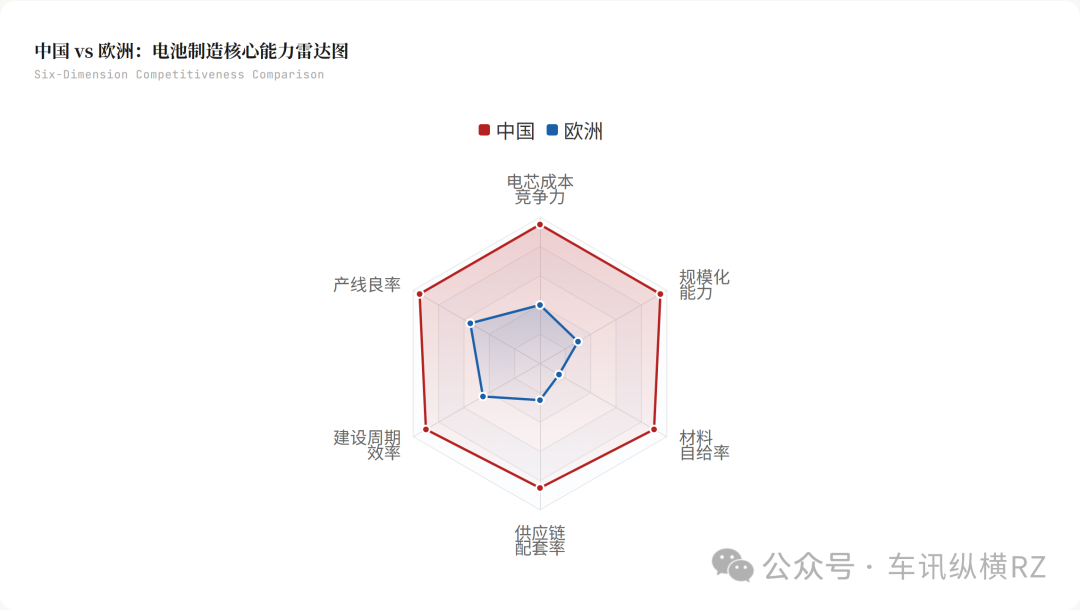
In Europe, each battery component typically has only 2 to 3 suppliers, while in Asia there are as many as 20 comparable suppliers. With only 3 cathode material suppliers, a capacity fluctuation at one of them can halt an entire production line. With 20 options in Asia, buyers can push down prices, switch suppliers and introduce new processes at any time. The same applies to the speed of yield ramp-up, the slope of cost reductions and the pace of process iteration.
ACC pivots to Asia
ACC was jointly launched by Stellantis and Mercedes-Benz. Its French plant began production in 2023, with initial capacity of more than 13 GWh. The original plan was to build on high-nickel NCM chemistry and replicate the expansion in Germany and Italy, creating a European battery platform on the scale of 40 GWh. But mass-production yields of NCM cells never reached target, forcing the company to bring in Chinese technical experts from CATL to help with commissioning, while shifting its strategic direction to lower-cost LFP chemistry.

LFP already accounts for nearly half of EV batteries globally, and close to three-quarters in China. The problem is that ACC's entire investment logic, equipment selection and upstream supply base were designed around the NCM route. Changing the chemistry turns a large share of the upfront investment into sunk costs.
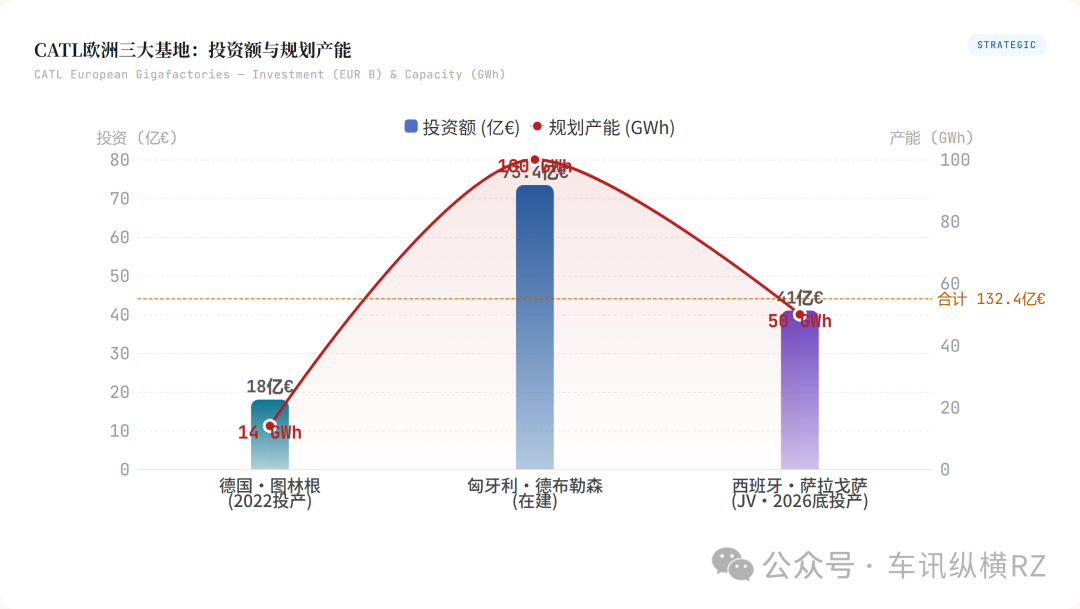
The outcome came in Feb 2026: Stellantis scrapped ACC's two gigafactories in Kaiserslautern, Germany, and Termoli, Italy, booking a EUR 2.1 billion write-down. That same month, Stellantis signed a deal pointing in a completely different direction with CATL: a 50:50 joint-venture plant in Zaragoza, Spain, with investment of up to EUR 4.1 billion and planned capacity of 50 GWh, due to start production by the end of 2026.

One of Europe's largest automotive groups paid EUR 2.1 billion to admit its in-house battery cell strategy had failed, then committed EUR 4.1 billion to a Chinese partner. The "European champion" narrative now holds together.
Volkswagen PowerCo: merely surviving
Northvolt died of supply chain density, ACC died of betting on the wrong chemistry, and PowerCo has chosen proactive retrenchment. Volkswagen's PowerCo is currently the project with the most complete industrial base in the European camp. Its Salzgitter plant officially started mass production of the unified cell in Dec 2025, with initial annual capacity of 20 GWh, enough for about 250,000 electric vehicles. The first models to use it include the ID. Polo, Cupra Raval and Skoda Epiq, meaning PowerCo is already supplying series-production vehicles within the development cycle.
But PowerCo also made a telling choice: it paused construction of the second production line and dropped its original target of expanding to 40 GWh.
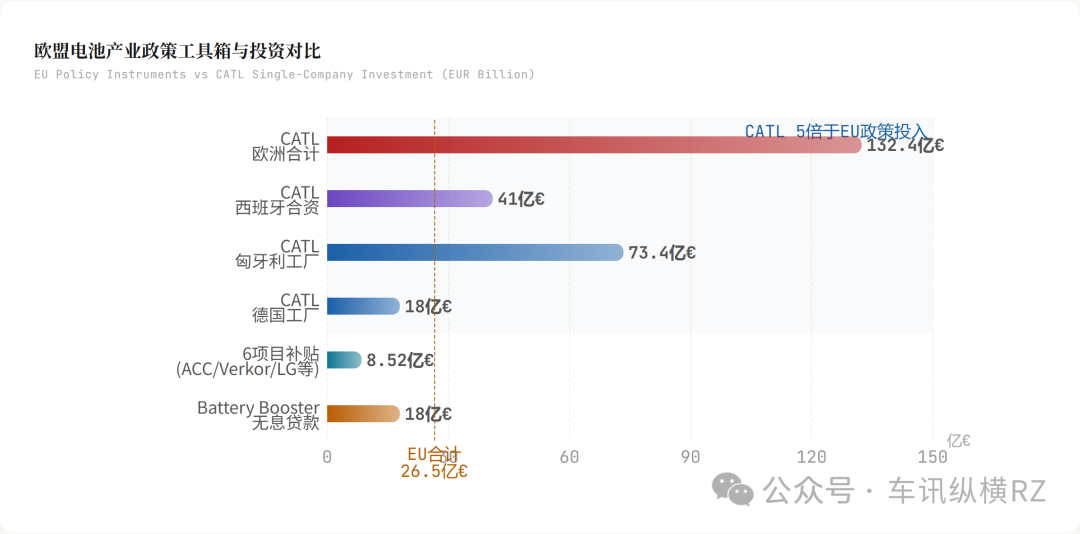
Comparing the three: Northvolt bet on independent financing and died from a lack of supply-chain density. ACC bet on high-nickel NCM and was ruled out as LFP went mainstream. PowerCo took a third path, tying its first-line capacity to production vehicles already in development and trading certain orders for room to survive while delaying second-line expansion. Stellantis, meanwhile, spent €4.1 billion to buy straight into CATL's supply chain, embedding LFP capacity into its own system through a joint venture. PowerCo's "alive but cautious" approach is the only one that has not yet been declared a failure.
China's European chess game: CATL becomes a European company
CATL's European footprint now forms a locked-in triangle. Its plant in Thuringia, Germany, started production in 2022, with planned total capacity of 14 GWh and investment of up to EUR 1.8 billion. The project in Debrecen, Hungary, involves investment of EUR 7.3 billion and planned capacity of 100 GWh, making it one of the largest under construction in Europe. In Q1 2026 the plant officially began cell production; its first-phase 40 GWh capacity is fully booked by BMW, Stellantis and Volkswagen. By the end of Q1 it had produced more than 120,000 battery module sets, supplying more than 30,000 EVs in Europe, and its workforce had risen to 1,500. Together with the joint venture with Stellantis in Zaragoza, Spain (EUR 4.1 billion/50 GWh), the three plants anchor supply nodes in Western, Central and Southern Europe. In Nov 2025, CATL also broke ground on its own in Zaragoza, with investment of about EUR 4.04 billion (including EUR 300 million in EU subsidies), targeting start of production by the end of 2026 and designed as a fully carbon-neutral plant.
BYD has also put boots on the ground: at the end of January 2026, its plant in Szeged, Hungary, began trial production, with volume production due in Q2. Annual capacity is about 200000 units, and the first model is the Dolphin Surf. Chinese companies' integration into Europe has moved up a level, from "building factories" to "building ecosystems". Estimates put the 2025 global market share at 39.2%, with installations of 465 GWh. BYD follows closely with a 16.4% share and 195 GWh installed. LG Energy Solution ranks third with 9.2% and 109 GWh. At this scale, Europe's independent home-grown battery start-ups are not even in the race.
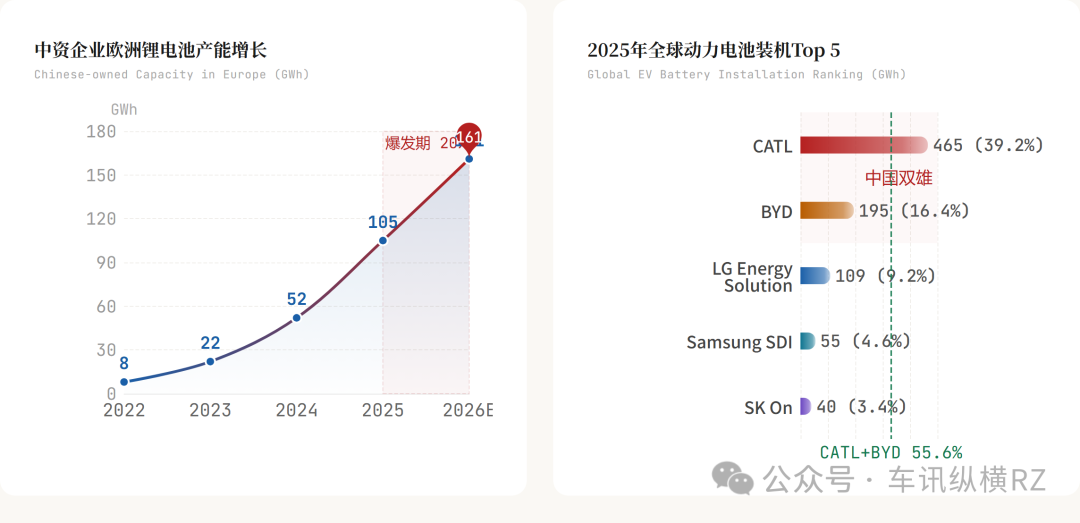
The mass arrival of Chinese companies is bringing even bigger change. By 2026, Chinese-owned lithium battery capacity in Europe is expected to reach 161 GWh, 20 times the 2022 level and about 14% of Europe's total lithium battery capacity. Gotion High-Tech, Sunwoda, EVE Energy, BYD: these names are appearing in industrial zone planning documents across Europe at an unprecedented pace.
In practice, therefore, "European battery localization" is turning into "Chinese batteries localized in Europe". From a policy perspective the two look contradictory; from an industrial perspective they are entirely consistent. As long as companies meet carbon footprint declaration requirements (in force from Feb 18, 2025), traceability audits and local content rules, it makes no difference where they are headquartered.
The real winners
The biggest beneficiaries of this round of battery industry restructuring are not any battery company but the OEMs that control end demand. Volkswagen has tightly linked cell design to its vehicle platforms. Stellantis has brought LFP supply in-house through joint ventures. France's Verkor opened its first gigafactory in Dunkirk (16GWh) in Dec 2025, tied to the Renault group. ACEA data show the European auto industry provides 13.2 million jobs, including 2.4 million in manufacturing, accounting for 7% of total EU employment. Whoever controls battery supply holds the advantage in the contest for pricing power within this vast employment system.
Policy bottom line: security matters, but not at the cost of self-harm
Whatever leverage OEMs have comes essentially from EU policy restraint. On Dec 16, 2025, the European Commission formally adopted the Battery Booster strategy, worth EUR 1.8 billion in total: EUR 1.5 billion in zero-interest loans targeted at battery cell manufacturers, aimed squarely at the core pain point of supply-chain funding gaps, plus EUR 300 million for critical raw materials projects. Adoption is one thing, implementation another: since Feb 2026, the first disbursements have been stuck in inter-service coordination between the industry commissioner and the climate commissioner (who controls the Innovation Fund budget) and have still not been released. An inconspicuous exemption clause in the Industrial Accelerator Act says more about EU policymakers' real logic than the EUR 1.8 billion: if local-content requirements cause delays of more than seven months or cost increases above 30%, member states can opt not to apply them.
ANALYSIS · In depth
Localization's greatest irony
Localisation policies aimed at "de-Sinicisation" are pushing the European market deeper towards Chinese technology. Locally made battery cells in Europe cost about EUR 9-11/kWh more than imports from China, a structural gap across the entire manufacturing system.
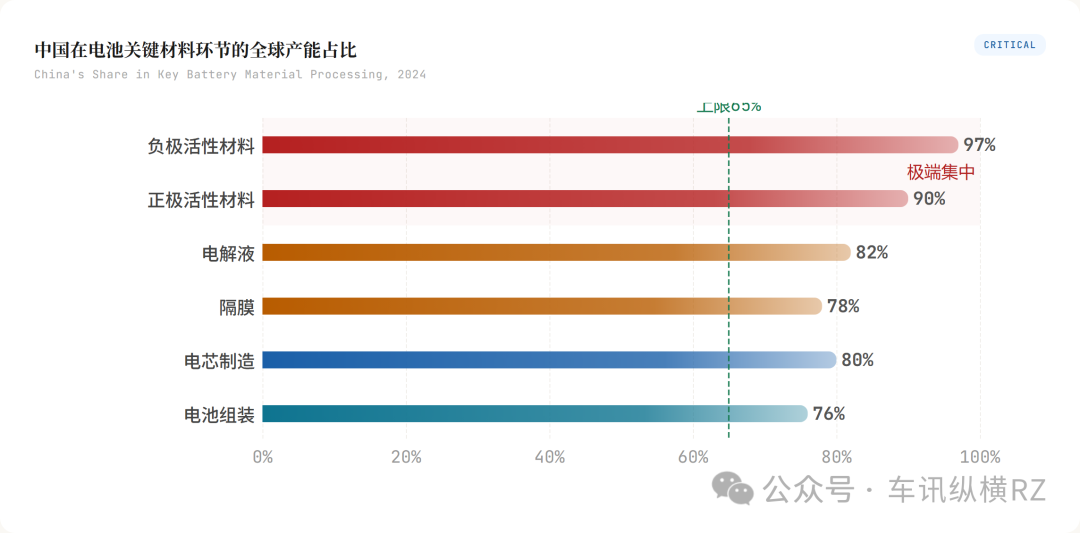
Estimates suggest that if China stopped exporting battery cells, EV plants worldwide would face losses of USD 17 billion a month, with EU plants bearing more than half. China also holds nearly 90% of global cathode active material capacity and more than 97% of anode active material capacity. Against upstream dominance on this scale, "complete de-Sinicization" is not a workable policy option but a rhetorical device.
The phase-out order is already set
Who exactly is European battery localisation weeding out? The first to go is Europe's home-grown middle tier, which has neither China's cost advantage nor locked-in demand from OEMs, as Northvolt has already shown.
Only two kinds of players will stay at the table: Chinese leaders that have embedded themselves in European manufacturing, and OEMs that use batteries to lock in the competitiveness of their vehicle platforms. What Europe ultimately gets is not a "de-Sinicised" battery industry, but a hybrid system in which Chinese technology is deployed within the European regulatory framework.
On May 6, 2026, Norway's Morrow Batteries ASA filed for bankruptcy, running out of cash just months after starting commercial production; in the same month, Swedish start-up Enerpoly also declared bankruptcy. From Northvolt (Mar 2025) to Morrow and Enerpoly (May 2026), the pace of failures has shortened from quarterly to monthly. All three share the same traits: relatively small scale, no deep ties to an automaker, and independent financing. This is not a chance chain of collapses but the repeated playing-out of the same structural logic.
Chinese companies will also see sharp divergence among themselves. Those able to bring technology, supply chains, compliance and local relationships with them will become "European industrial players" within three to five years; those stuck in an export mindset will quickly be marginalized. What Europe ultimately gets will not be a "de-sinicized" battery industry, but a hybrid system in which Chinese technology and manufacturing capability take root within the European regulatory framework.
The cruelest part of this knockout round: the first to fall are all Europe's own.