The EU's 2035 battle: relief for combustion cars, with the bill passed to the grid
The row over the EU's 2035 combustion-engine ban has reached a showdown. In month 12 last year the Commission rolled out its "Automotive Package", hoping flexibility would give carmakers some breathing room, but it instead split member states into two camps. While most are still picking sides between the environment and the economy, a fresh grid study shifts the question elsewhere: EVs are the missing energy-storage piece in Europe's energy transition. Relaxing the rules for combustion cars yields illusory savings; the bill merely shifts from carmakers
The fight over the EU's 2035 combustion engine ban has reached a showdown. The Commission's "automotive package", unveiled last 12, was meant to give automakers breathing room through flexibility, but instead split member states into two camps. While most are still choosing between the environment and the economy, a new grid study has shifted the question: EVs are the missing storage piece in Europe's energy transition. Easing rules for combustion cars produces illusory savings; the bill merely moves from automakers to the grid.
The grid bill: an extra €4 billion a year
A study by Fraunhofer ISI for Transport & Environment is the first to translate the "relaxation" into hard costs for the power system. T&E is an environmental group that strongly backs keeping the targets, and this is a scenario analysis it commissioned, so it is safer to read it as advocacy material; nor do grid costs fall entirely on EVs, as heat pumps, industrial electrification and data centres are also driving up demand. Even after these two discounts, the direction of the conclusion holds.
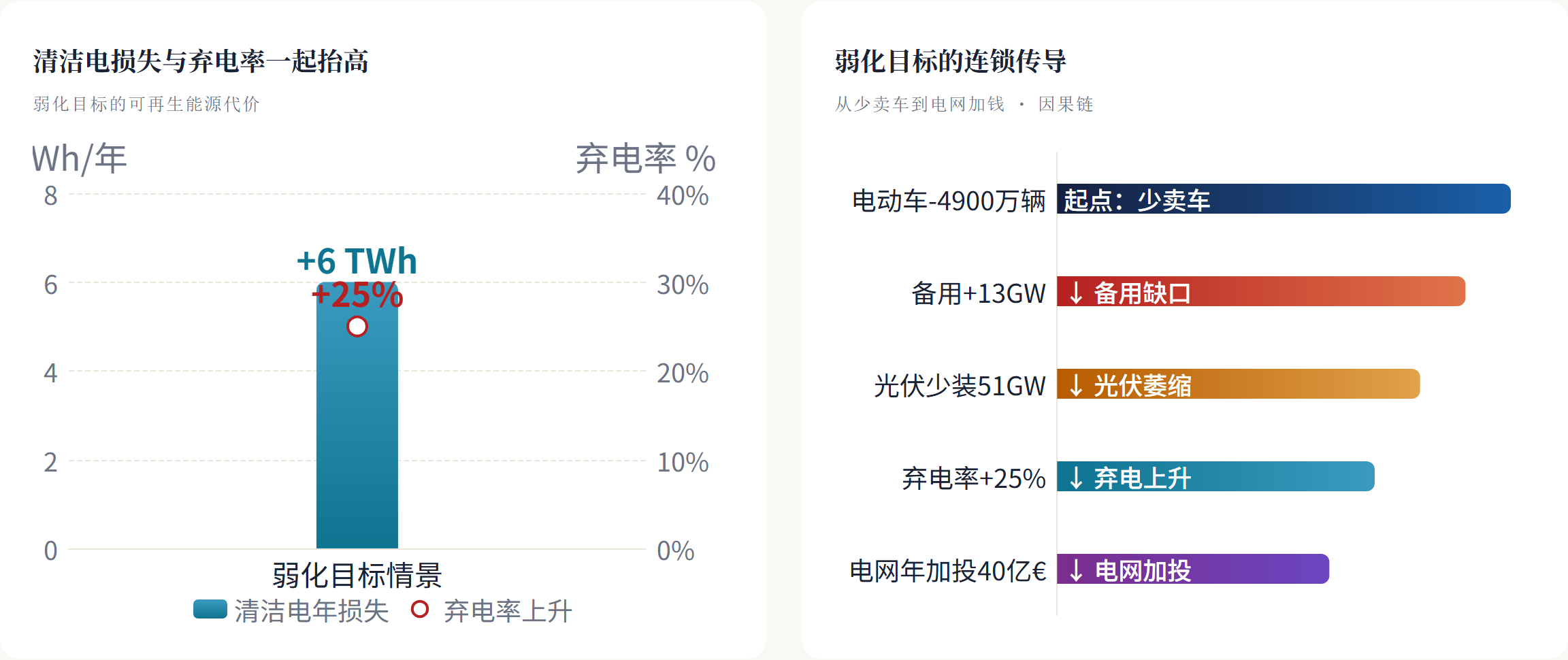
The study assumes targets are weakened as ACEA demands, resulting in 49 million fewer electric vehicles on Europe's roads by 2040. Those vehicles also represent a lost slice of continent-scale energy storage. EV batteries can absorb surplus power during wind and solar peaks and feed it back to the grid during demand peaks. Without this buffer, the grid's capacity to absorb green power drops sharply, and wind and solar output has to be curtailed at generation peaks.
EVs are the grid's "continental-scale sponge"; loosening the rules amounts to removing that sponge
49 million EVs could have absorbed surplus power into their batteries at peak wind and solar output and fed it back at peak demand. Without them, the grid's capacity to absorb green power drops sharply: wind and solar output has to be curtailed at peak generation, curtailment rises by 25%, and 6 TWh of clean electricity is wasted every year. Pressure on grid investment does not come from cars alone, as heat pumps and industrial electrification are also driving up demand, but EVs are the most readily available source of additional flexibility: they grow naturally with the vehicle parc, sit at the end point of consumption, and need no dedicated siting or construction. In other words, every additional EV sold with bidirectional charging gives the grid another unit of free distributed storage; every one not sold leaves that gap to be filled by centralised, fossil-fuelled peaking plants that require costly new construction. This is the central line of logic that pulls the debate back from climate morality to the balance sheet.
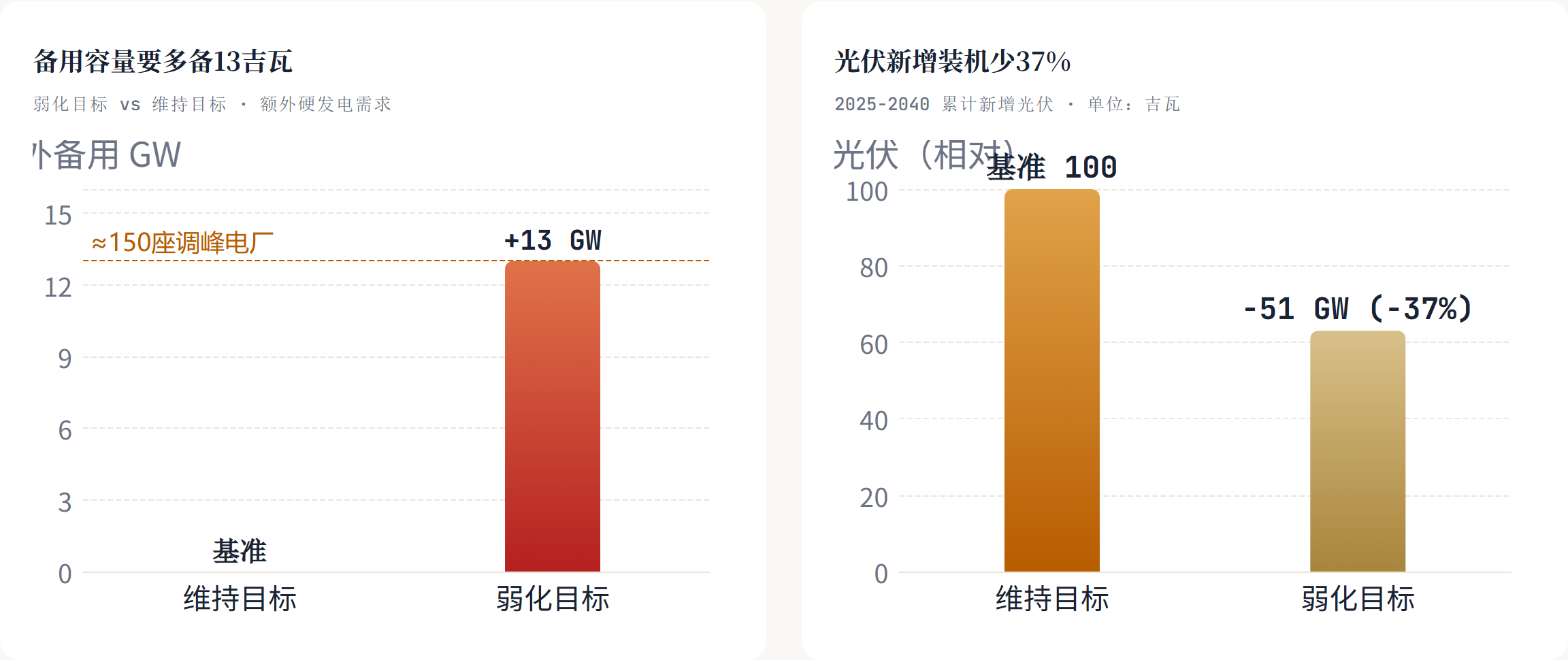
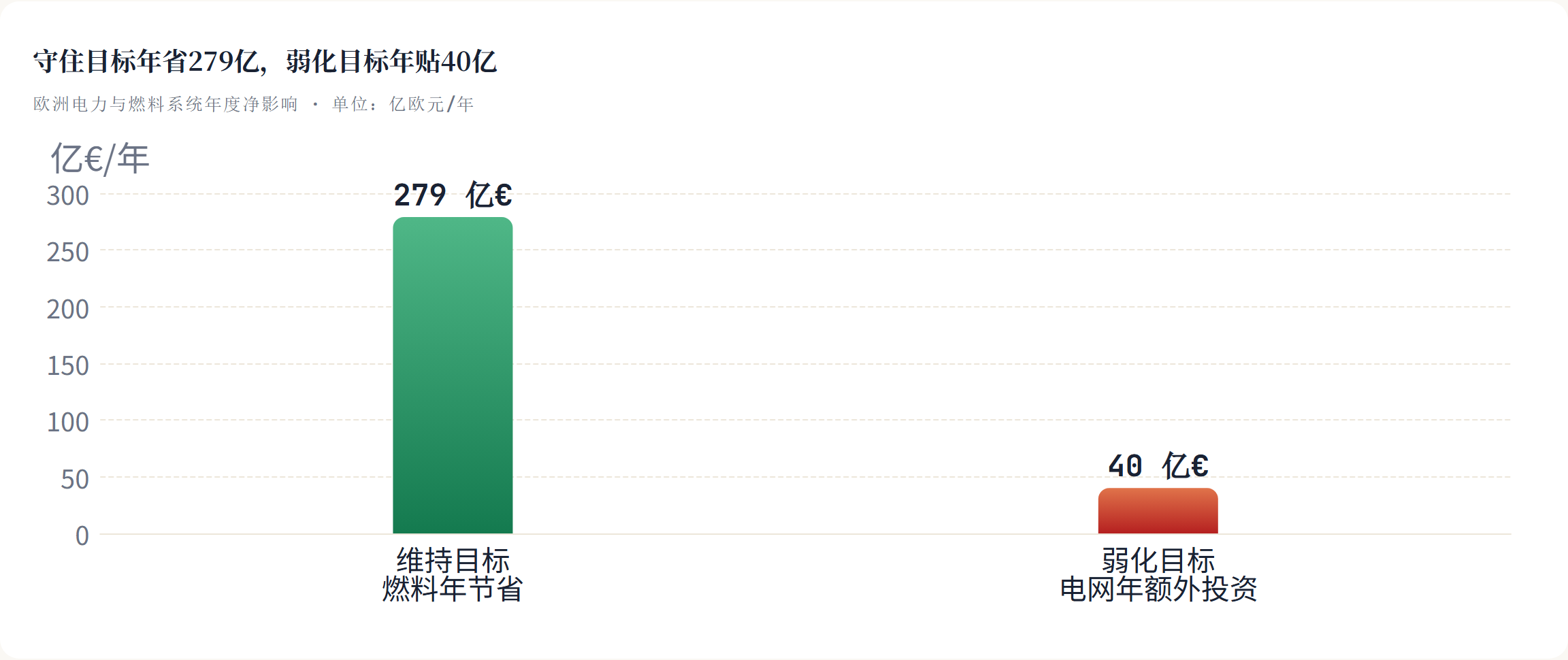
The costs cascade. Without battery buffering, the grid must rely on firm generation to cover peaks, requiring an extra 13 GW of capacity, equivalent to 150 more peaking plants, and raising reserve requirements by about a third. Most of these peaking plants burn fossil fuels, running directly counter to the EU's push to end fossil dependence. Supply shrinks as well: from 2025 to 2040, new EU solar installations would be 37% lower, or 51 GW. Without flexible storage, the grid's capacity to absorb solar hits a ceiling, leaving investors with no incentive to build new plants. Six TWh of clean electricity would be wasted every year, with renewable curtailment 25% higher. The physical grid also costs more, requiring an additional EUR 4 billion a year in investment in heavier cables and more transformers to handle local peaks.
Keeping the current targets would save European consumers €27.9 billion a year on fuel through EVs, a saving that pays back the upfront grid investment and purchase subsidies. Cutting the targets essentially shifts the cost of balancing the power system onto future infrastructure investment: carmakers get relief now, but the grid pays an extra €4 billion every year.
The political calculus: seven countries show their hand, Germany stuck in the middle
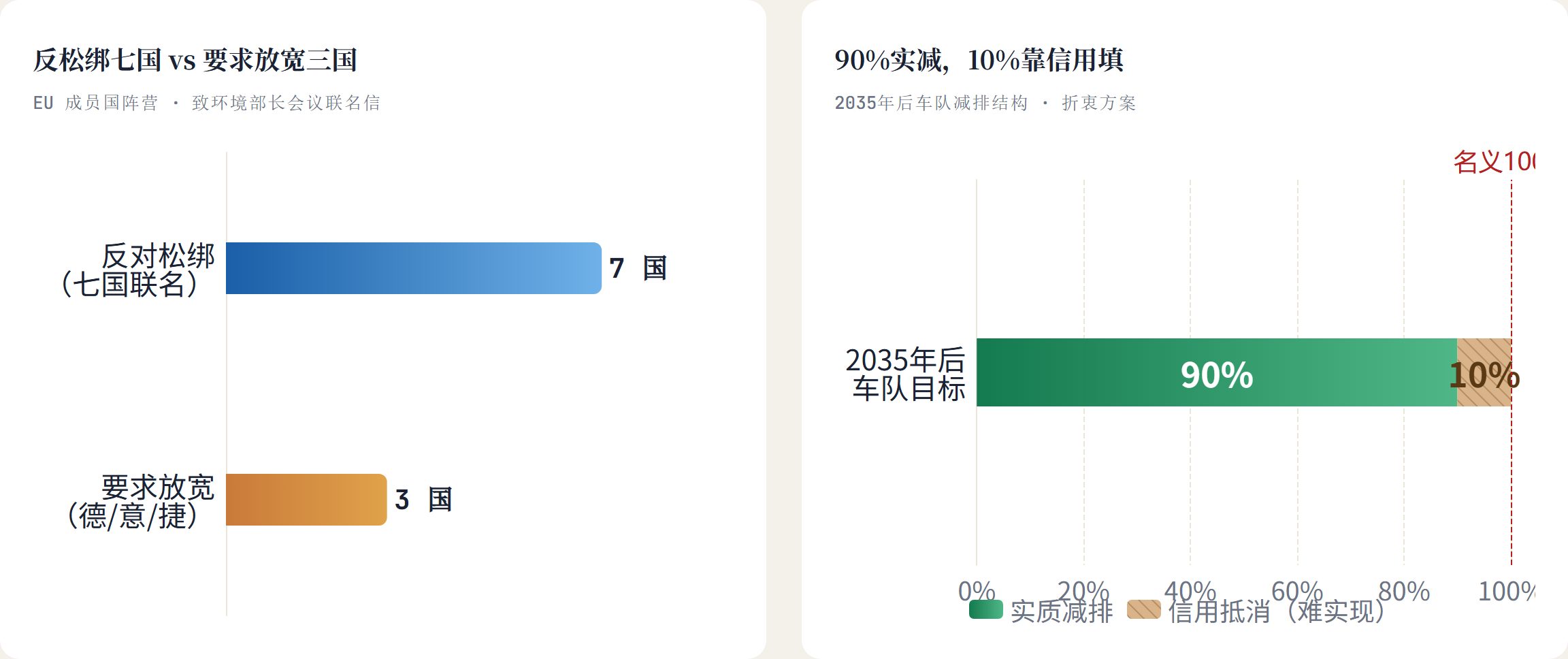
Denmark, France, Luxembourg, the Netherlands, Portugal, Spain and Sweden sent a joint letter ahead of this month's meeting of environment ministers, demanding that the 2035 zero-emission bottom line for new cars be held. The language was blunt: any further retreat would be a strategic mistake. They tied electrification to energy security rather than treating it only as a climate issue. With oil and gas prices high, ending fossil fuel dependence has become a fiscal matter. This argument, built on energy security and grid economics, stands on firmer ground in the data than pure climate ethics.
On the other side are Germany, Italy and the Czech Republic, pushing to relax PHEV requirements, amend the offsetting mechanism after 2035 and set looser transitional targets. The Commission's compromise contains a key figure: partial hybrids and combustion cars could still be registered after 2035, provided their CO2 is fully offset through a credit system. That means fleets would formally cut emissions by 90%, short of 100%, with the remaining 10% filled by clean fuels, EU green steel or super-credits for small cars under 4.20 metres; yet this 10% is widely considered hard to genuinely offset. Germany's position is the most conflicted: it wants flexibility, yet opposes the small-car super-credits strongly backed by Volkswagen and resists mandatory electric quotas for corporate fleets. In Parliament, the European People's Party group (EPP) goes further, demanding the credit system be scrapped altogether and a real 90% cut be required, which would effectively keep petrol and diesel passenger cars alive. Behind this lies Germany's dilemma: protect the profit structure of its existing premium combustion cars, or swallow the pain of the electrification transition.
The concerns of those pushing for relaxation are partly valid. EVs in Europe still cost more than comparable combustion cars. After incentives were phased down in many countries, low- and middle-income buyers cannot be won over. The public charging gap in southern and eastern Europe is a serious weakness: targets are set but the cars don't sell, and the grid benefits remain gains on paper only. In regions with weak infrastructure, PHEVs may indeed be the more realistic transition. But relaxation does not resolve these concerns. It shifts the cost from automakers' books to the power sector's, where it simply lives on.
In fairness to the deregulation camp: their concerns are real
EVs in Europe are still pricier than comparable combustion cars, and with subsidies phased down in many countries, uptake among low- and middle-income buyers has stalled. The public charging gap in Southern and Eastern Europe is a hard constraint: the targets are set, but the cars don't sell. PHEVs may indeed be the more realistic transition in areas with weak infrastructure. What the relaxation camp fears is that mandatory targets end up as "fines for automakers, consumers who won't pay and a hollowed-out industry". These are not concerns to be waved away. But relaxation doesn't solve them; it merely shifts the cost from automakers' books to the power bill, where it lives on elsewhere.
Chinese automakers: an asymmetric bet
For now, V2G is only a long-dated option. Bidirectional chargers become mandatory only in 2032, still several years away. Rules for electricity-market access and battery-warranty limits on bidirectional cycling have yet to be sorted out. And the business of selling grid flexibility rests on Europe's distributed power markets, which have no direct counterpart in China's centrally dispatched grid. Basing today's decisions on a capability that arrives only in 2032 breaks the timeline.
V2G is a long-dated option today, not a ready-made asset — but positions need to be staked out early
Bidirectional chargers only become mandatory in 2032. Electricity market access rules and battery warranty limits on bidirectional cycling have yet to be sorted out, and this business of selling grid flexibility is built on Europe's distributed power markets, which have no direct counterpart in China's centrally dispatched grid. So "preparing for both outcomes" is correct but empty advice. The cleaner play is an asymmetric bet: plan product and pricing cadence on the likely relaxation, and keep V2G and bidirectional charging know-how as a low-cost upside option. Whoever first turns the EV from a means of transport into an energy node gets the ticket to the next round of rules.

So "preparing for both outcomes" is technically correct but says nothing useful. A manufacturer with limited resources that splits its bets evenly pays double and still backs neither outcome fully. A cleaner approach is an asymmetric bet. Plan product and pricing on the assumption that the easing will most likely go through. At the same time, keep V2G and bidirectional charging technology on hand as a low-cost upside option. If the EU ends up keeping the targets, manufacturers that prepared early can move beyond simply selling vehicles to offering grid flexibility services. The cost of getting it wrong is lopsided: misjudging the product timeline hurts current sales, while a technology option that doesn't pay off only costs some R&D spending.
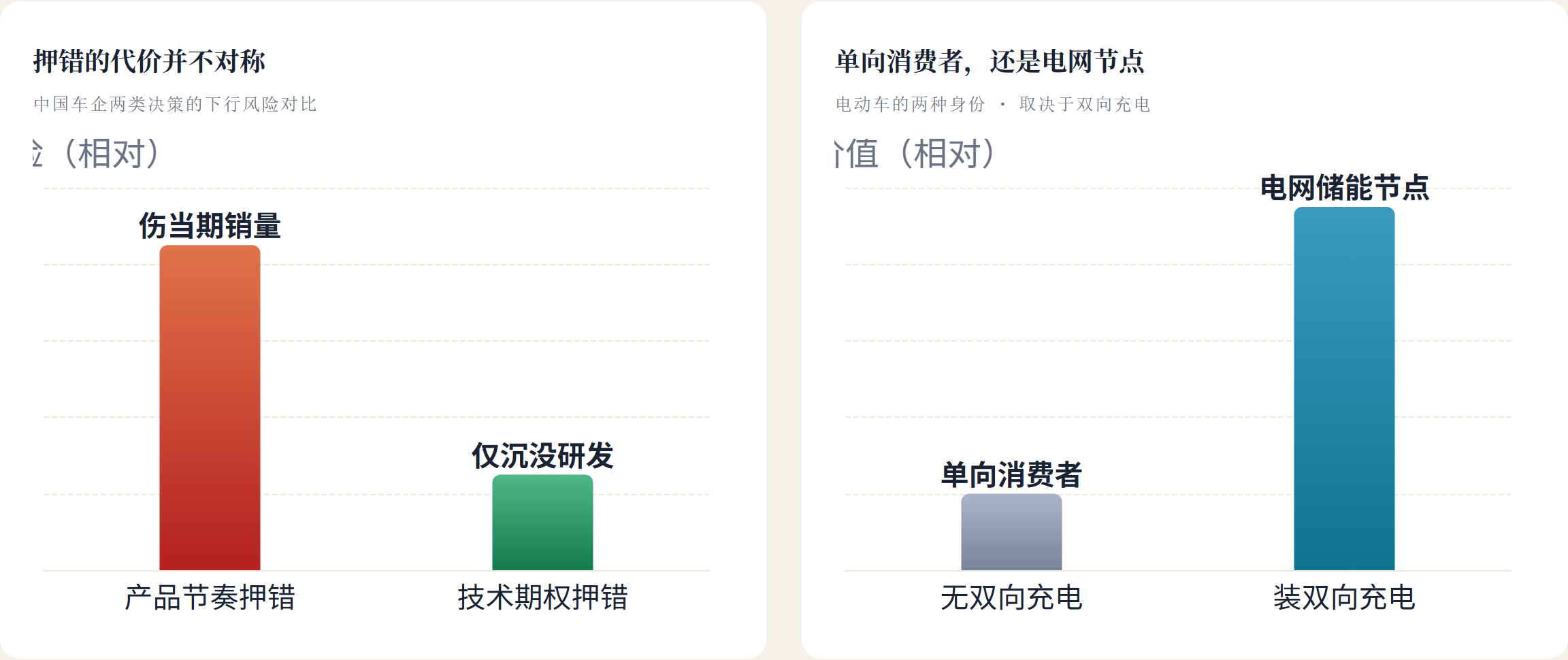
Take the same BEV model exported to Europe: if its underlying electrical architecture has bidirectional charging interfaces and battery management capability built in, then once mandatory provisions take effect, compliance requires only a software update, adding almost no marginal cost. Conversely, if the architecture left no room for this from the start, the automaker will have to either overhaul the platform or pull out of some markets altogether. That is where the option value lies: spend a little in normal times to hold a position, so you are not shut out by the rules when it matters.
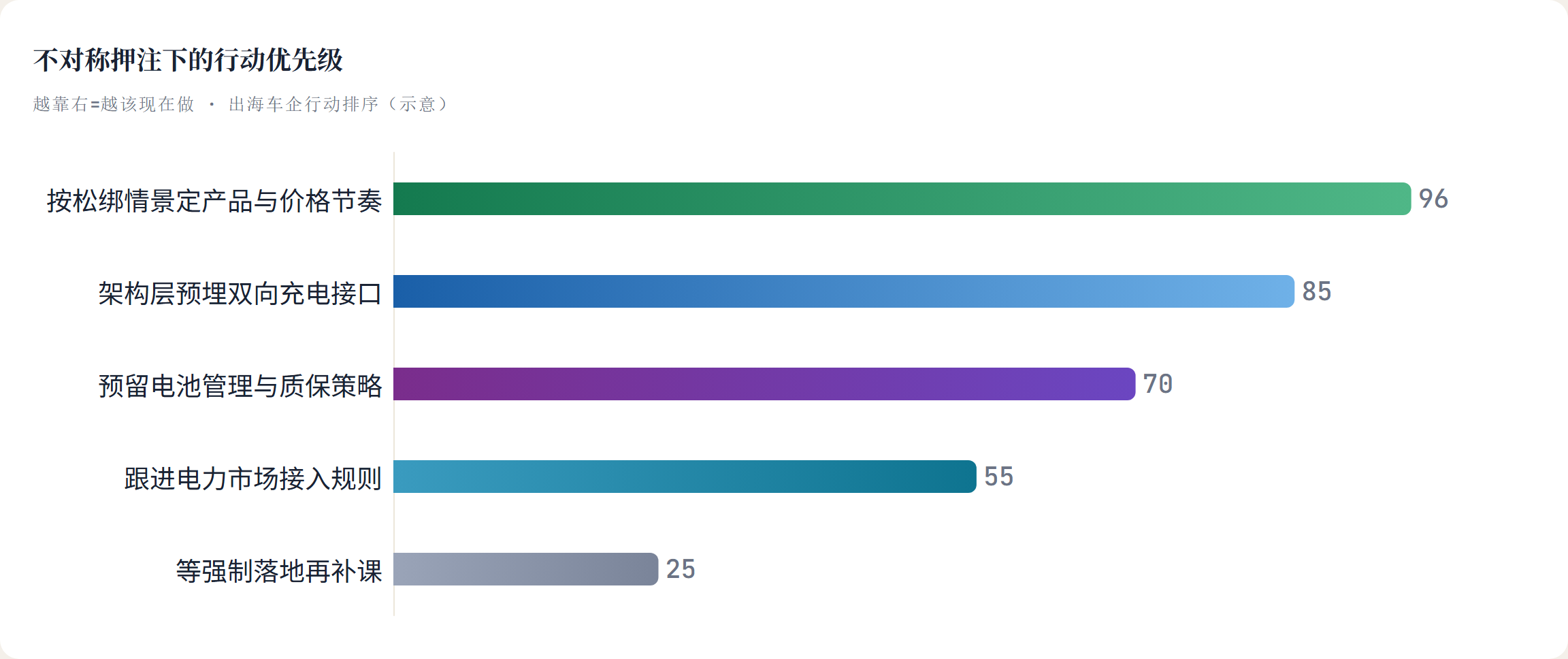
At its core, this debate is a contest between the industrial bases of different countries, and a top-level design question about how grid assets should be allocated. From an industry perspective, manufacturers that understood earlier that electric vehicles are part of the energy system will have the upper hand under the next set of rules. Whoever first turns the electric vehicle from a means of transport into an energy node gets the ticket to the next round of rule-making.