European car market data for 4: BYD closes in on Tesla
ACEA's newly released European new car registration data for January–April 2026 show modest headline figures: cumulative EU sales of 3.794 million units, up 4.2% year on year; the BEV share reached 19.7%, up 4.4 percentage points from 15.3% a year earlier. Seeing these two numbers, most people will conclude that "European electrification is advancing steadily" and move on.
Yet the value of this report lies precisely where the headline numbers can't reach. Break it down by brand, country and powertrain, and three developments that are reshaping the market come into view.
Chinese brands are grabbing share
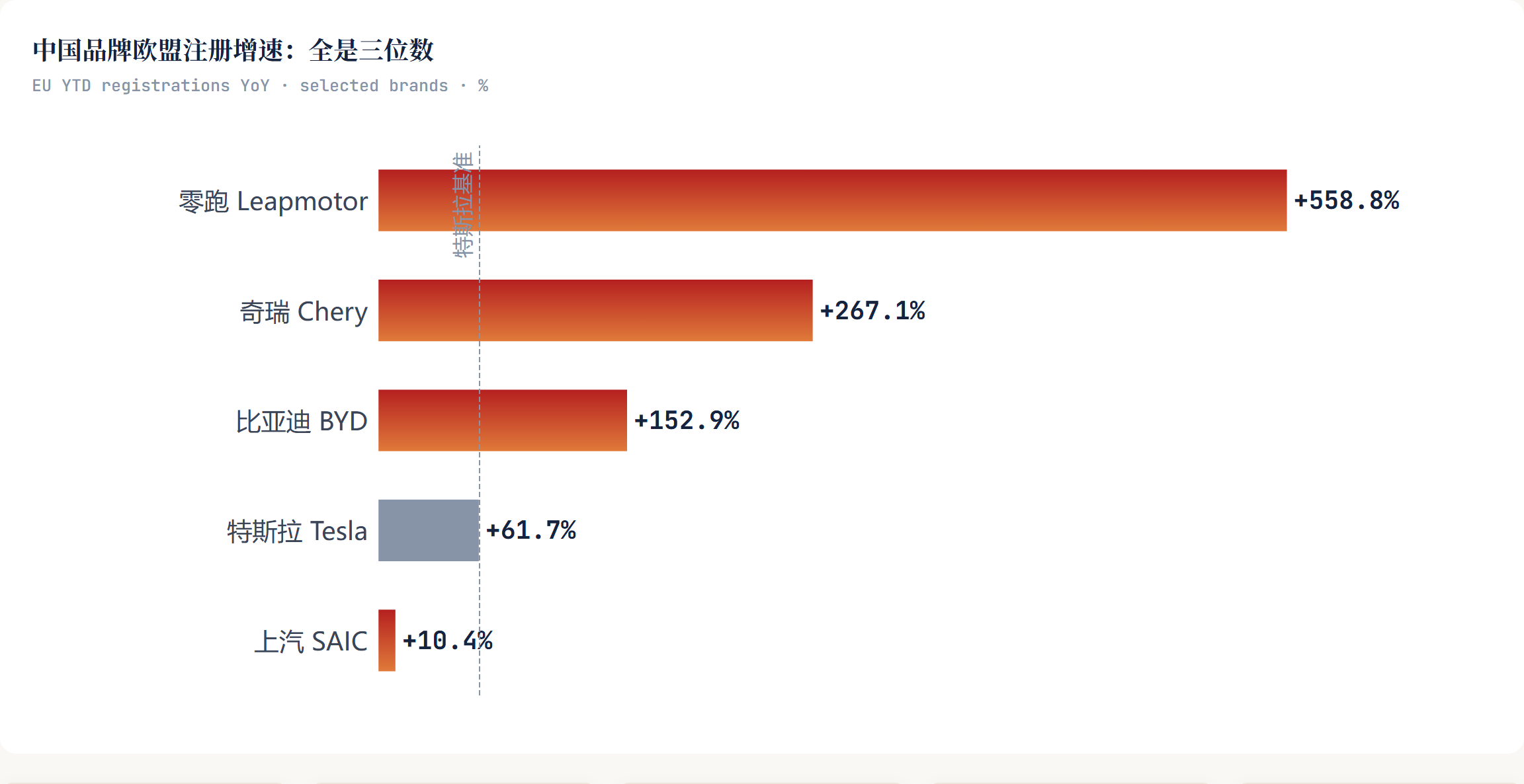
Start with the most striking figures. In the first four months, BYD registered 71863 units in the EU, up 152.9% year on year, with its share doubling from 0.8% last year to 1.9%. Chery (including brands such as Jetour and Omoda) grew 267.1%, Leapmotor 558.8% and SAIC Motor 10.4%.
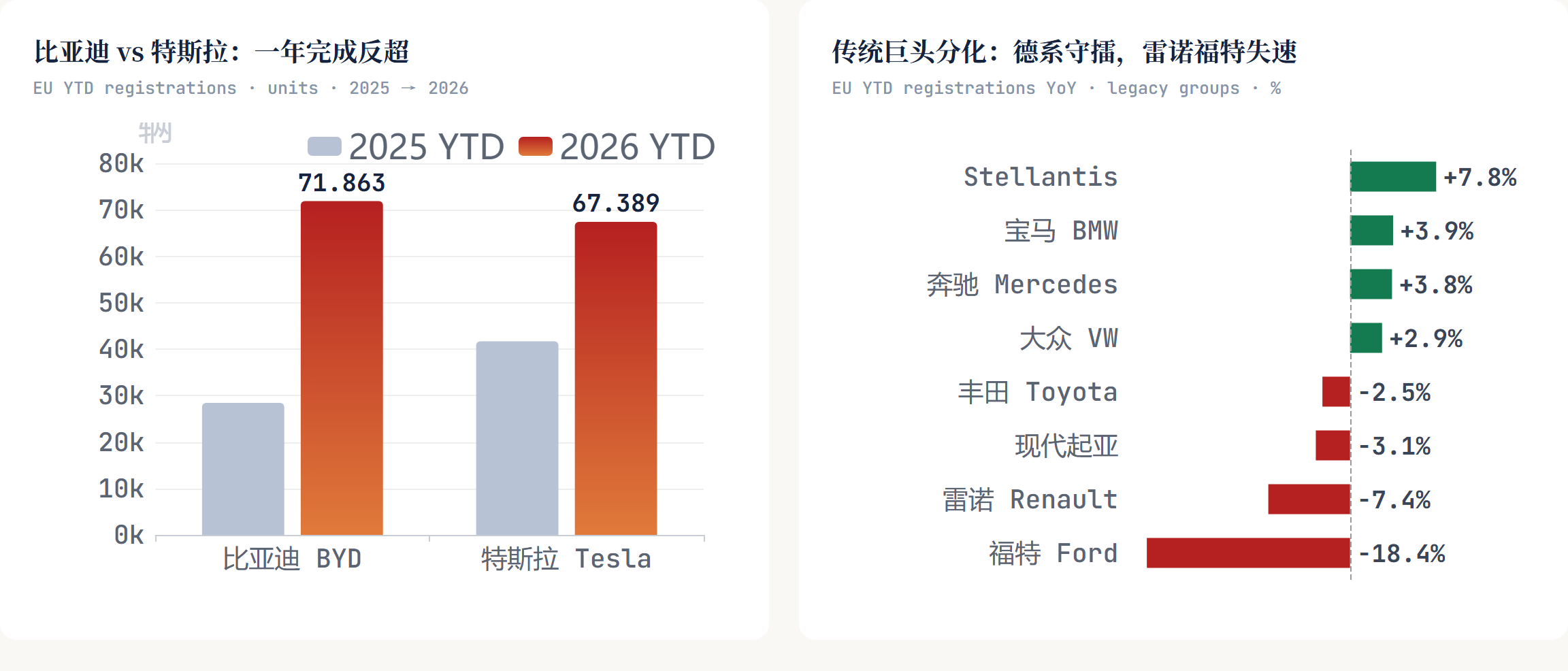
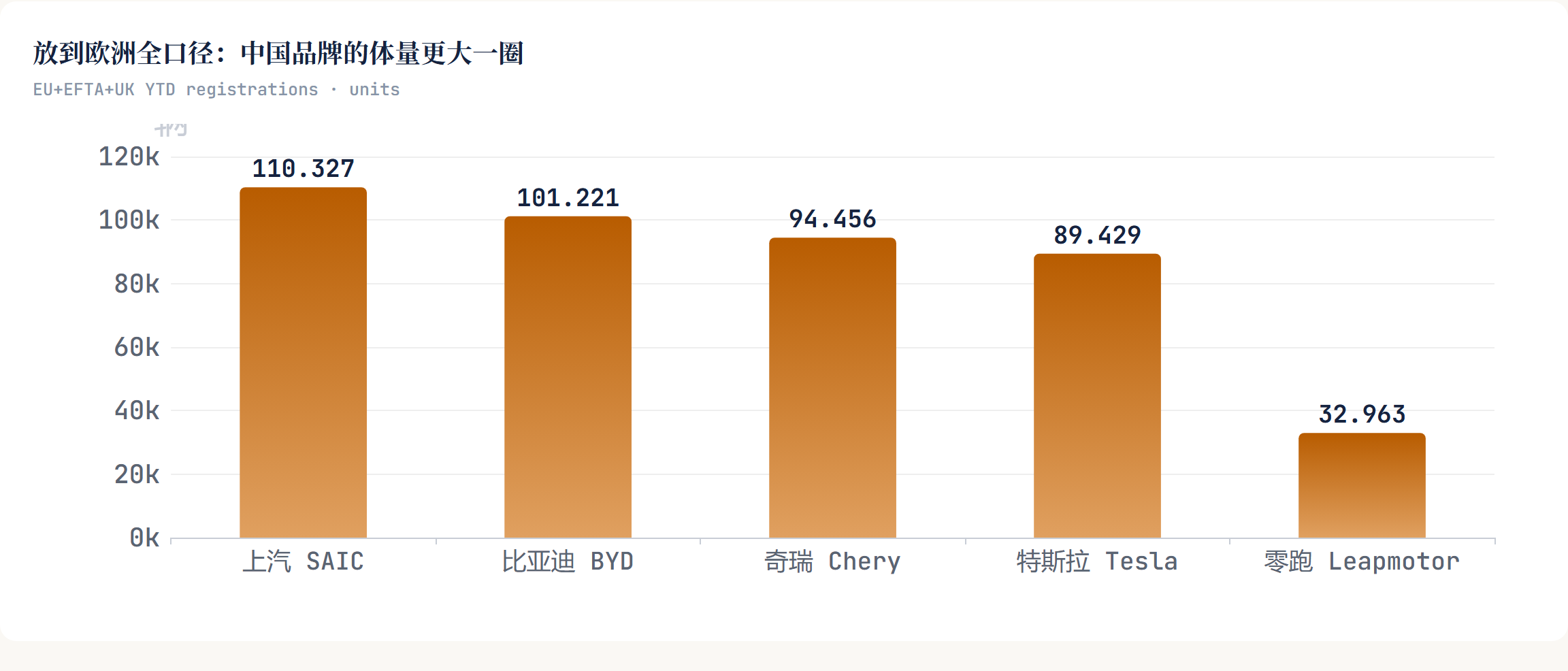
It is more telling to set BYD's 71863 units next to Tesla's 67389 units. Tesla grew 61.7% in the first four months, a solid rebound. BYD, however, climbed more than twice as fast and has already overtaken Tesla on monthly sales. The EU imposed tariffs on China-made EVs last year, yet Chinese brands are still growing this fast. That points to structural penetration built on product and distribution, not a cyclical peak driven by a one-off promotion. A wider scope makes this clearer: including the UK and EFTA countries, BYD sold 101221 units in the first four months, Chery 94456 units and Leapmotor 32963 units, which is larger still.
A 1.9% share sounds unremarkable today. But share is the surface; the slope is what matters. At the current growth rate, the volume will be on a completely different scale in two years. More important is how the penetration is happening. The growth is driven by BYD, Chery, Leapmotor and SAIC Motor advancing on several fronts at once, pushing product line-ups, local dealer networks and supply chains into Europe together, rather than relying on a single star model for volume. Many brands and models moving at once are far harder to stop than one hit product: block one price point and they come in at another.
Growth is country-specific
The second point explains why Chinese brands have been able to take off: Europe's electrification growth is highly concentrated in a few countries.
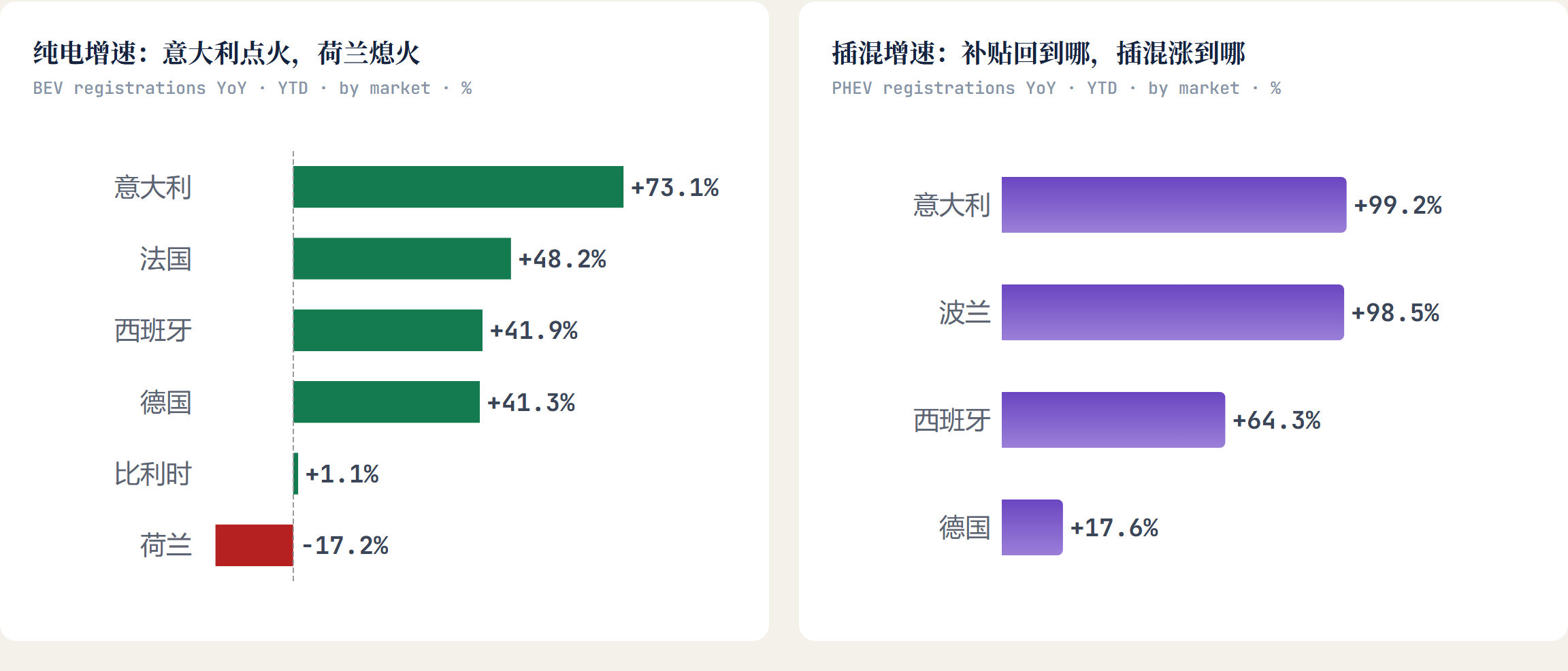
The 19.7% BEV share is a weighted average blending 27 member states. Broken down, the four largest markets account for 64% of all European BEV registrations. In the first four months, BEV registrations grew 73.1% in Italy, 48.2% in France, 41.3% in Germany and 41.9% in Spain: this is the side that has caught fire. On the other side, Belgium grew only 1.1%, and the Netherlands actually fell 17.2% year on year.
Why do markets within the same "Europe" differ so widely? The answer is the fiscal policy switch. Italy and Spain reinstated and expanded purchase incentives and tax breaks this year, and demand took off immediately. The Netherlands tightened its incentives, and BEV registrations fell back right away. The pattern is even more pronounced for plug-in hybrids (PHEV): PHEV sales jumped 99.2% in Italy, 64.3% in Spain and 98.5% in Poland. Wherever incentives return, EV volumes take off. The so-called European market is at heart a dozen-plus separate markets, each divided by its own policy calendar.
For Chinese automakers, this is precisely a window of opportunity: wherever incentives return, there is a ready-made pool of demand waiting to be filled, and first movers win.
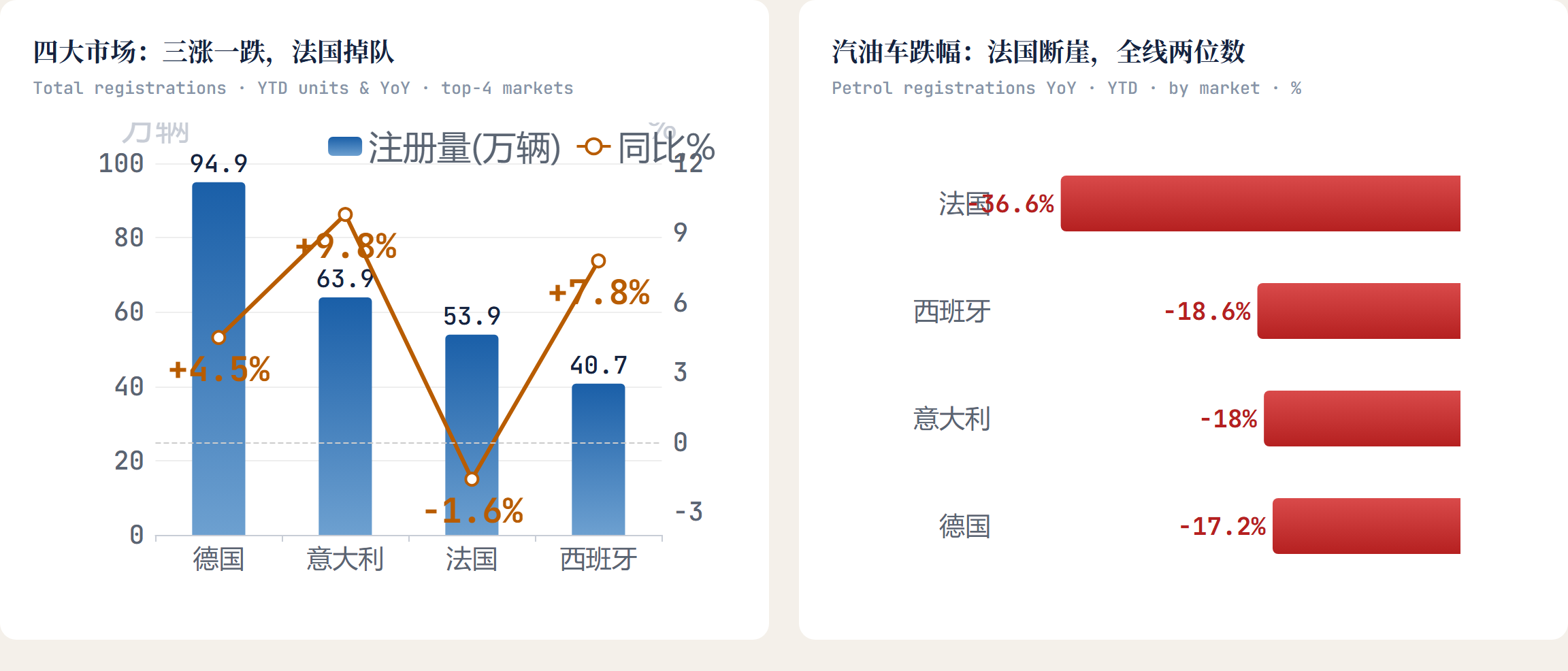
Lining up the totals of the four big markets makes the divergence even clearer. In the first four months, Germany reached 949,000 units, up 4.5%; Italy 639,000 units, up 9.8%; and Spain 407,000 units, up 7.8%, all three growing. Only France fell, by 1.6%, to 539,000 units. Italy's and Spain's strength reflects the return of subsidies; France's weakness is tied to a 36.6% plunge in combustion-engine cars, a gap that new energy vehicles have not yet fully filled. Even among big markets, different policy timing has sent trends in different directions.
Combustion cars are collapsing
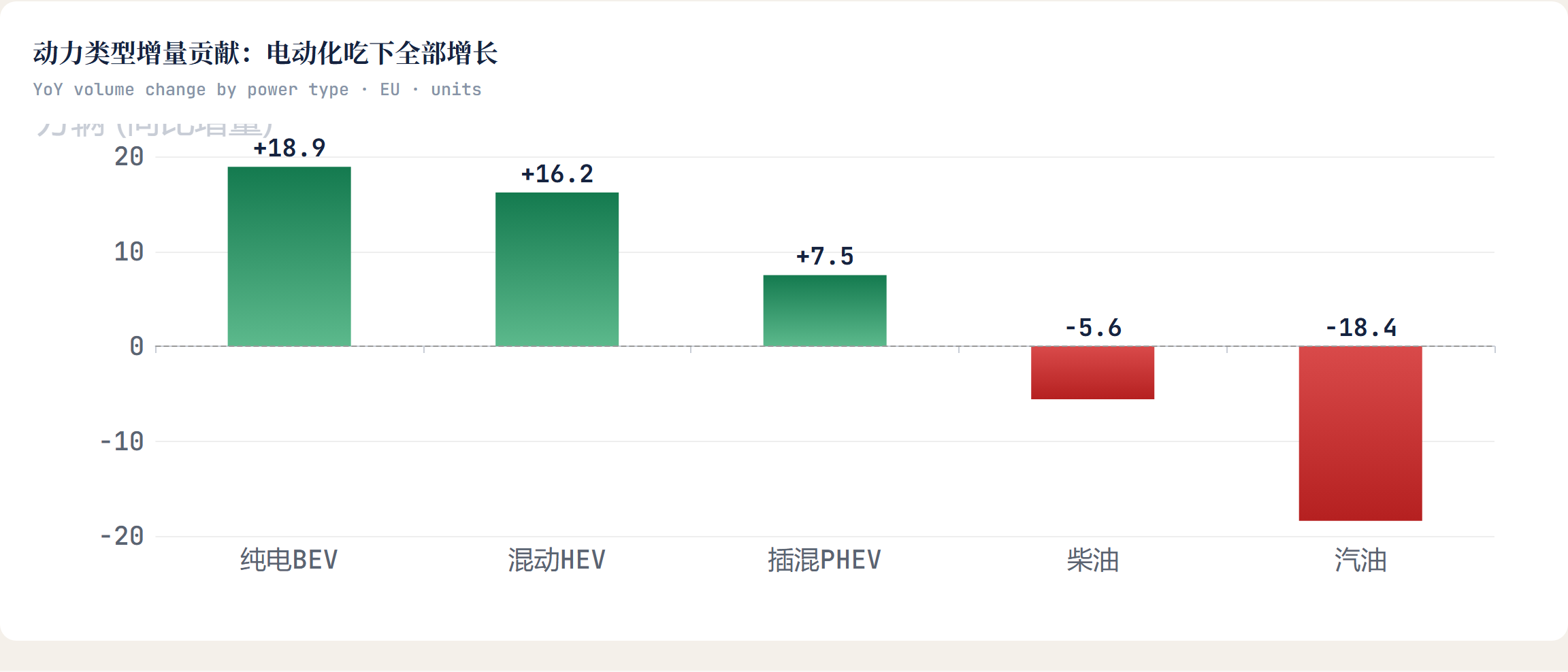
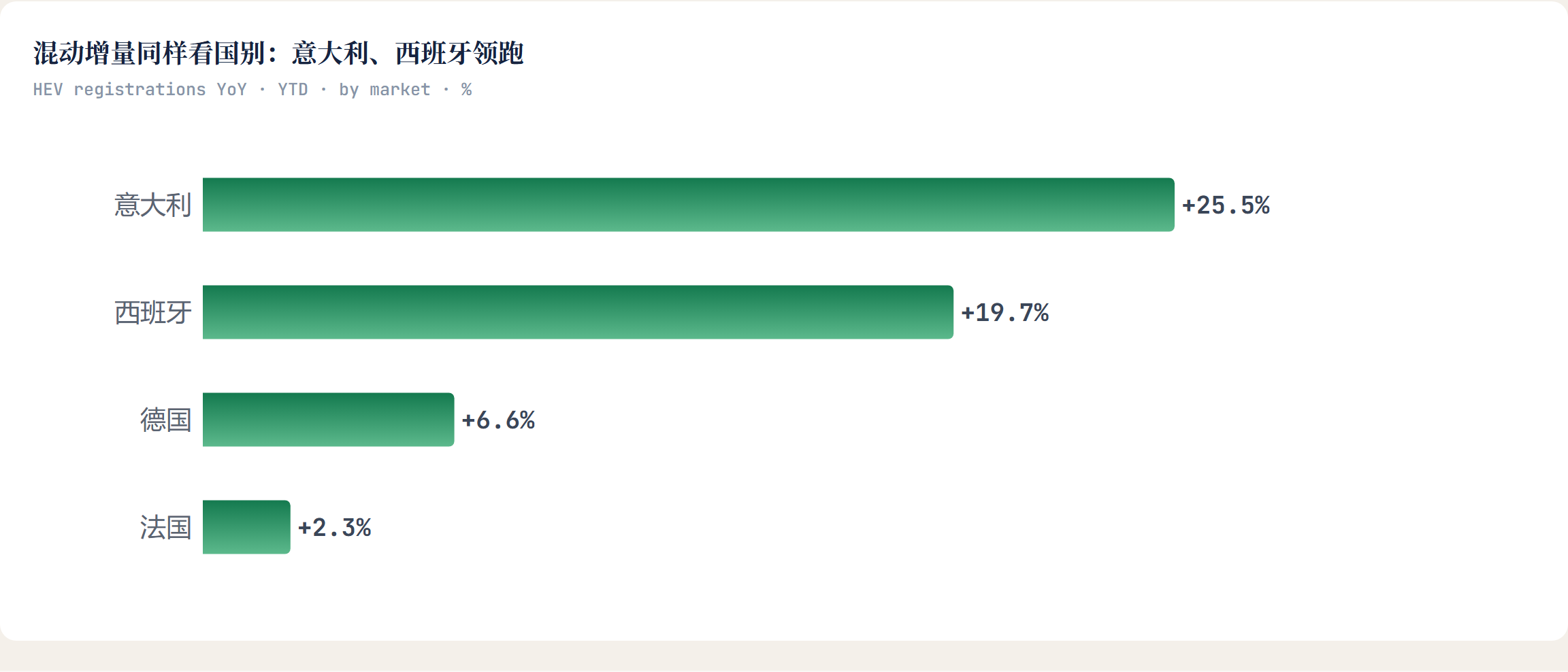
The third trend is a shift in powertrain mix. Hybrids (HEV, including full and mild hybrids) remain Europeans' default choice, with 1.448 million registrations in the first four months, a 38.2% share and growth of 12.6%. While charging networks and residual values remain uncertain, an "electric motor without relying on charging points" solution feels safest. Growth here also varies by country: Italy (25.5%) and Spain (19.7%) led HEV growth, while Germany (6.6%) and France (2.3%) also contributed.
The PHEV comeback is being underestimated. Once written off as a transitional technology that BEVs would eventually replace, PHEVs sold 364,000 units in the first four months, up 26%, and their share rose from 7.9% to 9.6%. With range anxiety on one side and uneven charging on the other, buyers have turned to them as a hedge.
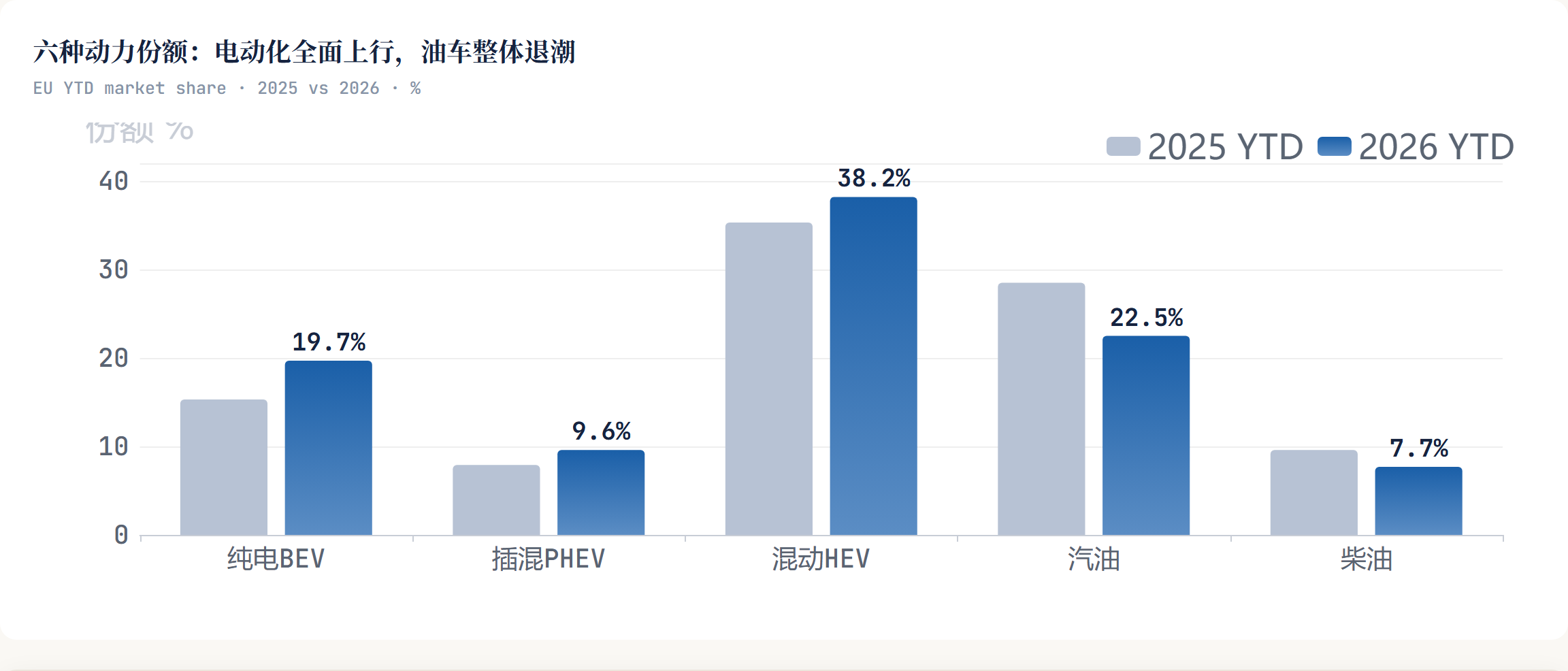
Meanwhile, the combustion engine is exiting faster. Petrol car registrations in the first four months were 855,000 units, down 17.7% year on year, with share sliding from 28.5% to 22.5%. Petrol cars plunged 36.6% in France, with double-digit declines in Germany, Spain and Italy. Diesel fell 16.1%, leaving a share of just 7.7%. Combined, petrol and diesel share dropped from 38.1% a year earlier to 30.2%. Put the other way, BEVs, PHEVs and hybrids together now account for 67.5% of the EU market. The existing fleet of combustion cars is still on the road, but growth in that segment has essentially stopped.
The ICE exit is no gentle slope: major markets are falling by double digits in unison
Petrol cars fell by double digits in every major market, plunging −36.6% in France, with Germany at −17.2%, Spain −18.6% and Italy −18.0%. Diesel continued its decline (−16.1%), leaving it with only a 7.7% share. This means the base for dealers' ICE inventory, combustion powertrain capacity, and the service and parts business built around the internal combustion engine is shrinking fast.
For the supply chain, the timeline for the pivot is tighter than the share figures suggest. A manufacturer still relying on ICE cash flow to fund electrification will find that the cash cow itself is bleeding at double-digit rates.
The giants are diverging
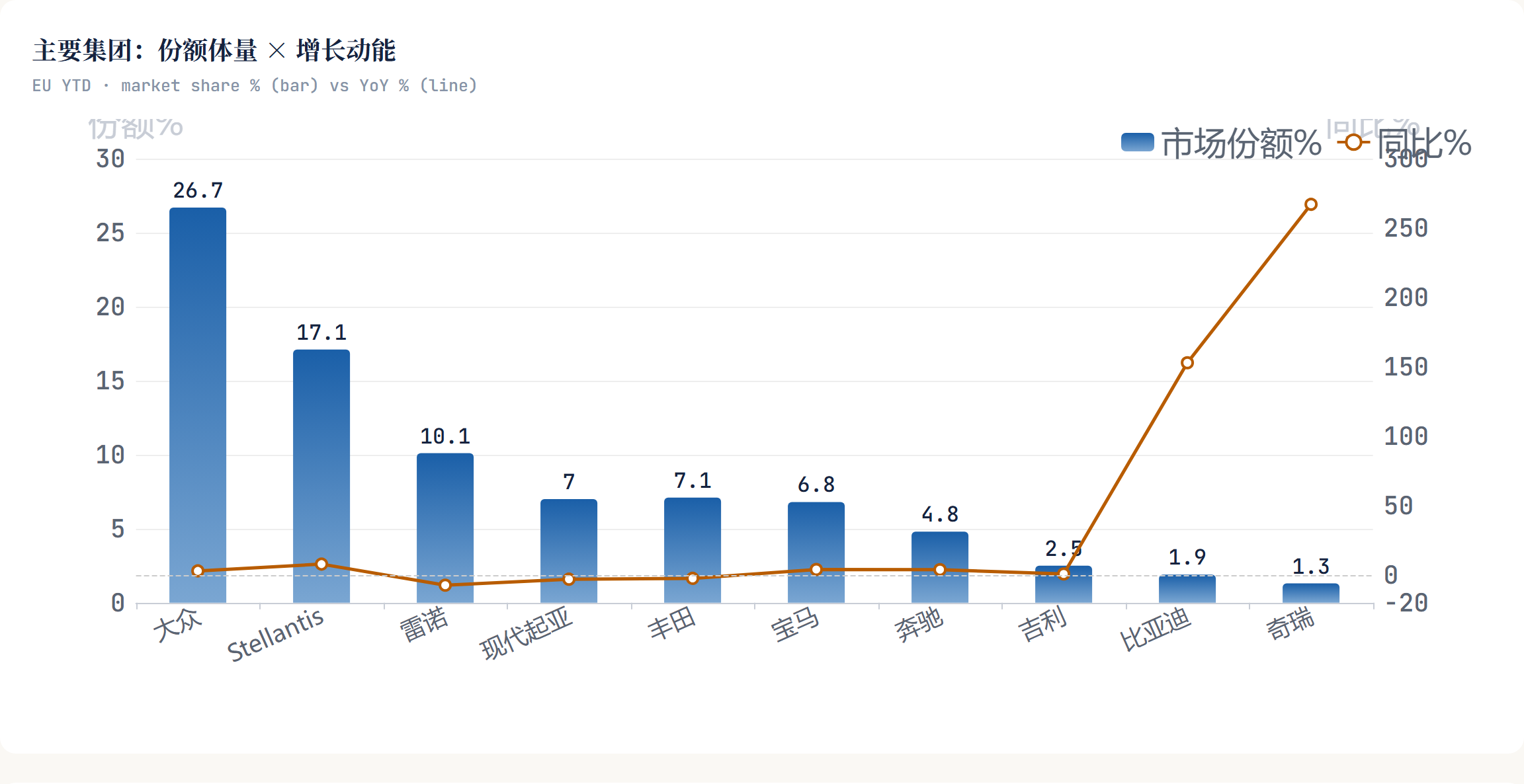
At group level, the legacy majors are performing unevenly. Volkswagen Group held its ground, with 1,014,000 registrations in the first four months, a 26.7% share and 2.9% growth; Škoda's 15.5% rise was a highlight. Stellantis grew 7.8%, with Fiat up 32.6% and Opel up 22%, recovering on the back of new models.
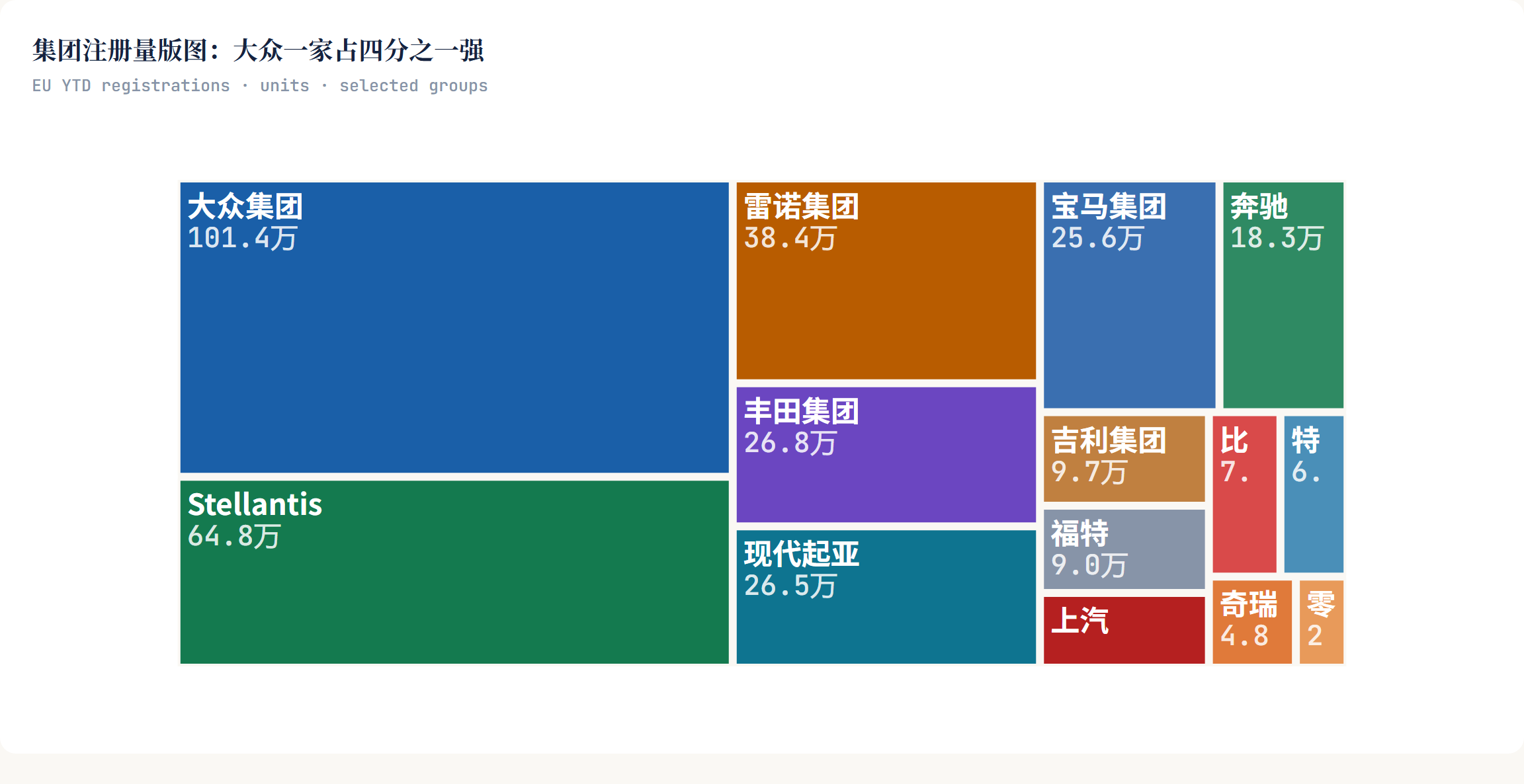
Another group lost momentum. Renault Group fell 7.4% in the first four months and Dacia fell 15.3%. Ford fell 18.4%, Toyota 2.5% and Hyundai 3.1%. The German premium camp held steady: BMW Group grew 3.9% and Mercedes-Benz 3.8%, thanks to product cadence and a gradual rollout of electric models. Market share does not simply vanish. It is moving bit by bit from slow-reacting makers to faster rivals, and a sizeable part of it is going to Chinese brands. With some rising and others falling, the seating order at Europe's table is being reshuffled.
What to watch
The data offers automotive professionals three practical takeaways.
First, stop treating "Europe" as a single market. A uniform European electrification strategy will leave you missing your footing this year. Subsidy windows, tax milestones and charging-infrastructure progress all move at a different pace in each country. The right approach is to deploy according to each country's policy calendar and concentrate resources on markets where incentives are returning.
The "European market" is a statistical illusion: it is a dozen-plus separate markets carved up by policy calendars
Collapsing 27 countries into a single 19.7% hides the key fact: electrification gains are not spread evenly but follow each country's fiscal incentives as they are switched on and off. Italy and Spain reinstated and expanded purchase subsidies in 2026, and demand rose in response; the Netherlands tightened incentives, and BEV registrations immediately fell back by 17.2%.
For automakers going global, this means a "unified European strategy" will leave teams wrong-footed this year. The right approach is to deploy according to each country's policy calendar and concentrate resources in markets where incentives are returning: wherever a subsidy window opens, a demand pool is waiting to be filled.
Second, the competitive clock is speeding up. Chinese brands' triple-digit growth is structural, and the time left for the established giants to catch up on electric products, distribution and cost is visibly running out. Waiting until share grows from 1.9% to double digits before responding will be too late.
Averages lull you into complacency; the gaps decide who wins
The Apr 2026 data offers three practical takeaways: first, plan overseas expansion around each country's policy calendar rather than treating Europe as a single market; second, Chinese brands' triple-digit growth is structural, and the competitive clock is speeding up; third, the PHEV rebound (+26%) shows electrification is not linear, so product planning should leave room for non-linearity.
These three findings interlock: national policy determines where demand emerges, powertrain mix determines which products can meet it, and the competitive landscape determines who ultimately captures it. Layering all three together is where the real value of this 4 data lies.
19.7% is a reassuring number. But what will decide who wins Europe's car market over the next two years lies beneath that average: which markets are being ignited by policy, which powertrains are being reshuffled, and which brands are moving at twice the speed of everyone else. Those who know how to read data always look at that layer.
Third, the path is not linear. The PHEV comeback shows electrification will not happen in one go, and transitional technologies are proving more resilient than many forecasts assumed. Product plans betting on a straight jump to BEV need to leave room for such reversals.
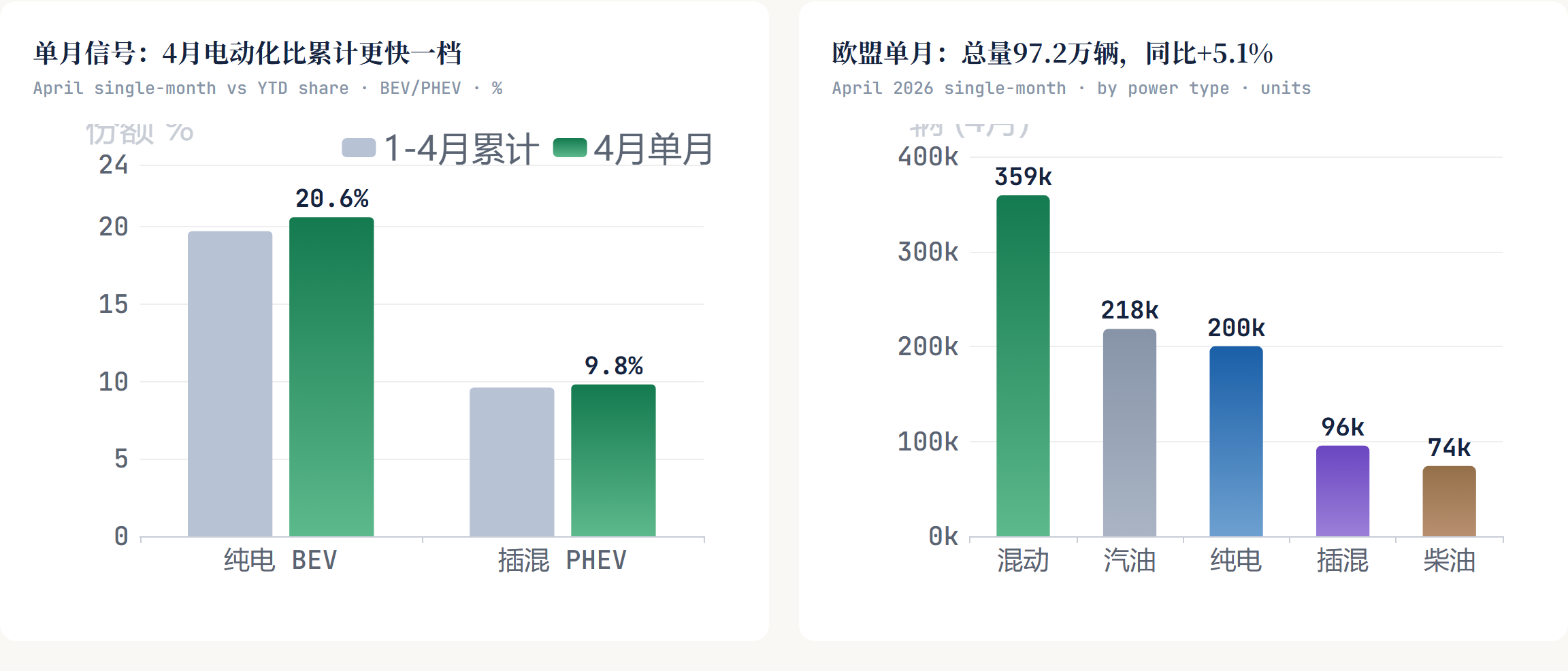
19.7% is a reassuring figure. But what will decide who wins Europe's car market over the next two years is what lies beneath that average: who is being ignited by policy, who is being shaken out, and who is running at twice everyone else's pace. Those who know how to read data always look at that layer.
The competitive clock is speeding up: a 1.9% share looks negligible today, but at this rate it will jump an order of magnitude within two years
BYD's EU share has more than doubled from 0.8% last year to 1.9%, and on an EU+EFTA+UK basis it has passed 100,000 units. Harder to block is the mode of penetration: BYD, Chery, Leapmotor and SAIC Motor are pushing in together with multiple brands and models, so seal off one price point and rivals come in at another.
The window for legacy giants to catch up on EV product strength, sales channels and cost structure is visibly closing. Waiting until share grows from 1.9% to double digits before responding will be too late.