Selling you a EUR 15,000 small EV isn't about the car margin: Europe's CO2 credit arbitrage game
Read the news and you'd think it's a party for consumers: Stellantis and Renault are going to build EUR 15,000 EVs! Read the EU Official Journal and you'll find that's not the story at all. The M1E category clause buried in it runs just a few lines: small battery-electric cars made in the EU and no longer than 4.2 metres count as 1.3 vehicles in an OEM group's average CO2 calculation, with the mechanism running until 2034. comp
Reading the news, you'd think this is a consumer bonanza: Stellantis and Renault are going to build EUR 15,000 EVs! Open the EU Official Journal and you'll find that's not the case at all. The M1E category clause buried in the communiqué is just a few lines: small BEVs made in the EU and no longer than 4.2 m count as 1.3 vehicles in an automaker group's average CO2 calculation, with the mechanism running until 2034. 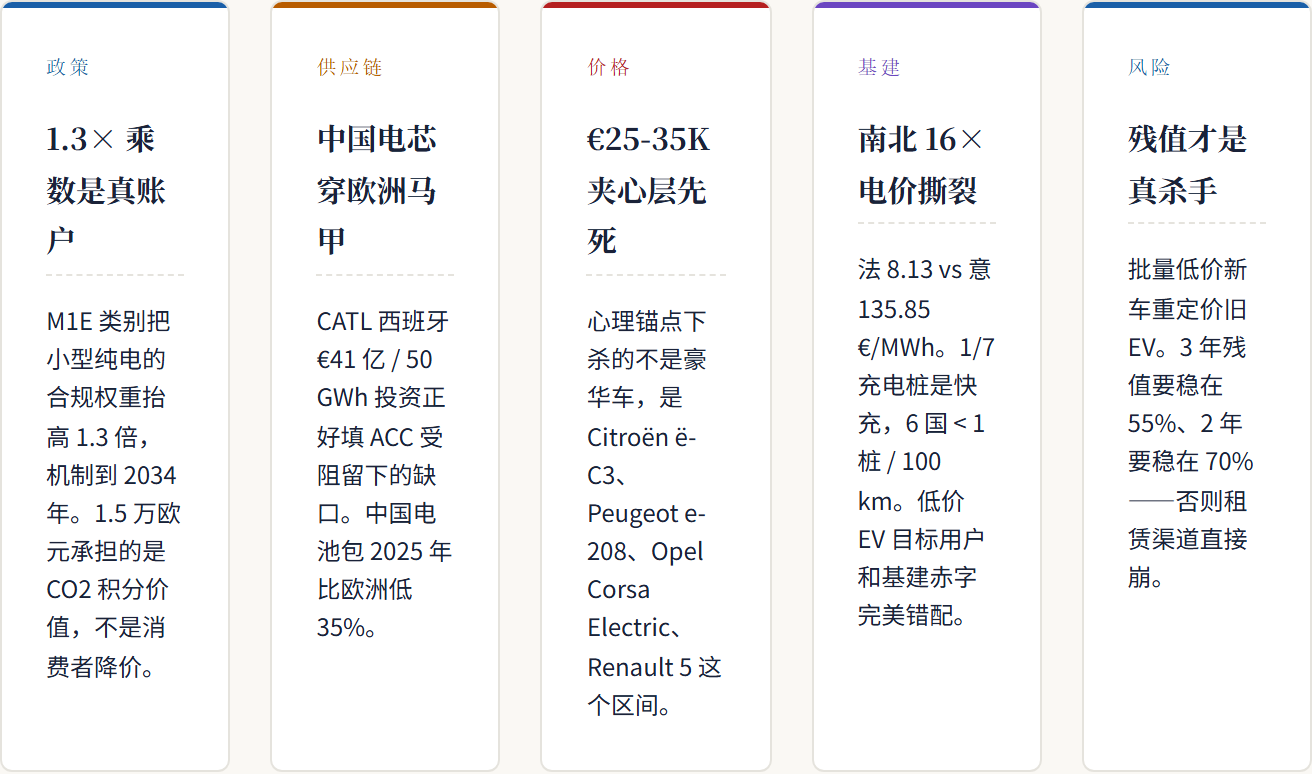 This inconspicuous multiplier is worth ten times the €15,000 sticker price. Do the math and it becomes clear A combustion SUV has high emissions and keeps the group average from coming down. But every additional small BEV sold that qualifies as M1E counts as 1.3 units of compliance performance in the group's emissions ledger. The extra 0.3 slots gained can keep a high-margin SUV on sale in Europe. Of course automakers are happy to lose money on these small cars: they aren't really products, they're compliance certificates. ACEA put it bluntly: the current 2030 and 2035 CO2 targets are "unachievable, and Europe needs a smarter regulatory path". In plain terms: push back the targets themselves, or give small cars greater weight in the compliance ledger. Stellantis, Renault and Volkswagen jointly pushing EUR 15,000 models is a way of using products to hand ACEA bargaining chips at the negotiating table. 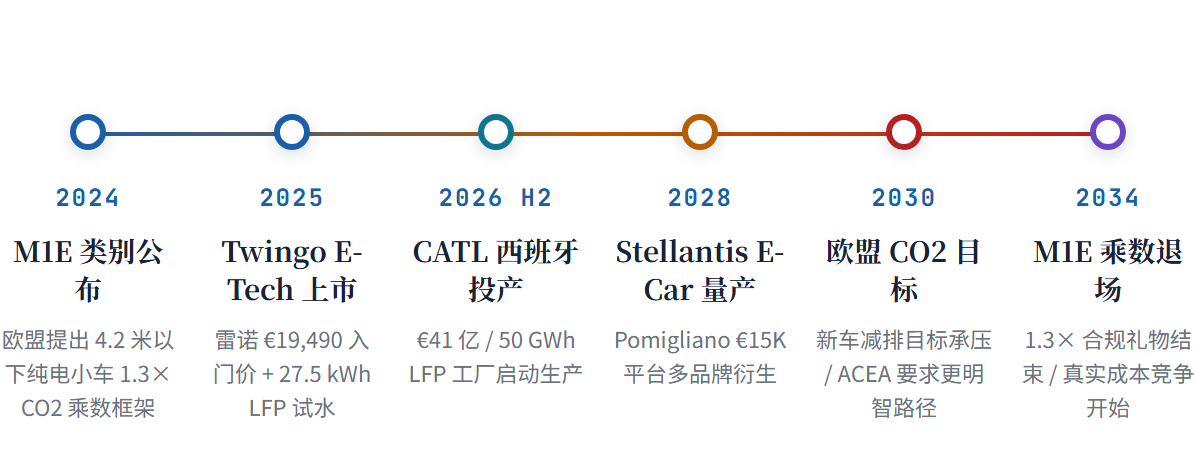 Once you understand this, everything that follows makes sense. Reviving the old Pomigliano plant Outside Naples, Italy, lies the Pomigliano d'Arco plant, a legacy line from the Fiat era. Stellantis plans to start volume production of the E-Car there in 2028, at a target price of EUR 15,000, on a platform shared by Fiat, Citroën, Opel and Peugeot. The news likes to frame this as a nostalgic revival of the Citroën 2CV. But focusing on nostalgia misses the real story: building a €15,000 small car in a high-labour-cost European plant simply doesn't add up with a European supply chain alone. To make the numbers work, you have to go through China. Stellantis laid the groundwork long ago. It holds about 21% of Leapmotor and leads Leapmotor International, the joint venture responsible for all sales and manufacturing outside Greater China. Leapmotor already has 850 sales and service points in Europe and delivered more than 40,000 vehicles there in 2025. Stellantis plans to bring the Leapmotor B10 platform directly into its Zaragoza plant in Spain, which will also build a battery-electric Opel C-segment SUV from 2028. On top of that, Stellantis and CATL have just signed off on a EUR 4.1 billion LFP battery joint-venture plant in Spain, with planned capacity of 50 GWh and shipments due to start by the end of 2026. 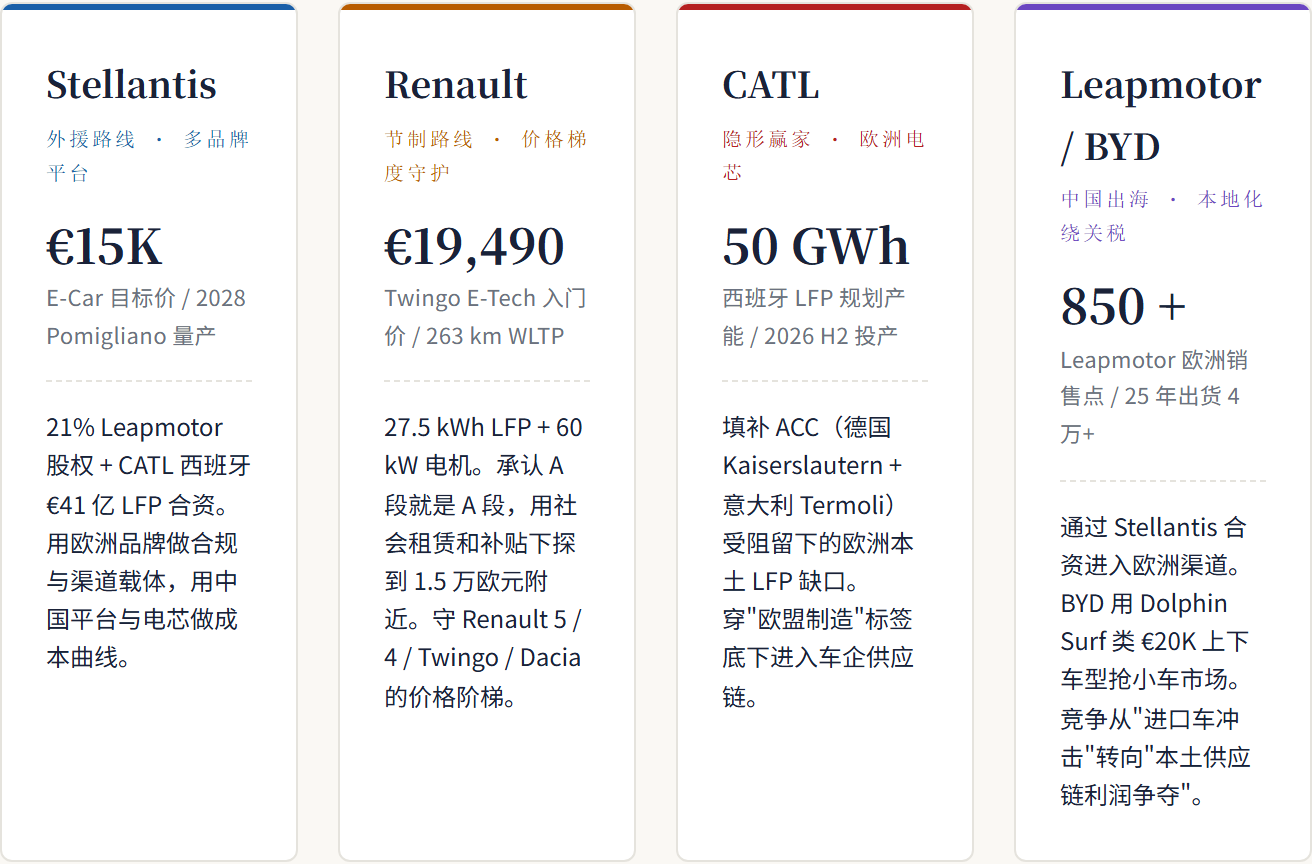 This is not Europe striking back at China — it is about moving the Chinese supply chain's cost curve wholesale into the shell of European factories, European channels and European brands. Old plants like Pomigliano, short of orders in recent years, have come back to life; CATL has found an entry point to the mainstream market in Spain; Leapmotor has gained European distribution; and the few suppliers with low-cost electrical/electronic architectures have landed big orders. Who loses? European battery projects that bet on high-nickel NMC, and European Tier 1 suppliers that make their money on high-value components per vehicle. Their customers are quickly learning that "good enough will do". Renault is playing a different game Renault did not follow Stellantis in seeking outside help; its play is restraint. The Twingo E-Tech spec sheet won't excite you: a starting price of EUR 19,490, a 60kW motor, a 27.5kWh LFP battery pack and 263 km of WLTP range. No big battery, no high power, no flashy assisted driving. But that is exactly the point. The Twingo is built for city radiuses, low purchase cost and a lightweight body. It is not meant for long trips; it is meant for commuting in Paris, Lyon and Marseille. What Renault is really protecting is the internal order of its price ladder: Renault 5, Renault 4, Twingo and Dacia Spring. Make the Twingo too strong and it cannibalises the Clio and Dacia; make it too weak and it can't hold off Chinese imports like the Leapmotor T03 and BYD Dolphin Surf. Every product move Renault has made over the past three years has served to maintain this ladder, so its counterattack is not a new concept but an acknowledgement that an A-segment car should be an A-segment car. But Renault's approach is no sure win either. The Twingo's ability to get down to around EUR 15,000 through social leasing plus subsidies depends on France's policy framework. Once subsidies are phased out, the real list price of EUR 19,490 will be exposed again, and consumers will weigh it against a used Model 3, a used Volkswagen ID.3, the Hyundai Inster and the BYD Dolphin Surf. Renault wins by being early, but not necessarily for the long run. The first to fall isn't a luxury brand Chinese media are focused on two questions: will luxury brands take a hit, and will Chinese vehicles be blocked by tariffs? The answer to both is "yes, but neither is what happens first." The first to fall is the €25,000–35,000 middle tier. This price band was once the mainstream BEV segment European automakers most wanted to grow: a bit more refined than Chinese entry-level cars and more affordable than premium SUVs, in theory able to capture Golf, Clio, 208 and Corsa buyers upgrading from combustion cars. But once a EUR 15,000 anchor is set, the value anchor in consumers' minds is reset: if a city-commuter BEV can be had for EUR 15,000 to 20,000, why should a small crossover with somewhat more range cost EUR 30,000? Who takes the first hit from this psychological discount? Citroën ë-C3, Peugeot e-208, Opel Corsa Electric and Renault 5, along with transaction discounts on some MG and BYD models on sale in Europe. The supply chain is under pressure too: electrification has wiped out half the market for engines, transmissions, exhausts, fuel tanks and mechanical parts in the traditional combustion small-car supply chain. Yet small EVs have not rescued local parts suppliers; low-cost models will only concentrate purchasing power further in a few platforms and a few low-cost suppliers. Automakers will deliberately reduce model variation, cut interior materials, simplify cockpit integration and reduce wiring harness complexity. Tier 1 suppliers will lose bargaining power, and more Tier 2 and Tier 3 suppliers will be pushed out entirely. Dealers are struggling too. A EUR 15,000 EV earns a thin gross margin per unit and brings in little aftersales servicing revenue. Yet it is no simpler to sell than a EUR 30,000 SUV: the dealer still has to explain incentive schemes, wallbox installation, public charging cards and battery warranty coverage. Small dealers that make their money on traditional markups and labour charges are being squeezed. The business is going to channel players that can handle financing, insurance, used-car residual values and accessory service packages. The business model for low-cost EVs is completed in the finance contract, not in the showroom. Charging and electricity prices are the real hard barrier Electricity costs and charging points are the hurdle low-cost EVs truly can't clear – not a policy hurdle, but a physical one. Low-cost EVs have small batteries and short ranges, so they are far more sensitive to charging frequency and unit prices than premium cars. But Europe's electricity market is now so fragmented that it has torn apart the TCO model of "one price-band model conquering all of Europe". Look at a single day's spot power prices in Europe in Jun 2026 and it becomes clear: France at EUR 8.13/MWh, Italy at EUR 135.85/MWh, a 16-fold gap. Germany 61.34, Spain 55.32, Poland 72.42, and some Norwegian zones as low as 13.17. What does that mean? The same EUR 15,000 electric car costs a Parisian almost nothing to charge, while a driver in Milan pays electricity costs close to those of a combustion car. The biggest selling point of low-cost EVs is running costs below combustion cars, but Italian power prices wipe out that moat entirely. Charging infrastructure is even worse. According to ACEA data, 6 European countries have fewer than 1 public charging points per 100 km of road, and only 1 in 7 (about 14.3%) of all charging points are fast chargers. This is a perfect mismatch with the target users of low-cost EVs: buyers of cheap electric cars depend most on public charging, since they are less able to afford home wallboxes and less able to wait for slow charging. Norway's 88% PEV penetration is often cited, but Norway is an isolated case built on oil revenues. In core EU mass markets such as Germany, France and Italy, the overall PEV share is only around 20%. Replicating Norway's path would require an impossibly large fiscal outlay. The EUR 15,000 car plans from Stellantis and Renault implicitly target the central markets of Germany, France and Italy — precisely the markets with unfavourable electricity prices, scarce charging points and unsustainable subsidies. Dependence that tariffs can't stop, just rebranded The EU has imposed anti-subsidy tariffs on Chinese BEVs, with different rates for BYD, Geely and SAIC; SAIC is hit hardest. But tariffs only block imports of finished vehicles. They cannot stop four things: technology, platforms, battery cells and localisation through joint ventures. The most rational response for Chinese automakers is not to absorb the tariffs head-on, but to shift the contest from "an influx of imports" to "a fight for local supply-chain profits". Leapmotor is entering European channels through its Stellantis joint venture; CATL is filling the battery gap with its plant in Spain; BYD is going straight for the small-car market with European plants and models like the Dolphin Surf, priced around EUR 20,000; MG and Chery are establishing a local presence through joint ventures and licensing. The profit in low-cost EVs lies in battery cells, thermal management integration, e-drive efficiency, software architecture, supply chain turnover and manufacturing yield, capabilities still dominated by Chinese companies. Over the next few years, European automakers will get compliance credits plus a brand shell; European suppliers will get limited local supply content; the real cost learning curve will keep accumulating in Asia. In 2025, Chinese battery pack prices were 35% lower than in Europe, LFP accounted for more than 10% of EU EV battery demand, and European LFP capacity has not kept pace, with ACC's battery projects in Kaiserslautern, Germany, and Termoli, Italy, both stalled. Stellantis's Spanish partnership with CATL fills exactly this gap. How broadly the "Made in EU" label is eventually defined is the most important policy variable. If it is loose, the Stellantis-Leapmotor joint venture and CATL's locally made cells would both qualify, and consumers would get cheap cars fairly quickly. If it is tightened, for example by requiring minimum local shares for batteries, critical materials, software and components, the EUR 15,000 price pledge would immediately collapse into dependence on subsidies. Residual value is the real killer Ultimately, the key to whether the EUR 15,000 plan can become commercially self-sustaining is not the selling price but residual value. If €15,000 is a tax-inclusive retail price, the profit margin left for the automaker is alarmingly thin. Deduct VAT, then dealer margin, logistics, warranty and financing costs, and what can the remainder buy? With a 27–30kWh LFP battery pack plus body, safety systems, E/E architecture, thermal management, software and warranty reserves, it is hard for an OEM to make money on hardware alone. The more realistic paths are a low-spec traffic-driving price, a post-subsidy price, a monthly leasing price, or using the compliance value generated by the 1.3x CO2 multiplier to subsidize other models, rather than actually handing the car to consumers at that price. Almost every reading of the plan overlooks residual value risk. Low-priced new cars will reprice used EVs. Over the past three years, Europe's used EV market has already taken pressure from three directions at once: falling battery prices, new-car price cuts and shifting subsidies. If EUR 15,000 new cars arrive in volume, residual values of entry-level BEVs aged two to four years will be pushed down further. Leasing companies will have to either raise monthly payments on new cars or lower buyback residuals. Once consumers see that residuals are unstable, they will ask for smaller down payments and shorter lease terms, and that pressure flows back to dealers and OEMs. The low-cost car plans were meant to make cars easier to buy, but they may end up shifting all of the risk onto the finance side. Whoever dares to assume high residual values for low-priced EVs is underwriting the OEMs' price war. Who are these cars really for? Three groups: urban households with reliable charging access, buyers adding a second car alongside a main vehicle, and municipal and shared fleets with stable commuting radii. They are genuinely unsuitable for households that need long-distance driving, have no home charging, or need one car to cover every family journey. Hybrids hold a steady 38% of the EU new car market, petrol and diesel together still account for 30%, and BEVs reach only 19.7%. That structure alone shows most European households are not yet ready to bet all their mobility on cheap BEVs. Three tables for 2028 will provide the answer The outcome of Europe's EUR 15,000 EV plan will not be decided at today's launch events. It will be decided by three spreadsheets opened around 2028: plant utilisation, supply chain localisation costs and used-car residual values. Plant utilization tells the story: whether the small-car lines at Pomigliano, Zaragoza, Wolfsburg and Valladolid can run at full capacity determines whether fixed costs can be spread thin enough. Localisation costs will decide it: whether the cost curves for European LFP capacity, e-drive integration, thermal management and cockpit integration can catch up with China's determines whether going subsidy-free is possible. The used-vehicle residual value tables will tell: whether 3-year residuals on new vehicles can hold above 55% and 2-year residuals above 70% will determine whether the leasing channel can hold up. Stellantis's outside-partner route, Renault's restrained route and Chinese automakers' localization route will all ultimately have to answer to these three tables. The underrated opportunity is not the €15,000 price point itself but how the low-cost EV is defined as a product. Define it as "the main car for a European family" and disappointment is almost inevitable: range, equipment and brand strength all fall short. Define it as "a high-utilization, short-radius, low-monthly-payment urban mobility tool" for rental fleets, municipal use, corporate commuting, social leasing and shared mobility, and the business model can actually work. The mainstream narrative is still asking whether Europe can beat cheap Chinese cars. The real question is whether Europe can still hold five cards in the low-cost EV race: batteries, platforms, distribution, residual values and regulatory credits. Today, Europe fully holds none of these five cards. EUR 15,000 is not the finish line but the entry ticket. Once inside, what follows is accelerating divergence, not an industry recovery. What do you make of the "Chinese cells + European brand" pairing of Stellantis and CATL? Is it a cure for Europe's supply chain, or the start of a new dependency? |