Automakers expand US production under 15% tariffs: in Europe, Audi exports and components take the hit
Honda's expansion, Toyota's move back from Mexico and Audi's new plant are three US investments of different kinds. Only Audi's directly replaces European exports to the US, and it will reach full output in 2031 at the earliest. European parts suppliers will feel the impact sooner: once vehicles are assembled in the US, sourcing shifts to local North American suppliers.
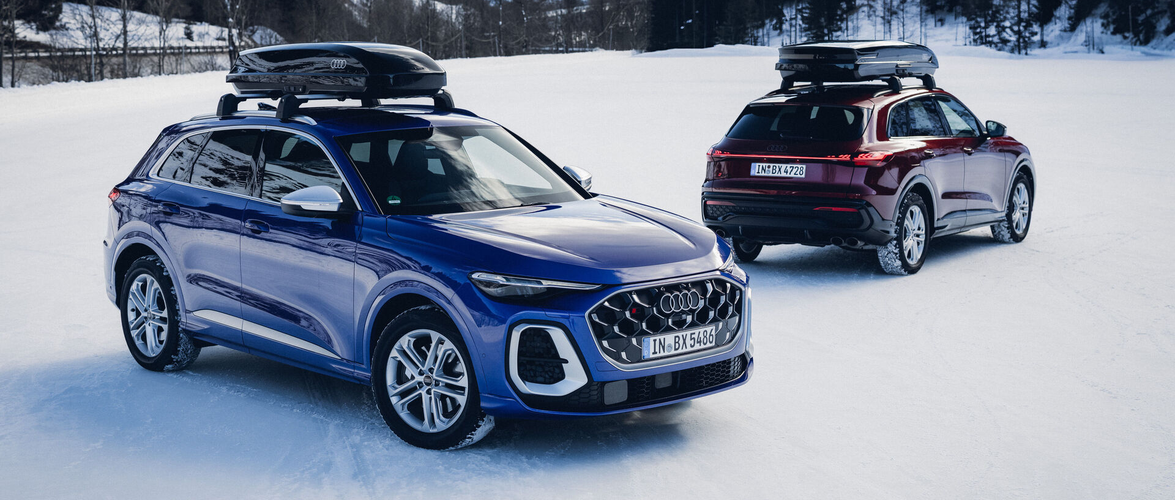
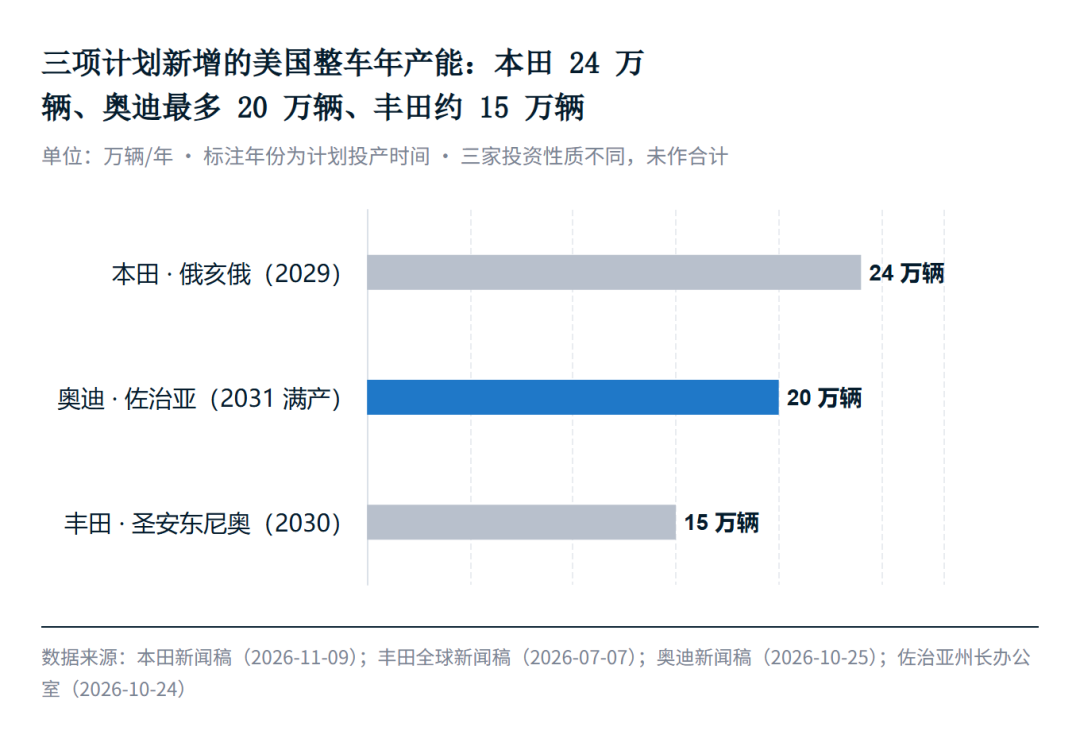
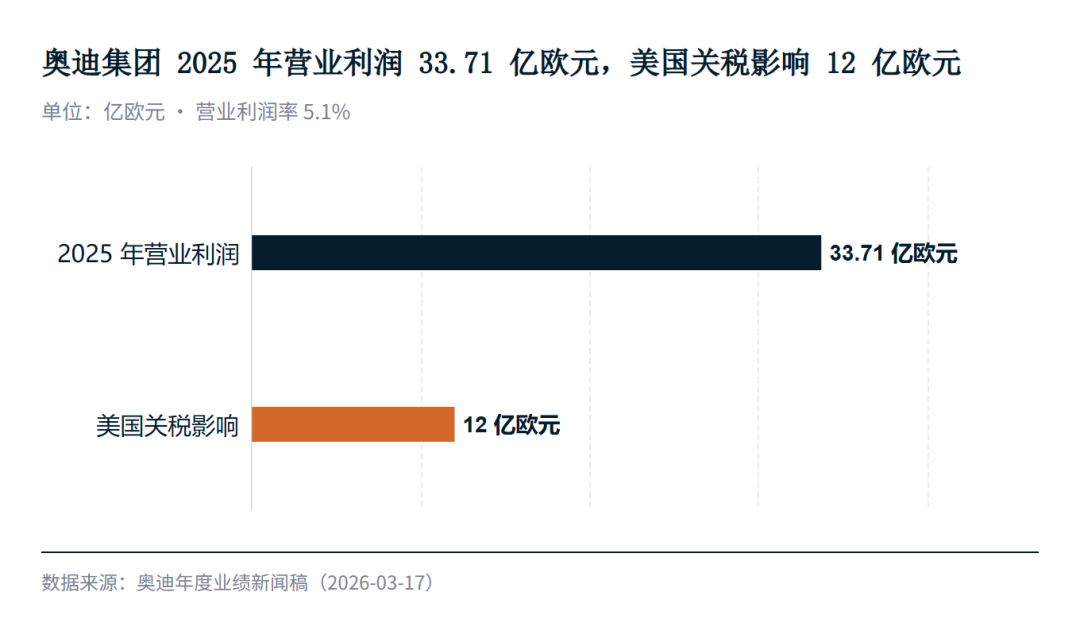
On Oct 25, Audi announced plans to build its first US plant in Georgia, with investment of about USD 4 billion and annual capacity of up to 200,000 units, producing premium SUVs for the North American market. Until now, all Audi cars sold in the US have come from plants in Europe or Mexico. In 2025, US tariffs cut Audi Group's operating profit by EUR 1.2 billion, equal to about 36% of that year's operating profit of EUR 3.371 billion.
Two weeks later, on Nov 9, Honda announced another vehicle assembly plant in Ohio. Earlier, in month 7, Toyota announced an expansion of its San Antonio, Texas plant, moving Tacoma pickup production there from Mexico. Automakers are moving production capacity back to the US.
Honda is expanding its existing Ohio production network, and Toyota is shifting output within North America from Mexico to Texas. Only Audi's new plant will replace vehicles shipped from Europe to the US, and it will not reach full output until around 2031; the decision to build it also still requires approval from the relevant Volkswagen Group committees. Of these three investments, only Audi's directly replaces European OEMs' exports to the US, and it comes later. For European suppliers, the impact arrives sooner and lasts longer: once vehicles are assembled in the US, sourcing will shift more toward North America.
Expansion, new build, reshoring: whose output each of the three investments replaces
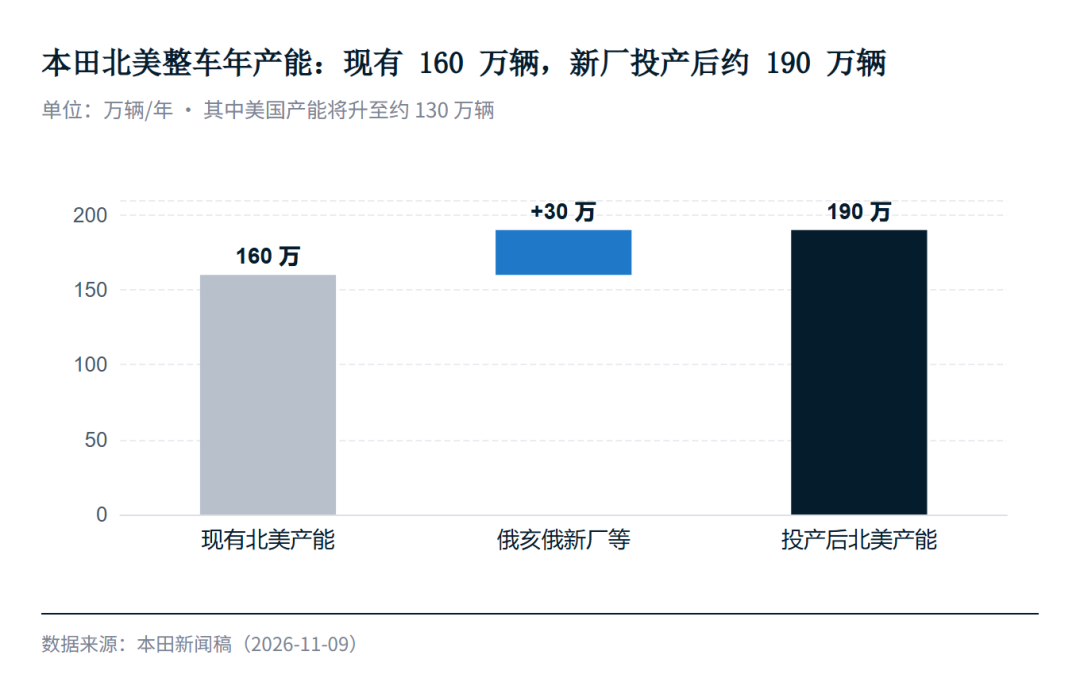
Honda's new plant sits between its existing Marysville and East Liberty plants and will be its fourth vehicle assembly plant in Ohio; production still requires final government approval. Once complete, Honda's US vehicle capacity will be about 1.3 million units a year, and its North American capacity will rise from 1.6 million to about 1.9 million units. The same investment round adds hybrid system lines at its transmission plants in Ohio and Georgia, raising Ohio's hybrid system capacity by 250%, and adds V6 hybrid engines at the Alabama plant. The new plant can build hybrid, combustion and battery-electric vehicles.
The plant mainly serves Honda's hybrid plans. In March this year, Honda cancelled three BEV models it had planned to build in North America. EV-related losses for FY2025 (ending Mar 2026) totaled JPY 1.5778 trillion, of which JPY 1.4536 trillion was booked in operating profit. At its business briefing in May, Honda set a target of launching 15 next-generation hybrid models worldwide by the end of Mar 2030, mainly in North America.
Toyota's San Antonio plant built 197,506 vehicles in 2025, all Tundra and Sequoia models. A new second vehicle assembly line will start production in 2030, adding about 150,000 units of annual capacity, and over roughly four years Tacoma production will move there from the Baja California plant in Mexico. This volume was already built in North America; what Toyota is changing is the division of work between Mexico and the US.
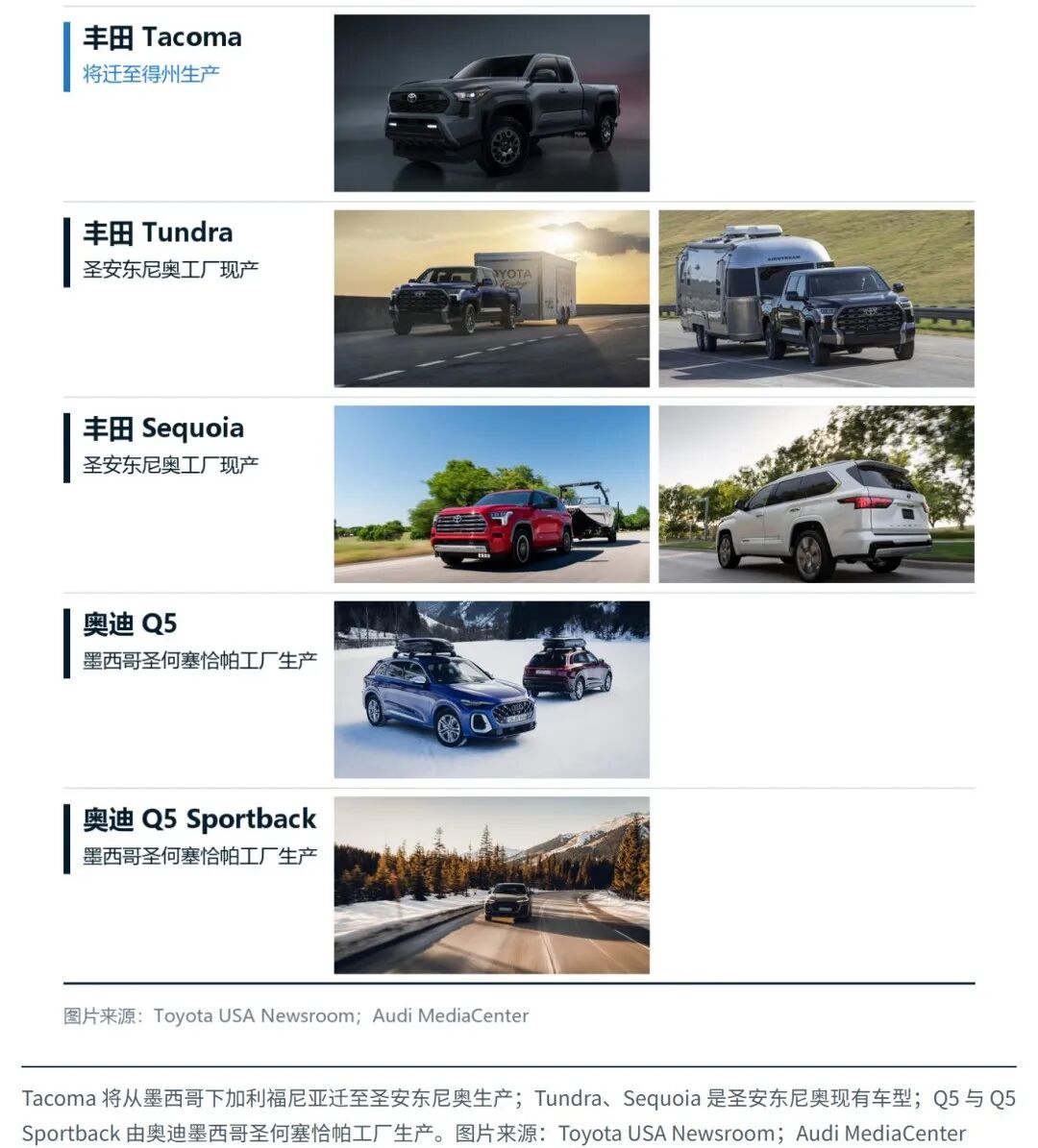
Audi calls the plant its third major production pillar after Europe and China. Under the timeline published by the Georgia state government, site grading takes place in 2027, construction starts in 2028, and full production is reached in 2031. Audi's current North American production site is its San José Chiapa plant in Mexico, which built 146784 Q5 and Q5 Sportback units in 2025. In 2025, Audi delivered 202143 vehicles in North America (excluding Mexico), down 12.2% year on year.
Of the three automakers, only Audi's new capacity corresponds to export volumes from its European plants; the added capacity at Honda and Toyota does not directly substitute for their European plants.
Tariffs from 2.5% to 15%
The US previously levied a 2.5% most-favoured-nation tariff on imported passenger cars. From Apr 3, 2025, invoking Section 232, the US imposed an additional 25% on imported vehicles on top of the 2.5%, raising the combined rate on European passenger cars to 27.5%. In a joint statement on Aug 21, the US and EU set the combined tariff on EU passenger cars at 15%, which was implemented by notice in the Federal Register on Sep 25; all vehicles entering after Aug 1 are charged 15%. Compared with before 2025, the tariff on European cars entering the US has risen by 12.5 percentage points.
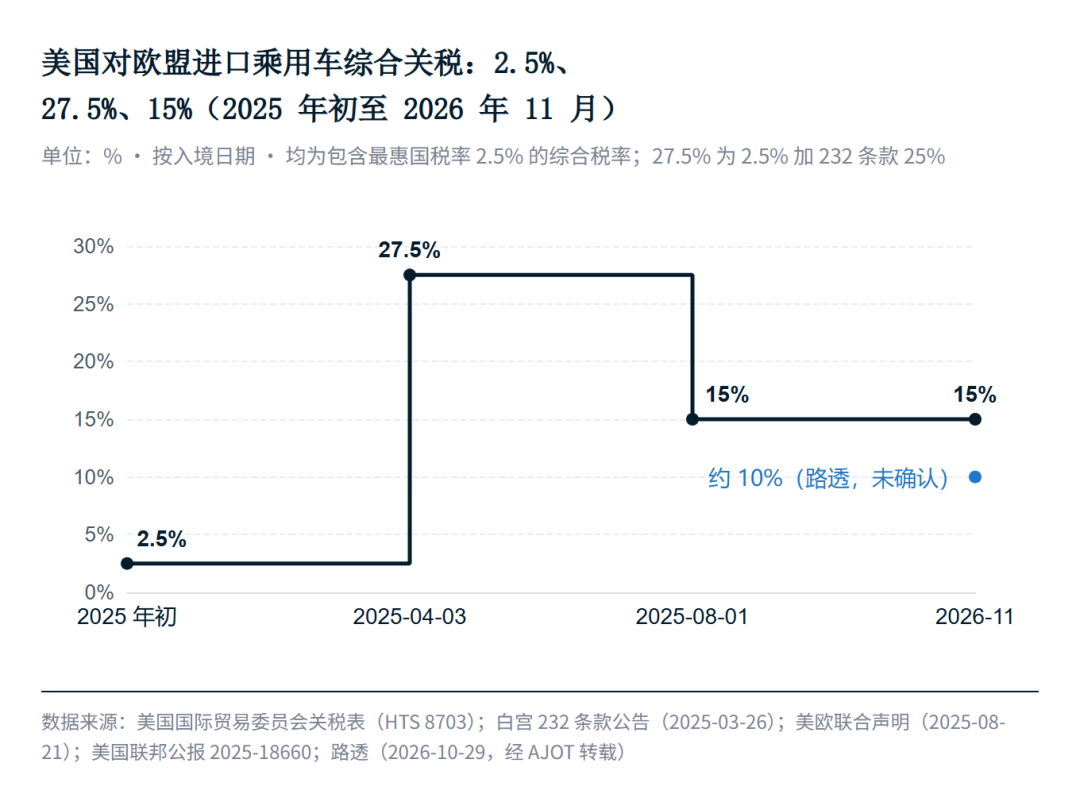
Audi Group's €1.2 billion refers to the impact of tariffs on its 2025 operating profit. That year included both the 27.5% rate from April to July and the 15% rate from August onwards. Reuters reported on Oct 29, citing two people familiar with the matter, that the US government has agreed to grant Audi tariff relief to secure the Georgia plant project; Audi had asked for the 15% rate to be cut to 7.5%, and the US Department of Commerce is expected to agree to around 10%. Audi declined to comment, and the relief has not been publicly confirmed.
Japanese automakers are also factoring tariffs into their procurement plans. At its business briefing in 5, Honda said it would raise the localisation rate of motors, inverter assemblies and components to more than four times the current level, citing the need to cushion the impact of US tariffs as one reason.
If the exemption goes ahead, European cars entering the US will no longer face a uniform 15% rate. Companies with large US investments will get lower rates, while models still exported from Europe with no plans for US production will be at a greater price disadvantage.
EU car exports to the US down by a fifth
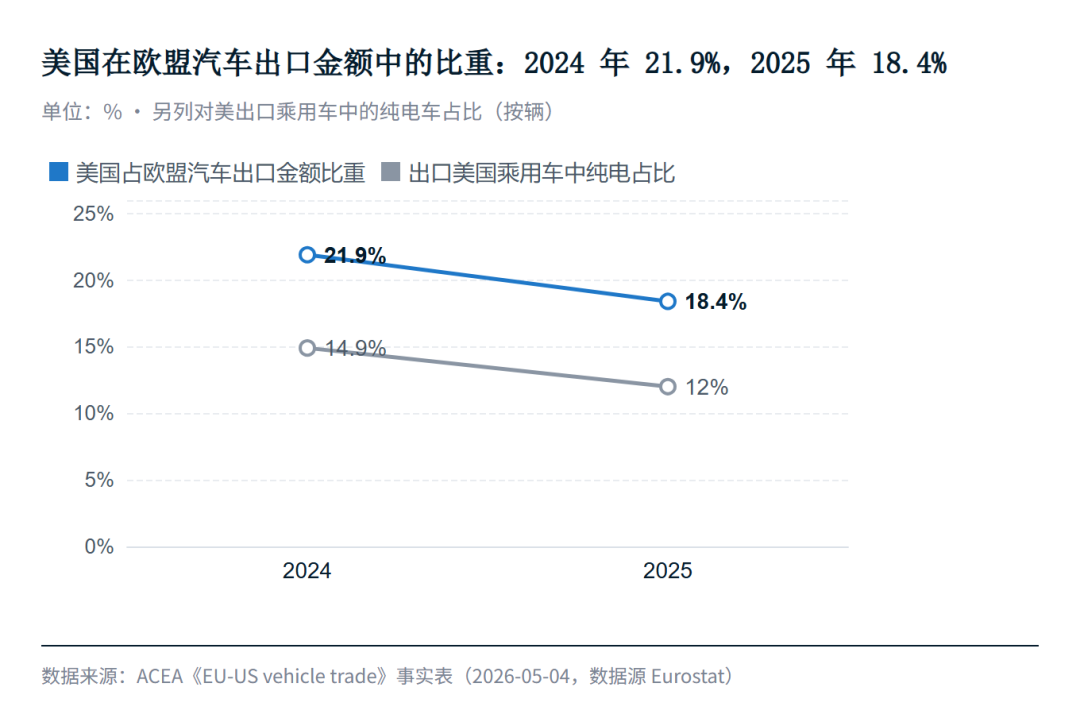
A fact sheet published in May by the European Automobile Manufacturers' Association (ACEA) shows the value of EU car exports to the US fell 21.7% in 2025 to EUR 31 billion. Passenger cars accounted for 667,794 units and EUR 30.9 billion, an average of about EUR 46,300 per vehicle. The US share of EU automotive export value fell from 21.9% in 2024 to 18.4%.
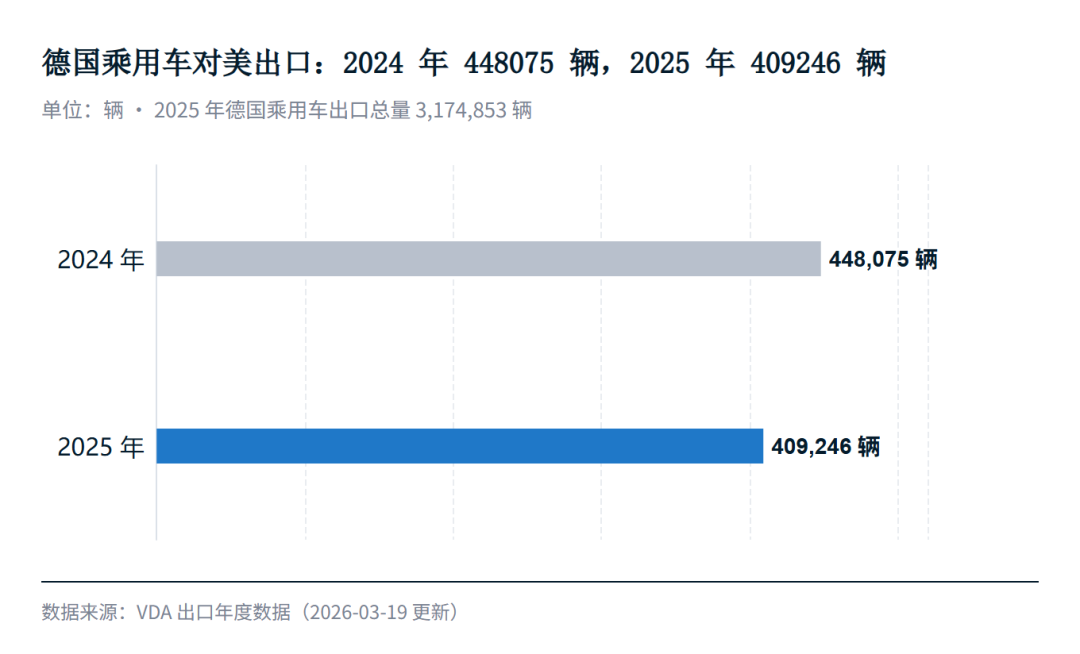
Data from the German Association of the Automotive Industry (VDA) show that German passenger car exports to the US fell from 448,075 units in 2024 to 409,246 units in 2025, a drop of about 39,000 units or 9%. The US takes about 12.9% of German passenger car exports.
ACEA's annual economic report attributes the 21.4% fall in passenger car exports to the US directly to tariffs. This figure covers passenger cars only. The BEV share of exports to the US fell from 14.9% to 12%, so the export mix itself is shifting; German passenger car exports to China fell 45% in the same year to 98313 units, so pressure on German automakers' exports does not come only from the US. A review by Austrian industry media also notes that these figures cannot cleanly separate the effects of tariffs, changes in demand and the long-term internationalisation of production. Falling exports are part of the backdrop to the plant decision, but a plant that only reaches full output after 2031 years is planned around tariff rates and US demand over the next decade, not as a reaction to one year's export figures.
Audi the last to go to the US
BMW's Spartanburg plant, which opened in 1994, built 412,799 X-series vehicles in 2025 and exported nearly 200,000 worth USD 9 billion; about 48% of output goes to export. According to the US Department of Commerce, BMW is the largest US automotive exporter by value. Volkswagen's Chattanooga plant, which opened in 2011, has built more than 1.85 million vehicles to date.
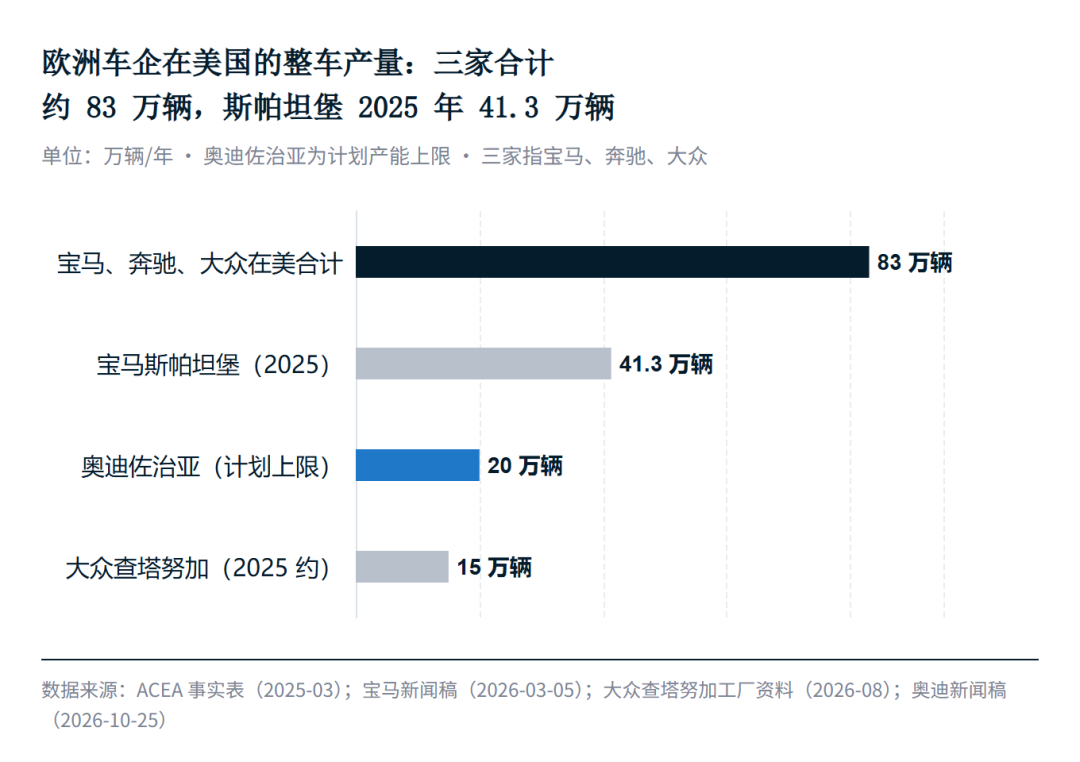
According to ACEA's fact sheet from March last year, BMW, Mercedes-Benz and Volkswagen together build about 830,000 vehicles a year in the US and export 50% to 60% of them. With a capacity of up to 200,000 units, Audi's Georgia plant would equal about 24% of the three companies' current US output.
European automakers' US plants were always export bases, shipping more than half their output to other markets. Audi is building its first US plant more than three decades after BMW. The new plant will produce SUVs for North America, replacing vehicles previously shipped there from Europe.
Components
BMW's investments already point toward local sourcing. On Nov 13, BMW opened its high-voltage battery assembly plant in Woodruff, South Carolina, and began series production. The plant has more than 300 employees and 250 robots, is about 24 km from the Spartanburg vehicle plant, and supplies battery packs for BEVs assembled in the US. It only assembles packs and does not make cells. Of the $1.7 billion South Carolina investment BMW announced in 2022, $700 million went to Woodruff.
Also in November, BMW announced that it has added LG Energy Solution as a supplier of its Gen6 cells in the US and Samsung SDI in Europe. Alongside CATL and EVE Energy, they will supply from their existing local plants from the late 2020s. BMW calls this "local for local": sourcing components as close to its vehicle plants as possible to shorten transport distances and improve supply security. Under this principle, US-assembled vehicles will use US-made cells wherever possible and European-assembled vehicles European-made cells. The two new suppliers will not begin deliveries until the late 2020s.
Honda's move to more than quadruple the localisation rate of motors and inverters points in the same direction. US plants don't automatically exclude European suppliers; European companies that already have North American plants may even win new orders. The squeeze falls on plants exporting parts from Europe.
Powertrain mix is also changing parts demand. Honda focuses on hybrids in the US, and Europe is moving the same way. ACEA data show that hybrids made up 36.3% of EU new car registrations from month 1 to 9 of 2026, and BEVs 22.7%, up from 16.1% for BEVs a year earlier. Hybrids need engines and transmissions as well as motors, power electronics and batteries, so supplier orders depend on the specific powertrain mix, not just vehicle output.
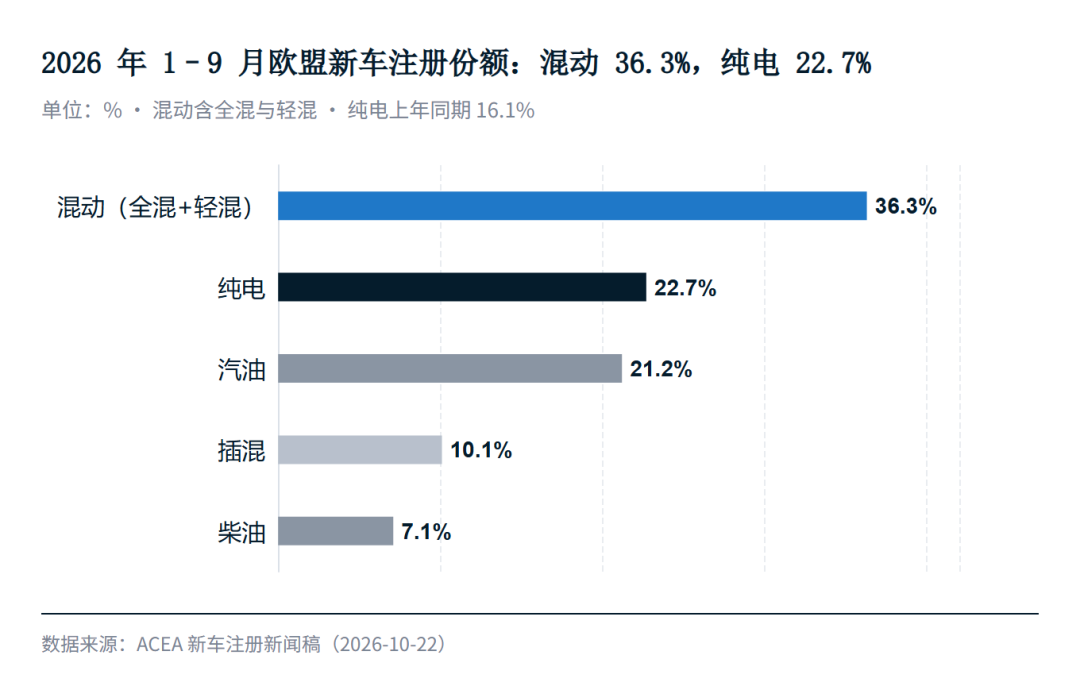
Source: Chart by AutoMusic based on the public sources listed in the article; first published on the AutoMusic WeChat account.
Cost pressure at home in Europe is also mounting. The Volkswagen Group CEO said in a recent interview that labour costs in Germany are about twice those in other European countries and that the group will cut more than 100,000 jobs. German suppliers that want to follow customers in setting up plants in the US will first have to deal with cost and capacity problems at home. For European suppliers, what matters is whether they have North American capacity and can win sourcing nominations for these new models, not how much is invested in new US plants. Suppliers without North American plants are at a disadvantage in competing for this new business.
Audi's decision and tariff relief
Honda's and Toyota's US investments mainly reshuffle production allocation within North America and their respective powertrain strategies. European OEMs' exports to the US will only be directly replaced once Audi's Georgia plant starts production, and will be phased out gradually until it reaches full capacity in 2031. For European suppliers, sourcing for new North American models is decided before vehicle production starts, so this round of pressure will reach them earlier than the OEMs.
Sources: Honda press releases (2026-11-09, 2026-05-14, 2026-03-12) and FY2025 results materials; Toyota press release (2026-07-06) and Texas plant fact page; Audi press release (2026-10-25), 2025 results and delivery data, Mexico plant information; Office of the Governor of Georgia (2026-10-24); Volkswagen Group (2026-10-25); Reuters (2026-10-29, via AJOT); US-EU joint statement (2025-08-21); US Federal Register 2025-18660; White House Section 232 proclamation (2025-03-26); ACEA fact sheets (2025-03, 2026-05), annual Economic and Market Report, Sep 2026 registration data; VDA export statistics; BMW press releases (2022-10-19, 2026-03-05, 2026-11-09, 2026-11-13); Volkswagen Chattanooga plant information; ecomento (2026-11-16); Industriemagazin (2026-11).