Overseas brand sentiment, issue 2: after-sales problems worsen for nine Chinese automakers, Europe included
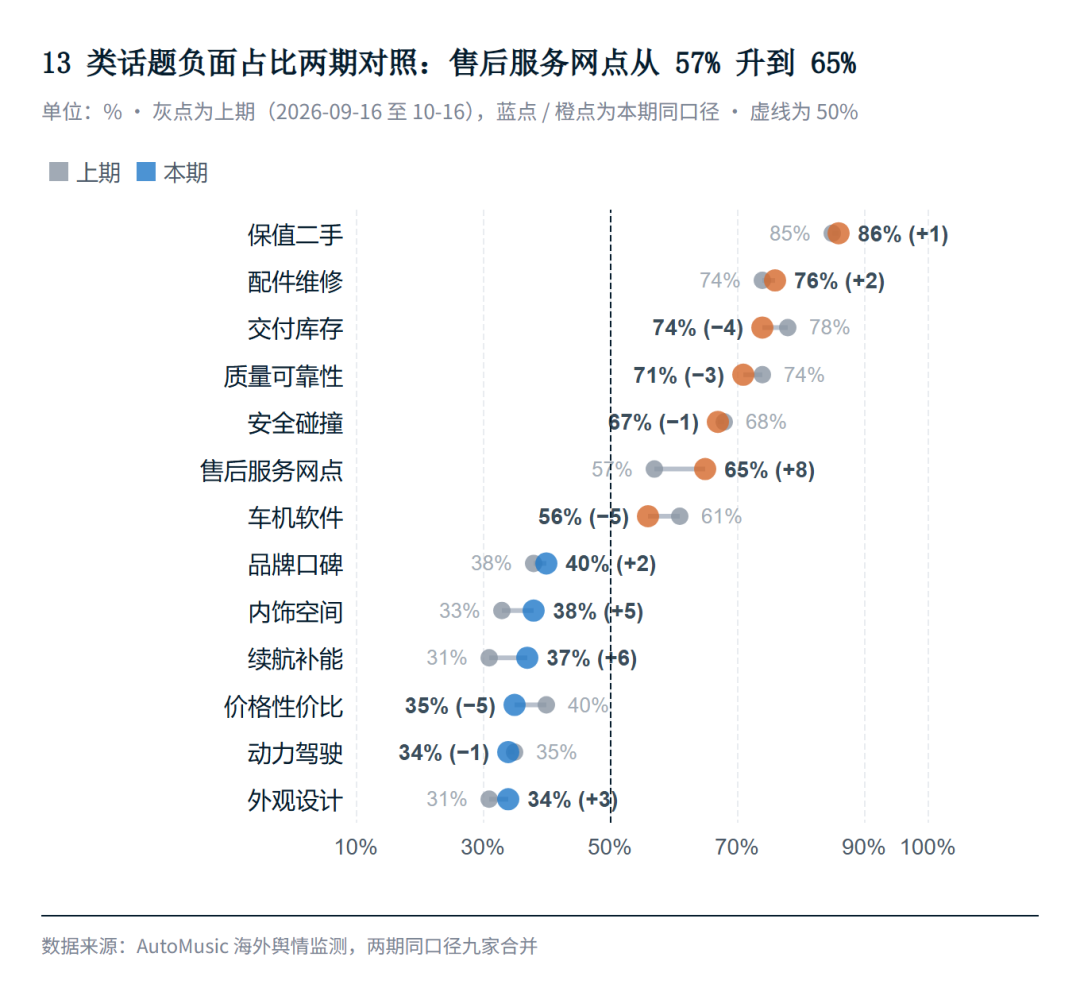
From 2026-10-17 to 11-14, across 48901 overseas discussions about nine Chinese automakers, design and powertrain still drew mostly positive comments. For after-sales networks, every 1 positive comments were matched by about 2 negative ones, compared with about 1.3 in the previous period.
A German video about the 30,000 km first service drew nearly 200 negative comments. After the owner described the service, commenters discussed service charges, whether the transmission oil needed changing and parts that were slow to arrive. Some said this made them give up on buying. Germany had 2,197 discussions this month, with 186 negative and 44 positive about service outlets, the widest gap of any European country.
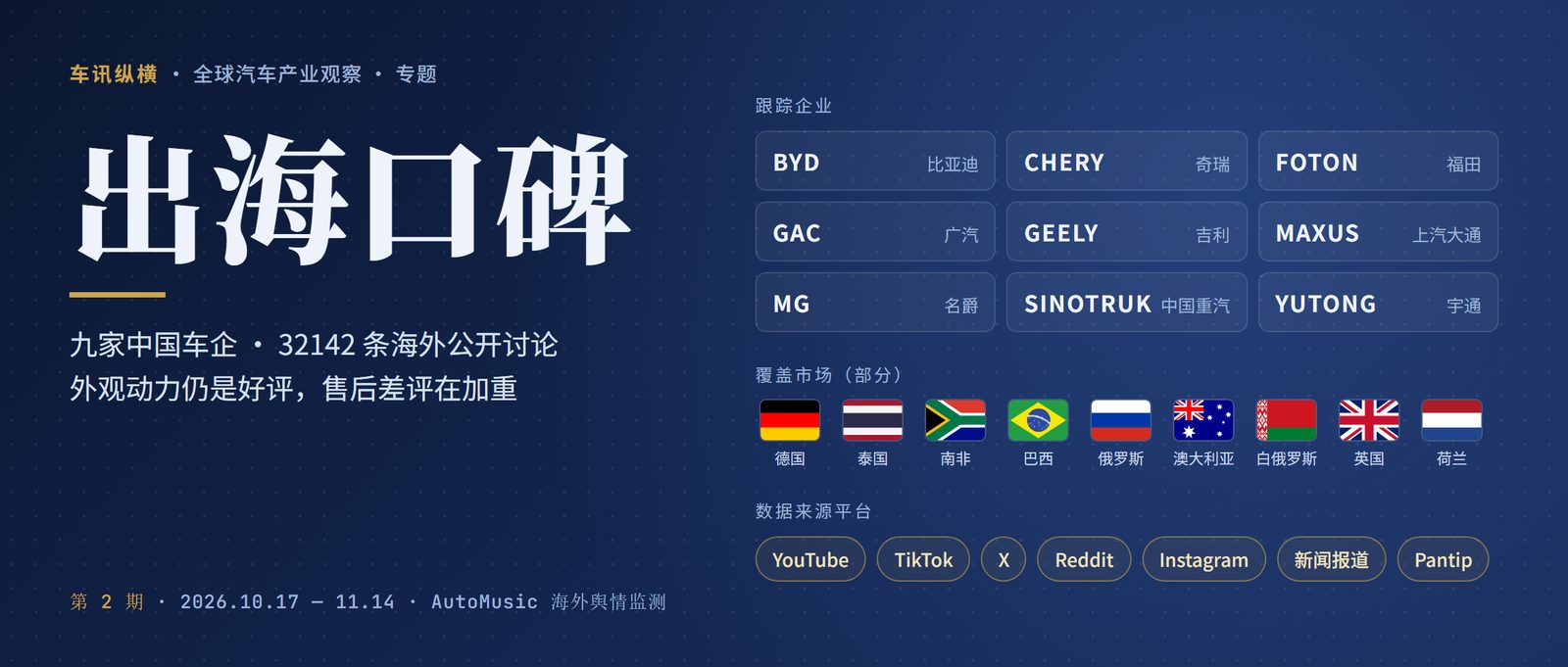
From 10 to 11, nine companies (BYD, Chery Group, Geely, MG, GAC, Maxus, Foton, Sinotruk and Yutong) generated 48901 public discussions overseas (GAC counted from Oct 16). Sources include YouTube, TikTok, X, Reddit, news reports and Thailand's Pantip forum, excluding content posted by brands themselves or by dealers. This month, monitoring expanded to all markets where the nine have sales; 25 European countries accounted for 12514 posts, roughly a quarter. Positive comments still outnumber negative ones for all nine on exterior, interior and powertrain; on price, only Foton has slightly more negatives. After-sales network, parts and repairs, and residual value/used cars remain negative-leaning. For the after-sales network, every 1 positive comments are matched by roughly 2 negative ones, versus about 1.3 last period. The vehicles themselves are still well received, but negative sentiment after delivery has grown, including in Europe, where expectations for after-sales service are high.
The table follows a fixed order; the number of entries does not reflect share of voice. BYD and Chery together account for about 55%, so the nine-company total mainly reflects these two. Each topic below notes which companies it covers.
Styling and performance still praised
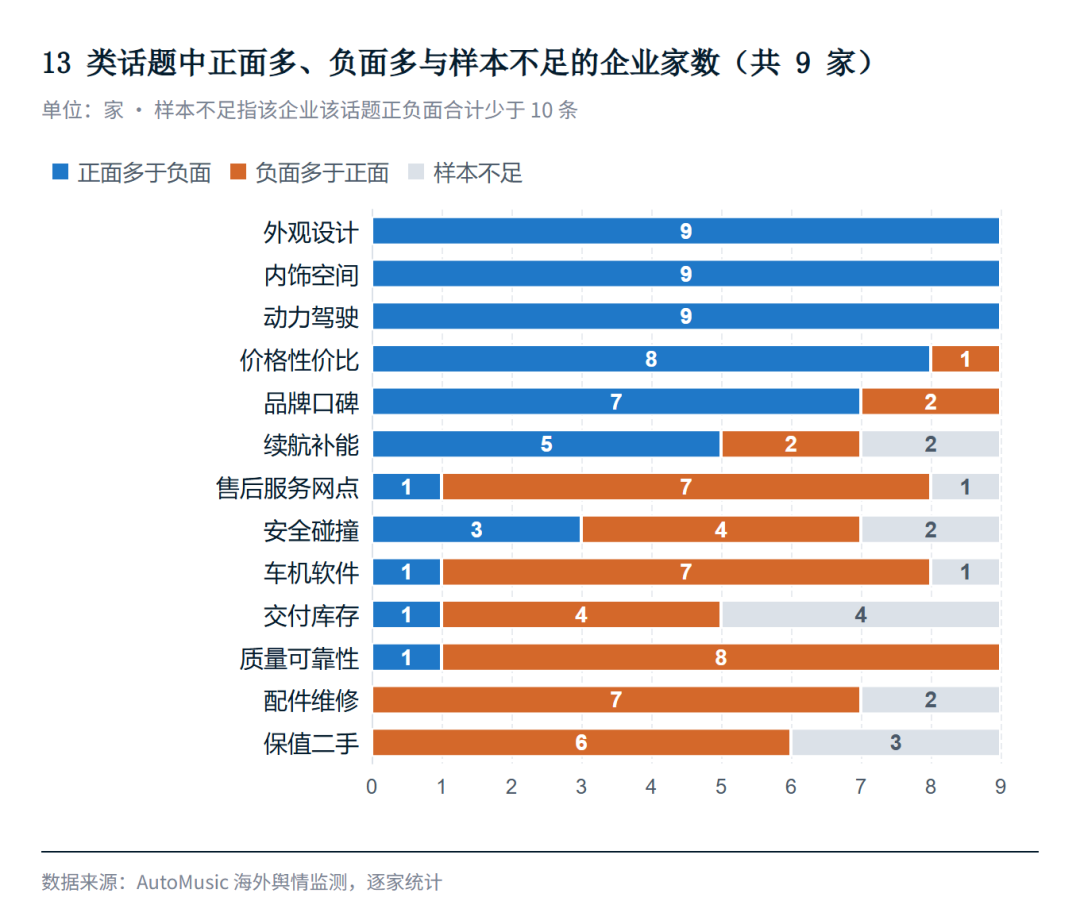
Across the nine automakers, exterior design draws about 2.2 positive comments for every 1 negative ones, still the highest positive-to-negative ratio of any topic. Individually, all nine have more positive than negative comments on exterior design, interior space and performance/driving. Praise mostly targets specific models' styling, space, acceleration and features, and appears in new-car reviews, launch coverage and under short videos.
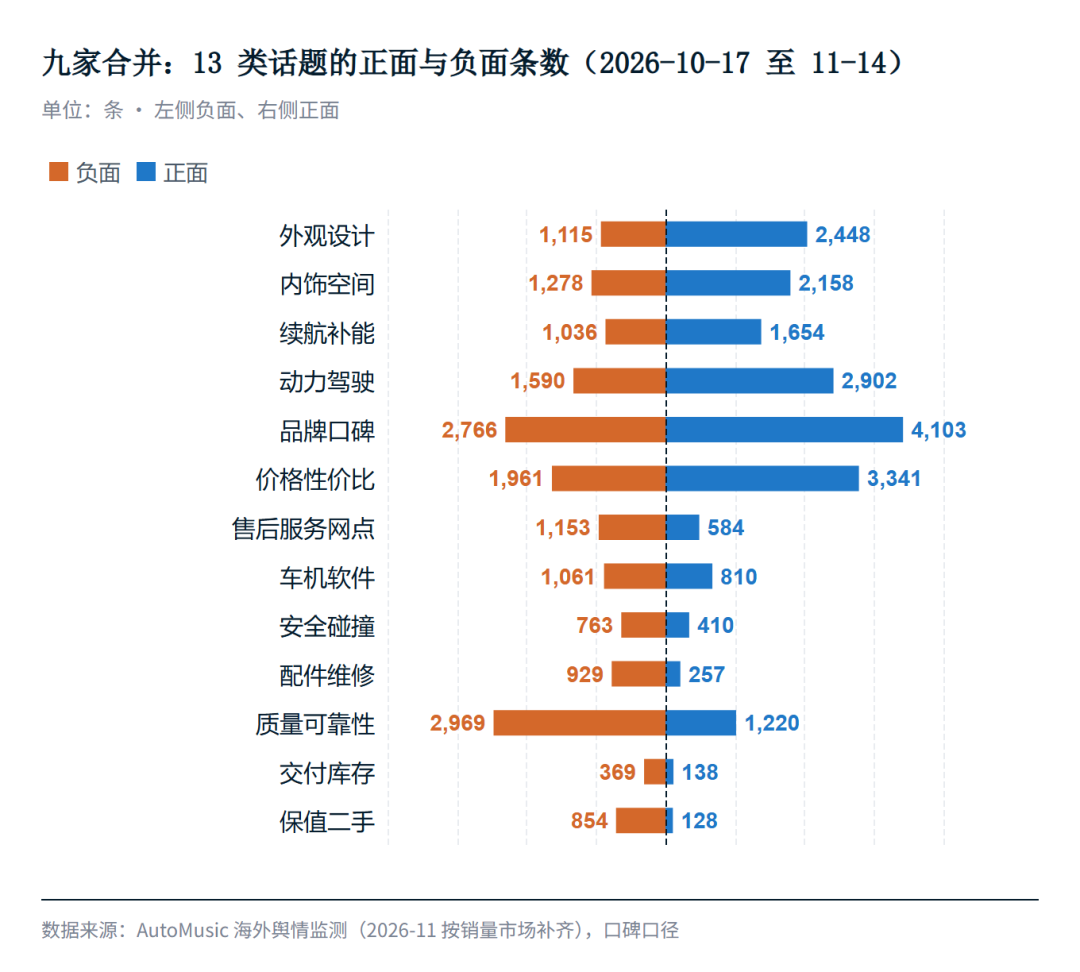
Negative comments on price were spread across several markets: in Brazil, the new Chery Omoda E5 and the Aion UT were criticised as not cheap enough; in Vietnam, the MG ZS Hybrid is priced on par with Japanese and Korean cars; in Russia and Kazakhstan, buyers compared Chinese domestic prices with local prices. Of the nine brands, only Foton had slightly more negative than positive price comments, stemming from discussion of Tunland pricing in Brazil, Russia and Turkey.
Positive feedback on range and charging declined. Last month there were about 2.2 positive mentions for every 1 negative ones. This month the figure is about 1.6, and just 1.7 when counting only markets monitored last period. Maxus and Foton drew more negative than positive mentions: Maxus mainly over the winter range of its electric vans, Foton over the fuel consumption of the petrol version of its pickup. Positive mentions of interior space also dipped slightly, while exterior design, performance and price were broadly unchanged from last month.
Negative reviews of after-sales outlets worsened within a month
After-sales service networks were the topic with the biggest change this month. Across the nine brands, there were 584 positive and 1153 negative mentions, with negatives making up 66% of positive and negative comments. This month covered more markets and channels than last time; the negative share was 65%, versus 57% in the previous period. Of the eight brands with more than 10 positive and negative mentions combined, only Sinotruk had more positive than negative; BYD, Chery, Geely, MG, GAC, Maxus and Foton all skewed negative.
New this month were service charges and network coverage: owners in Germany and Australia questioned service items and fees, one UK owner said the dealership in their town had closed, and a Danish owner worried the brand had too few outlets locally. Parts waits persist: owners in Thailand and South Africa reported waiting five to six months for repairs or parts, and a Polish owner said they waited 30 days just for a damage assessment after an accident.
Parts and repairs drew 257 positive and 929 negative posts, or about 3.6 negative for every 1 positive. Counting only markets monitored in the previous period, the figure is 3.2, versus 2.8 last month. All seven brands with enough posts had more negative than positive mentions. Resale value drew 128 positive and 854 negative posts, or about 6.7 negative for every 1 positive; on a like-for-like basis it is 6.0, versus 5.6 last month. All six brands with enough posts had more negative than positive mentions. After time-limited price cuts on several models in Thailand, existing owners shifted their discussion from price to residual value.
Two areas improved slightly. For infotainment software, every 1 positive mentions were matched by about 1.3 negative ones, down from 1.5 last month; complaints centred on having to turn off driver-assistance alert sounds every time the driver gets in. For delivery and inventory, the same measure fell from 3.6 to 2.9.
All of these issues arise after handover, and all require a local setup to resolve: service prices must be published per market, parts need local warehousing and reliable delivery times, and residual values depend on pricing cadence and official used-car channels.
25 European countries: pricing well received, after-sales equally weak
Net sentiment (positive minus negative, divided by total posts) across 12514 European posts was +3.6%, versus +3.9% outside Europe, roughly the same. The difference lies in topics. Negative posts on price and value made up 28% in Europe versus 41% elsewhere, so European users are more accepting of Chinese car pricing. Negative shares for after-sales networks, parts and repairs, and resale value were 65%, 79% and 85%, almost identical to the all-market figures of 66%, 78% and 87%. Negative posts on brand reputation made up 44%, 4 percentage points above the all-market figure.
Countries differ widely. The UK had 2585 posts with net sentiment of +7.9%; new car reviews leaned positive, but on resale value there were 9 positive and 97 negative posts, with comments focused on how much value cars lose in a year. Spain (1178 posts, +20.8%) and Greece (395 posts, +34.2%) leaned positive. Negative sentiment was concentrated in Germany and Poland, both at −9.4%. In Germany, complaints centered on aftersales charges and parts availability. Poland had 1851 posts, with MG, BYD and Chery discussed most. Comments mostly calculated how much used cars would fetch, worried that no one would supply parts if a brand exited, and some said electric vans had too little range in winter.
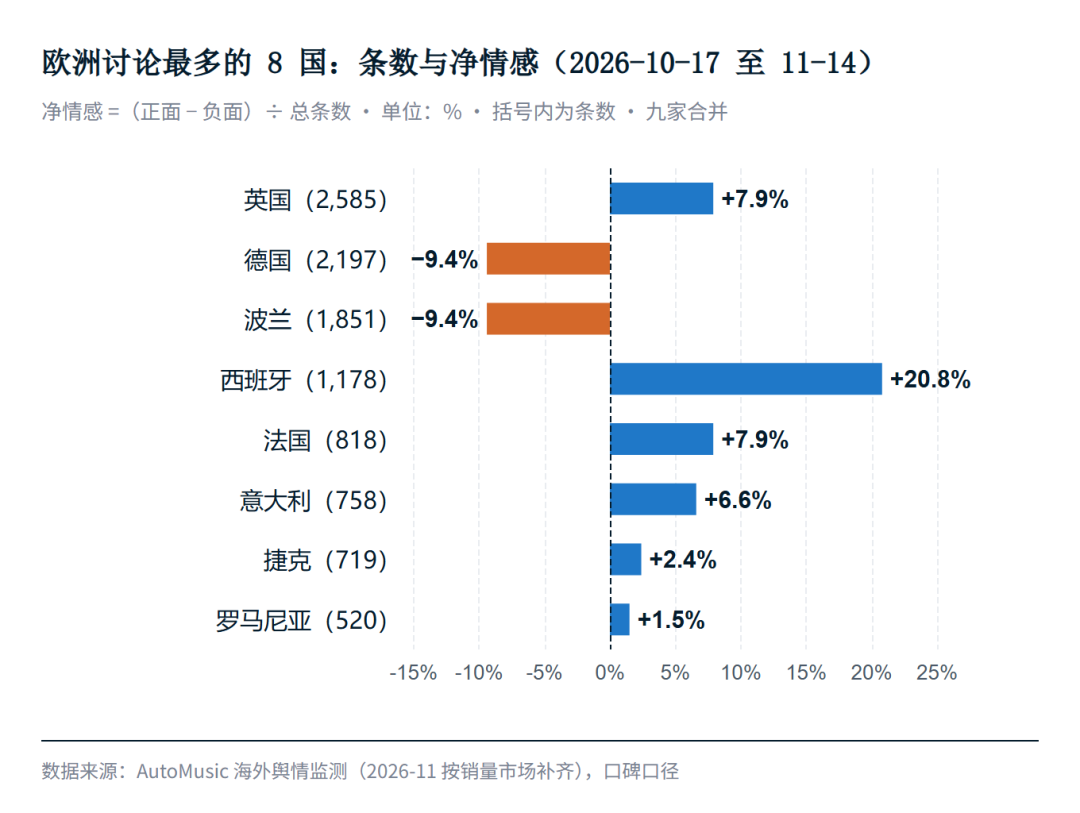
The most negative videos from Germany and Poland come from owners who have driven 30,000 km or owned the car for two and a half years, and they focus on first service and resale. For companies expanding in Europe, opinion on pricing is already fairly positive, but post-delivery reputation will depend on first-service charges, parts availability and used-car residual values.
Summary by automaker
Quality and reliability remain the topic with the most negative mentions, 1220 positive and 2969 negative; of the nine companies, all except Yutong have more negative than positive mentions.
BYD. Reviews of the Sealion 07, Seagull and Shark 6 lean positive, as do the UK and Spain. Negatives center on after-sales and parts in Germany, Thailand and Poland; about a third of Germany's negatives come from one owner's first-service video.
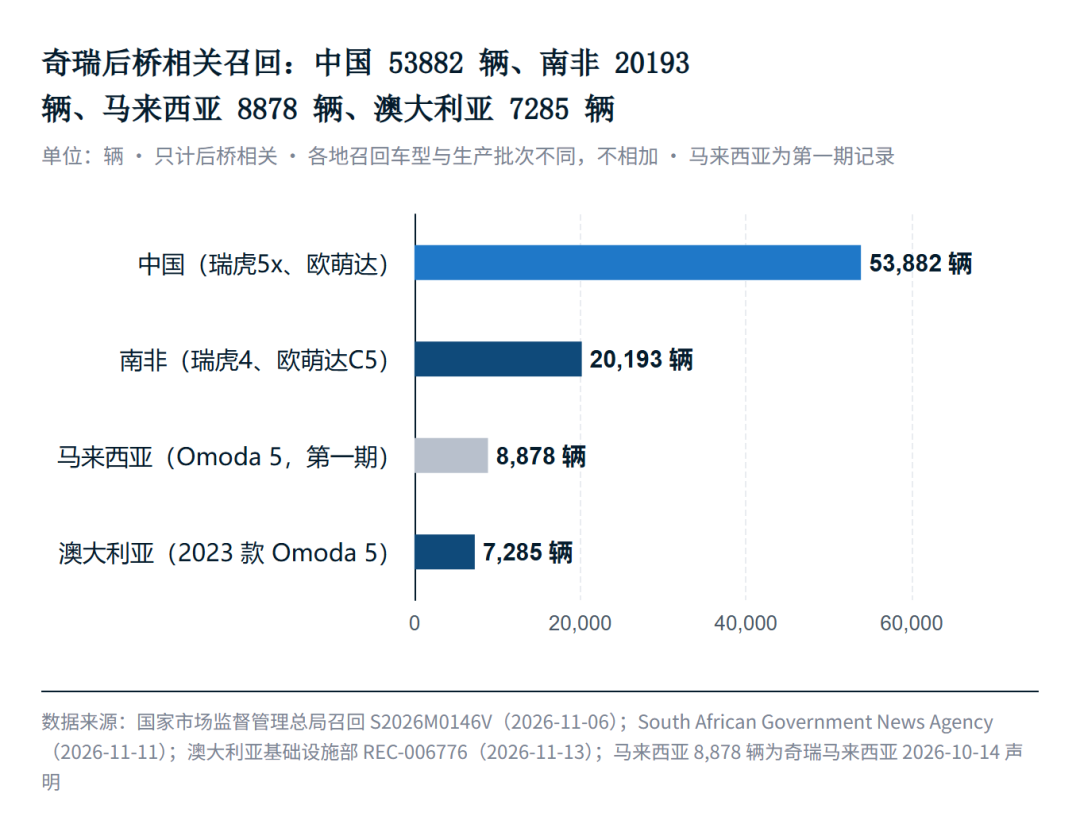
Chery Group. Comments on the Tiggo 7 and Tiggo 9 lean positive, as do those from Spain and Greece; negative comments in the UK focus on chassis build quality and first-year depreciation. The main negative theme remains the rear axle issue. On Nov 6, the State Administration for Market Regulation issued a recall notice covering 53882 Tiggo 5x and Omoda vehicles produced from Jun 6, 2022 to Dec 31, 2023, due to possible poor welding between the rear axle trailing arm and the sleeve, with free inspections from Nov 27. South Africa's National Consumer Commission announced on Nov 10 Chery recalls totalling 23667 vehicles, of which 20193 Tiggo 4 and Omoda C5 units involve the rear axle and another 3474 Tiggo 8 Pro Max units involve brake lines; the commission also said it has opened an investigation into allegedly unreported recalls, while Chery South Africa described them as precautionary. Australia recalled 7285 units of 2023 Omoda 5 models, with Chery saying no related incidents had occurred locally. In addition, on Oct 28 Latin NCAP gave the 4-airbag version of the Tiggo 2 zero stars under its 2026 protocol.
Geely. Reviews in Mexico, the UK and Spain were mostly positive. Negative comments came from discussions of rust protection and paint quality in Belarus, debate over pricing of the facelifted Boyue L in Kazakhstan and Russia, and delivery waits for the Xingyuan (EX2) in Brazil. On Nov 3, Geely Brazil confirmed that some Xingyuan versions were out of stock, with new shipments arriving in months 11 and 12 and local production starting in month 12; customers with existing orders will get priority delivery at unchanged prices.
MG. Sentiment in the UK and Spain leans positive, with coverage of the new MG4 and ZS drawing plenty of praise. Negatives centre on residual values and parts in Poland and Germany, and on pricing of the ZS Hybrid in Vietnam.
GAC. Comments on the Aion UT and Aion V were broadly positive. Negatives came from Russian discussions of high-mileage condition and rust, and Polish concerns over GAC Emkoo pricing and long-term parts supply. No recalls or regulatory notices were found this period.
Maxus. Launch reviews of the T70 in Peru were mostly positive. Negative coverage centred on the reliability and parts supply of the T60, along with Polish comments on electric van range in winter. No recalls or regulatory notices were found in this issue's period.
Foton. Reviews of the Tunland were broadly positive in Australia and South Africa; negative coverage in Russia, Turkey and Brazil was largely driven by one or two videos. Russia's sales restrictions on specific models such as the 77N5BJ had not been lifted as of the end of this period.
Sinotruk: HOWO short videos are mostly positive in Vietnam and Indonesia. Nigeria's Federal Road Safety Corps reported that in Oct 20, a HOWO dump truck fully loaded with asphalt rolled backward into a car in Kano. Investigation findings have not yet been released.
Yutong. Coverage of new vehicles entering service and route launches leaned positive, and among the nine brands only Yutong had slightly more positive than negative posts on quality and reliability. Negative posts fell into two groups: passenger comments on seats and appearance, and the ongoing discussion in the Netherlands and Norway about remote access. Replying to parliament in 5, the Dutch state secretary confirmed that contracting authorities cannot always rule out the possibility of vehicles being remotely restricted or disabled, while stating there is no evidence that unwanted remote control is actually feasible or has occurred.
Across the nine companies, quality and reliability remain the biggest source of negative posts for the five passenger car makers combined. Negativity around after-sales, parts and residual values worsened from last month. For the four commercial vehicle makers, negative posts came mainly from quality discussions about specific models and from individual accidents. For passenger car makers, the post-delivery service network is already affecting their reputation. For commercial vehicle makers, how they respond to accident investigations and operators' feedback is just as important.
Media still more upbeat than online users
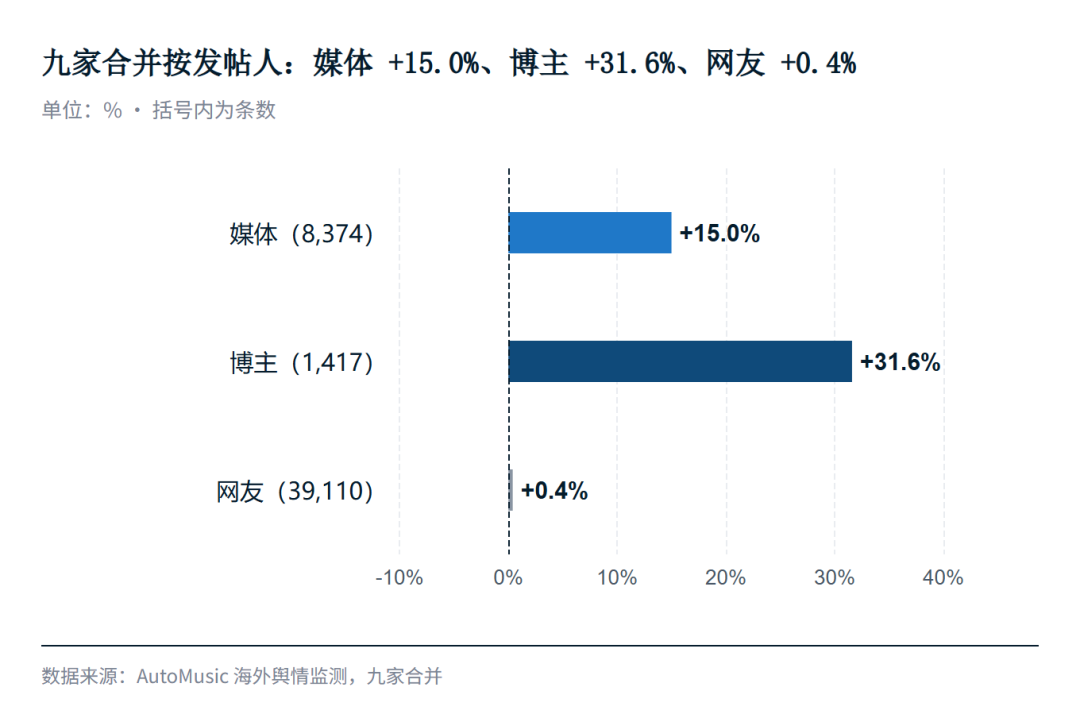
By poster type, net sentiment is +15.0% for media, +31.6% for bloggers and +0.4% for ordinary users; users posted 39110 items, about 80% of all discussion. For seven of the nine companies, media are more positive than users. The exceptions are Sinotruk and Yutong: user content for these two is mostly short videos of new vehicle deliveries and route launches, while media coverage includes accidents and industry reports.
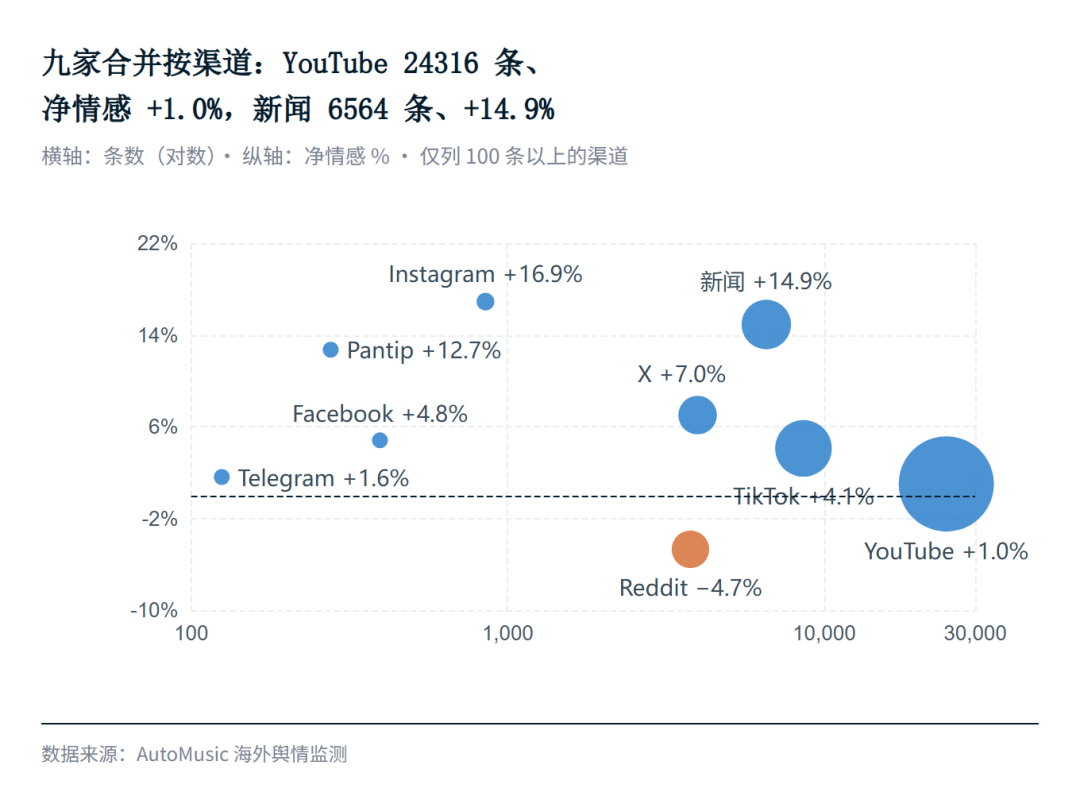
By channel, news is the most positive (+14.9%) and Reddit the most negative (−4.7%); the largest source, YouTube, has 24316 posts with net sentiment of +1.0%.
Media coverage focuses more on launches and sales, while comment sections talk more about servicing, parts and resale values. Reading only the coverage makes it easy to miss this post-delivery side of reputation.
Toyota's 2010 recall
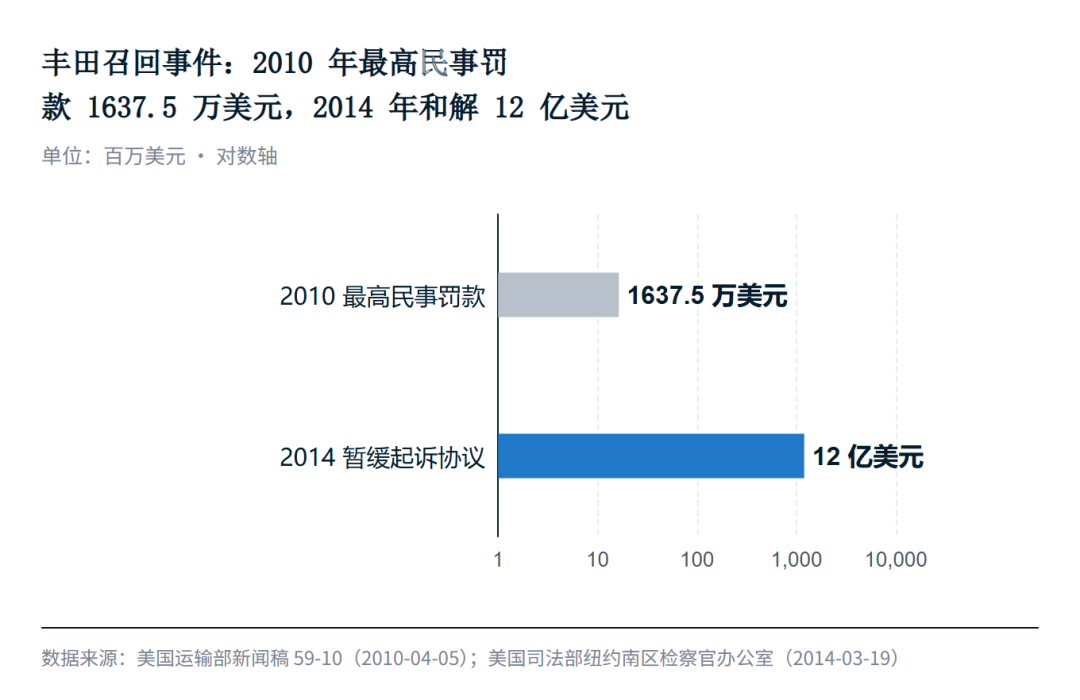
Recalls hurt a brand's reputation; how they are handled determines how long the damage lasts. From late 2009 to early 2010, Toyota recalled more than seven million vehicles in the US over accelerator problems. On Apr 5, 2010, the US Department of Transportation sought the maximum civil penalty of USD 16.375 million, on the grounds that Toyota had failed to report the pedal defect within five working days. In Mar 2014, Toyota reached a USD 1.2 billion deferred prosecution agreement with the US Department of Justice, admitting it had concealed information and misled consumers. Then Attorney General Eric Holder said a recall may damage a company's reputation, but deceiving customers makes that damage far more lasting.
Source: Chart by AutoMusic based on the public sources listed in the article; first published on the AutoMusic WeChat account.
After-sales reputation must be built market by market
As last month, overseas discussion of the nine brands splits into two halves. Styling, powertrains and equipment are praised in reviews, and new launches bring a fresh wave of positive comments. Negative feedback on after-sales service, parts and residual values appears after delivery, and it was more prominent this month, including in Europe. Beyond product improvements, the second half has to be addressed mainly through dealer and service networks, warehousing and price management in each market. Problems are currently most concentrated in markets such as Germany and Poland, where owners have started going in for first services and reselling their cars.
"Overseas Reputation" is updated monthly. The next issue will revisit the recalls, deliveries and after-sales issues mentioned here to check for progress. If you work in after-sales, parts or distribution in overseas markets, share what you're seeing in the comments.
Sources: AutoMusic overseas media monitoring (Oct 17, 2026 to Nov 14; 11 filled in for markets by sales volume); SAMR recall notice (2026-11-06); South Africa's National Consumer Commission (2026-11-10); SAnews (2026-11-11); Australian Department of Infrastructure REC-006776 (2026-11-13); Malaysia Road Transport Department (2026-10-11); BYD statement (2026-11-11); Canal VE (2026-11-05); RIA Novosti (2026-10-12); Latin NCAP (2026-10-28); BusinessDay (2026-10-21); Dutch parliamentary written answer No. 2014; US Department of Transportation press release 59-10 (2010-04-05); US Department of Justice (2014-03-19); NHTSA unintended acceleration investigation report (2011-02).