EU passenger car market passes its electrification tipping point in 2025, as traditional leaders and Chinese newcomers go head to head
The EU passenger car market underwent a structural shift in 2025. Latest ACEA data show that electrified vehicles (BEV + PHEV + hybrid) reached a market share of 61…
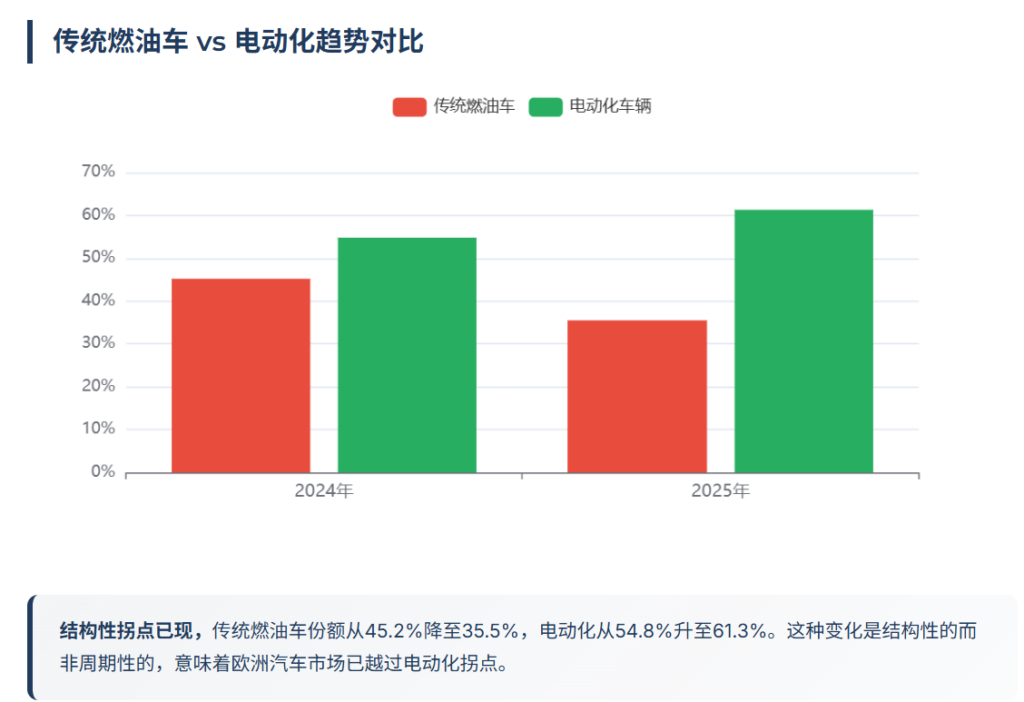
The EU passenger car market underwent a structural shift in 2025. The latest ACEA data show that new energy vehicles (BEV + PHEV + hybrid) reached a market share of 61.3%, exceeding 60% for the first time. Conventional combustion cars (petrol + diesel) fell from 45.2% in 2024 to 35.5%, a drop of nearly 10 percentage points in one year. The European car market has passed its electrification tipping point.
A three-stage shift: the realistic path to electrification in Europe
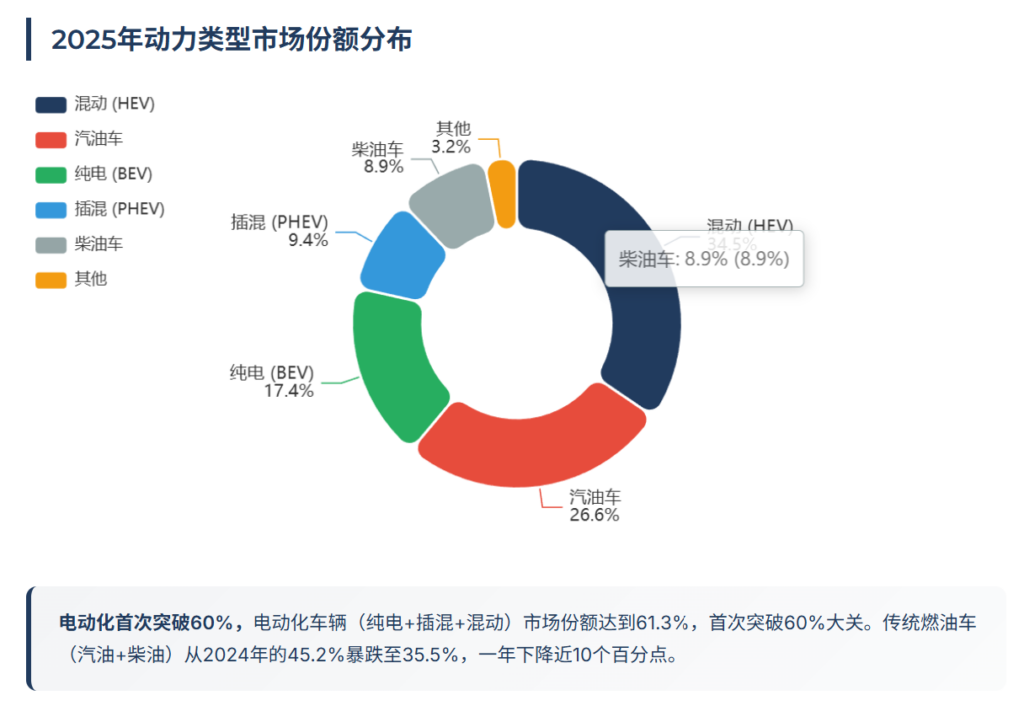
In 2025, EU battery-electric (BEV) registrations reached 1880370 units, a 17.4% market share, up 3.8 percentage points from 13.6% the year before. Hybrids (full and mild) registered 3733325 units for a 34.5% share, still the largest single powertrain type. Plug-in hybrids (PHEV) registered 1015887 units, a 9.4% share. Correspondingly, the combined share of petrol and diesel fell to 35.5%, from 45.2% the year before. European consumers are leaving conventional combustion engines, but new demand is not all going to BEVs; more buyers are choosing hybrids and PHEVs as a transition.
A BEV penetration rate of 17.4% looks good, but it is not yet enough to fully reassure the industry or policymakers. Total cost of ownership at purchase (especially as subsidies are phased out) and charging convenience still keep many households and corporate fleets in the "hybrid/PHEV" segment. Hybrids' 34.5% market share reflects what buyers actually prefer: a noticeable improvement in fuel consumption, emissions and running costs without changing how they refuel. PHEVs' 9.4% reflects a different need: when city commuting can be done on electricity but long trips require certainty, PHEVs become the compromise between policy and consumers.
BEV at 17.4%: overtakes ICE for the first time in history in 12
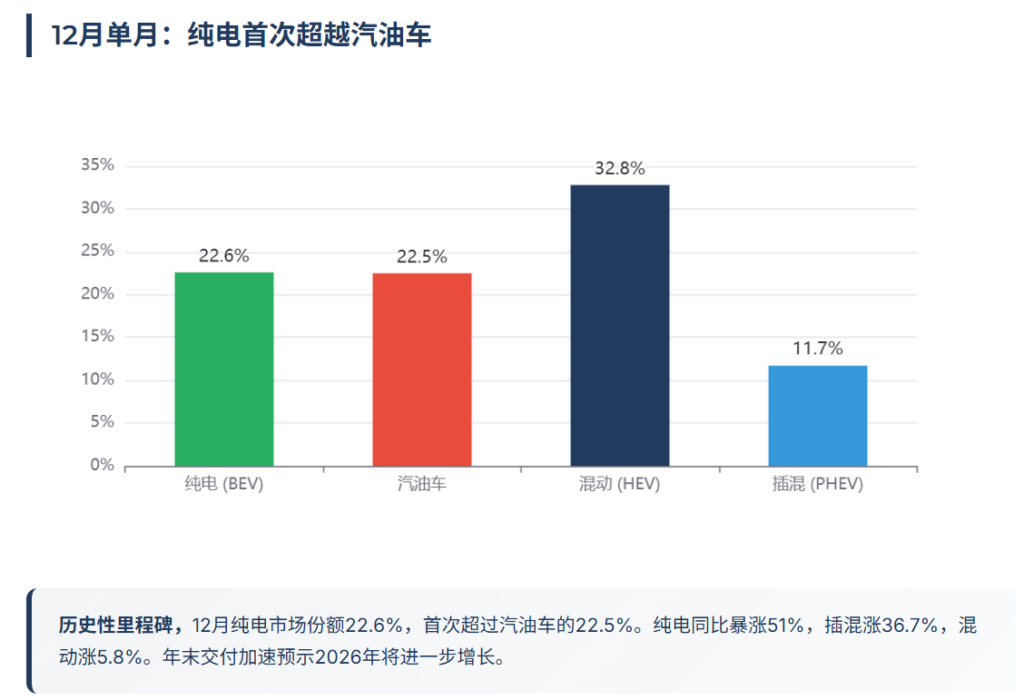
In 2025, battery-electric vehicles (BEVs) took a 17.4% market share with 1.88 million registrations, up 3.8 percentage points from 13.6% in 2024. December stood out: the BEV share reached 22.6%, up 51% year on year, and passed petrol's 22.5% for the first time ever. Consumer acceptance of BEVs is rising fast.
Germany contributed the most, with 545142 BEV registrations, up 43.2%. The Netherlands, Belgium and France grew 18.1%, 12.6% and 12.5% respectively. The four largest markets accounted for 62% of all BEV registrations, showing that EV adoption in Europe remains concentrated in core countries.
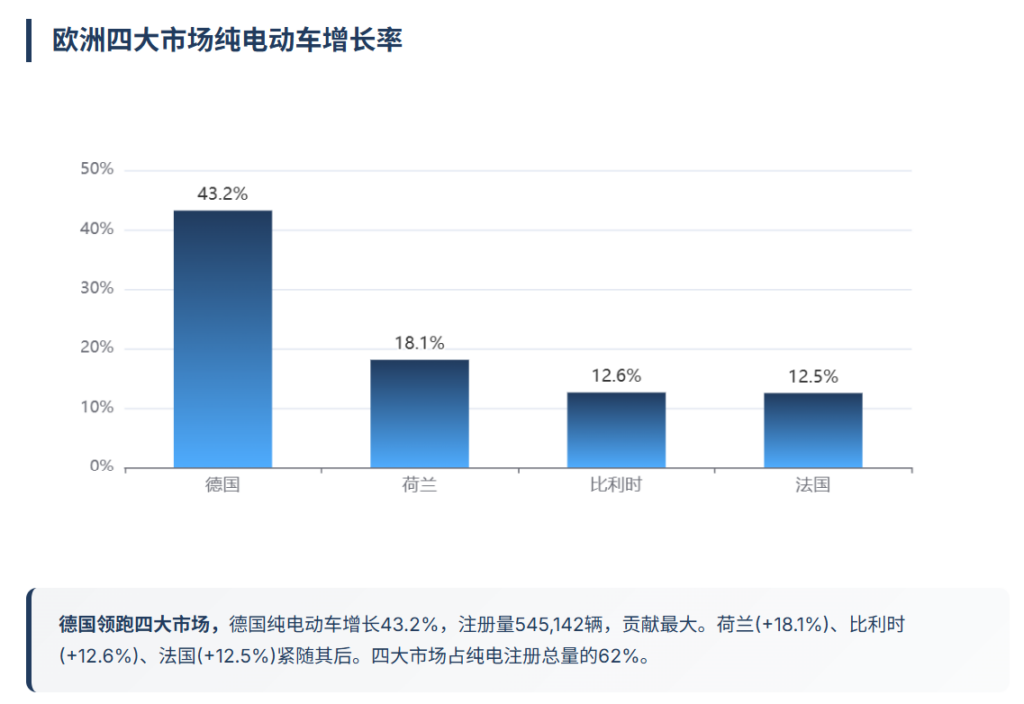
Together, the four countries accounted for about 62% of BEV registrations in the EU. Europe's BEV expansion looks more like "spillover from core markets" than all member states entering the same stage at once. For automakers, product and channel strategies need to be more country-specific: compete on efficiency and brand in high-penetration countries, and on lower entry barriers and use-case education in low-penetration ones. Differences in the maturity of charging networks, residual value systems and financial products will directly decide whether a BEV model can scale.
PHEVs grew fastest in southern Europe (Spain and Italy), reaching 111.7% and 86.6% respectively. This is a practical choice driven by patchy charging infrastructure: consumers want the electric driving experience and policy benefits without the range anxiety of a BEV.
Hybrids at 34.5%: a pragmatic choice for the transition
Hybrids became the best-selling powertrain in 2025 with a 34.5% market share and 3.73 million registrations. This shows European consumers are clear in their attitude towards electrification, but need a longer transition period to accept BEVs. Hybrids require no change in driving habits, bring no range anxiety, cut fuel consumption by 20–30% compared with pure combustion cars, and are priced close to conventional ICE vehicles. For most households, they are the safest bridge from combustion to battery-electric. By market, hybrids grew 21.6% in France, 23.1% in Spain, 8% in Germany and 7.9% in Italy, driven mainly by best-selling models offered in hybrid versions.
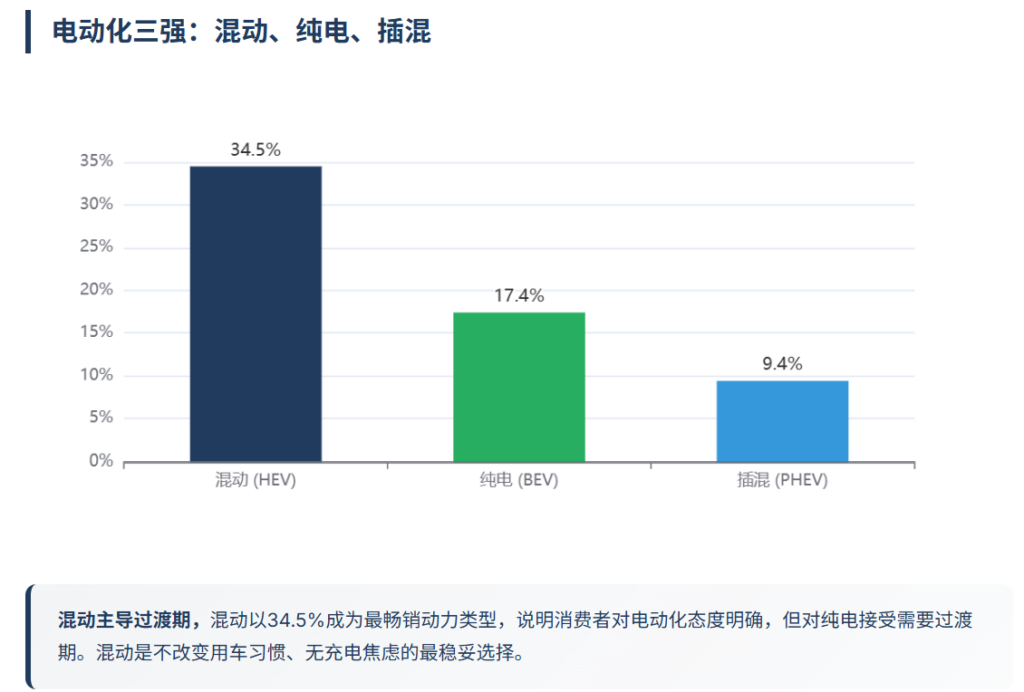
But hybrids are a transitional product. As EU CO2 emissions regulations keep tightening, hybrids can only help companies comply in the short term; in the long run, BEVs are the direction. This explains why European automakers continue investing in BEV platform development even as they push hybrids hard.
The structural decline of conventional ICE vehicles is irreversible
Petrol cars' market share fell from 33.3% to 26.6%, with registrations of 2.88 million units, down 18.7%. Diesel cars continued to shrink to 8.9%, with registrations down 24.2%. Combined, their share fell from 45.2% to 35.5%, a drop of 9.7 percentage points in one year. The shift is driven by three factors:
On the policy side, the EU's target to end sales of combustion cars in 2035 is set, and national purchase incentives are tilting towards EVs. The 32% drop in petrol cars in France is a direct result of policy.
On the technology side, the three core EV issues of range, charging and cost are being resolved quickly. A range of 300-400 km is now mainstream, fast-charger density is rising, and falling battery costs are bringing EV prices closer to those of combustion cars.
For consumers, driving an EV is a far better experience than a combustion car: faster acceleration, less noise and more smart features. Once consumers have experienced an EV, it is hard for them to go back.
Petrol declines in the major markets were sharp: down 32% in France, 21.6% in Germany, 18.2% in Italy and 16% in Spain. Conventional combustion vehicles are being squeezed by policy, urban low-emission rules, automakers' product offerings and consumer expectations all at once. The European car market is entering a phase in which combustion vehicles lose the mainstream narrative. Consumers will increasingly factor future residual value risk and usage restriction risk into purchase decisions. Once this expectation takes hold, the decline of combustion vehicles may come faster than before.
2025: traditional incumbents go head-to-head with Chinese newcomers
Looking at the manufacturer landscape, Europe's car market is undergoing an unprecedented restructuring of power.
Traditional Big Three hold their core base, but growth is weak
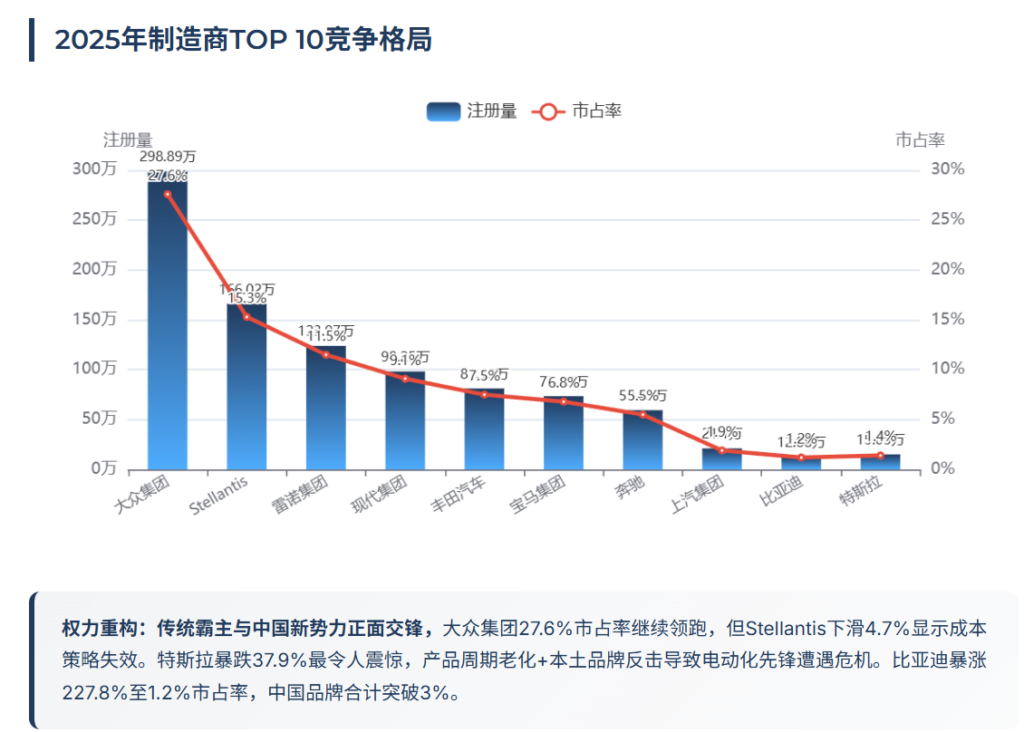
Volkswagen Group registered 2988870 units in the EU in 2025, a 27.6% market share, up 5.5% year on year. But given the heavy investment in electrification, Volkswagen's growth has come mainly from price wars and promotions. Stellantis registered 1660155 units, a 15.3% share, down 4.7%. Renault Group registered 1239693 units, a 11.5% share, up 5.6%, the most resilient of the traditional big three.
Korean and Japanese brands grow against the trend
Hyundai Motor Group sold 982454 units, a 9.1% market share, up 6.0% year on year; Toyota sold 811892 units, a 7.5% share, up 8.3%. Their growth against the trend shows that during the electrification transition, a hybrid advantage, disciplined pricing and supply chain efficiency still work. Toyota in particular saw its long-standing commitment to hybrids pay off in 2025.
Premium brands stall across the board
BMW Group registered 734546 units, a 6.8% share, down 3.1% year on year; Mercedes-Benz registered 594337 units, a 5.5% share, down 3.4%. Under economic pressure, European consumers are reassessing whether the "luxury premium" is justified. More importantly, BMW's and Mercedes-Benz's BEV products have not been strong enough to sustain their brand premium.
Tesla plunges 38%
Tesla sold 150504 units, a market share of just 1.4%, down 37.9% year on year. This is the most striking figure in the 2025 EU market. An ageing Model 3/Y lineup, the electric counteroffensive from European brands and Tesla's lack of local production in Europe all contributed. Now that EVs are no longer scarce, Tesla's brand moat is eroding fast.
Chinese brands: BYD surges 227.8%, SAIC Motor grows steadily
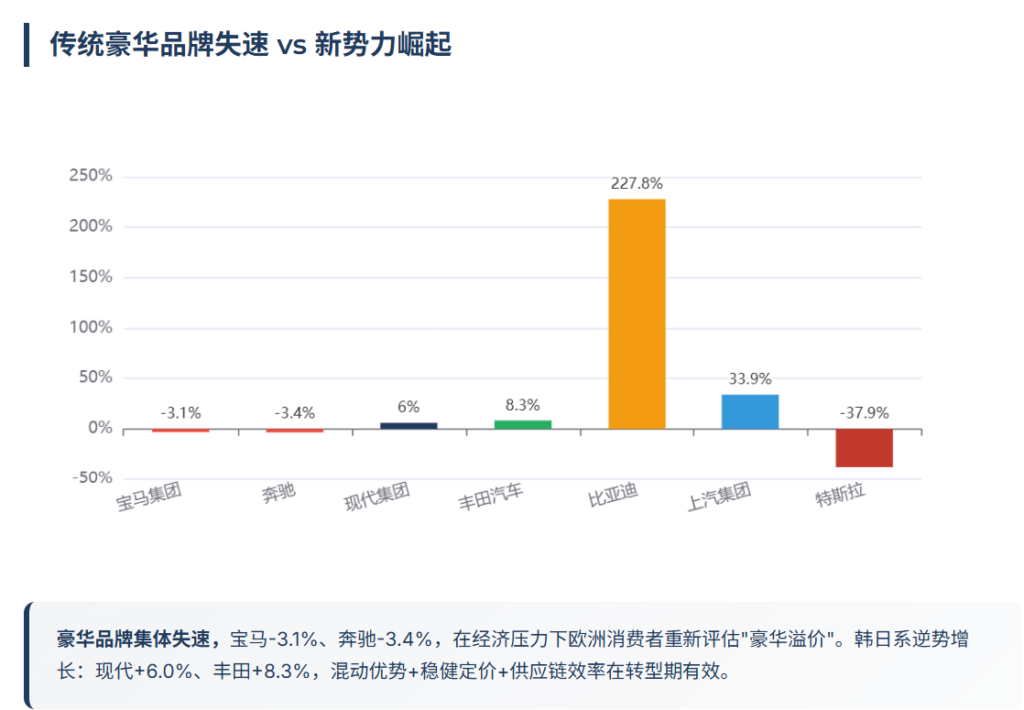
BYD sold 128,827 units, a 1.2% market share, up 227.8% year on year; SAIC Motor sold 211,014 units, a 1.9% share, up 33.9%. Together the two Chinese brands exceeded 320,000 units, pushing their combined share past 3%. BYD's surge reflects the success of its value-for-money strategy: in Europe, it offers equipment and performance on par with local brands at lower prices. SAIC Motor (MG brand) has built a stable sales network through years of localised operations.
The logic of competition in the European market has changed
The contest is shifting from "brand premium dominance" to a balanced competition of "product strength + pricing system + channel operations". The era of high premiums for legacy brands is ending, and Chinese brands are rapidly entering the market on the strength of price advantages and accumulated electrification technology. 2025 is only the beginning; the reshaping will intensify in 2026.
Electrification will accelerate further in 2026
Based on data and trends from 2025, electrification of the European car market will accelerate further in 2026.
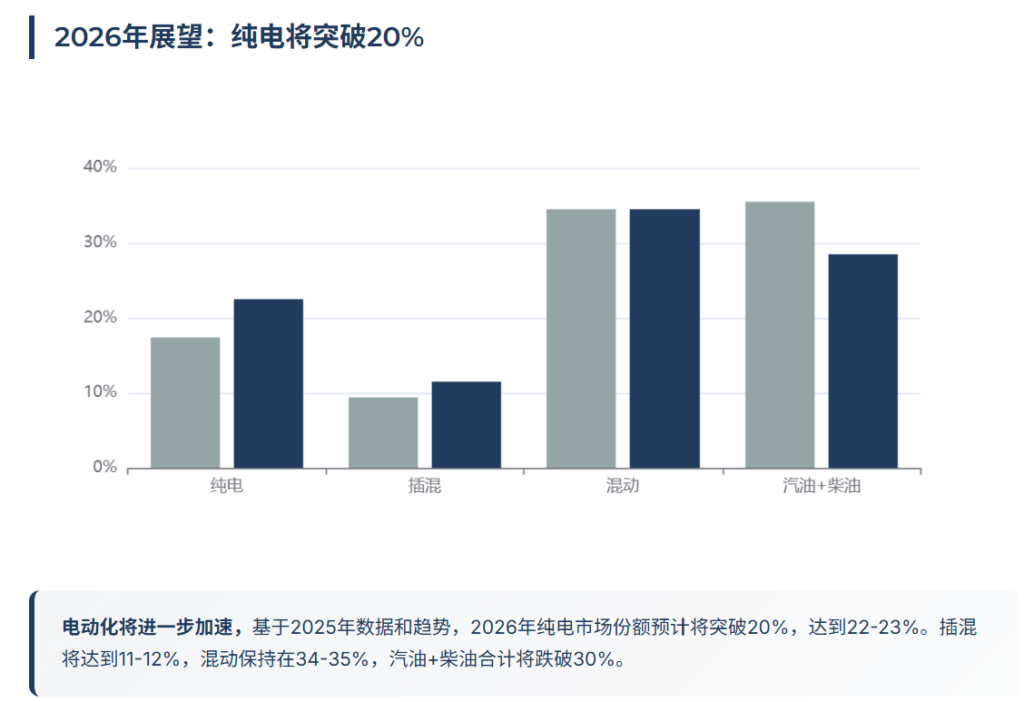
For BEVs, market share is expected to pass 20%, reaching 22-23%. Key drivers include more BEV launches, falling battery costs, better charging infrastructure and growing consumer acceptance.
For PHEVs, market share is expected to reach 11–12%, with continued popularity in Southern European countries and among family buyers.
Hybrids: market share is expected to hold at around 34–35%, remaining a mainstream choice, but to be gradually replaced by BEVs over the long term.
For combustion-engine cars, the combined share of petrol and diesel is expected to fall below 30%.
Europe's car market has passed the tipping point in its electric transition. The next phase of competition is no longer combustion versus electric, but a contest between electrification routes: BEV, PHEV and hybrid. Whoever strikes the best balance between cost, convenience and performance will win the market. The coexistence of multiple powertrains will keep complexity high for the long term, and platform and modular strategies will determine cost control.
Lessons for Chinese automakers
The opportunity for Chinese automakers from Europe's accelerating electrification is that European acceptance of EVs is rising rapidly, and Chinese automakers' accumulated technology and product competitiveness in electrification can be converted into market share. Brands such as BYD, NIO and XPeng have already established a presence in Europe.
European consumers have higher expectations of brand, quality and service, so Chinese automakers need to build a complete localised operating system, covering brand building, sales networks, after-sales service and charging partnerships.
More importantly, Europe's electrification path differs from China's. China jumped straight from combustion to BEVs, with a very low PHEV share; Europe is developing hybrids, PHEVs and BEVs in parallel. This means Chinese automakers need to adapt their product strategies for Europe rather than simply replicating their domestic model.
Europe's shift to electrification is irreversible, and the 61.3% electrification rate in 2025 is only the beginning. Over the next 5 years, Europe will complete the transition from ICE dominance to electric dominance, a process that will also reshape the competitive landscape of the global auto industry.
**Reproduction or excerpting without permission is strictly prohibited.** Questions and comments are welcome. Follow us for ongoing analysis of the latest developments in China and abroad.