Understanding Chinese NEV commercial vehicles in Europe: moving toward systematic penetration
From 2024 to 2025, Europe's new energy commercial vehicle market is undergoing structural change: bus electrification is accelerating, electric urban delivery VANs are shifting from policy-driven adoption to operations at scale, and while heavy-truck penetration remains low, the path forward is clear. Chinese brands are diverging markedly across these three segments: electric buses have reached the top tier, light vehicles have achieved breakthroughs in several countries, and heavy trucks remain mostly at the pilot and validation stage, though their technical solutions are increasingly "Europeanized". The sales data of Chinese NEV commercial vehicles show the situation in each segment more clearly:
- Electric buses: Chinese brands hold 20–25% of the European market. Yutong has ranked first in sales for two years running. BYD has delivered more than 5,000 battery-electric buses in total.
- Electric vans/light trucks: Chinese brands hold an overall share of about 5–7%. Maxus sold 54000 NEVs in 2025, giving it a 2.4% share of the UK market. BYD's monthly market share in Italy once reached 24%.
- Electric heavy trucks: in 2024, Europe registered about 4,291 electric heavy trucks above 16 tonnes, a 2.3% penetration rate. In 2025, registrations are estimated at 8000–10000 units, about 5% penetration, but the market overall is still at an early stage. Chinese brands are mainly in pilot projects.
Electric buses: shaping pricing and delivery pace
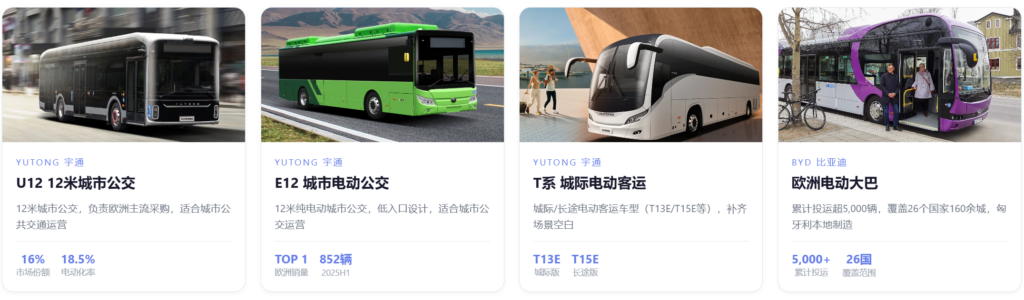
In 2024, registrations of electric buses over 8 tonnes in Europe totaled about 7,779 units, with an electrification rate of about 18.5%. In H1 2025, Yutong sold 852 electric buses in Europe, ranking first with a 16% market share. In 2024, Yutong registered about 1,092 electric buses in Europe, a market share of about 14%, nearly doubling year on year. On the service network, Yutong has set up a central parts warehouse and 32 service stations in France. This scale means the supply chain and after-sales network must be able to sustain continuous deliveries, and vehicle reliability, winter performance and battery safety systems must withstand high-frequency operation.
On the product side, Chinese bus makers' playbook is also more closely aligned with Europe: 12-metre city buses (e.g., U12/E12) cover mainstream procurement, while three-axle models and intercity/long-distance electric coaches (e.g., the T series, intercity electric models) fill gaps in use cases. On battery packs and energy strategy, they put more emphasis on operational range under SORT cycles, charging power and thermal management stability.
BYD has put more than 5000 battery-electric buses into service across Europe, in over 160 cities in 26 countries, and produces about 1000 a year at its Hungarian plant; local manufacturing reduces trade and delivery risks.
Meanwhile, Suzhou King Long, King Long/Golden Dragon, Zhongtong and other brands are advancing in Europe through niche use cases and local partnerships. King Long group brands hold a 25.9% share of Europe's new energy bus imports from China, creating a "multi-brand, multi-entry" landscape.
For European manufacturers, Chinese brands bring not just price pressure but a comparison of "total package capability": beyond the vehicle itself, after-sales service, spare parts, remote diagnostics and even coordination on local charging and depot upgrades determine whether operators are willing to hand over their next big order.
Electric vans: fleet operations are the dividing line
Electrification of light commercial vehicles in Europe has been growing for several years, but real scale tends to be concentrated in high-intensity fleet applications such as postal and parcel delivery, urban distribution and public services. Chinese brands' breakthroughs in this area rely mainly on usable cargo space and payload, relatively manageable purchase costs, and more flexible financing/leasing packages.
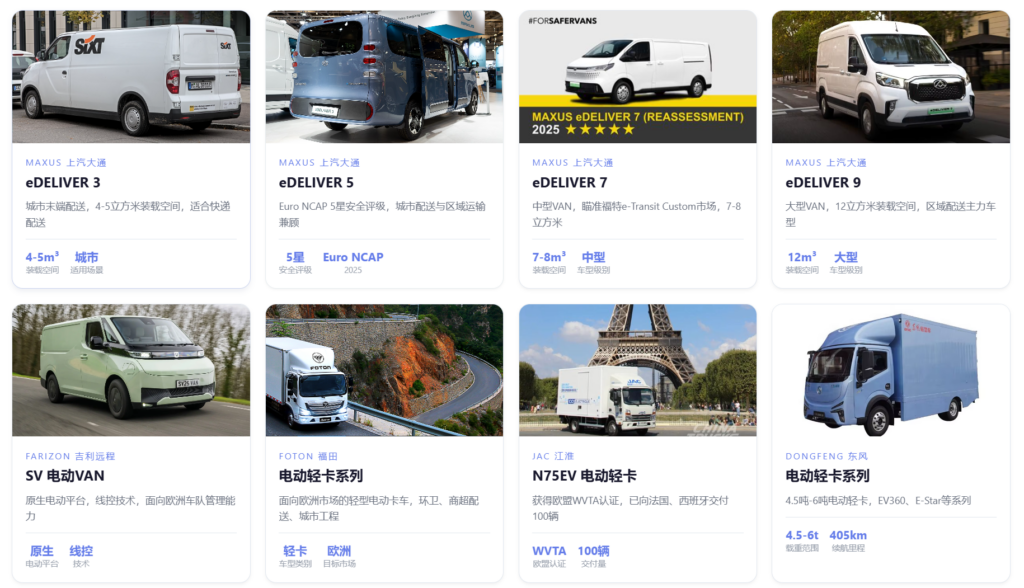
Take Maxus: its eDELIVER 3/5/7/9 essentially covers the size range of mainstream European vans, from 4–5 m³ to 12 m³, spanning urban last-mile to regional distribution. Fleet customers care more about delivery lead times, failure rates, ease of maintenance, and whether real-world range matches operating conditions. In 2025, Maxus NEV sales reached 54,000 units, with a 2.4% share of the UK market and growth of nearly 90%. BYD has also achieved interim breakthroughs in markets such as Italy: on Apr 2025, it held a 23.8% share of the Italian electric van market with 687 registrations. This shows that in some countries, a policy window combined with the right product mix can quickly produce a step change in market share.
Geely's Farizon is pushing the SV electric van in the UK, and its selling points go beyond price: a native electric platform, load space and safety ratings, as well as fleet management capabilities geared more towards Europe (such as payload monitoring). If such products can be combined with a local dealer and service network, they will be attractive to mid-sized European operators.
In light trucks, Foton, JAC, Dongfeng and others are entering through local dealers and specific applications (sanitation, supermarket deliveries, urban construction, etc.). Foton's eAumark electric light truck has reached about 5,000 units cumulatively in Europe. JAC's N55/N75 electric light trucks are priced 15–20% below European brands.
As long as energy and maintenance costs fall significantly and downtime risk is under control, "rapid fleet replacement" will follow. Whoever can deliver on value retention/residual value, used-vehicle remarketing and service turnaround times will find it easier to move from trials to volume procurement.
Electric heavy trucks: standards and infrastructure are being reshuffled
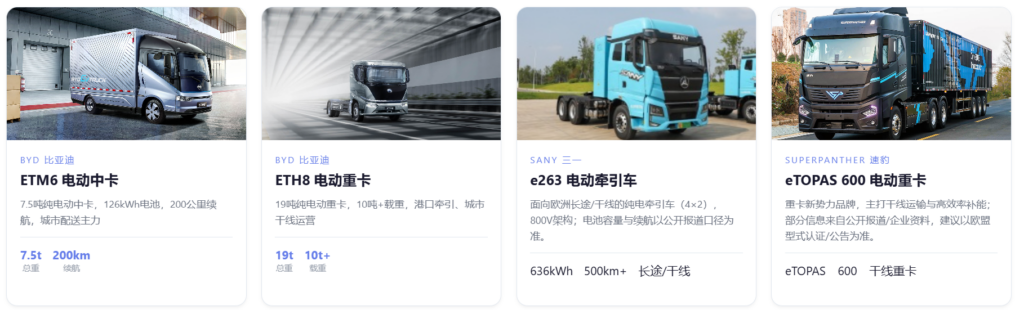
In 2024, European registrations of electric heavy trucks were about 4,291 units, a penetration rate of about 2.3%. They could reach an estimated 8000-10000 units in 2025, but the market is still at an early stage overall. For Chinese brands the bar is even higher: European long-haul transport is extremely rigorous about charging networks, driver working hours, payload compliance and total cost of ownership calculations. Heavy trucks are not about selling vehicles but about selling an operable system.
Chinese brands in Europe's heavy truck segment follow three main paths. The first, represented by BYD, is "full-vehicle system integration plus showcase orders": building fleet data and reputation in more controllable use cases such as port tractors and urban trunk routes. The order for 200 8TT electric heavy trucks in Sweden is an example. The second, represented by SuperPanther, is "re-engineering products for European standards": SuperPanther's eTOPAS 600 is built at the Steyr plant in Austria and launches in Europe in the first half of 2026. The third, taken by construction machinery and heavy truck makers, is "certification first, then project entry": SANY Heavy Industry's SANY e263 is expected to be delivered in Europe in early 2026.
The real constraints on heavy trucks, however, lie outside the vehicle: public and depot charging, grid connection capacity and electricity tariff structures. Without usable charging and power infrastructure, even the best truck stays stuck in pilot projects. So over the next two to three years, the heavy truck race will be decided not only by vehicle performance but by the ability to build alliances with energy, depot, operations and finance partners.
The UK and the Nordics are the "proving ground", Southern Europe the "volume window", and Benelux the "logistics hub"
The UK market has mature fleet operations, a wide range of financing tools, and, as a right-hand-drive market, a relatively separate homologation and distribution system. BYD plans to set up 100 dealerships in the UK in 2025, and Yutong and Farizon have also chosen the UK as their launch market.
The Nordics matter for their extreme operating conditions and high EV acceptance. Norway's BEV penetration reached 92% in 2024, and Yutong and Maxus have completed successful tests at minus 20°C.
Southern Europe (e.g. Italy, Spain, Greece) is more likely to see volume windows where policy and bus fleet renewal cycles coincide. Italy's electric bus registrations grew 161.7% in 2024, and Yutong has won large orders in both Greece and Spain.
Belgium and the Netherlands, as Western European logistics hubs, have highly concentrated fleets. BYD's order for 268 buses from De Lijn in Belgium (EUR 185 million) and Windrose setting up its headquarters in Antwerp both underline these markets' strategic importance.
The leap from "export products" to a "European operating system"
Over the next three years, the growth of Chinese new energy commercial vehicles in Europe will most likely be stepwise rather than linear: market share will jump once local manufacturing and service networks are in place, fleet customers start placing repeat orders, and charging and energy partnerships materialise. Conversely, companies that only make one-off sales without addressing maintenance and residual values or taking part in building charging infrastructure will see growth confined to small-scale pilots. The European market will ultimately divide players into two groups: "long-term suppliers" able to deliver an operable system, and "short-term fillers" that can only compete on price.
**Reproduction or excerpting without permission is strictly prohibited.** Questions and comments are welcome. Follow us for ongoing analysis of the latest developments in China and abroad.