EU approves Germany's EUR 1.6 billion charging subsidy for electric heavy trucks
Germany's subsidy this time is a national e-HDV (electric heavy truck) high-power charging network scheme formally endorsed by the EU under State Aid rules…
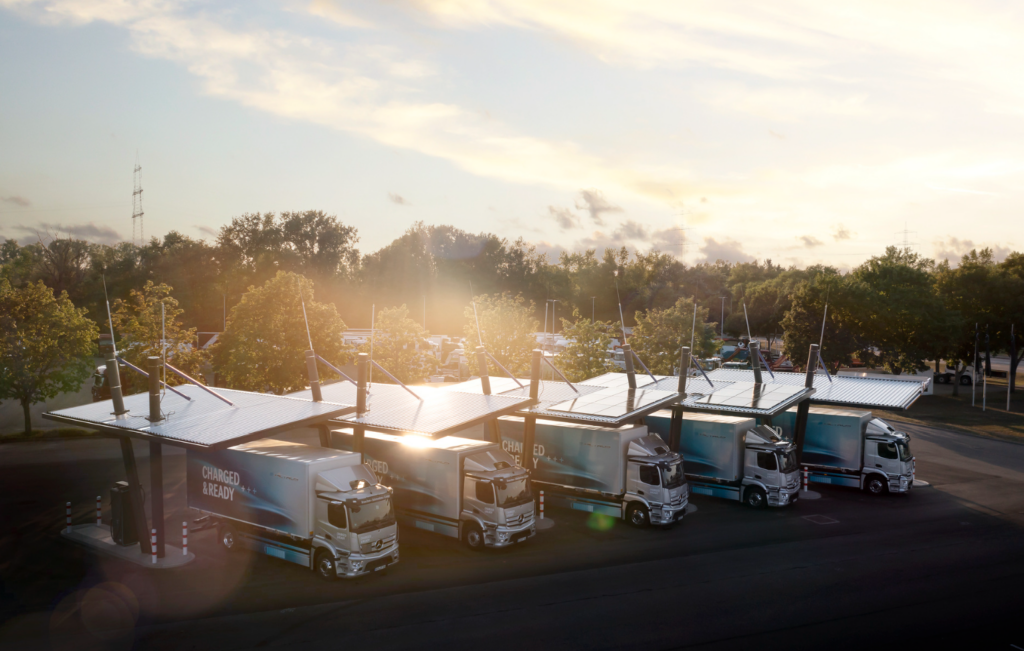
Germany's subsidy is a nationwide high-power charging network for e-HDVs (electric heavy trucks), formally endorsed by the EU under State Aid rules: up to €1.6 billion**, covering 120+ unmanaged rest areas on German motorways, with ****about 1,410 charging points** planned, implemented by Die Autobahn GmbH des Bundes. The base contract term is 8 years, extendable to 12 years; the subsidy is not just a one-off construction grant but also includes ongoing compensation for part of the operating costs.

State Aid approval tests: necessity / incentive effect / competitive neutrality
In State Aid** (state subsidy)** reviews, the European Commission is usually most wary of two things: distorting competition and using public money to buy market share for companies. This approval shows the Commission defines "e-HDV charging infrastructure" as a systemic gap with public-good characteristics: without a network, there will be no demand at scale; without demand, no one will build the network on their own — a classic chicken-and-egg problem.
Off-depot plus highway trunk routes: the hardest segment to commercialize
Germany's scheme covers "non-serviced rest sites". These locations usually lack established amenities (food, convenience stores, facility services), and their traffic is long-haul and time-sensitive. For charging operators, grid connection is harder, construction more complex and early utilisation lower. Left to market-driven investment alone, operators would prioritise more profitable locations (logistics parks, fleet depots, serviced rest areas, urban outskirts), leaving long-term gaps along motorway corridors. The European Commission explicitly found the measure necessary and appropriate for large-scale deployment of a fast-charging network on motorways.
Using subsidies to scale up and slow down construction
The threshold for State Aid** (government subsidy) is: ****you must prove that "without the money, you would not do it, or not do it this fast"**. Germany has put it bluntly this time: subsidy = pulling the market forward from pilots to a network. It covers not only CAPEX (construction costs) but also OPEX (part of operating costs), and uses long contract terms (8 years, extendable to 12) to reduce financing uncertainty.
"Pricing mechanism + multiple pricing models + recycling fees" leaves room for the market
More worth a close look is the so-called "neutrality" Germany built in at the Commission's request, which the EU judged to have a manageable impact on competition and trade:
- Operators must offer multiple pricing options: ad-hoc charging, contract pricing and a "pass-through" model (using the driver's own energy supplier's rates), so that no single subscription system locks users into one network and creates monopolistic competition.
- A charging network fee is built into end prices and remitted by operators to the German government, showing that the subsidy is not free but a cost-sharing arrangement with partial recovery, justified by public goals.
Structural differences from AFIF / Milence / Daimler TruckCharge
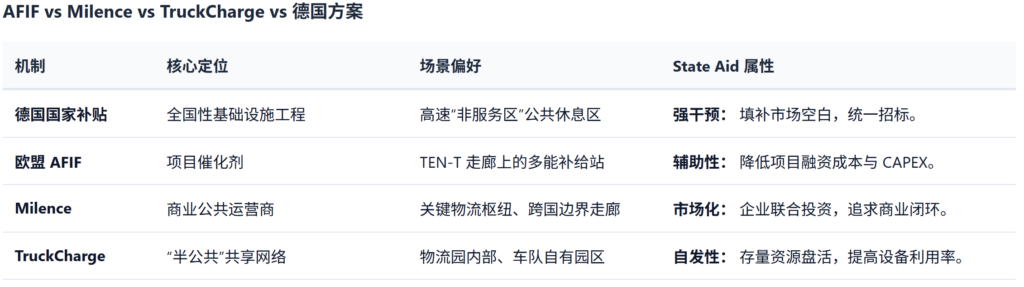
It is easy to lump all such projects together as "charging points under construction in Europe". In fact, these four types of mechanism — AFIF / Milence / Daimler TruckCharge — have entirely different goals.
AFIF: an EU-level "gap-filling funding pool"
AFIF (Alternative Fuels Infrastructure Facility) is part of the CEF2 framework and prioritises high-power charging along the TEN-T core network, with particular attention to "sparsely populated areas, safe parking areas and heavy-duty transport". It is characterised as an EU-funded programme that is multi-country with projects competing for funds; its drawback is that it struggles to deliver, as Germany does, a nationwide network built to a single standard and a single timetable in one go.
Milence: a cross-border network with a "corridor-based" focus
Milence (a joint venture of Daimler Truck, Traton and Volvo Group) is more of a "European trunk-route charging operator". It keeps expanding cross-border hubs, pushing high-power and MCS (Megawatt Charging System) capability, and rolling out corridors across multiple countries. It addresses "cross-border availability" and a "standardised experience", but it will not take on the "hard-to-cover areas" the German government aims to address.
Daimler TruckCharge: semi-public network
TruckCharge works more by "semi-publicising" charging resources at fleets, depots and dealers, opening them to paying users at times that do not affect the owners' own use, and so increasing density. Daimler Truck has publicly planned to expand the network to 3000+ fast-charging points by 2030, with roll-out in Germany, Austria and elsewhere. It addresses "denser points and higher utilisation", with a focus on fleets and industrial hubs rather than the government-defined "public network at non-service-area motorway sites".
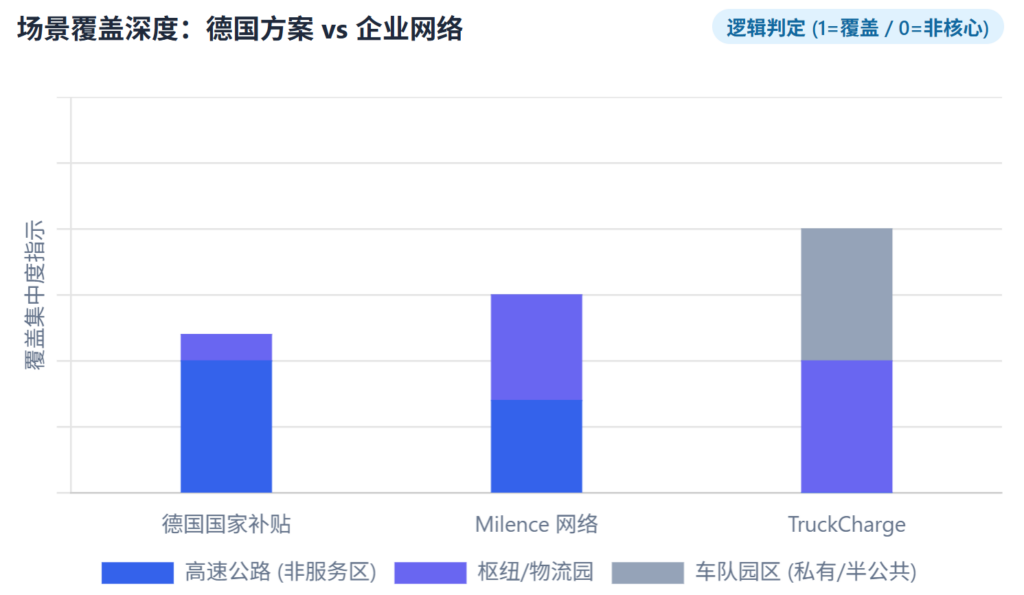
Germany's EUR 1.6 billion subsidy effectively fills the gap in the "public trunk-route network".
European OEMs vs. Chinese OEMs
For European heavy-truck OEMs, the biggest obstacle to selling electric heavy trucks is not the product itself. It is customers' doubts about route coverage, charging access and TCO. If public fast charging on motorway trunk routes starts to be covered by national-level programmes, OEMs can change their sales pitch from "we can run a small pilot" to "you can plan a large-scale rollout". That would boost confidence among key accounts. Amazon, for example, bought Mercedes-Benz eActros 600 heavy trucks and built 360 kW charging infrastructure alongside them, while stressing that public corridor charging is still inadequate. In effect, Europe's large logistics companies are filling the industry's gap in public charging corridors themselves.
For Chinese heavy truck OEMs, the opportunity is not really Europe's lack of infrastructure, but whether they are already positioned once that infrastructure starts to be filled in. Many Chinese manufacturers previously judged that public charging in Europe was inadequate, so they entered via "fleet-built depots plus demonstration routes". That approach is not wrong, but it has a ceiling: once the market moves from pilots to networks, European customers will focus more on the following:
- Compliance and sustainability scrutiny: joining the public network means more transparent and stricter operating and billing rules
- Service network and reliability: breakdowns and towing are extremely costly in highway operations
- Price and financing: once state subsidies have reduced infrastructure uncertainty, customers will return to competing more rationally on vehicle cost, residual value, maintenance and energy contracts
For Chinese OEMs, this effectively shifts the competition from "who dares to try" to "who can deliver at scale and meet European operating standards".
2026–2028 may be the real watershed
2026–2028 will be a critical window. For European OEMs, better infrastructure is a precondition for ramping up sales. For operators, policy provides a floor for fleet utilisation. For Chinese OEMs, the situation will shift from a market-entry window to the start of an all-round contest of companies' real capabilities.
**Reproduction or excerpting without permission is strictly prohibited.** Questions and comments are welcome. Follow us for ongoing analysis of the latest developments in China and abroad.