Mercedes-Benz heavy truck tests megawatt charging over 2400 km
Mercedes-Benz Trucks recently sent two eActros 600 BEV heavy truck test vehicles fitted with megawatt charging ports from Germany through the Netherlands, Belgium, Denmark…
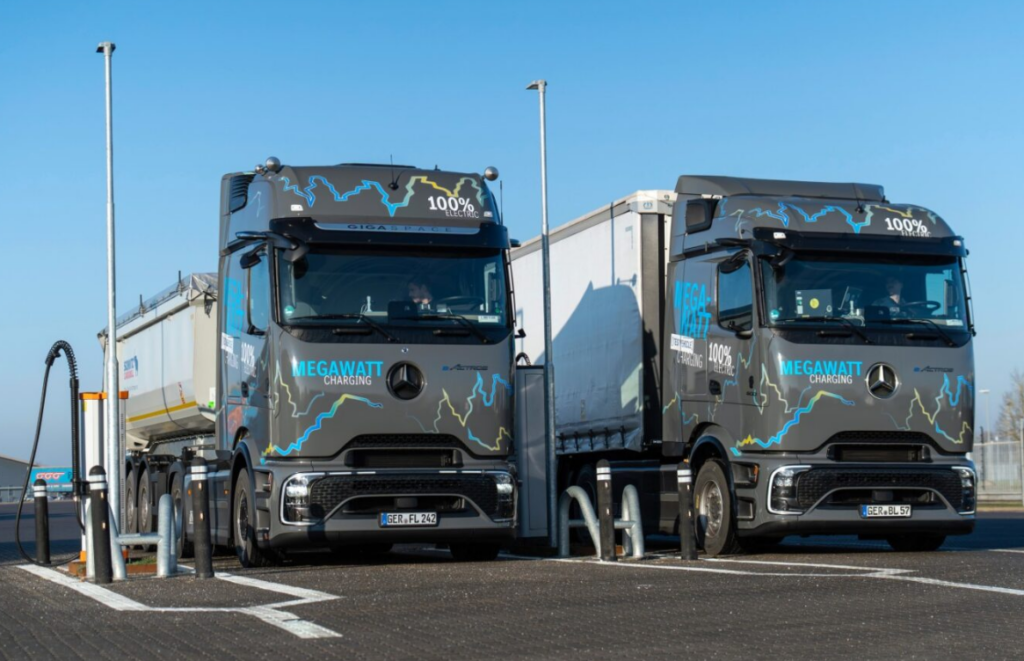


Mercedes-Benz Trucks recently sent two eActros 600 battery-electric heavy truck test vehicles fitted with megawatt charging ports from Germany through the Netherlands, Belgium and Denmark to southern Sweden, a journey of about 2400 km. Along the way they repeatedly charged at public and private megawatt charging sites, with the focus on charging curves, average charging power and the overall performance of megawatt charging infrastructure, including in winter conditions.
Megawatt charging
With megawatt charging, the eActros 600 charges from 20% to 80% in about 30 minutes. With common CCS high-power DC charging (up to about 400 kW), the same range takes about 1 hours. For long-haul fleets, this directly affects vehicle utilisation, whether drivers can charge during mandatory rest breaks, and how aggressive route planning can be.
Consistent experience is key
The main aim of the test was to verify the vehicles' compatibility with megawatt chargers from different manufacturers and their real-world availability. The extremely high currents involved in megawatt charging place heavy demands on thermal management; temperature, contact resistance and cooling capacity all affect whether power can be held steady. What fleets really care about is stable average power and a predictable charging curve, not the peak figure on the spec sheet.
Infrastructure is scarce, but the window has opened
Europe currently has only a limited number of publicly listed megawatt charging sites. One practical reason is that few megawatt-capable trucks are on the road, most of them test vehicles, creating a cycle of few trucks, few stations. But the industry is pushing for a common connector and standardisation. As interoperability matures, investment risk for operators will fall, corridor networks will be easier to roll out first, and fleet purchasing will accelerate accordingly.
This 2400 km northbound test in Europe is more of a system-level validation. Only if interoperability, thermal management and a consistent experience prove replicable will megawatt charging have a chance to move from demonstration to scale and commercialisation.