Power capacity is becoming a core element of national competitiveness
In modern society, electricity is treated as a "solved problem". For stable economies, a reliable power supply is almost taken for granted, and electricity is rarely…
In modern society, electricity is treated as a "solved problem". In stable economies, a reliable power supply is almost taken for granted. Power is rarely seen as a constraint on growth, let alone something that could sway a major industrial or investment decision. Yet power systems are shifting from "public infrastructure" to "a hard constraint that sets the ceiling on economic growth". This is not limited to developing countries. It is also happening in high-income economies in Europe and North America, and is already having a material impact on AI, semiconductors, the new energy industry, manufacturing investment and even long-term economic growth paths.
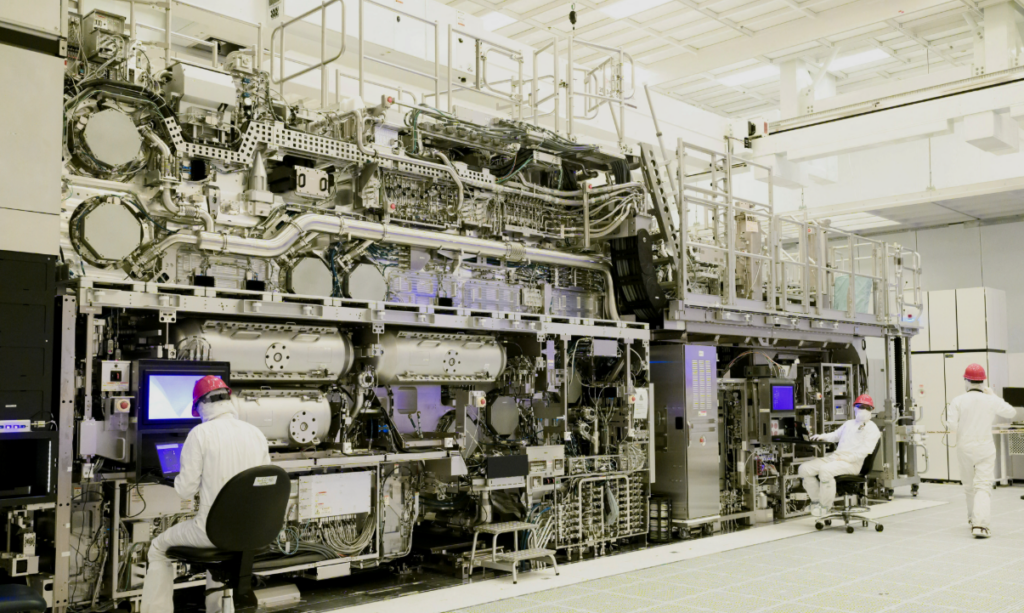
ASML's expansion is stuck on the power grid
ASML Holding, one of the world's most critical semiconductor equipment makers, plans to build a large new campus in the Eindhoven area of the Netherlands that could potentially house up to 20,000 employees. Whether the project goes ahead, however, depends on whether ASML can secure a sufficient grid connection.

Even for a Dutch "national champion" like ASML, power supply cannot be taken for granted. According to Dutch grid operators, around 12,000 companies nationwide are currently queuing for grid connection permits. Even with roughly EUR 8 billion invested in grid expansion each year, the structural bottleneck could persist for up to a decade. Even in high-income economies, electricity has shifted from a "background condition" to a "barrier to entry."
The long-term relationship between electricity and economic growth
There is an extremely stable, long-term structural relationship between electricity consumption and economic development. From the onset of industrialisation in the late 19th century to today's digital economy, the development paths of almost every country show the same pattern:
- Higher per-capita electricity consumption goes with greater economic complexity and higher per-capita GDP
- Holds true across different regions, institutional systems and resource endowments
- Compared with primary energy sources such as coal and oil, electricity is the only form of energy closely in step with income levels
Electricity is not just energy but a combined carrier of production, organisation and technological density. This is why studies of many developing countries repeatedly find access to electricity to be one of the core variables in long-term growth; in high-income countries, the relationship has merely been temporarily masked by "stable supply".
Power supply problems are resurfacing in so-called "rich countries"
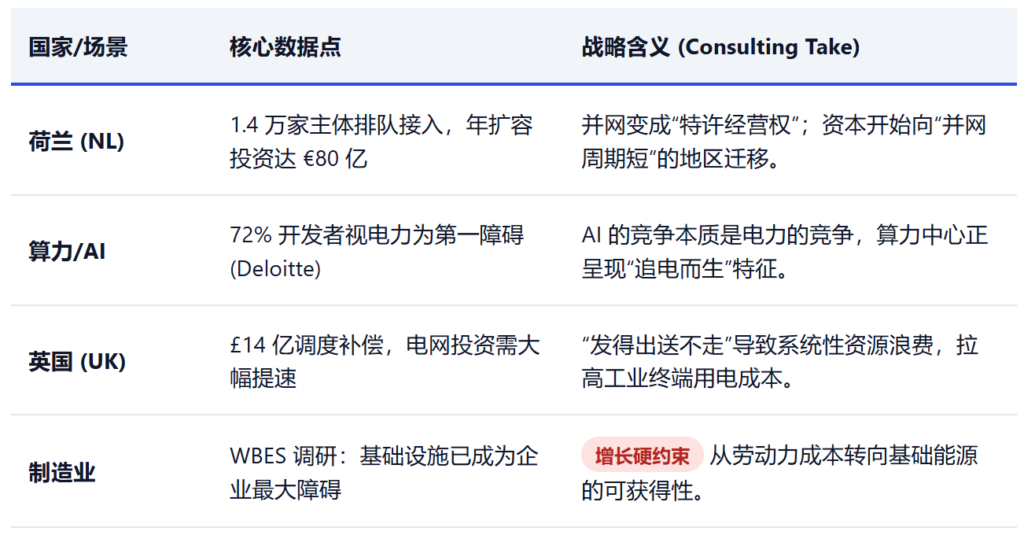
If electricity is so important, why has this problem only erupted in Europe and North America in recent years? It is the result of an abrupt shift in demand structure combined with lagging infrastructure planning. Over the past two to three decades, most developed economies experienced the offshoring and "hollowing out" of manufacturing, which caused electricity demand to stagnate or even decline for a long period. Power system planning accordingly assumed a premise: **economic growth can occur with "almost no increase in electricity consumption."** This approach to planning did indeed hold true around 2010.
But in the 2020s, three forces emerged at once and reinforced one another:
- AI and data centers: high-density, round-the-clock loads
- Electric vehicles and transport electrification: demand shifts from the fuel side to the grid side
- Systematic electrification of industry and buildings: replacing fossil energy
According to BloombergNEF scenario forecasts, electricity demand in Europe and the US will grow by more than 40% over the next 20 years. The problem is that grid planning, permitting and construction cycles in Europe and the US run far slower than the pace of technological and industrial change.
Electricity has become a decisive factor in business growth
Between 2018 and 2020, European companies almost never saw electricity supply as a major obstacle to doing business. In 2023–2025, however, that share rose markedly in several countries, and in some it multiplied. For companies, power is no longer just a question of price. It decides whether projects get approved, whether capacity can be expanded and whether new businesses are worth launching. So when electricity becomes an uncertain factor, the rational investment response is not to "take on the risk" but to "delay or relocate".
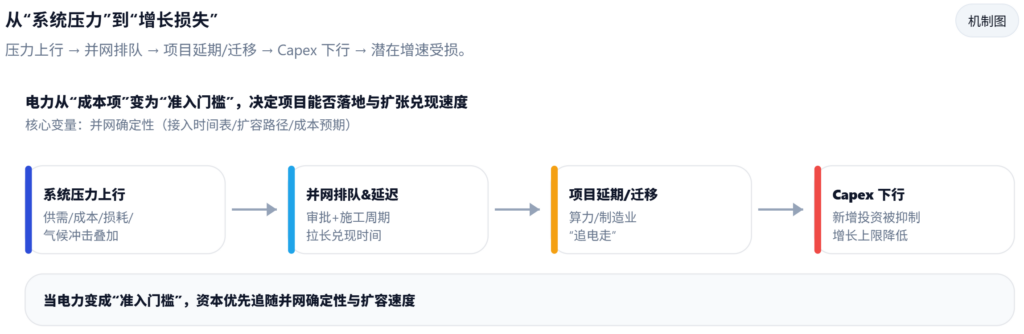
Electricity decides the geopolitical race for AI and computing power
Power constraints are reshaping the global geography of technology investment. There are already many real-world examples of this trend, such as:
- Google drops some data center plans in Germany
- Expansion constrained in the Frankfurt area, with grid connections unavailable until after 2030
- Microsoft shifts some investment from the UK and Ireland to the Nordics
- Some Silicon Valley data centers sit idle for long periods due to grid connection issues
Computing power therefore no longer simply follows tech talent, capital or policy; it has begun to follow power-supply certainty. In the AI era, the long-term impact of this shift has yet to be fully priced in.
Power defines the limits of growth
China's power supply is stable, and the US is also aggressively expanding power supply. The question Europe needs to discuss is not whether it is short of electricity, but whether, in an era where electrification, AI and industrial restructuring overlap, the power system is still treated as "growth infrastructure". If power resources are scarce, growth potential for decades to come will be severely affected. China's stable and ample power supply has long been taken for granted, but this "taken for granted" status may well become one of the country's core competitive advantages in the future.
**Reproduction or excerpting without permission is strictly prohibited.** Questions and comments are welcome. Follow us for ongoing analysis of the latest developments in China and abroad.