Europe's Net-Zero Industry Act: can solar and battery manufacturing return?
In recent years, solar modules and traction batteries have become some of the most common industrial products in Europe's energy transition and vehicle electrification. Yet these key products are not all…
In recent years, solar modules and traction batteries have become some of the most common industrial products in Europe's energy transition and vehicle electrification. But not all of these key products are "Made in Europe".
Under the combined pressure of supply chain shocks, geopolitics and energy security, the EU is starting to reconsider a manufacturing sector once thought to be lost.
Against this backdrop, the Net-Zero Industry Act (NZIA) was formally adopted. In effect, the act is a package of rules that tries to win back manufacturing investment through institutional design. But can the EU act really achieve its goal?
EU refocuses on manufacturing
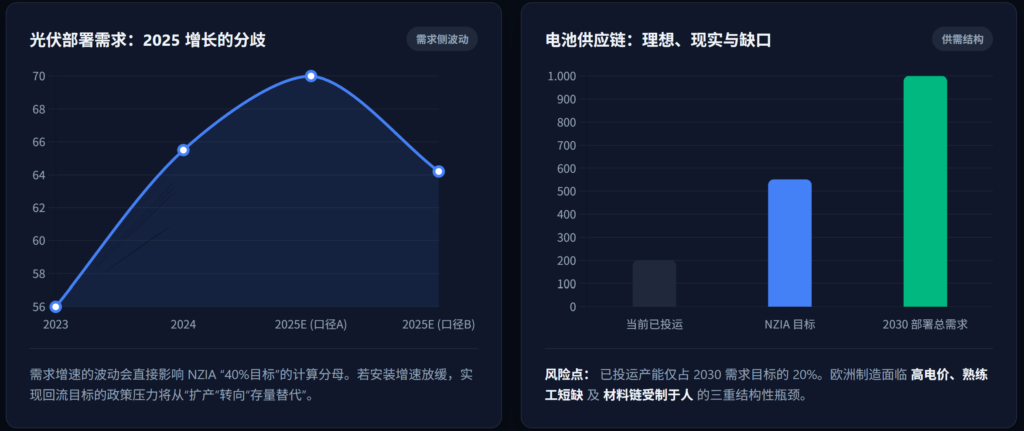
Over the past decade or so, Europe has gradually slipped into a downstream role in the solar and battery supply chains. In photovoltaics, Europe was one of the first regions to deploy solar at scale, yet its manufacturing of modules, cells and wafers has kept shrinking. The battery industry has rebounded somewhat in recent years, but core materials and some key equipment still depend heavily on outside suppliers. As a result, project delivery times are tied to overseas supply, price swings are hard to control, key technology and capacity are concentrated in a few regions, and any trade or logistics shock quickly amplifies the risks. The EU's policy goal, then, is not "full localisation" but reducing single-source dependence and strengthening supply-chain resilience.
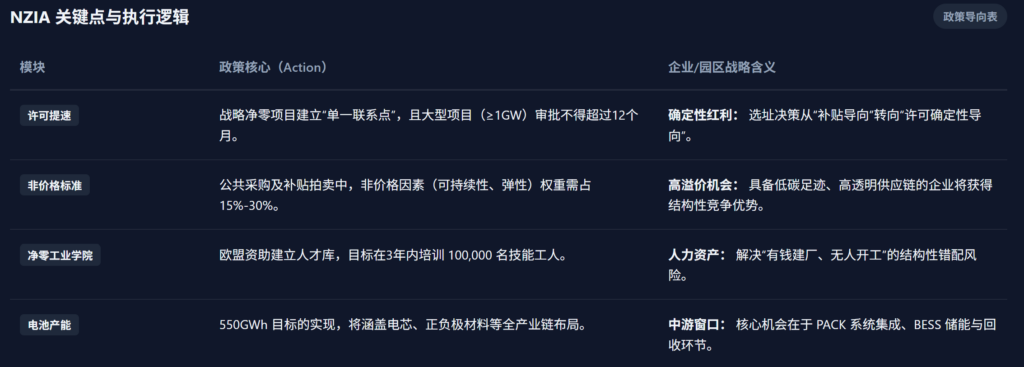
Key provisions of the Net-Zero Industry Act
The NZIA is not a subsidy act that hands out money directly. Its core aim is to use institutions and rules to reduce the "non-cost barriers" to building factories in Europe.
Explicitly designated a "strategic net-zero technology"
In its annex, the act sets out a list of industries considered "key net-zero technologies", including:
- PV modules and their key manufacturing stages
- Traction batteries and energy storage batteries
- Electrolyzers, heat pumps and related equipment
Inclusion on the list means these projects get higher priority in permitting, planning and public procurement.
Shorter approval cycles
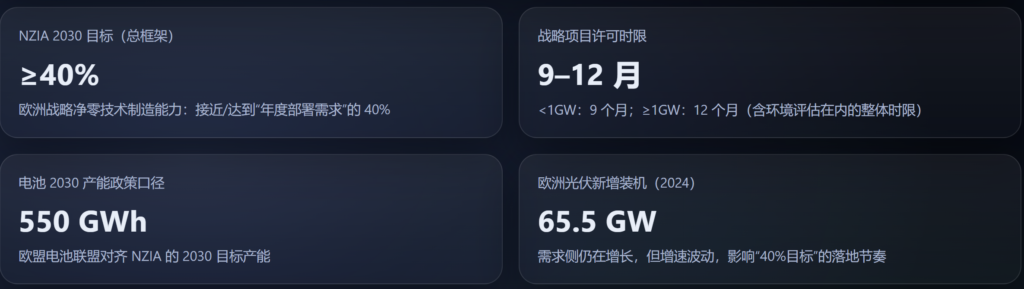
For large manufacturing investments designated as "strategic projects", the EU has set a clear target: approval should in principle take no more than 9 months, including environmental assessment, with a single coordination point to cut repeated back-and-forth between agencies. In Europe, uncertainty is itself a hidden cost, and approval times are often more damaging than labour or land costs.
Restrained targets
The NZIA proposes that by 2030 the EU should have about 40% of global solar manufacturing capacity, with the battery manufacturing capacity target also set at around 40%. These are ****policy directions, not binding targets. The EU wants these industries to "stay" and is willing to change the rules to make that happen.
Public procurement is the real core of demand
Compared with the permitting reforms, the NZIA's most consequential element is its public procurement rules. From 2025, the EU allows public bodies to give more explicit weight to product origin in tenders and to factor in carbon footprint and life-cycle cost (LCC), rather than using lowest price as the sole criterion.
For manufacturers, producing locally in Europe brings a structural advantage in public projects. For European local governments, it provides an additional legitimate policy rationale for supporting domestic industry.
Real-world impact
For European city and regional governments, manufacturing projects are easier to land if land, power and infrastructure are available locally. Local production also helps reduce delivery risk for large solar or energy storage projects. For end users, price changes will be limited in the short term, but over the medium to long term delivery reliability may improve, maintenance and replacement costs have room to fall, and product compliance and quality consistency will be higher.
Constraints beyond policy remain
The NZIA cannot solve all of European manufacturing's problems. First, energy costs remain Europe's biggest manufacturing disadvantage: whether for solar modules or batteries, electricity prices are the decisive factor. Without a structural improvement in energy costs, the competitiveness of manufacturing will remain constrained.
Raw material dependence also cannot be eliminated quickly: polysilicon, cathode and anode materials and key chemicals still rely heavily on non-European supply. Reshoring manufacturing does not mean a fully localised supply chain.
The legal boundaries are also clear but narrow: public procurement and origin considerations must comply with WTO and EU single market rules. There is policy room, but it is not unlimited.
Final thoughts
The Net-Zero Industry Act cannot solve every problem of reshoring manufacturing. It is more of a rulebook; ultimately, it still comes down to costs, returns and long-term expectations. For European local governments and companies, whoever can provide land, power, speed and certainty is more likely to win the next round of investment.
Data dashboard link: Data dashboard: Analysis of the EU Net-Zero Industry Act (NZIA)