Overseas brand sentiment, issue 1: nine Chinese automakers praised for styling and performance, criticized over parts and resale value
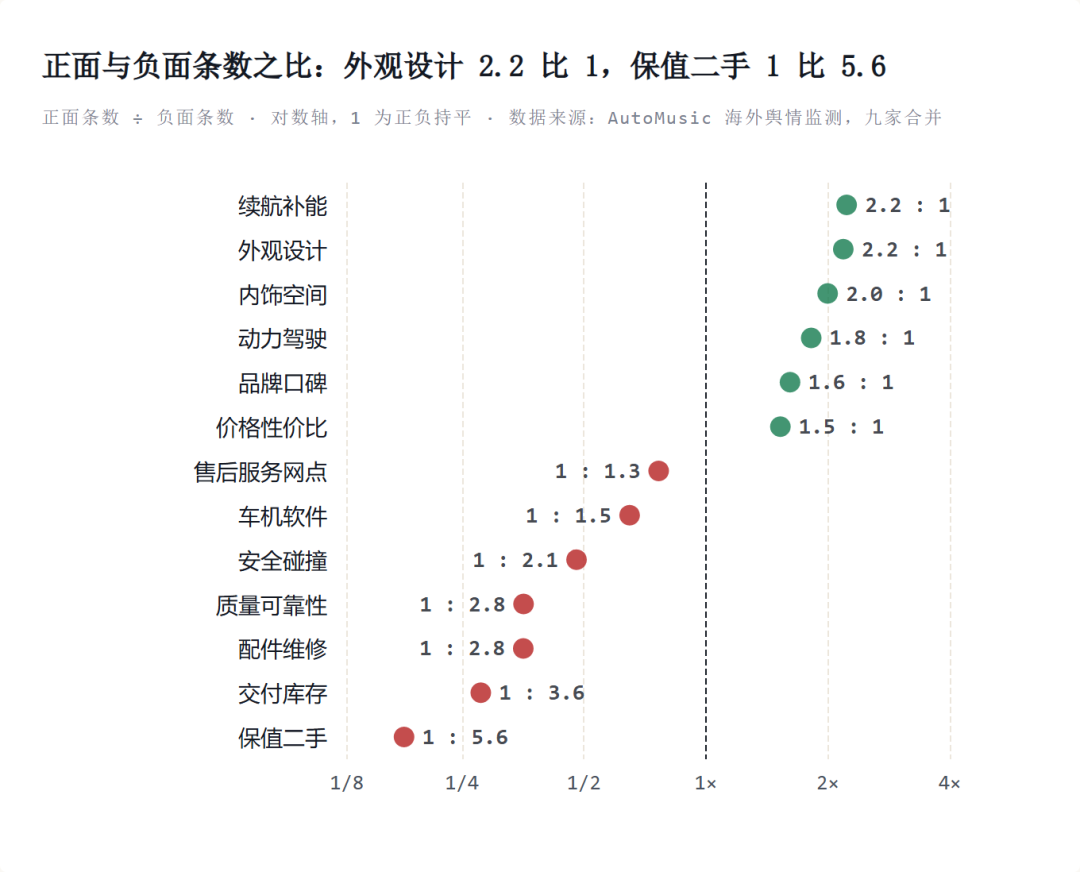
Across 23925 public overseas reviews of nine Chinese automakers in a single month, design, performance and brand image drew mostly positive feedback for every brand, while parts and repairs, residual value and used-car resale, and infotainment software drew mostly negative feedback for every brand: for parts, every 1 positive reviews were matched by about 2.8 negative ones; for residual value, about 5.6.
One spare part, a wait of about a month. That was an overseas owner's complaint in a comment section, and similar remarks come up again and again in overseas discussions of Chinese cars. Under new-car reviews and test-drive videos, by contrast, the feedback is mostly positive.
From Sep 2026 to 10, we found 23925 public overseas discussions of nine automakers: BYD, Chery Group, Geely, MG, GAC, Maxus, Foton, Sinotruk and Yutong. Sources included YouTube, X, Reddit, news reports and local car forums such as Pantip in Thailand and Drive2 in Russia. Content posted by the brands themselves or their dealers was excluded. On exterior, interior, powertrain and brand image, every one of the nine with enough mentions to count drew more positive than negative comments. On parts and repairs, resale value, infotainment software and delivery, all five passenger car makers (BYD, Chery, Geely, MG and GAC) drew more negative than positive comments. The cars themselves are broadly well regarded; the complaints start after handover.
(Note: item counts depend on search scope and do not indicate share of voice)
China exported 7.098 million vehicles in 2025, up 21.1% year on year, including 2.615 million NEVs. As more Chinese cars appear on roads abroad, topics such as servicing, replacement parts and resale are starting to show up in the comment sections.
Design, powertrain and brand perception mostly well received
Across the nine automakers combined, exterior design and range/charging each drew about 2.2 positive comments for every 1 negative ones, the highest ratio of any topic; interior, powertrain and brand image also drew clearly more positive than negative comments.
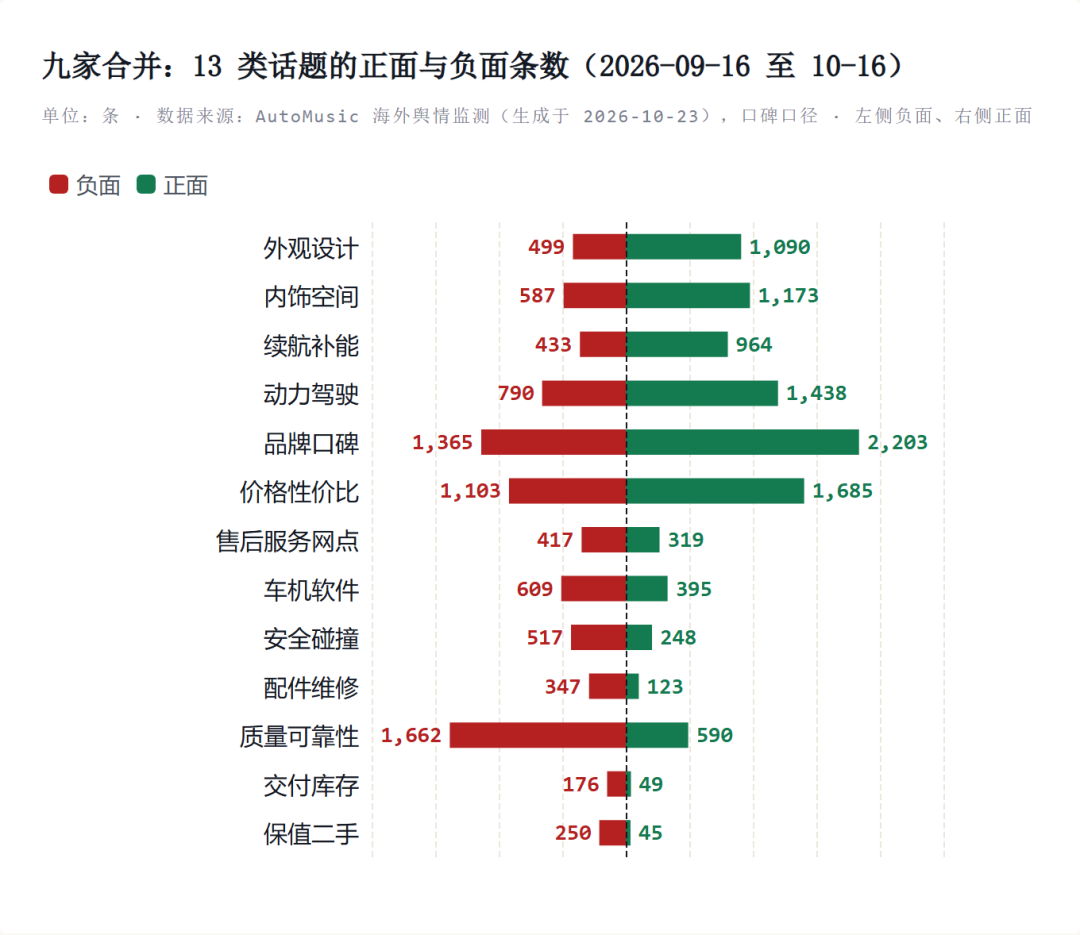
Looking at each company individually, the conclusion is the same. On exterior design and brand reputation, all nine companies had more positive than negative comments. On interior space and performance and driving, all eight companies with enough discussion to count were also net positive (a company with fewer than 10 positive and negative comments combined on a topic was excluded for that topic). Praise mostly centred on specific models: GAC's Aion UT and Aion V, Chery's Tiggo 7, Tiggo 8, Tiggo 9 and JAECOO 7, and BYD's Seagull and Seal. Comments focused on styling, space, acceleration and features, and appeared mainly in new car reviews and test drive videos.
Sentiment on value for money is also broadly positive, with 1685 positive and 1103 negative mentions, though not one-sided. Of the eight companies, only Chery Group had slightly more negative than positive price mentions, mostly from discussion in Brazil of the JAECOO 5's pricing; price discussion for MG and Sinotruk was clearly positive. The most common price complaint was comparison with local Japanese rivals in the same class: Toyota and Isuzu pickups at the same price point, and hybrid SUVs in the same segment. On range and charging, only Maxus had slightly more negative mentions.
Parts, resale value and infotainment: complaints arise after purchase
Parts and repairs is among the topics with the highest share of negative reviews. Across the nine automakers there were 123 positive and 347 negative mentions, roughly 2.8 negative for every 1 positive. BYD, Chery, Geely, MG, GAC and Foton all had more negative than positive mentions. Complaints mostly concern long waits for parts, expensive OEM parts and parts being unavailable in remote areas. Google reviews of GAC dealerships show the same pattern: after-sales reception itself is mostly praised, while negative reviews mostly relate to missing parts, repair waits and slow quotes.
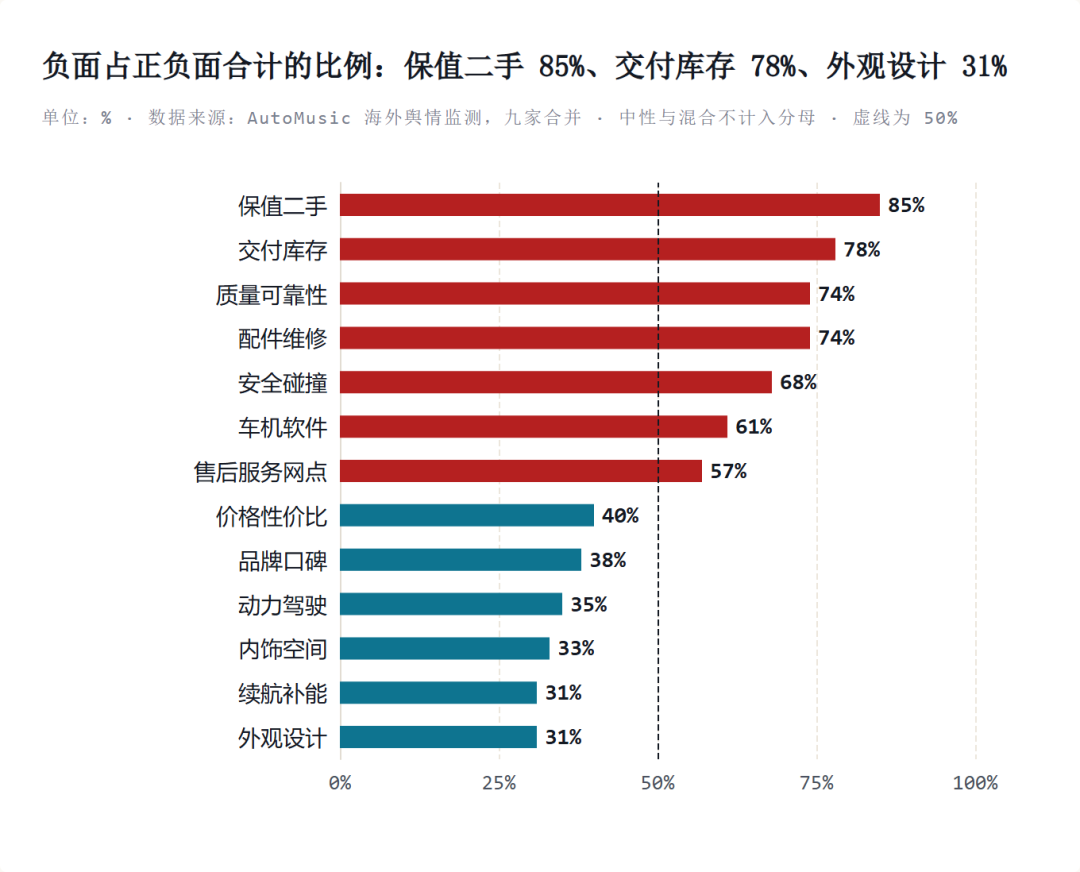
Posts on resale value are few, but they are the most consistent in direction: 45 positive and 250 negative, or about 5.6 negative for every positive. Negative posts outnumbered positive ones for all five brands: BYD, Chery, Geely, MG and GAC. The main triggers are new-car price cuts and overly rapid model changes. After BYD cut prices on the Seal 05 and Sealion 05 DM-i in Thailand by THB 100,000, existing owners worried the cars they had already bought would not hold their value; Russian media reported that used prices for the Geely Monjaro (Xingyue L) could fall by as much as RUB 1 million within a year. For car buyers, residual value is part of the cost of ownership.
Infotainment software drew 395 positive and 609 negative comments, and all six brands (BYD, Chery, Geely, MG, GAC and Yutong) received more negative than positive feedback. A large share of the specific complaints relate to localization: the Geely Galaxy E5 in Morocco has no connected services or over-the-air updates, and Geely models in Mexico lack CarPlay and Android Auto; owners raised GAC's smartphone integration and menu translations in Russia and its Portuguese voice control in Brazil; MG owners complained about the removal of physical buttons and unstable phone connections. Yutong's infotainment complaints were almost all about data and remote access.
On delivery and inventory, there were 49 positive and 176 negative mentions; again, all five passenger car makers had more negative than positive mentions, mainly about long delays in delivering stock vehicles and blocked registrations of new cars. After-sales service networks were different: BYD, Chery, Geely, MG and GAC had more negative than positive mentions, while commercial vehicle makers Foton and Sinotruk had more positive than negative.
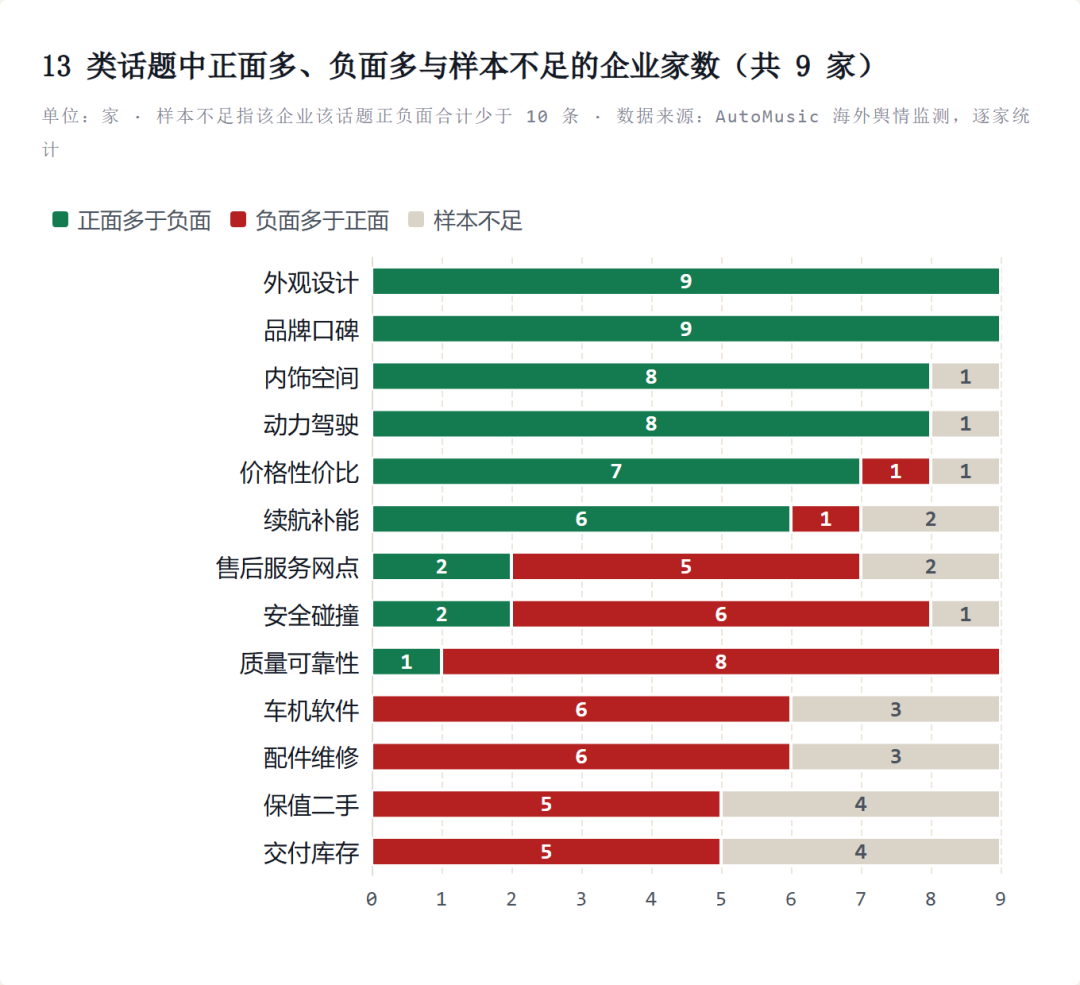
None of these problems can be solved at the level of a single vehicle: parts supply depends on local warehousing and logistics, value retention depends on price management and certified used-car programmes, and infotainment localisation requires a separate software version for each market.
Company-by-company analysis
Quality and reliability was the topic with the most negative mentions, with 590 positive and 1662 negative; of the nine companies, all except Foton had more negative than positive mentions. Safety and crash performance had 248 positive and 517 negative mentions. About 60% of the quality negatives concerned the Chery group, mainly related to a recent rear axle recall in Malaysia.
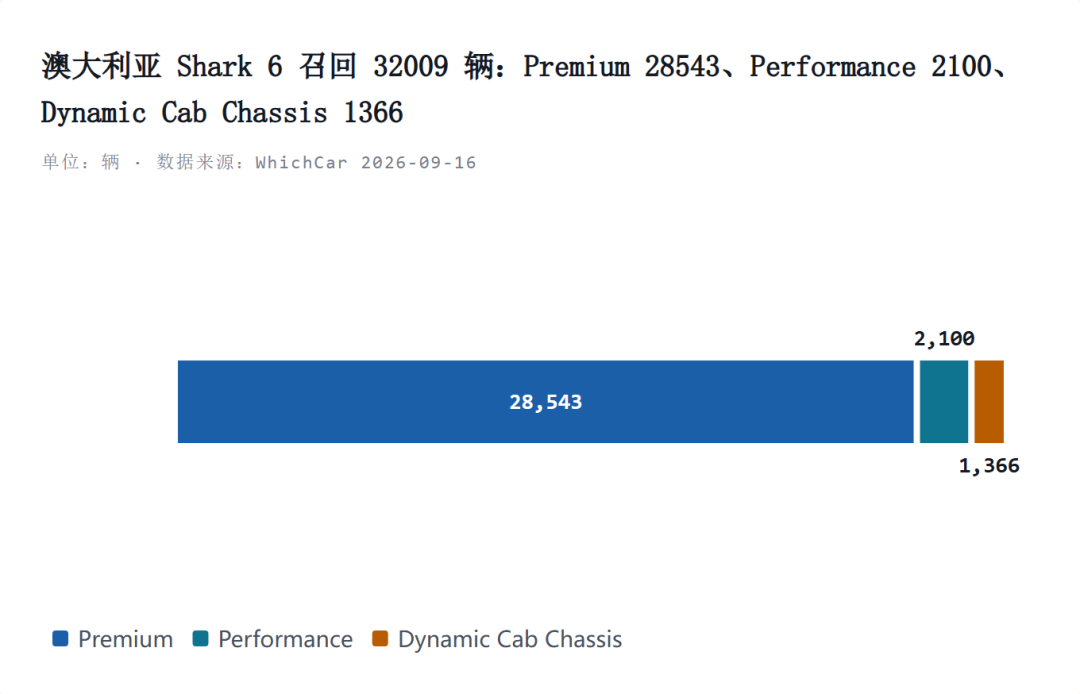
BYD. Comments on the Seagull and Seal lean positive, with positive remarks on price and range/charging clearly outnumbering negative ones. Negative coverage is concentrated in Australia, where BYD recalled 32009 Shark 6 PHEV pickups: 28543 Premium, 2100 Performance and 1366 Dynamic Cab Chassis. BYD explained that incorrect spare wheel installation position, bracket positioning or tightening torque could cause abnormal wear on the spare wheel support cable and ultimately cause the spare wheel to fall off; owners are advised to remove the spare wheel before the repair, which is free of charge. In the same period, the Australasian New Car Assessment Program (ANCAP) gave the Sealion 05 a three-star rating, with 51% for collision avoidance and 48% for safe driving; its emergency lane keeping did not intervene in the road-edge scenario. Both vehicles were tested under ANCAP's new 2026–2028 rating protocol. ANCAP noted that the Sealion 05 was not voluntarily submitted by BYD but selected for testing by ANCAP itself, while the M9 tested in the same period received five stars. BYD Australia responded that the Sealion 05 complies with all Australian Design Rules and safety regulations, that the 2026 protocol is stricter than the 2023–2025 protocol that applied when the vehicle launched, and that all other BYD models tested by ANCAP have received five stars.
Chery Group. Comments on the Tiggo 7, Tiggo 8, Tiggo 9 and JAECOO 7 were broadly positive, with 397 positive and 186 negative posts on exterior design. The negatives came mainly from Malaysia: on Oct 6, the rear suspension assembly of an Omoda 5 detached in Johor Bahru, Johor, after which Chery Malaysia expanded its rear-axle recall to 8878 pre-facelift C and H variants, and the Road Transport Department (JPJ) suspended the model's type approval. The measure applies only to this model and not to other Chery models. A similar rear-axle problem occurred locally in 2024; Chery inspected 600 vehicles assembled in mid-Aug 2023 at the time and attributed it to welding heads not being recalibrated after replacement. The original Omoda 5 ended production in Sep 2025 for a model change, and the facelifted model uses a multi-link independent rear suspension. Discussion of the incident was spread across more than 200 threads and spread from Malaysia to Indonesia, Vietnam, Thailand and other markets selling the same model. The remaining negatives came from Brazilian discussion of JAECOO 5 pricing.
Geely. Reviews and owner discussions in Australia and Mexico focus on value for money, styling and equipment, with 139 positive and 43 negative mentions of exterior design. Negatives centre on infotainment and after-sales: the Galaxy E5 in Morocco has no connected services or OTA updates enabled, Russian commenters question the higher price of the locally assembled Boyue L, and local media have reported steep used-price declines for the Xingyue L (Monjaro).
MG. Value for money: 202 positive and 37 negative mentions, clearly skewed positive. Negatives centre on quality, after-sales and parts: Reddit discussions focus on chassis rust, hard-to-find parts and low resale values, while owners in India want improvements to the Windsor's suspension.
GAC. The Aion UT and Aion V are the two most-mentioned models, and comments lean positive. Interior space drew 265 positive and 73 negative mentions, and crash safety also had more positive than negative comments. Negative feedback centres on build quality and infotainment issues in owner logs for the Trumpchi GS8 in Russia, as well as opaque servicing prices, expensive OEM parts and waits for parts across several markets.
Maxus. Comments on a T60 MAX test-drive video in France were mostly positive, praising the styling and exemption from the CO2 malus; negative comments centred on an eTerron 9 electric pickup review video in Thailand, focusing on air-suspension durability and the THB 1.6 million price.
Foton. The Tunland pickup dominated the discussion, with Australian media reporting the debut of the new-generation PHEV version; positive sentiment led on powertrain/driving and exterior. Negative sentiment was concentrated in Russia: on Oct 12, Russia's Federal Agency for Technical Regulation and Metrology (Rosstandart) restricted sales of specific models in Russia, including the Dongfeng DFRZ-35, Foton 77N5BJ, two XCMG models and the JAC K7, over issues involving braking systems, visible pollutant emissions, seatbelt anchorages and cab safety. The automakers concerned and their official representatives in Russia have notified Rosstandart that sales are suspended. The restrictions target specific models, not the brands as a whole.
Sinotruk. Positive sentiment came mainly from Kenya, where users on X discussed the Howo light bus chassis entering the minibus market, praising its price and power; on price/value, there were 28 positive and 3 negative mentions. Safety negatives came almost entirely from news reports on a few crashes, for which there are no final investigation findings on the causes.
Yutong. Showcase videos and passenger reviews of its coaches are broadly positive. The negatives centre on data and remote access for European city buses. In Oct 2025, Norwegian public transport operator Ruter tested a new Yutong bus and a three-year-old Dutch VDL electric bus in isolation inside a mountain tunnel. It found that the Yutong bus supports over-the-air updates and that Yutong can access the battery and power control systems over the mobile network, while the on-board cameras are not connected to the internet. Ruter stressed that the issue concerns vehicle connectivity technology rather than any particular manufacturer or country of origin, and said it is deploying isolation measures, developing firewalls and raising security requirements for future procurement. A year on, the test is still being cited in Dutch and Norwegian public transport discussions.
Media more optimistic than netizens
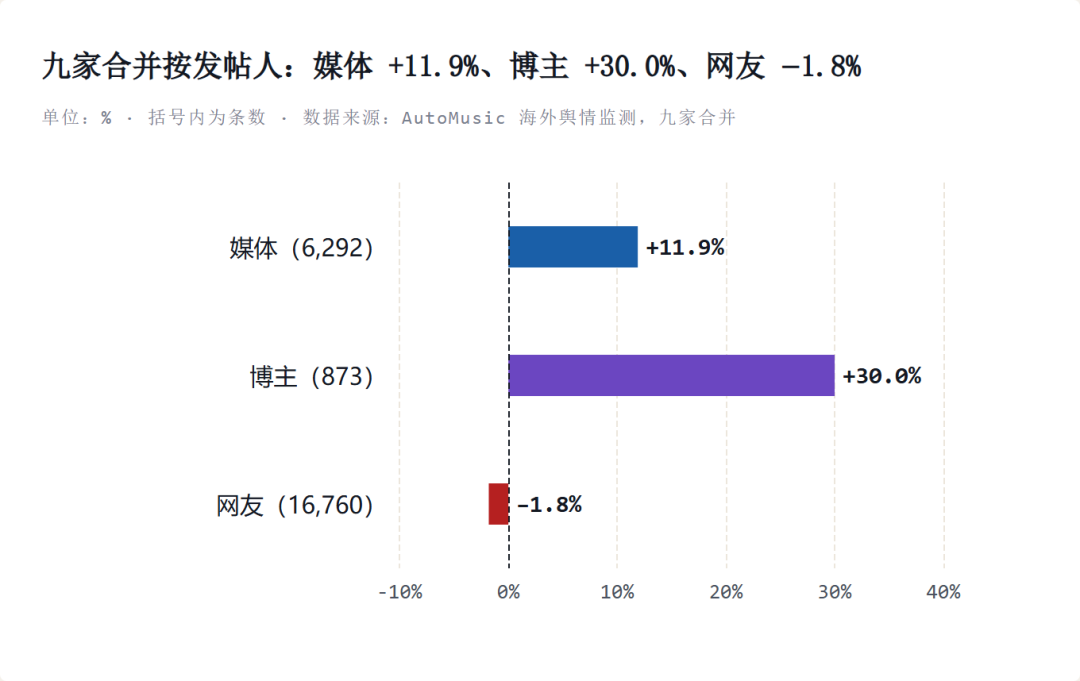
By poster type, net sentiment (positive minus negative, divided by total posts) was +11.9% for media, +30.0% for bloggers and −1.8% for netizens. Netizens produced 16760 posts, about 70% of all discussion. For eight of the nine companies, media were more optimistic than netizens; the exception was Sinotruk, at 0% for media and +12% for netizens. This month its news coverage centred on accidents and industry reports, while netizen discussion focused mostly on the price and horsepower of its Kenyan minibus chassis.
The same divergence shows up across channels. Net sentiment was +13.5% in news, +8.2% on X, +2.6% on Reddit and −2.3% on YouTube. YouTube was the largest source, with 12605 posts, most of them comments under videos, where owners and prospective buyers compare prices, ask questions and share ownership experiences. News coverage focuses more on launches, auto shows and sales, so its tone naturally skews positive.
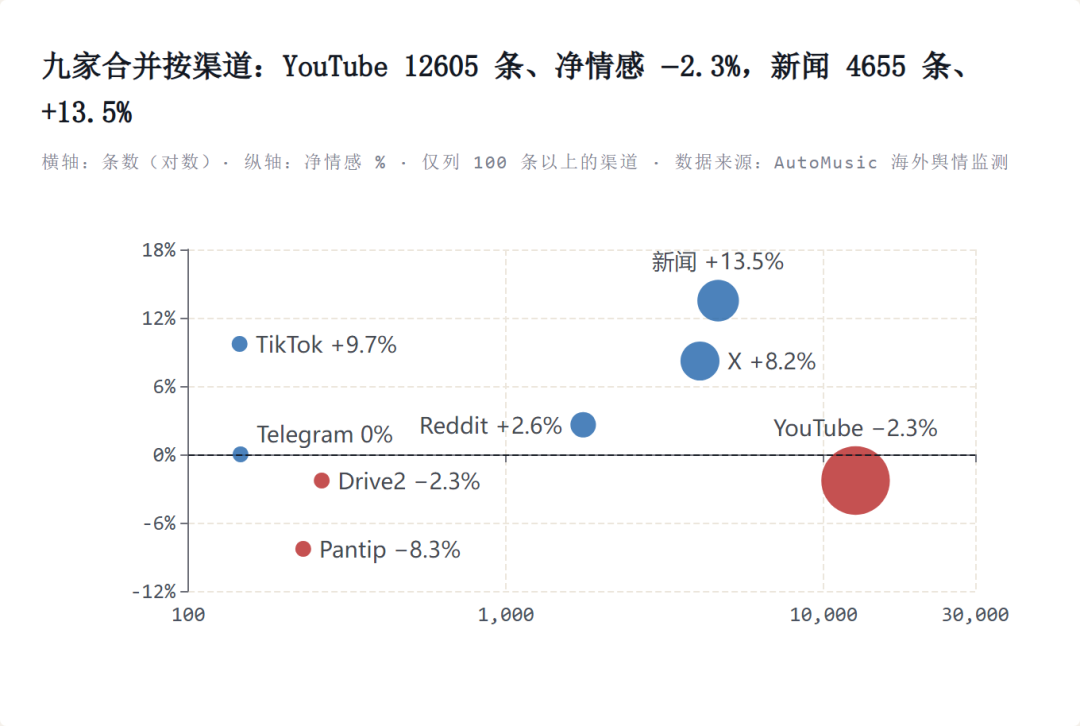
Relying only on overseas news coverage makes it easy to overestimate overseas customer satisfaction. Ownership experience is documented far more in comment sections and long forum threads. On Russia's Drive2, GAC owners' logbooks are more critical than pre- and post-purchase discussions, and those writing logbooks are mostly owners who have been driving their cars for some time.
Hyundai's 1998
There is a precedent for an overseas reputation moving from "good car" to "reliable to own". Hyundai Motor America calls 1998 the worst year in the company's history, when Hyundai drew widespread criticism over quality problems. It then launched a warranty programme called Hyundai Advantage, with a 10-year or 100,000-mile powertrain warranty, the longest in the industry at the time. According to figures cited at the time, Hyundai's vehicles had 42% fewer problems in 2002 than in 1998, against an industry-average improvement of 24% over the same period. In the following years, Hyundai's US sales recovered markedly.
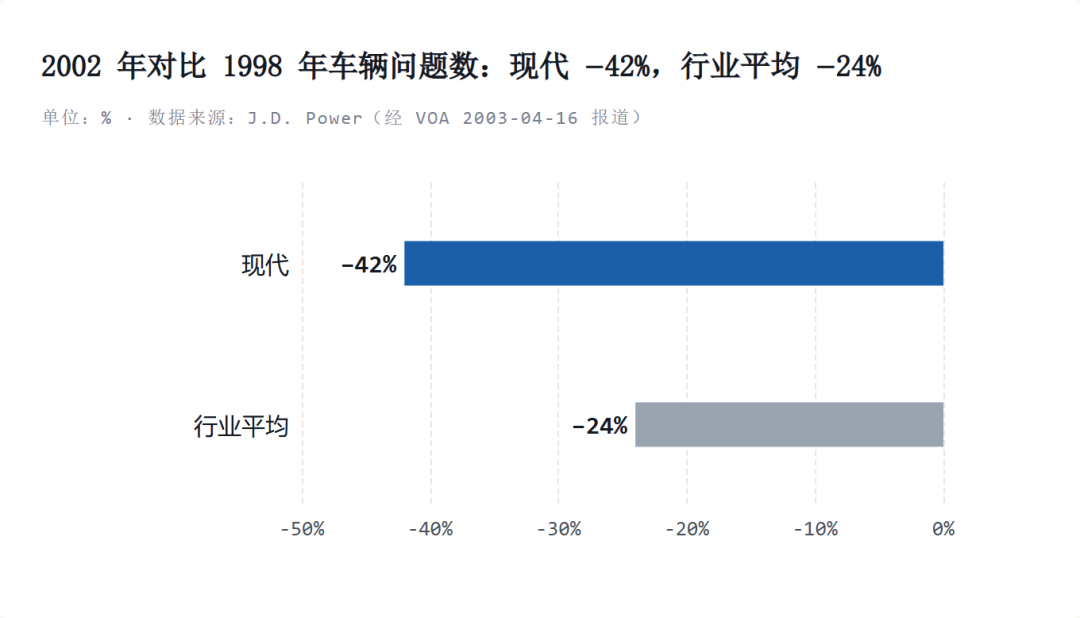
Source: Chart by AutoMusic based on the public sources listed in the article; first published on the AutoMusic WeChat account.
The nine Chinese automakers face similar situations. Their products have won recognition in reviews and test drives; owners' doubts centre on the years that follow: can repairs be done quickly, are parts expensive, and what will the car be worth in a few years. European consumer surveys point the same way. Market research firm Escalent surveyed 1692 people in Germany, the UK, France, Italy and Spain between May 2025 and 7; the share willing to consider buying a Chinese car rose from 31% the previous year to 47%, but only 28% consider Chinese brands trustworthy, compared with 22% a year earlier. Translated to today, parts delivery times, repair waiting times, residual values and local availability of infotainment features can all be made into concrete commitments to owners, provided, again, that they are delivered first.
Post-delivery reputation has to be built through a system
In overseas discussion of the nine companies this month, the praise and the complaints fall on two different stages of a car's life. Exterior design, performance and equipment win approval in reviews and test drives. That part of a brand's reputation is set by the product and can be refreshed as soon as a new model launches. Complaints about parts, residual values and infotainment appear after delivery. Behind them are local service outlets, parts warehousing, used-car channels and software localisation. No new model can fix these. They can only be built up slowly through time and investment.
"Overseas reputation" is updated monthly. The next issue will revisit the recalls, repairs and remedial actions mentioned in this one to see whether there has been progress. If you work in after-sales, parts or distribution in overseas markets, tell us what you're seeing in the comments