European truck makers' Q3 results: orders broadly recover, truck margins range from 0.5% to 12.3%
European truck orders broadly recovered in Q3, yet truck-business margins ranged from 0.5% at Iveco to 12.3% at Scania; most of the growth at TRATON and Daimler came from North America, and Volvo's share of Europe's battery-electric heavy truck market went from 27.6% in a year…
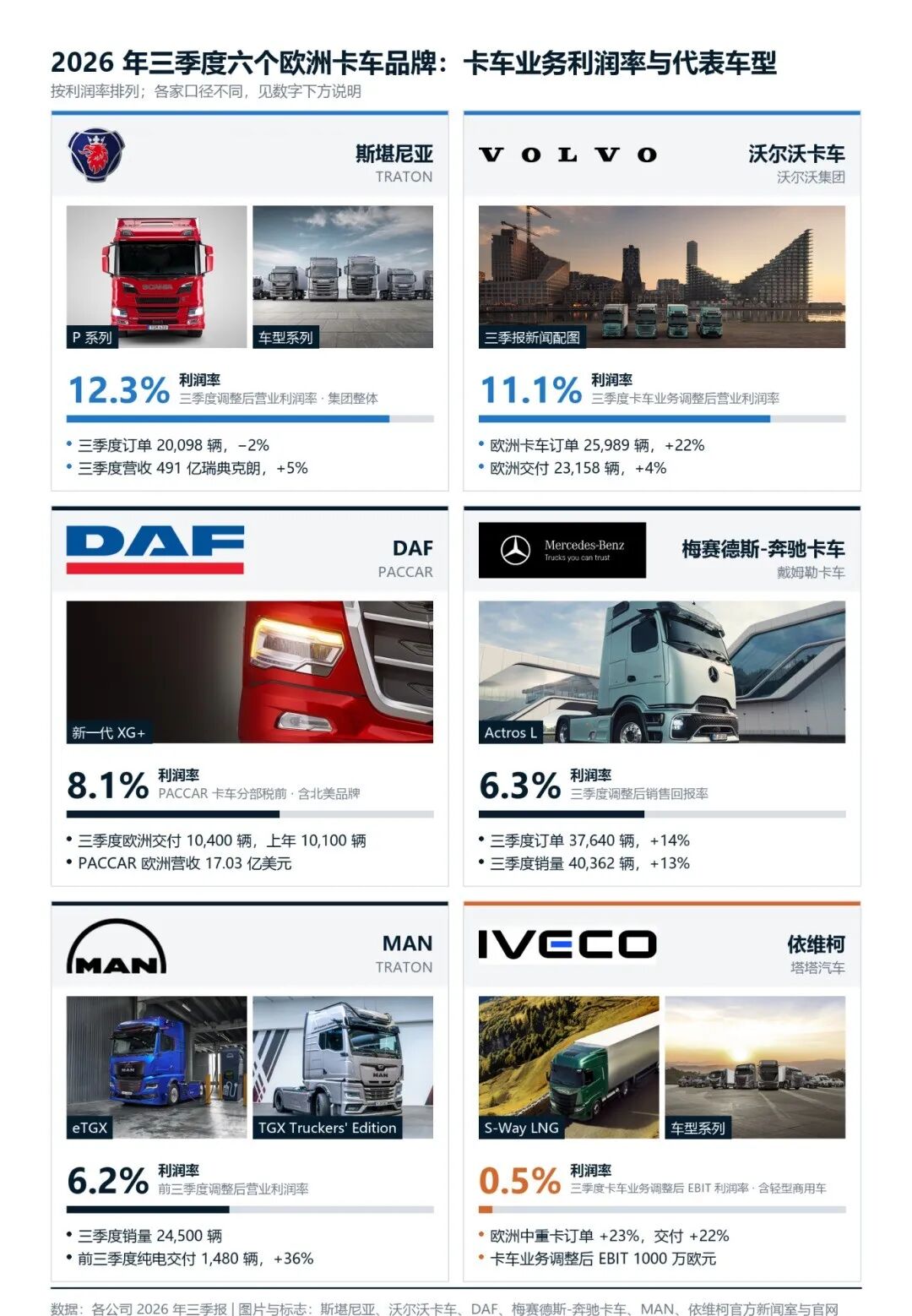
From Oct 23 to Nov 6, Europe's major truck makers released their third-quarter results one after another. Most saw European orders rise. Volvo Group's European truck orders grew 22%, Iveco's European medium and heavy truck orders grew 23%, and orders at the Europe-focused Mercedes-Benz (Daimler) Trucks segment grew 14%. Profit margins in the truck businesses, however, were very far apart. In the same quarter, Scania's adjusted operating margin was 12.3%, Volvo Group's truck business 11.1%, Mercedes-Benz Trucks 6.3%, and Iveco's truck business only 0.5%. Note that the figures are not reported on exactly the same basis. Scania's figure covers the whole group, and Iveco's truck business includes light commercial vehicles. Neither figure is limited to Europe.
Recovering European demand has lifted volumes, but margins have not broadly followed; much of the seemingly strong growth at several groups comes from North America.
European orders rose faster than registrations
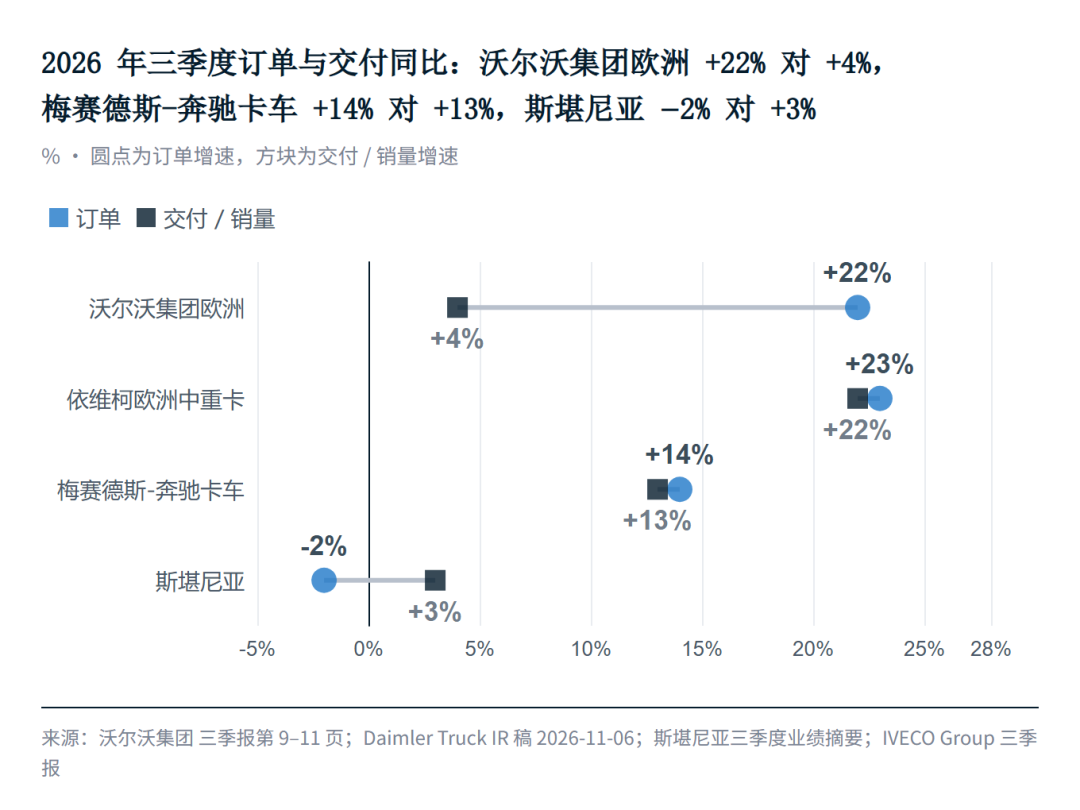
Volvo Group's European truck orders in Q3 were 25989 units, up 22%, with medium and heavy trucks up 25% and light trucks up 13%; European deliveries in the same period were 23158 units, up only 4%. Iveco's European medium and heavy truck orders rose 23%, while by its own count the European medium and heavy truck market was flat year on year in Q3 and the light commercial vehicle market fell 4%. The Mercedes-Benz Trucks segment booked 37640 orders, up 14%, with sales of 40362 units, up 13%; the segment is mainly European but also includes other regions.
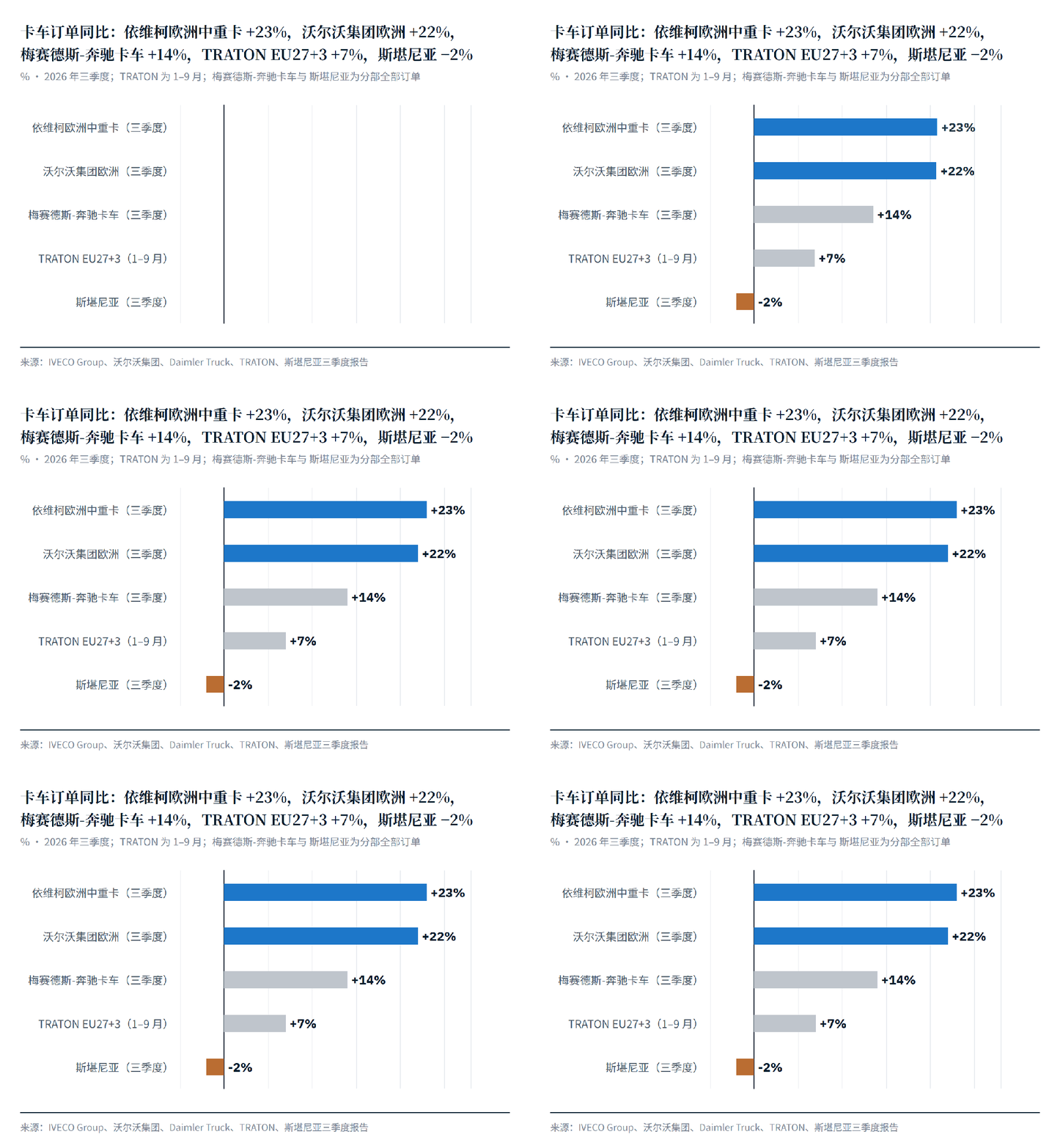
TRATON's truck orders in the EU27+3 (the 27 EU member states plus the UK, Norway and Switzerland) reached 80494 units in the first three quarters, up 7%. Germany was down 3% for the first nine months but turned to growth of 9% in Q3 alone. Scania was the exception: its global Q3 orders were 20098 units, down 2%, while deliveries were 22086 units, up 3%.
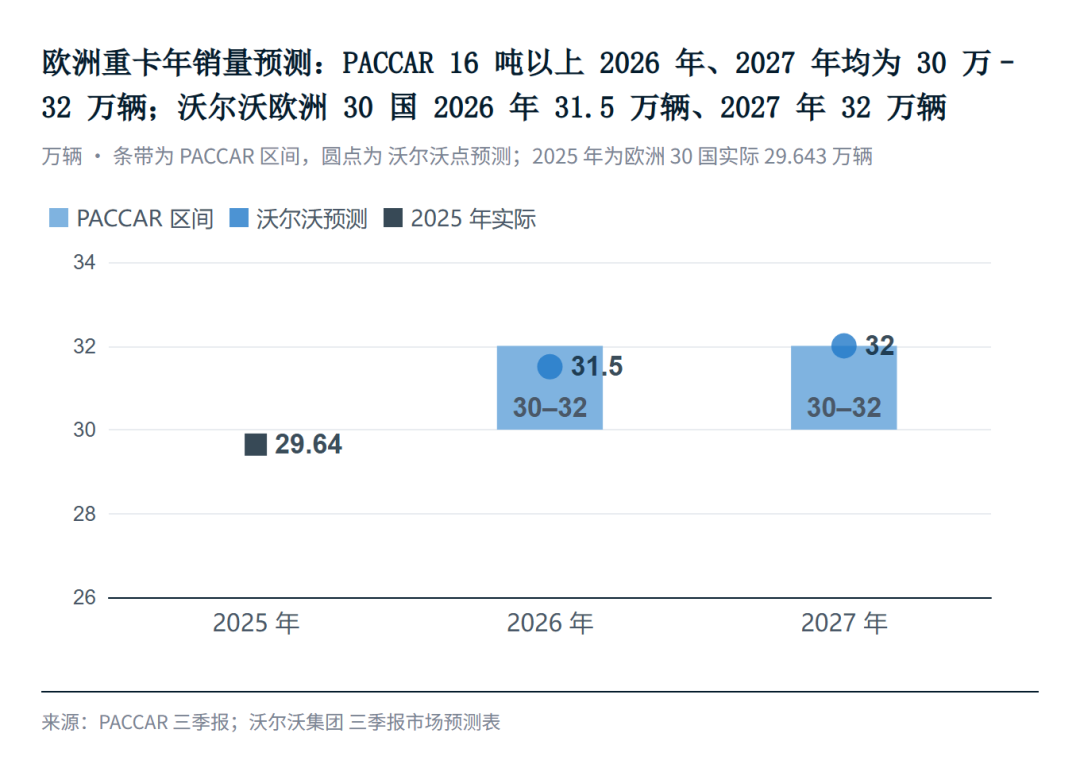
Registrations grew much more slowly. Volvo's count for heavy truck registrations in Europe's 30 countries was 233,332 units in the first three quarters, up 7%. The European Automobile Manufacturers' Association (ACEA) counted 245,079 new truck registrations in the EU, up 7.5%, with heavy trucks up 8.5%. Volvo expects 315,000 heavy trucks in Europe's 30 countries this year and 320,000 in 2027. PACCAR expects trucks above 16 tonnes to be between 300,000 and 320,000 units both this year and next.
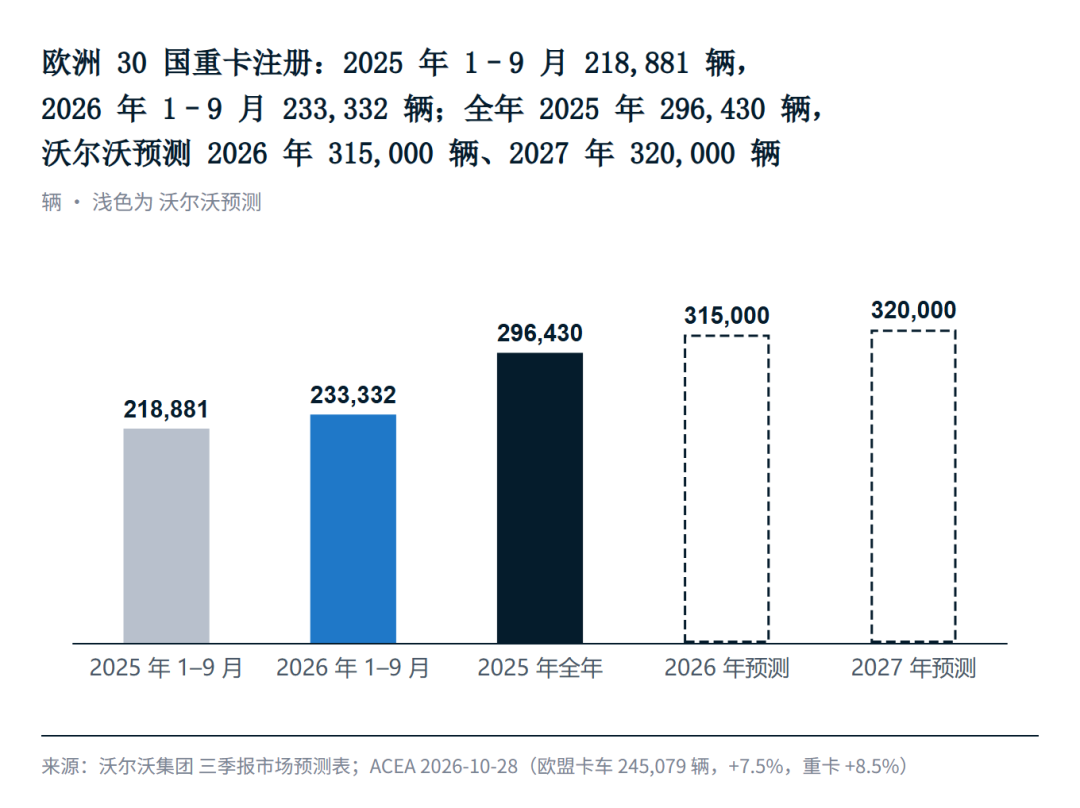
Orders are growing much faster than registrations, but both manufacturers' forecasts for next year differ little from this year's. The order recovery has not yet changed their view of the overall market size.
Most of the group's growth came from North America
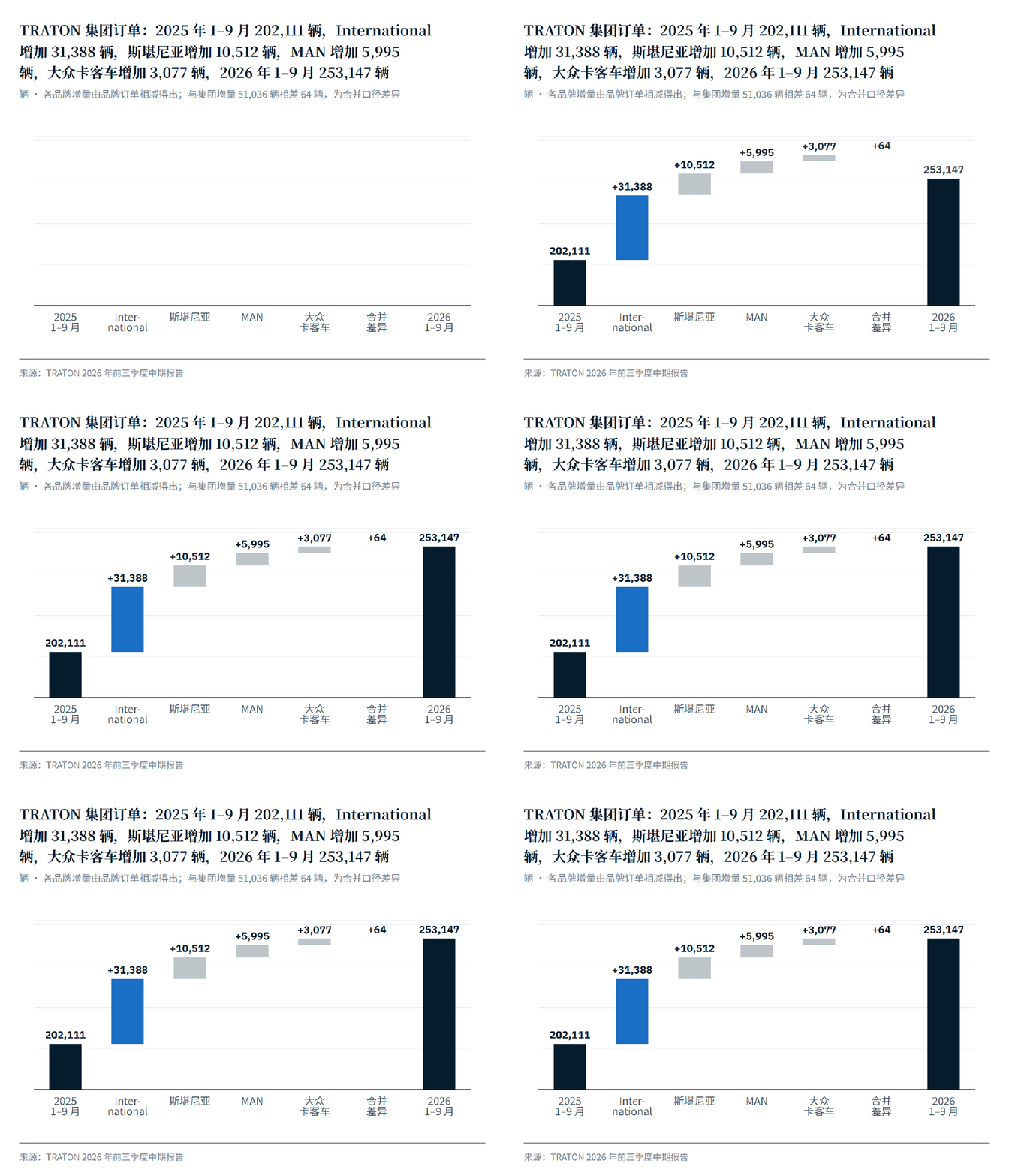
TRATON's order intake for the first three quarters was 253147 units, up 25%. Broken down, its US truck brand International took orders for 63299 units, up 98%, with North American truck orders up 105%. Of the group's 51036 additional orders, International accounted for 31388 units, roughly 60%, while EU27+3 grew only 7%. Third-quarter sales followed the same pattern: International sold 19900 units, up 48%; MAN sold 24500, about 100 fewer than a year earlier; and Scania sold 22100, up 3%.
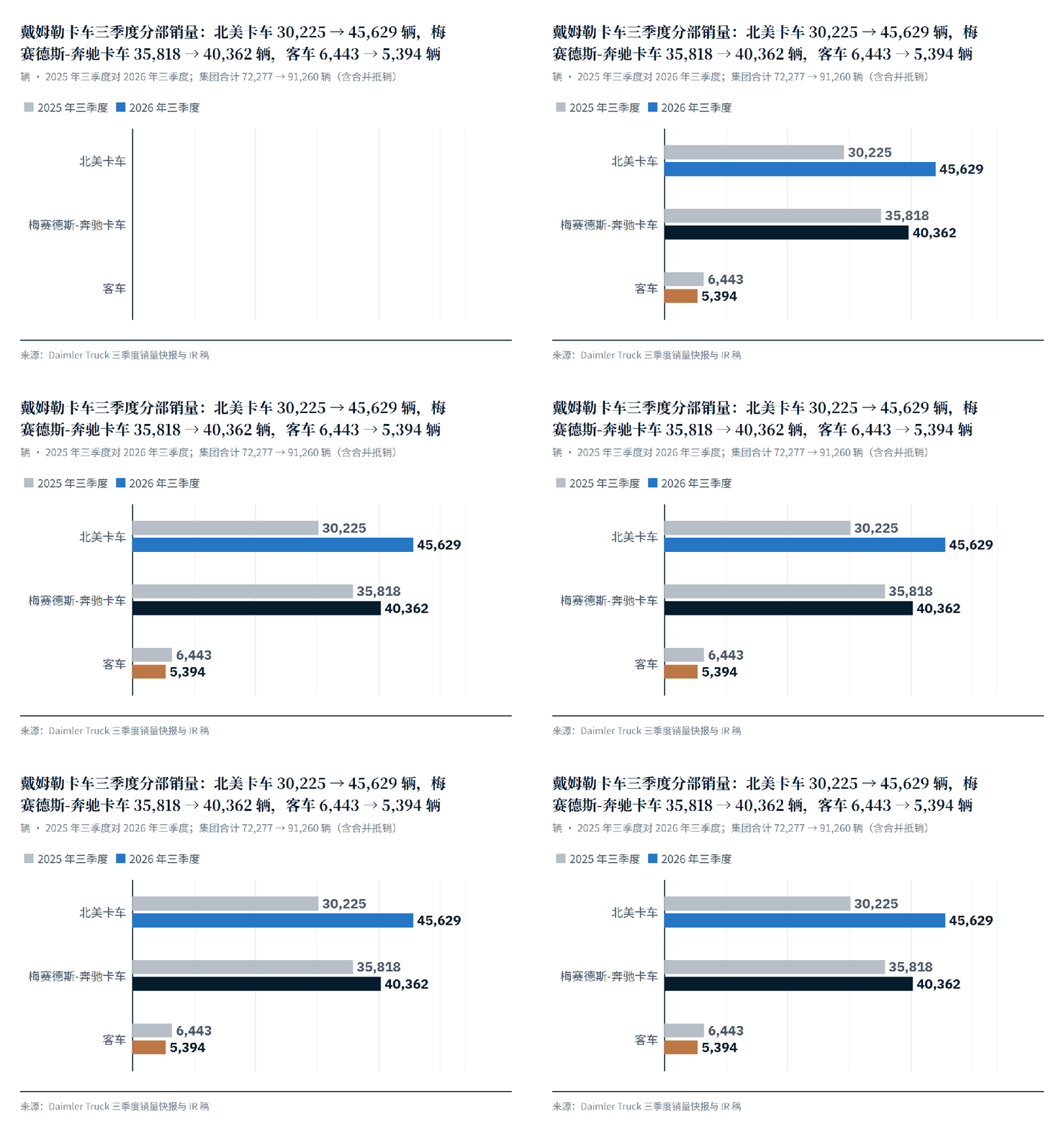
Daimler Truck's third-quarter unit sales were 91,260, up from 72,277 a year earlier. Of the additional 18,983 units, Trucks North America accounted for 15,404, or about 80%; Trucks North America's adjusted return on sales rose from 6.4% to 12.1%, while Mercedes-Benz Trucks slipped from 6.5% to 6.3%. Group adjusted EBIT rose from €648 million to €1,124 million, and the industrial business adjusted return on sales was 9.1%, versus 6.2% a year earlier; for the first nine months it was still 7.1%, below 8.4% a year earlier. Full-year guidance remains 7% to 9%.
Besides DAF, PACCAR owns Kenworth and Peterbilt in the US. Its truck segment posted Q3 pre-tax profit of $454.5 million, versus $102.5 million a year earlier, for a pre-tax margin of about 8.1%, up from about 2.3%. By region, US and Canada revenue was $5.017 billion, versus $3.98 billion; European revenue was $1.703 billion, versus $1.677 billion, almost flat; European new-truck deliveries were 10,400 units, versus 10,100 a year earlier. The parts business posted pre-tax profit of $404.4 million, versus $410 million.
Daimler's additional profit came mainly from North American trucks, and almost all of PACCAR's revenue growth came from the US and Canada. Looking only at group figures overstates the improvement in their European businesses.

Profit margin 0.5% to 12.3%
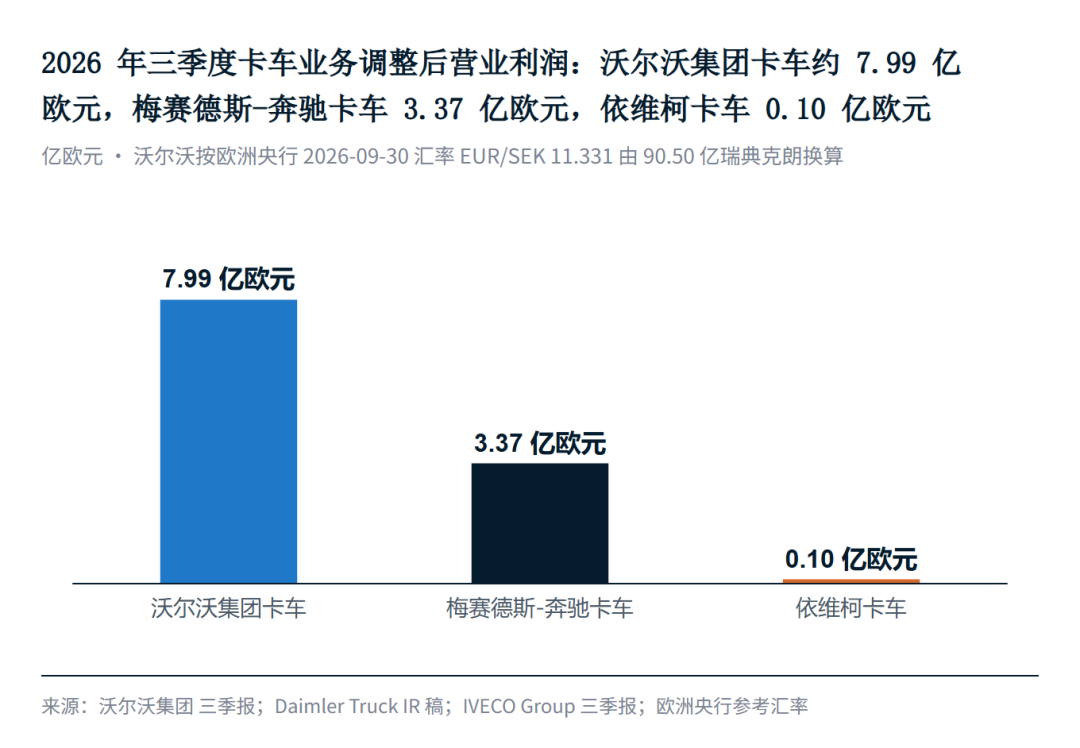
Scania's Q3 revenue was SEK 49.1 billion, up 5%, with an adjusted operating margin of 12.3% versus 11.1% a year earlier; in the quarterly report, Scania's CEO highlighted its service network and new products launched in Q3. Volvo Group's truck business posted adjusted operating income of SEK 9.05 billion, about EUR 799 million at the ECB's Sep 30 exchange rate, with a margin of 11.1% versus 9.1% a year earlier. TRATON attributed the group's profit improvement to services, financial services, and volume, price and product mix, partly offset by tariffs and higher raw material costs.
Mercedes-Benz Trucks posted revenue of €5.363 billion, up 10%, adjusted EBIT of €337 million, up 6%, and an adjusted return on sales of 6.3%. Iveco's truck business posted revenue of €2.099 billion, up 4.5%, and adjusted EBIT of €10 million versus €59 million a year earlier, with the margin falling from 2.9% to 0.5%, even as its European medium and heavy truck deliveries rose 22% over the same period. Iveco said profit was weighed down mainly by competition in light commercial vehicles, while European heavy trucks maintained pricing discipline; at group level it also cited quality investments and an unfavorable product mix. Iveco has completed the tender offer and is now part of India's Tata Motors.
Mercedes-Benz Trucks' adjusted return on sales was 9.9% in Q3 2023, 6.4% in Q3 2024, 6.5% in Q3 2025 and 6.3% this year. MAN's adjusted operating margin for the first three quarters was 6.2%, against 5.6% a year earlier.
In the same order recovery, Mercedes-Benz Trucks and Iveco trucks sold more but with lower margins than a year earlier; margins rose at Scania and Volvo Trucks. The benefits of the recovery were very unevenly shared among manufacturers.
BEV orders up, deliveries down
Volvo Group's Q3 orders for battery-electric trucks were 1928 units, up 163%, while deliveries were 878, down 17%; both figures are group-wide totals across all weight classes worldwide. The Volvo brand's share of Europe's overall heavy-truck market was 19.5%, versus 19.3% a year earlier, but its share of Europe's battery-electric heavy-truck market fell from 27.6% to 14.1%, and Renault Trucks, also part of Volvo Group, fell from 17.0% to 8.7%. Daimler Truck sold 1207 battery-electric trucks and buses in Q3, versus 1679 a year earlier, down 28%.
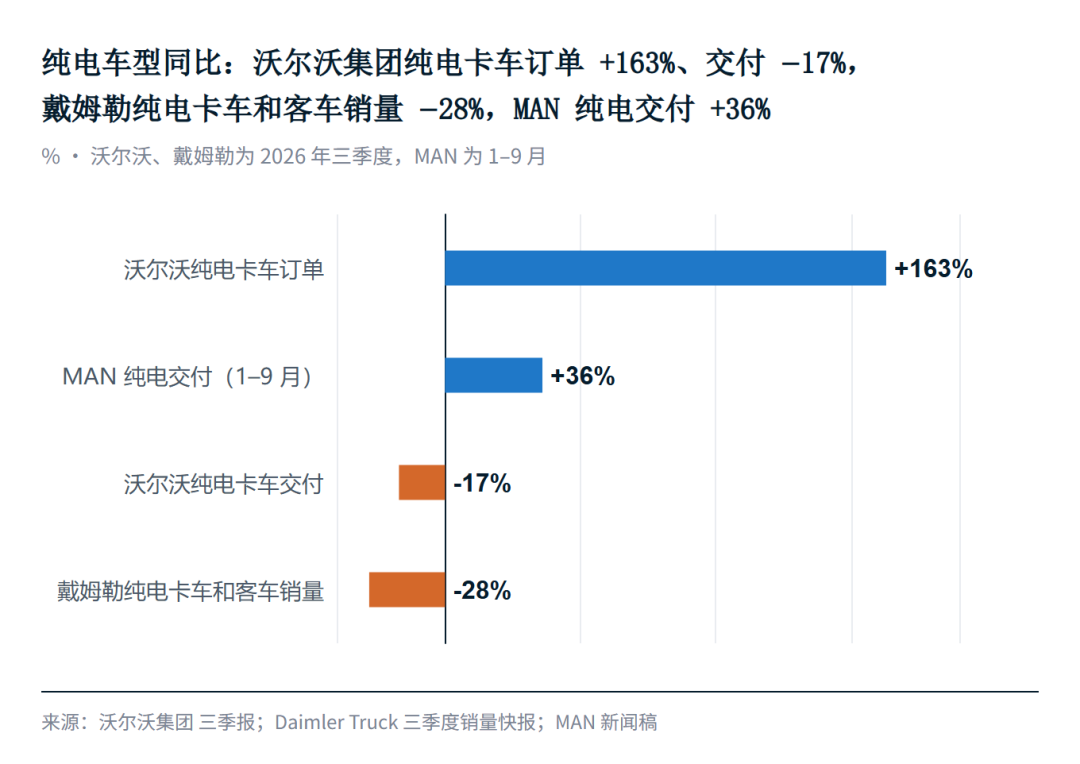
MAN's battery-electric deliveries are growing: 1480 units in the first nine months, up 36%, including 805 trucks and 675 buses. The overall market is rising too: ACEA data show EU registrations of electrically chargeable trucks (BEV and PHEV) up 49.8% in the first nine months, accounting for 5.3% of new truck registrations.
Volvo and Renault saw their combined share of battery-electric heavy trucks halve in one year. In a segment where total volume is growing, current shares are far from settled.
European market holds steady at around 300,000 units
Volvo forecasts that heavy truck volumes in the 30 European countries will be about 5,000 units higher next year than this year; PACCAR's range is 300,000 to 320,000 units for both this year and next. With limited growth in the overall market, Chinese brands entering Europe will mostly have to win sales by taking share from existing brands. Incumbent OEMs are in very different positions: Scania and Volvo Trucks have margins above 11%, while Iveco's truck business is at just 0.5%, and Iveco itself says the pressure comes mainly from light commercial vehicles.
Source: Chart by AutoMusic based on the public sources listed in the article; first published on the AutoMusic WeChat account.
What to watch next: whether European orders keep growing in Q4, whether Mercedes-Benz Trucks' return on sales stops falling, and how deliveries of Volvo Group's 1928 battery-electric orders progress. Chinese truck makers preparing to enter Europe need to compare more than vehicle prices. Rivals' margins and service networks matter too. Market share in battery-electric heavy trucks is being redistributed, and who is picking up that share is more worth tracking than the size of the market.