European Parliament committee holds three votes in Nov 4: vans can use low-carbon steel to offset, corporate fleet targets made indicative
European Parliament committee votes three items, Nov 4: passenger cars keep the 87.5% target for 2035, topped up to 95% with low-carbon steel credits; vans may use steel credits; corporate fleet targets made indicative; from 2028, subsidies only for EU-made vehicles; heavy-duty Eur…
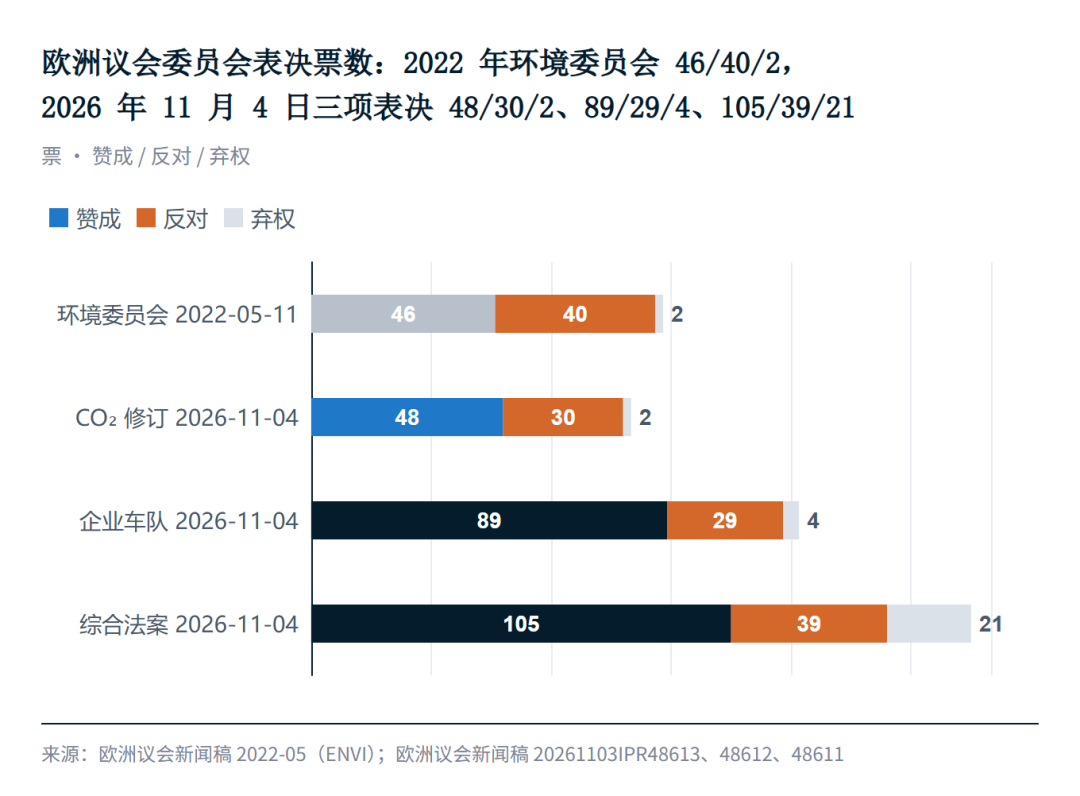
On Nov 4, European Parliament committees voted on three regulations in the EU automotive package. The Environment Committee approved the revision of CO₂ standards for passenger cars and light commercial vehicles by 48 votes to 30, with 2 abstentions. The corporate fleets regulation passed by 89 votes to 29. The bill simplifying automotive technical rules (the automotive omnibus) passed by 105 votes to 39.
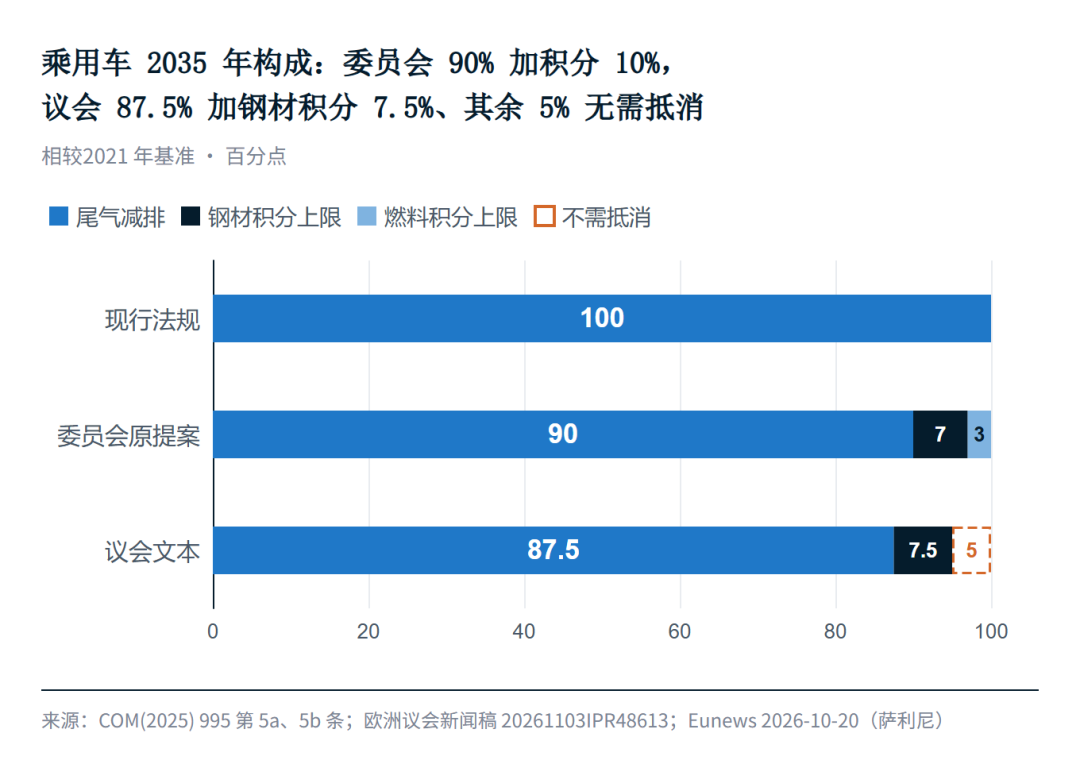
The passenger car figure for 2035 is the same as in the Industry and Transport committees' version from Oct 22: a 87.5% cut in tailpipe emissions, topped up to 95% with credits from EU-produced low-carbon steel. This time, the related provisions were adjusted. Vans can also use steel credits, national targets for corporate fleets are changed from mandatory to indicative, the "Made in EU" subsidy conditions are retained, and Euro 7 for heavy-duty vehicles is postponed by 18 months.
So while the emissions figures did not change across the two rounds of committee votes in Parliament, the "made in the EU" condition carried more and more weight.
Differences between versions
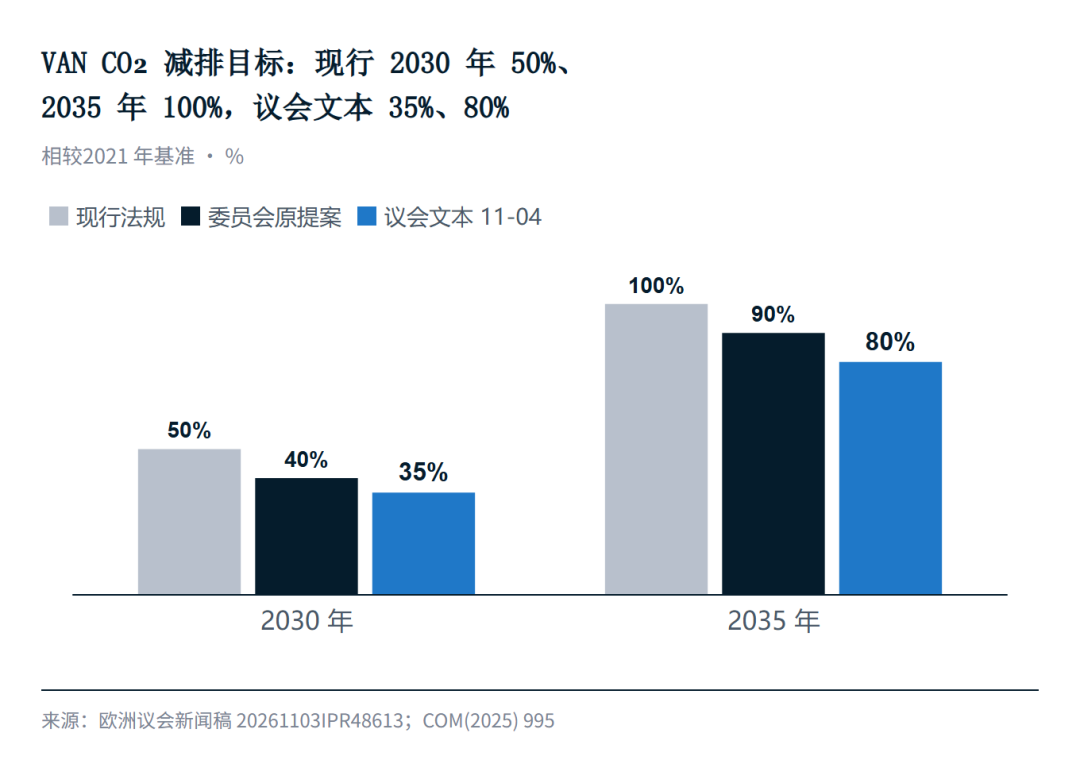
The Oct 22 compromise amendment stated that steel credits used to make up the 95% apply "to passenger cars only". The Nov 4 text also brings in vans: the 2035 van target is lowered from 100% to 80%, and steel credits may be used, likewise capped at 7.5% of the 2021 baseline. The difference is that passenger cars must make up the gap, while vans may choose to use the credits. The 2030 van target is 35%, versus 50% under current regulation and 40% in the Commission's original proposal.
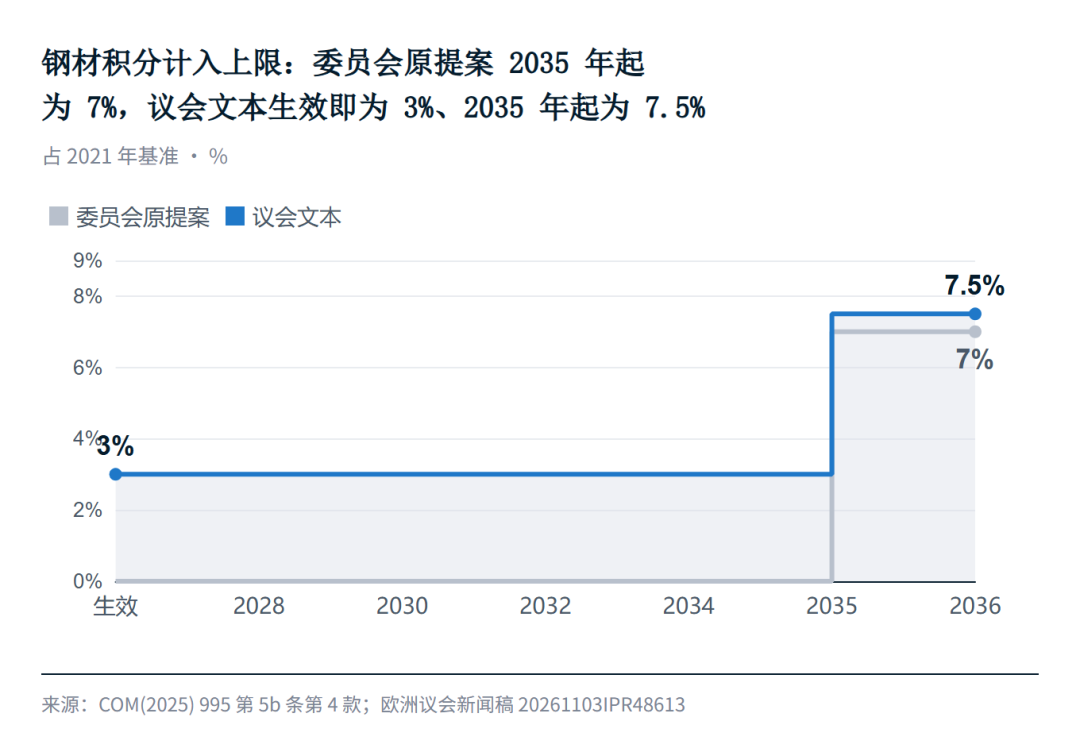
Steel credits also kick in earlier: they can be used as soon as the regulation takes effect, counting for up to 2034% until the end of 3. The Commission's original proposal would not have allowed them until 2035, with a 7% cap, plus separate fuel credits capped at 3%. The International Council on Clean Transportation (ICCT) estimates that under the Commission's proposal, credits could offset up to about 11 g/km of passenger car emissions after 2035, equivalent to 10%; applying the same ratio, 3% works out to about 3.3 g/km and 7.5% to about 8.25 g/km.
The treatment of renewable fuels changed the most. The Commission's original proposal converted fuel emission reductions into credits, capped at 3%. The Parliament text creates a new VEEF category (Vehicles running Exclusively on Eligible Fuels, i.e. vehicles using only eligible renewable and low-carbon fuels) and includes it in the definition of "zero-emission vehicles", so such combustion-engine models count directly as zero-emission vehicles. Rapporteur Salini has said this category would apply from 2030.
The super-credit rules are also more detailed: EU-built small electric cars up to 4.2 metres long count as 1.4 vehicles, EU-built high-efficiency electric cars count as 1.2, and those registered through social leasing get an extra 0.1 each; EU-built battery-electric vans count as 1.2 vehicles until the end of 2034 and as 1.4 from 2035.
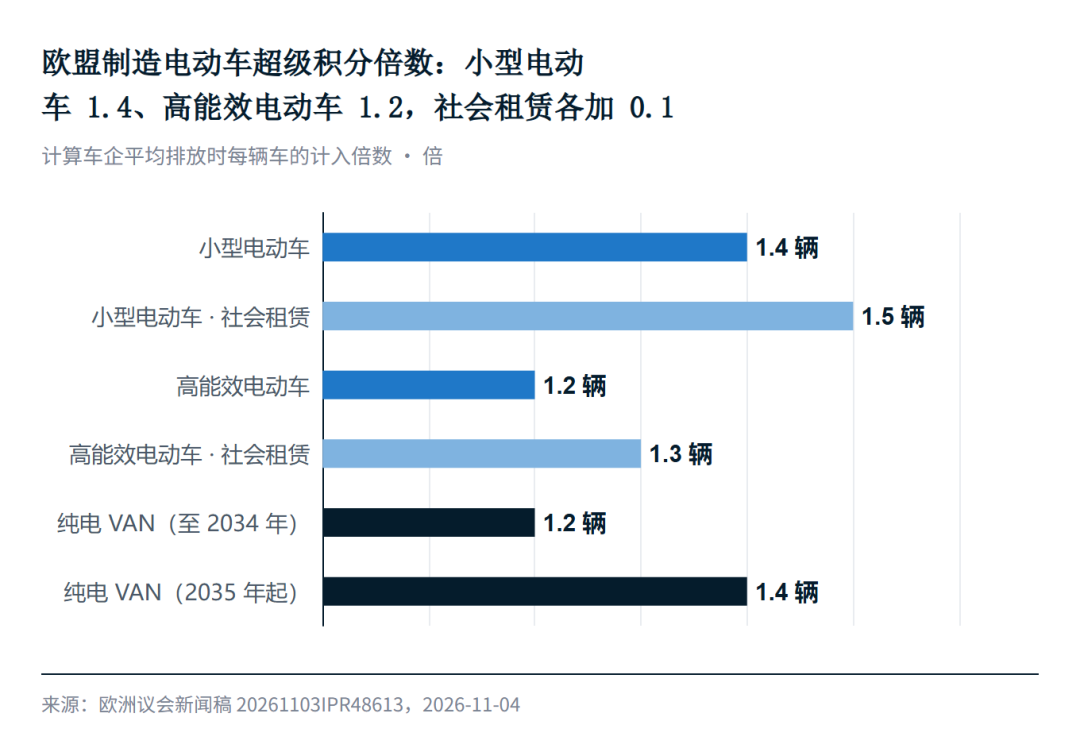
For van makers, 2035 brings a compliance route based on steel procurement, in addition to electrification and super-credits, provided the steel purchased meets the delegated act's definition of low-carbon steel.
Corporate fleet targets made non-binding
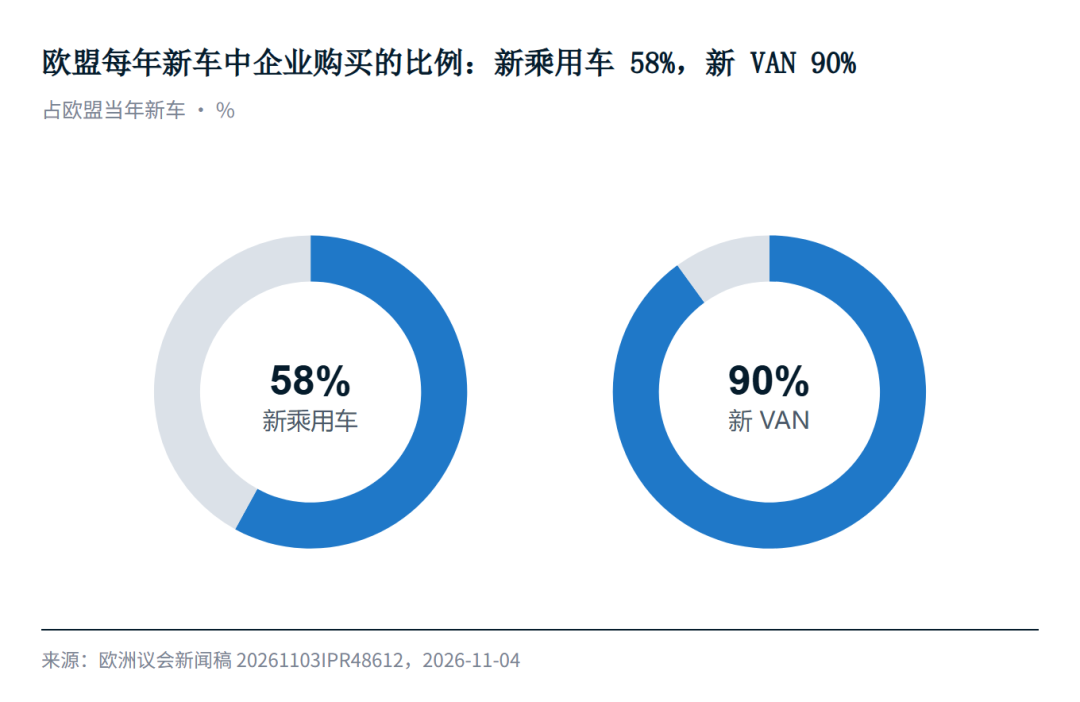
Companies buy 58% of the EU's new passenger cars and 90% of its new vans each year; in 2025, zero-emission vehicles made up only 17% of company passenger car registrations. The regulation's national targets apply to company cars registered by large companies, defined as those with more than 250 employees and turnover above EUR 50 million.
Article 3 of the Commission's original proposal required that member states "shall ensure" the national targets set out in the annex are met from 2030. The combined passenger car targets for 2030 range from 48% in countries such as Bulgaria and Poland to 90% in countries such as the Netherlands and Sweden, with 83% for Germany and 69% for France and Italy. The Commission estimates that zero-emission vehicles will make up at least 45% of corporate passenger cars across the EU in 2030, about 2.6 times the 17% in 2025.
Parliament turned the 67% to 95% range into indicative national targets. Each member state chooses its own measures and draws up a national plan from 2028. In a joint statement after the vote, the Federation of German Industries (BDI) and Confindustria, the Italian industry association, explicitly opposed mandatory quotas.
The subsidy provisions were not relaxed. Article 4 of the original proposal stipulates that from two years before national targets take effect, i.e. from 2028, member states may only subsidise zero- and low-emission company cars, and only vehicles "made in the EU". Parliament retained both provisions and specified that "made in the EU" will be defined under the Industrial Accelerator Act currently being legislated.
With the target made indicative, each member state will decide whether to use fiscal measures to drive the electrification of company cars; where fiscal measures are used, from 2028 they may only apply to EU-made vehicles.
Chinese brands and origin clauses
Three provisions are tied to place of manufacture: corporate fleet incentives apply only to EU-made company cars; super-credits apply only to EU-produced models; and the new "small electric vehicle" category in the omnibus package requires EU manufacture. None of these provisions restricts registration of imported cars. Imported BEVs still count as zero-emission vehicles in manufacturers' CO₂ accounting, and subsidies for private purchases fall outside the corporate fleet regulation.
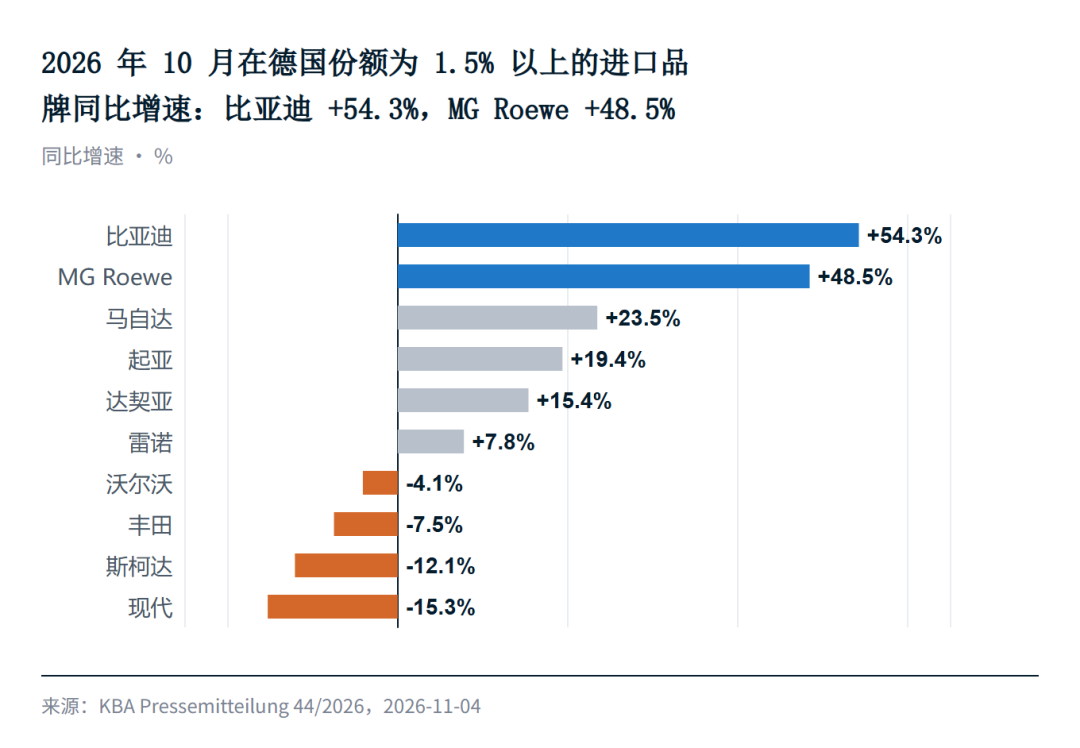
Germany offers a benchmark. Data from the Federal Motor Transport Authority (KBA) show 254492 new passenger car registrations in Germany in month 10, with private registrations accounting for just 40.7% and the rest by businesses and other commercial users. In the same month, BYD's registrations in Germany rose 54.3% year on year, for a 2.0% share.
If the provision passes as currently drafted, cars imported from China would be ineligible for member-state subsidies in the large-company fleet channel and would earn no super-credits in automakers' CO₂ accounting. The scale of the impact depends on how the Industrial Accelerator Act defines "made in the EU"; a Franco-German non-paper in 10 proposed that products from Norway, Iceland, Switzerland and the UK could also count as made in Europe.
Omnibus package and heavy-duty Euro 7
The part of the Automotive Omnibus most directly relevant to the industry is an 18-month delay to Euro 7 for heavy-duty vehicles. Under EU Regulation 2024/1257, Euro 7 was to apply to new heavy-duty vehicle types from May 29, 2028 and to all new vehicles from May 29, 2029; these dates move to Nov 29, 2029 and Nov 29, 2030 respectively. The European Automobile Manufacturers' Association (ACEA) called for a two-year delay in October, while the Council presidency's compromise text in February proposed 18 months. The package also requires passenger cars and vans under 3.5 tonnes to be fitted with child presence detection systems. The Commission estimates the simplification measures in the original proposal would save EUR 706 million a year.
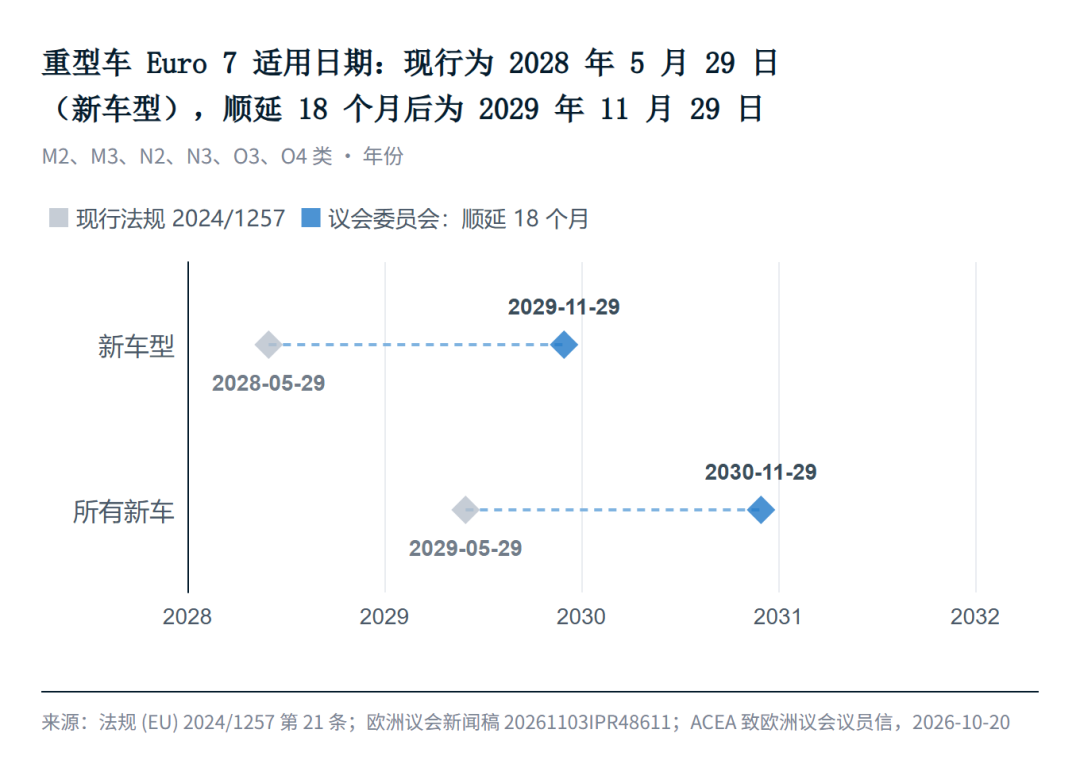
Euro 7 governs pollutant emissions; delaying it does not change the heavy truck CO₂ target of a 43% cut by 2030 versus 2019, so heavy truck makers' electrification compliance pressure is not eased.
Member states are divided
Italy's automotive industry association ANFIA called the compromise "a step in the right direction" but said that requiring 7.5% of the 2035 target to be offset with low-carbon steel is "unsustainable"; BDI and Confindustria want the fleet target cut unconditionally to 90%.
Member states were clearly divided at the Council debate in 6. Sweden, Spain, France, Portugal, Luxembourg and the Netherlands backed a clear electrification path, and Luxembourg and the Netherlands opposed counting vehicles running on renewable fuels as zero-emission vehicles. Czechia opposed the 2035 deadline, Italy wanted vehicles running on renewable fuels to be recognised, and Poland, Slovakia and Bulgaria called for more technology neutrality. On Oct 16, France and Germany reached an agreement backing 90% for 2035 with no offsetting requirement. Adopting a Council position takes a qualified majority, meaning at least 15 member states representing at least 65% of the EU population. Ireland, which holds the rotating presidency, aims to reach agreement with Parliament by the end of 2026.
The three hardest points in the trilogue: 87.5% with a steel credit or 90% with no offset, whether VEEF count as zero-emission vehicles, and the scope of "Made in EU".
Timeline
Source: Chart by AutoMusic based on the public sources listed in the article; first published on the AutoMusic WeChat account.
The same environment committee voted 46 to 40 four years ago to keep 100%, and this time voted 48 to 30 to cut it to 87.5%, widening the margin from 6 votes to 18. After the plenary in month 12, the dispute will shift to the Council and to how the Industrial Accelerator Act defines "Made in EU".