Euro NCAP's first city delivery truck ratings: 3 of 7 miss out on CitySafe, and none offer lane keeping
Euro NCAP's first ratings of 7 12-tonne city delivery trucks: the MAN TGL scored five stars, while DAF, Isuzu and Iveco missed out on CitySafe, and none of the seven offers lane keeping. The gaps lie in features not required by regulation, such as automatic braking when turning.
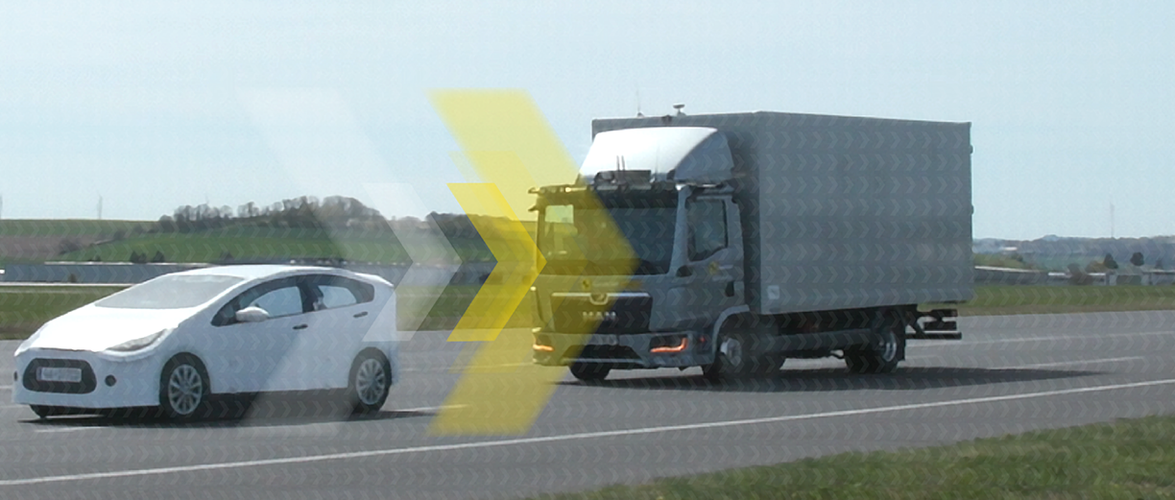
On Nov 3, Euro NCAP published safety ratings for 7 12-tonne 4x2 rigid urban delivery trucks. The MAN TGL earned five stars, scoring 89% for safe driving and 71% for crash avoidance; the Volvo FL, Renault Trucks D and Mercedes-Benz Atego earned four stars. All four received CitySafe recognition. The DAF XB earned three stars, and the Isuzu F-Series and Iveco Eurocargo two stars; none of these three received CitySafe. None of the seven trucks offers lane keeping.
All seven trucks scored 80% for post-crash safety, so star ratings were decided entirely by safe driving and crash avoidance. The Iveco Eurocargo scored just 20% for crash avoidance, the lowest in the group; the Isuzu F-Series, rated by Euro NCAP for the first time, scored 29% for crash avoidance.
None of the seven vehicles has lane keeping, so all lost the same 25 points in crash avoidance. What separated the models was whether they brake automatically when turning, whether the turn signal must be activated first, and how well forward braking performs for pedestrians and cyclists; for these items, EU regulation only requires a warning.
Rating results
These 7 models are all 12-tonne-class urban delivery vehicles that shuttle daily between motorways, suburbs and city centres, and are widely used for e-commerce and municipal deliveries.
The MAN TGL had the highest safe driving score at 89%. The Volvo FL and Renault Trucks D, which share a platform, both scored 78%; Mercedes-Benz Atego 77%; DAF XB 66%; Isuzu F-Series 67%; Iveco Eurocargo 58%.
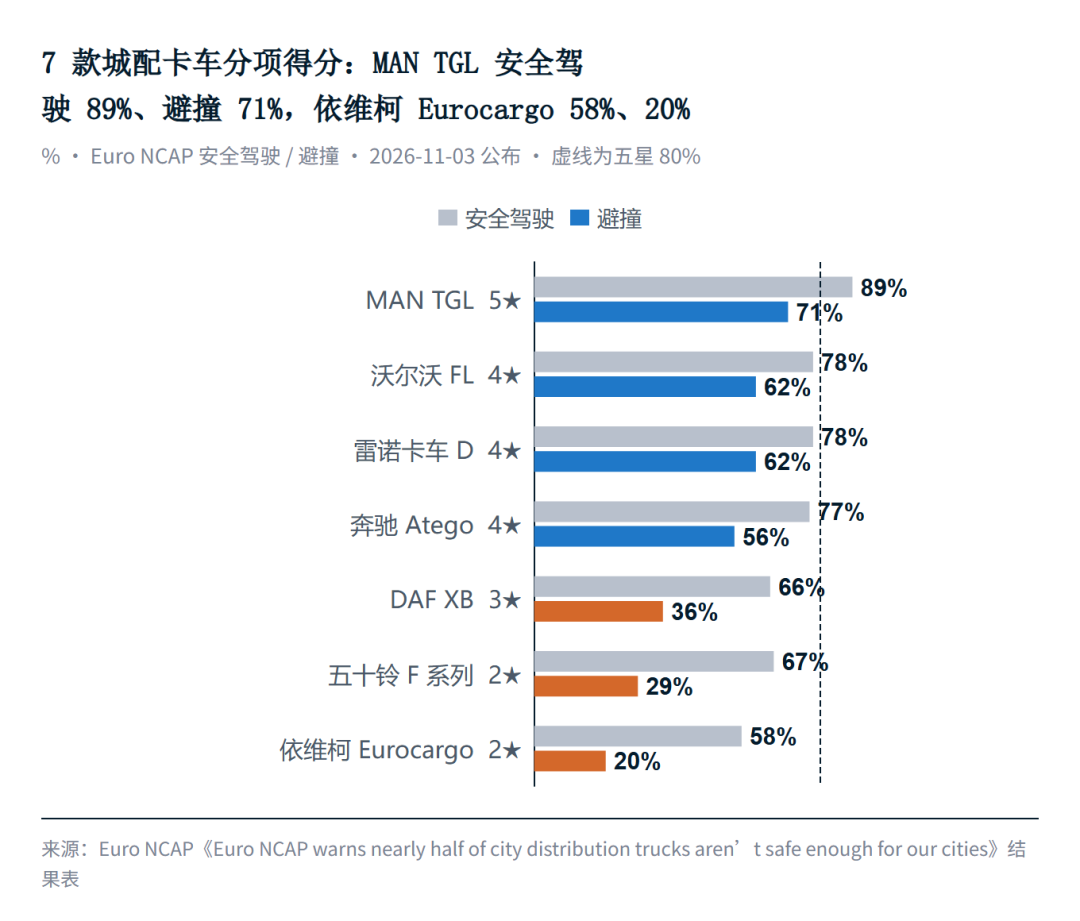
The gap in collision avoidance scores is wider. MAN TGL scored 71%, Volvo FL and Renault Trucks D both scored 62%, and Mercedes-Benz Atego scored 56%. The bottom three were DAF XB at 36%, Isuzu F-Series at 29% and Iveco Eurocargo at 20%.
The differences in equipment come down to a few items. The MAN TGL offers an optional camera monitor system (CMS) with adaptive digital mirrors to cover blind spots around the vehicle. It also has a cyclist turn assist system that works even without the indicator on, earning full marks of 15 points in the low-speed turning test. The Volvo FL offers optional lower door windows and 360-degree surround view, but its turn assist only activates when the indicator is on, as is also the case with the Renault Trucks D. The Mercedes-Benz Atego has more standard equipment, with adaptive cruise control and speed limit assist lifting its score, but it does not offer CMS.
Euro NCAP states in its test notes that for fleets to get the safety performance reflected in the rating, they must order the same optional equipment as the tested vehicle; its assessment of the MAN TGL also assumes the full set of optional safety equipment used in the rating. All seven vehicles are in the 12-tonne class, so for fleets the difference comes down to which options are ticked on the order sheet.
Star rating method
Euro NCAP truck ratings use protocol v1.20, effective from Nov 2024. From 2025 to 2027, five stars require 80% in both Safe Driving and Crash Avoidance, four stars 65%, three stars 50%, two stars 35% and one star 20%. The overall star rating is set by the lower of the two scores; Post-Crash Safety does not count towards the rating in this round.
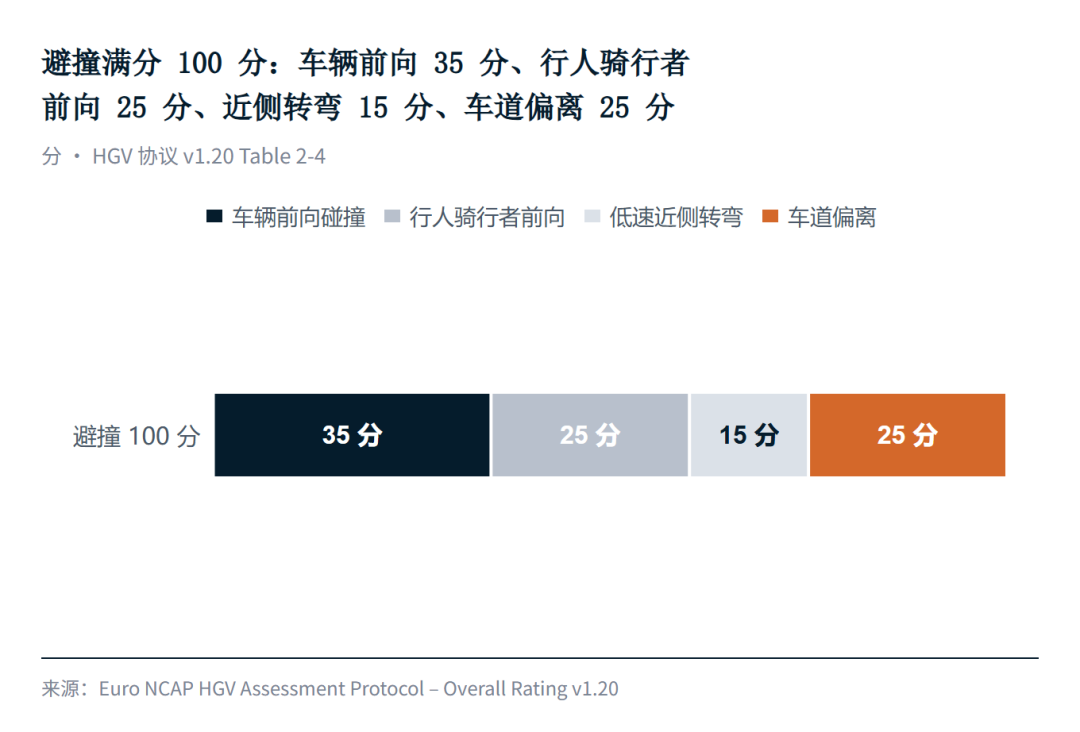
Crash avoidance is scored out of 100 points: 35 points for vehicle forward collision, 25 points for forward collision with pedestrians and cyclists, 15 points for low-speed near-side turning and 25 points for lane departure. Lane departure scoring only applies to systems that actively correct steering, namely Lane Keeping Assist (LKA) and Emergency Lane Keeping (ELK); Lane Departure Warning (LDW) is mandatory under regulation and is not scored.
None of the seven vehicles had lane keeping, so none received those 25 points; the maximum crash-avoidance score was therefore 75 points, 5 points short of the 80% required for five stars. The MAN TGL scored 71% for crash avoidance, 9 points short of 80%; its safe-driving score was 89%, 9 points above the threshold, and after balancing both scores reached exactly 80%.
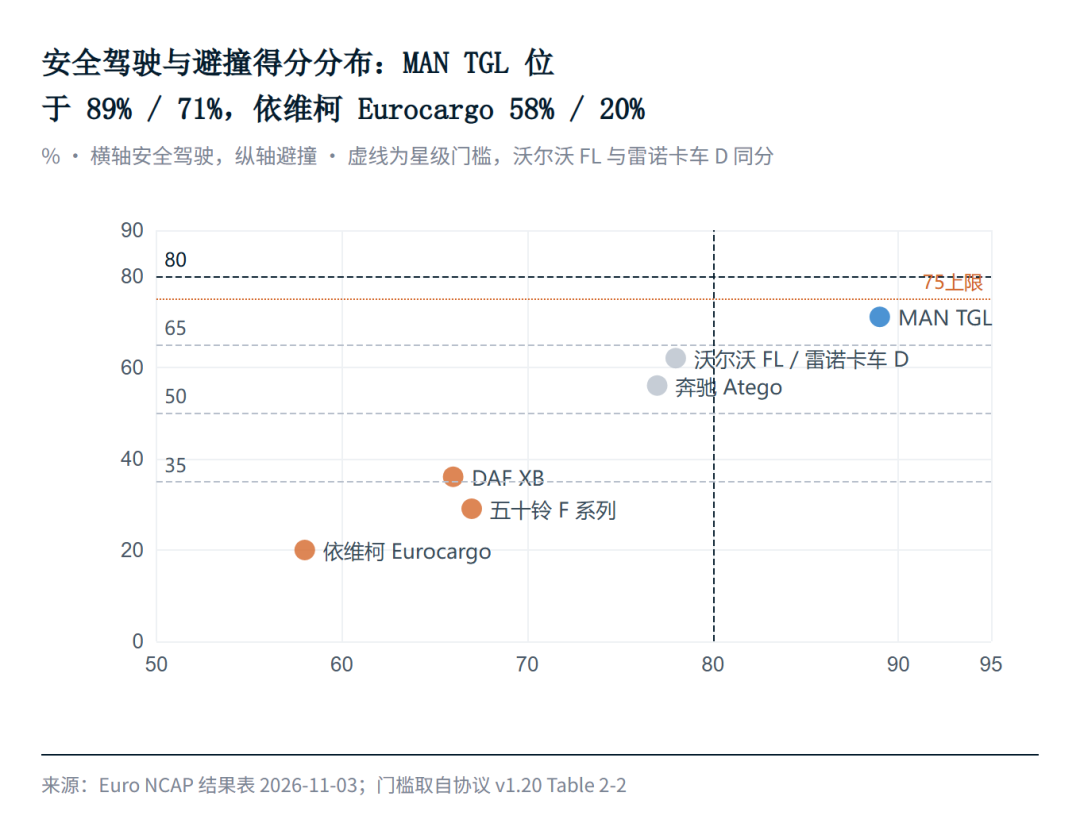
The star ratings of the last three also depend on the points-transfer rules. The DAF XB scored 36% in collision avoidance. Reaching four stars would have required 29 more points, above the 20-point cap; it was 14 points short of three stars, and its 16-point surplus in safe driving was enough to cover the gap, so it was rated three stars. The Isuzu F-Series scored 29% in collision avoidance, 21 points short of three stars, while its safe driving score of 67% was only 17 points above the three-star threshold, so even transferring all of it could not close the gap. Its combined score of 96 was below the 100 needed for three stars, and it was rated two stars. The Iveco Eurocargo scored 20% in collision avoidance and needed 15 more points for two stars; its safe driving score of 58% was enough to cover them.
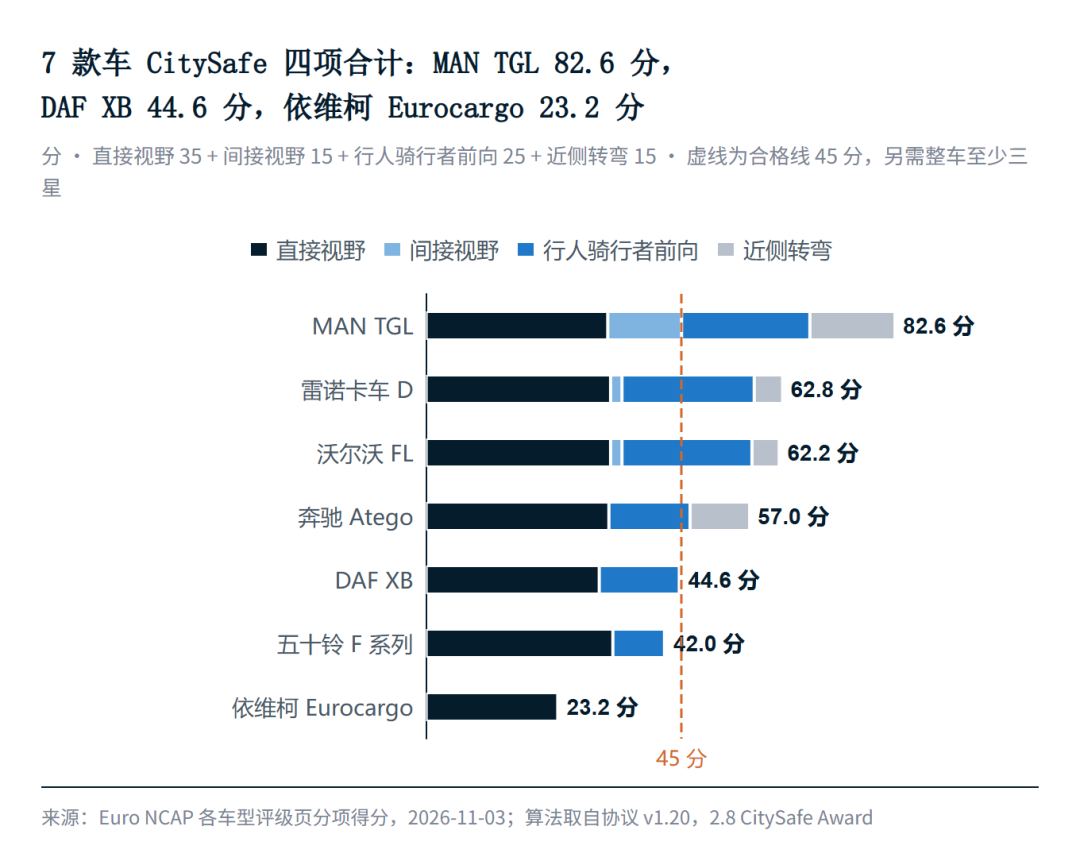
CitySafe has its own scoring system: direct vision 35 points, indirect vision 15 points, forward collision with pedestrians and cyclists 25 points, and low-speed near-side turning 15 points. The four add up to a maximum of 90 points; a vehicle must score above 45 points to pass and must also achieve at least three stars overall.
Adding up the sub-scores on each vehicle's rating page: MAN TGL scores 82.6 points, Renault Trucks D 62.8, Volvo FL 62.2 and Mercedes-Benz Atego 57.0. DAF XB scores 44.6, just 0.4 short of the pass mark, with 0 points in near-side turning. The Isuzu F-Series, with narrow cab pillars and a tall windscreen, scores 32.9 in direct vision, the highest of the seven, but it has no CMS and scores 0 in both indirect vision and turning, for a total of 42.0. With only a two-star overall rating, it meets neither condition. Iveco Eurocargo totals 23.2 points.
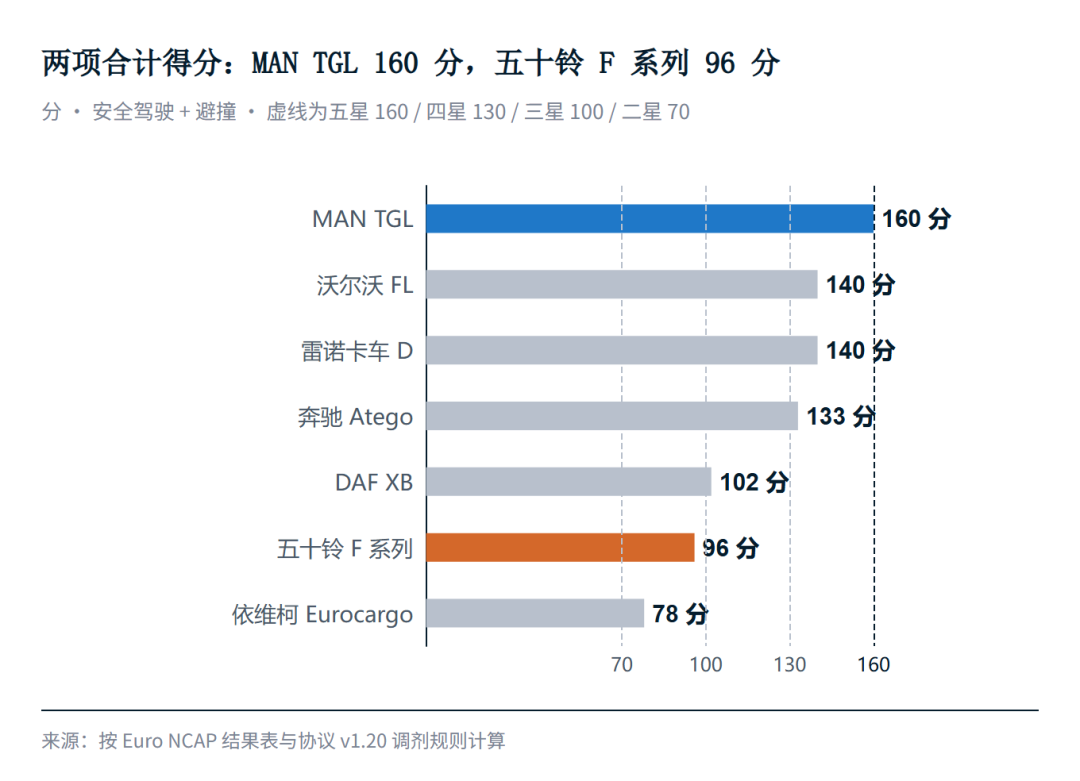
Under the current protocol, an urban delivery truck without lane keeping can only reach five stars by making up the collision-avoidance score with safe-driving points above the threshold.
Top three, bottom three
The top three (MAN TGL, Volvo FL, Renault Trucks D) and bottom three (DAF XB, Isuzu F-Series, Iveco Eurocargo) averaged 81.7% and 63.7% for safe driving, a gap of 18 percentage points, and 65.0% and 28.3% for crash avoidance, a gap of about 37 percentage points.
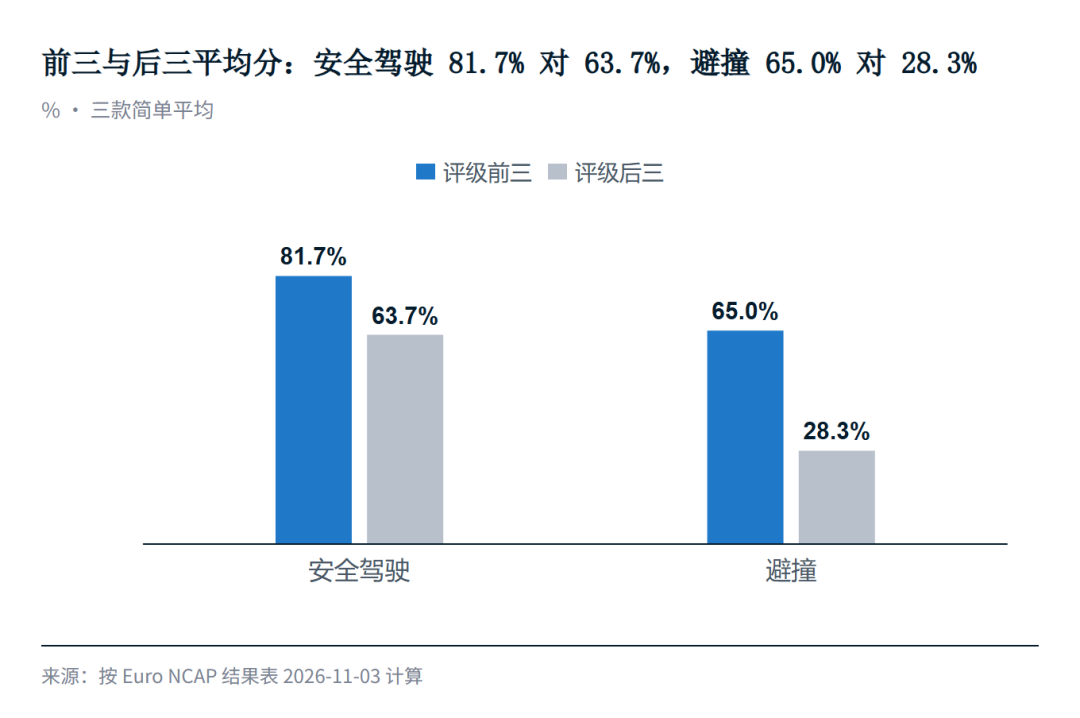
The gap for the last three models lies mainly in crash avoidance. According to Euro NCAP, the DAF XB has good direct vision and an optional lower door window, but no nearside turning protection at all, only adequate forward collision protection, and no CMS option at the time of rating. The Isuzu F-Series offers weak active protection for pedestrians and cyclists ahead and cannot intervene for cyclists alongside the vehicle when turning. The Iveco Eurocargo's car-to-car AEB is adequate, but it scored zero on forward protection for pedestrians and cyclists, cyclist turning protection and lane departure; its direct vision is also weak, and it likewise offers no CMS.
A nearside turn is when a truck turns towards the passenger side: a left turn in the UK, where traffic drives on the left, and the equivalent of a right turn in China. In this situation, cyclists can easily end up on the side of the truck the driver cannot see. Euro NCAP's protocol cites its research on UK police accident records: about 22% of crashes in which HGVs killed cyclists occurred in nearside turn scenarios, rising to about 40% in London.
All are fitted with turn assist, yet test scores varied widely. The MAN TGL achieved the maximum 15 points and the Mercedes-Benz Atego 10.5 points; both detect cyclists even without the turn signal on. The Renault Trucks D scored 5 points and the Volvo FL 4.8 points; these only intervene once the indicator is on. All four received CitySafe.
Even among vehicles with CitySafe recognition, measured turn-assist scores can differ by a factor of 3. Fleets operating mainly in cities should check the trigger conditions together with this score when ordering.
EU regulation
Article 9 of the EU General Safety Regulation GSR2 (Regulation (EU) 2019/2144) sets several requirements for categories N2 and N3 (medium and heavy goods vehicles): lane departure warning and advanced emergency braking; systems able to detect pedestrians and cyclists in front of the vehicle and on the near side and to issue a warning or avoid a collision; and cab designs that minimise front and side blind spots to improve direct vision of vulnerable road users. Emergency lane keeping is covered in Article 7 and applies only to categories M1 and N1, i.e. passenger cars and light commercial vehicles.
The implementation timetable is set out in Annex II. For the blind spot information system (UN R151) and the moving off information system (UN R159), type approval of new vehicle types will be refused from Jul 6, 2022, and registration of new vehicles without them will be prohibited from Jul 7, 2024. The direct vision requirements for heavy vehicles come in later: they have applied to new vehicle types since Jan 7, 2026, and will cover all newly registered vehicles from Jan 7, 2029. The two steps are 3 years apart, and the interim period mainly concerns older, already approved vehicle types.
Euro NCAP states explicitly in its protocol that in near-side turning scenarios, the regulation only requires information and warnings, while the rating awards additional points for systems that can brake automatically; the same applies to lane departure, where the regulation mandates a warning but the rating only scores systems that can steer the vehicle back into its lane.
The three vehicles that missed CitySafe fell short on turning protection and forward braking for pedestrians and cyclists: the DAF XB and Isuzu both scored 0 points on turning, and Iveco scored 0 points on both items. These are precisely the areas where regulation requires only a warning, while the rating awards extra points.
London licensing
At city level, London has its own Direct Vision Standard (DVS). In Sep 2016, the Mayor of London announced this world-first direct vision standard. It applies to HGVs over 12 tonnes gross weight operating in London and rates cab direct vision from 0 to 5 stars. Operators must hold a safety permit to enter Greater London. Enforcement began on Mar 1, 2021, with a minimum requirement of one star.
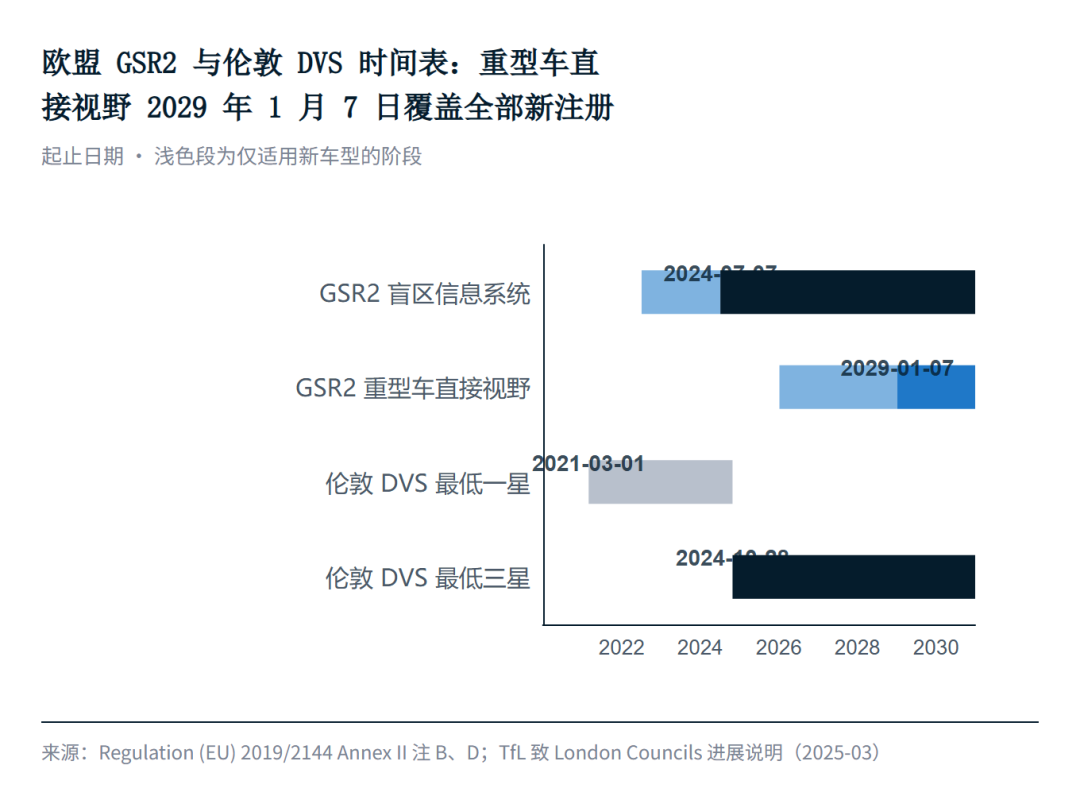
From Oct 28, 2024, the minimum star rating rises to three stars. Vehicles rated zero to two stars must be fitted with a Progressive Safe System (PSS) to obtain a permit. The PSS technical specification incorporates two regulations: UN R151 on blind-spot information and UN R159 on moving-off information. According to a progress note from Transport for London (TfL) to London Councils, 266911 old permits expired on Oct 27, 2024, of which 165926, or about 62%, were for zero-star vehicles.
The DVS applies only to vehicles over 12 tonnes gross weight. Euro NCAP tested a 12-tonne-class specification this round, which falls outside the scope of the London permit scheme.
12-tonne urban distribution trucks can operate in London without being subject to the DVS, and the EU's direct vision requirements will not cover all new registrations until 2029. Until then, fleets wanting to compare the active safety performance of these vehicles can use Euro NCAP's sub-scores, which provide directly comparable public test data.
Rating cadence
Euro NCAP published its first truck ratings on Nov 20, 2024, covering 9 long-haul models: two received five stars, two four stars, four three stars and one a single star, while four earned CitySafe recognition. The press release at the time said urban delivery results would be published in Oct 2025, but they were actually delayed to Nov 2026. In the regional delivery category published on 4/22 this year, 5 of 7 models received five stars and all earned CitySafe. In this round's urban delivery category, only 1 models received five stars and only 4 earned CitySafe.
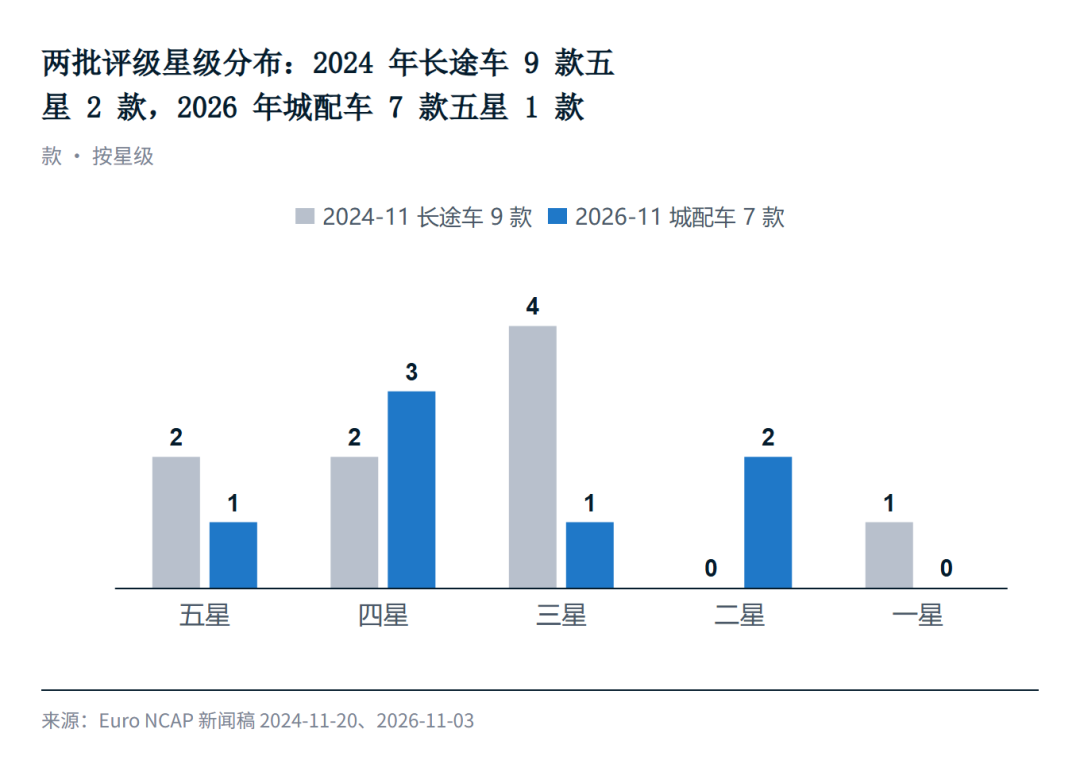
Source: Chart by AutoMusic based on the public sources listed in the article; first published on the AutoMusic WeChat account.
Lane assist systems are already fitted to long-haul trucks. In the first ratings in 2024, Euro NCAP rated the lane assist system on the MAN TGX as performing well; in this round, the same brand's urban distribution truck, the TGL, received five stars but has no lane keeping. On month 9 day 14 this year, the BYD ETT 44 tractor received five stars and CitySafe recognition in its first assessment, scoring 89% for safe driving and 73% for crash avoidance, its crash avoidance score likewise below 80%. Euro NCAP specifically noted that it lags the leading models in car-to-car forward collision and lane departure.
Iveco's entries all ranked near the bottom, though not with the same model. In the first round of ratings in 2024, the Iveco S-WAY performed worst with just one star; in 9 this year the S-WAY received two stars in the regional delivery category, and the Eurocargo also received two stars this time. On Oct 30, Tata Motors completed the first settlement of its tender offer for Iveco Group.
According to Euro NCAP's current website guidance, restraint systems such as pretensioners and airbags will be included in the assessment from 2028, and full-vehicle crash tests are planned for 2031. Under the current protocol, an urban delivery truck can only score above 75 points for crash avoidance if it is fitted with lane keeping.