Germany's electric heavy truck quota: creditable energy per vehicle rises to 2.19 times from 2027
From 2027, Germany will raise the GHG quota valuation for electric heavy trucks from 33400 to 54800 kWh and the factor from 3 to 4.
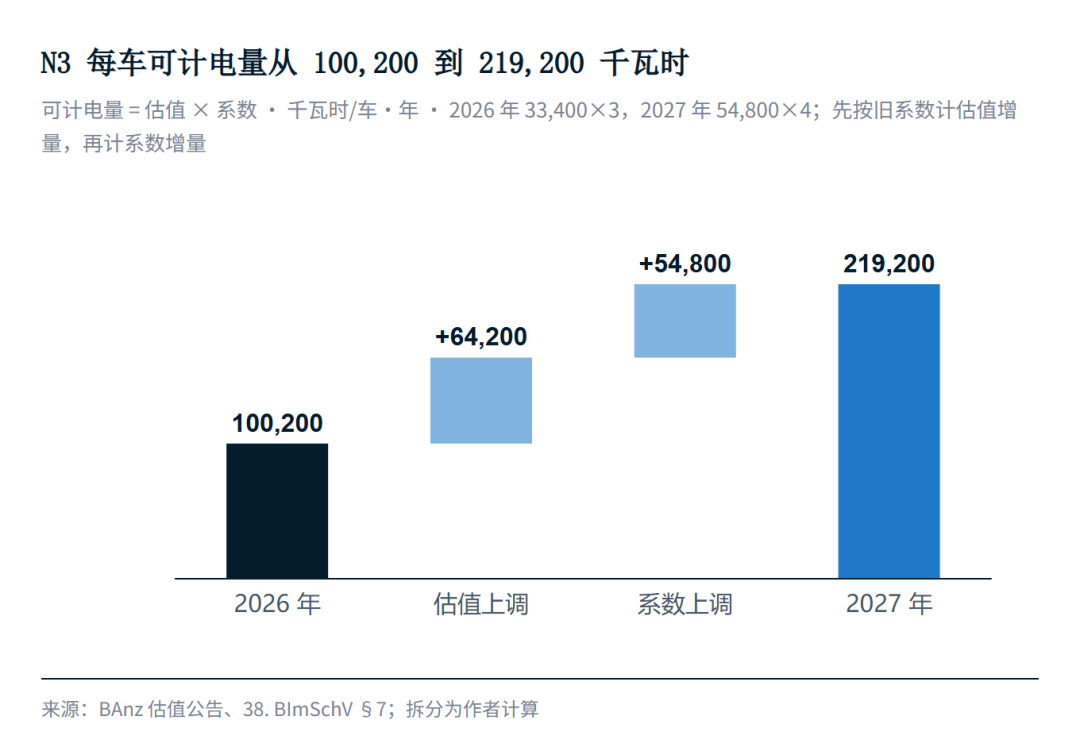
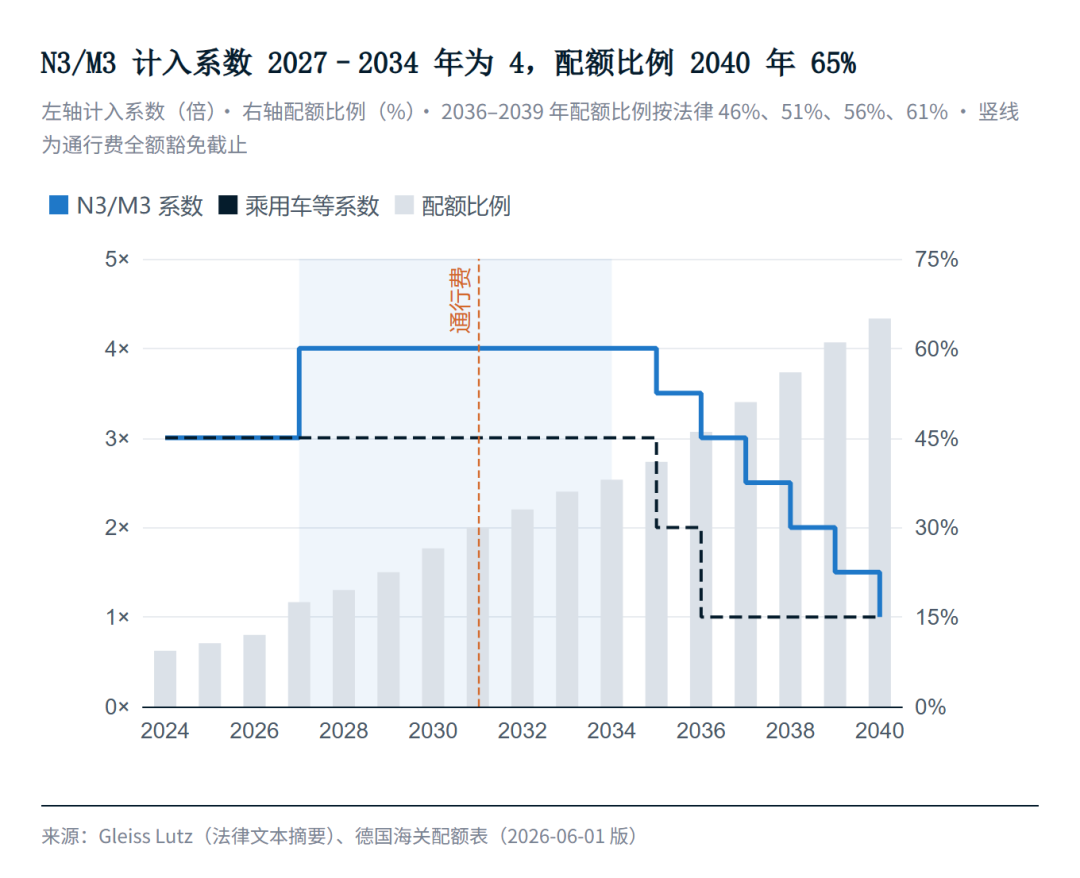
Germany's Federal Gazette published on Oct 28 the environment ministry's newly set estimated charging volume: from 2027, N3 battery-electric trucks with a gross weight above 12 tonnes will be credited with 54,800 kWh of non-public charging per year, up from 33,400 kWh. The amendment that took effect in June also raised the multiplier for these vehicles from 3 to 4. Combined, the credited annual electricity of one electric heavy truck rises from 100,200 kWh to 219,200 kWh, 2.19 times the previous figure.
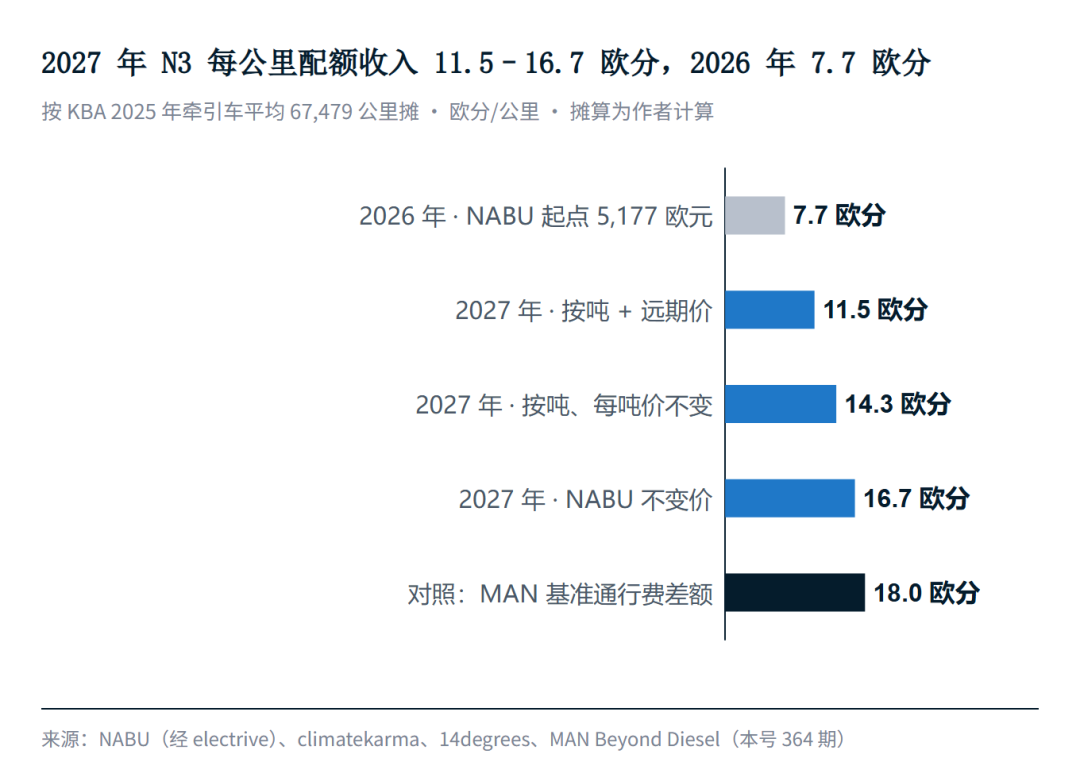
The money comes from trading in Germany's fuel-sector greenhouse gas reduction quota (THG-Quote), paid by the fuel companies that supply filling stations. On this basis, the German nature conservation group NABU estimates that an electric heavy truck's annual quota income will rise from about EUR 5177 to about EUR 11300. After adjusting for the tonnes of reductions that can actually be sold and for forward prices, this works out to 11.5 to 16.7 euro cents per km in 2027. That is about half to 70% of what the current German toll exemption saves. For an electric tractor unit running average mileage, this income is now large enough to include in total cost of ownership calculations. But it moves with quota prices and cannot be counted on in the way the toll exemption can.
Valuations and multipliers raised together
Fuel suppliers must cut the greenhouse gas emissions of the fuel they sell by a statutory percentage each year. Any shortfall can be covered by buying emission reductions from others, and electricity used by EVs can be converted into such reductions. This year's rate is 12%, rising to 17.5% in 2027 and 65% in 2040. Electricity from public chargers is reported by meter. Since electricity charged at fleet depots and at home is hard to meter vehicle by vehicle, the environment ministry sets an annual estimate for each vehicle category. The proceeds go to the registered keeper of the vehicle and are pooled by service providers before being sold to fuel suppliers.
Only after the new rules took effect on Jan 1, 2022 did ordinary vehicle owners enter this market in large numbers. At that time all battery-electric vehicles shared a single valuation of 2000 kWh per year, so a 40-tonne electric tractor received the same credit as a car. In Aug 2023, the environment ministry set values by vehicle type for the first time, with heavy trucks at 33400 kWh; this has now been raised to 54800 kWh.
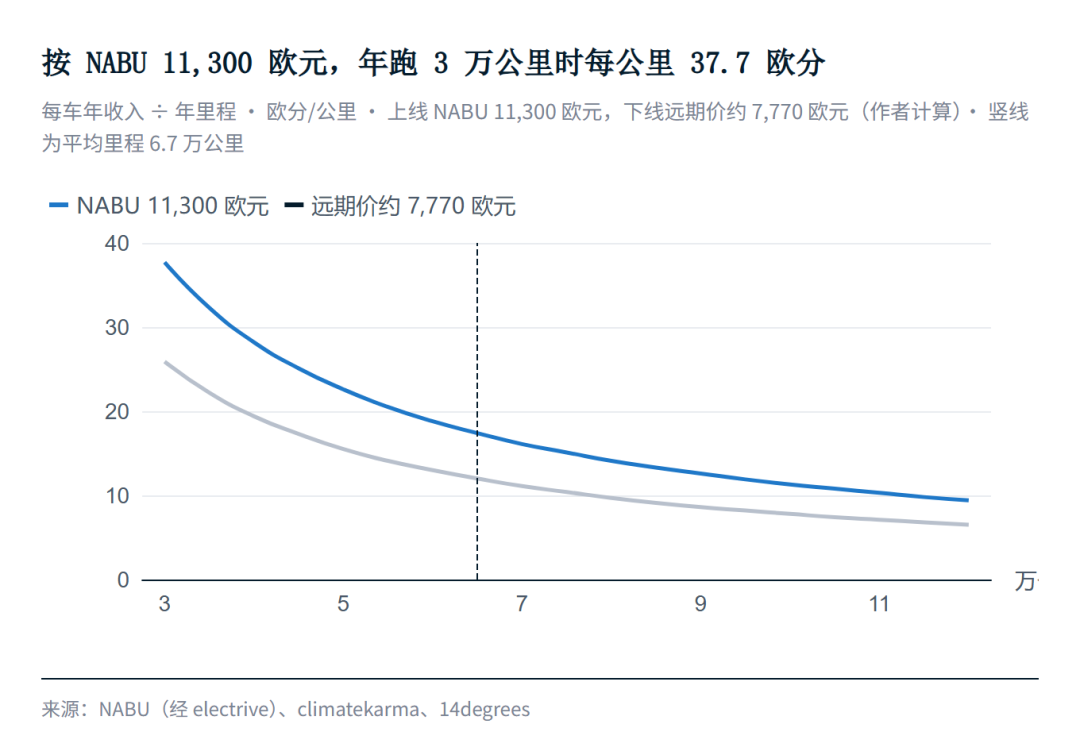
The new estimate is still below a tractor's actual electricity consumption. Data from Germany's Federal Motor Transport Authority (KBA) shows semi-trailer tractors averaged 67,479 km each in 2025. At about 100 kWh per 100 km, as estimated by MAN, that is more than 67,000 kWh a year, of which 54,800 kWh is about 81%. The estimate is fixed per vehicle and does not vary with mileage, so the more a truck drives, the less it works out per kilometre.
Per kilometre: from 7.7 euro cents to more than ten
Based on 67479 km, this year's EUR 5177 works out to about 7.7 euro cents per km, and NABU's EUR 11300 to about 16.7 euro cents per km. NABU applies the increase in credited electricity volume directly to its revenue estimate, which is optimistic on two counts.
The first is tonnes of emissions reduced. Once the emission reduction obligation rises from 12% to 17.5%, the baseline emissions of fuels are lowered accordingly, and each kilowatt-hour of electricity converts into a smaller reduction. Quota service provider climatekarma, using 2026 grid emission factors, estimates that the reduction an N3 electric truck can sell rises from 12.70 tonnes to 23.70 tonnes, an increase of 87%, not 119%. With prices and revenue shares unchanged, annual revenue would be about EUR 9700, or about 14.3 euro cents per kilometre.
Second, price. A weekly report from quota trader 14degrees shows that in mid-8 this year, 2026-vintage certificates averaged about EUR 507 per tonne, while 2027-vintage certificates fetched only EUR 400 to 415, about 20% lower. This year, vehicle owners net about EUR 408 per tonne (EUR 5177 divided by 12.70 tonnes), roughly 80% of the average price. Applying the same ratio to forward prices, a vehicle would earn about EUR 7800 in 2027, or about 11.5 euro cents per km. NABU's figure of 16.7 cents is closer to the upper bound; fleets would be safer budgeting from 11.5 to 14 cents.
Roughly half to 70% of the value of the toll exemption
The MAN benchmark customer analyzed in a previous article drives 100,000 km per vehicle per year, 70% of it on tolled roads, with diesel trucks paying EUR 0.34 per km in tolls and electric trucks EUR 0.09. Spread over total mileage, the electric truck pays about 18 euro cents less per km. Germany currently exempts zero-emission trucks from tolls entirely, saving about 24 euro cents per km under the same parameters. Revenue from 2027 credits, spread over average mileage, comes to 11.5 to 16.7 euro cents, roughly half to 70% of this saving.
The two sums move in opposite directions with mileage. Toll savings are per kilometre, so the more a truck drives, the more it saves; allowances are granted per vehicle, so the higher the mileage, the less revenue per kilometre. On MAN's parameters, the two are roughly equal at annual mileage of 33,000 to 47,000 km. For long-haul trucks that drive more, the toll discount matters more; for lower-mileage urban delivery trucks, allowance revenue carries more weight.
In MAN's total cost calculation, the two trucks are now roughly at parity: 219 euro cents per km for electric versus 220 for diesel. The electric truck's extra cost lies in leasing: 50 cents per km versus 20, a gap of EUR 30,000 a year at 100,000 km. Credit revenue can cover 26% to 38% of that. This money narrows the electric truck's leasing disadvantage, but on its own cannot close it.
Price is the top factor
Toll exemptions are written into the toll schedule, but quota revenue is only fixed when it is traded. Passenger car owners have already been through one cycle of volatility: in the first two years after the market opened, an electric car could earn EUR 400 to 500 a year; by 2025, service providers rarely offered more than EUR 90; this year it is back to around EUR 300. Part of this recovery stems from one-off factors such as low Rhine water levels restricting biofuel shipments.
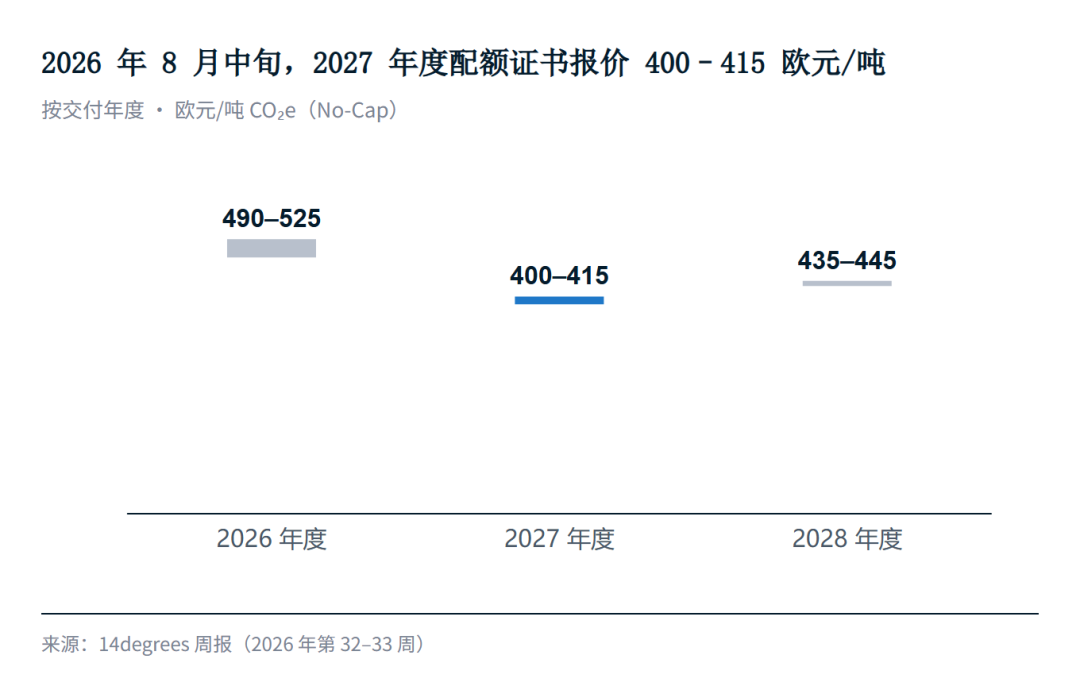
Both supply and demand will shift next year. The roughly 6.7 million tonnes that fuel companies over-delivered in 2024 can be carried forward and used in 2027, and valuations for electric heavy trucks and light commercial vehicles are being raised. In 2025, battery-electric vehicles that obtained valuation certificates accounted for only about 58% of eligible vehicles, leaving room for supply to grow; on the demand side, the obligation rate jumps from 12% to 17.5%.
The higher tonnage of emissions reductions provides a buffer against falling prices: with the revenue share unchanged, the price per tonne would have to drop to 53.6% of this year's level, a fall of about 46%, before annual revenue per vehicle fell back to this year's EUR 5177. By our estimate, every EUR 50 change in the price per tonne shifts the annual gross revenue of an N3 electric truck by about EUR 1200.
France delays the switch, the Netherlands bills by the meter
France's current TIRUERT mechanism only recognizes electricity from public chargers. The government had planned to switch to IRICC in 2027 and bring depot charging for heavy trucks into scope. The draft 2027 budget bill debated by the National Assembly in 10 instead leaves the switchover date to be set by decree, no later than Jan 1, 2028. The same article cuts the electricity excise duty on power used by electric trucks over 7.5 tonnes, which the report estimates will save about EUR 2200 per vehicle per year. The Netherlands replaced HBE with ERE emission reduction certificates this year. Instead of estimates, operators declare the actual electricity supplied to transport, and must prove it was used only for vehicle charging through a dedicated connection point, a dedicated metering point or a MID-certified meter on each charger. Per-vehicle allocations give a fixed income; meter-based accounting makes income track charging volume. For cross-border fleets, which country this income accrues to depends on where the vehicle is registered and at which connection point it charges, not on where it drives.
Written into the quote
Fleets and truck dealers should estimate this revenue as a range in their models and specify in leasing and charging contracts who it belongs to: at this year's price level, it comes to about 14 euro cents per km at average mileage; at forward prices, about 11.5 cents; and a fall of about 46% in the per-tonne price would bring annual revenue back to this year's level. The timelines of the different policies also need to be calculated separately: the full toll exemption for zero-emission trucks runs until Jun 30, 2031, after which the reduction is capped at 75%; the 4x multiplier for N3 applies until 2034 and reverts to 1 in 2040, while the obligation quota rises to 38% by 2034, and the emission reductions credited per kWh of electricity will keep declining.
Source: Chart by AutoMusic based on the public sources listed in the article; first published on the AutoMusic WeChat account.
This revenue matters more to urban delivery and short- to medium-haul fleets than to long-haul trucks, and is best built into quotes as a price range rather than treated as a fixed discount.