Two European Parliament committees back 87.5% passenger car emissions cut for 2035; European low-carbon steel can offset a further 7.5 percentage points
On Oct 22, the European Parliament's industry and transport committees adopted a compromise: tailpipe emissions from new passenger cars to fall at least 87.5% by 2035, topped up to 95% with credits for EU-made low-carbon steel. Germany and France favour a 90% cut with no offsetting requirement.
On Oct 22, the European Parliament's Committee on Industry (ITRE) and Committee on Transport (TRAN) voted separately to adopt compromise amendments agreed two days earlier by the European People's Party, the Socialists and Democrats, and Renew Europe. The industry committee voted 49 in favour, 27 against with 5 abstentions; the transport committee voted 27 in favour, 18 against with 1 abstentions.
The amendment requires average tailpipe CO₂ emissions from new passenger car fleets in 2035 to be at least 87.5% below 2021 levels, with credits for low-carbon steel produced in the EU making up the difference to 95%. The remaining 5 percentage points do not need to be offset. The current regulation requires 100%, which means zero tailpipe emissions from new cars from 2035. The European Commission's proposal of Dec 2025 set the figure at 90%, with the remaining 10% to be made up entirely through credits.
Under this version, internal combustion and hybrid vehicles would still have room for new registrations in the EU after 2035. The committee vote is only one step within Parliament, to be followed by votes in the Environment Committee and the plenary, and then trilogue negotiations with the Council of member states and the European Commission.
Three different versions
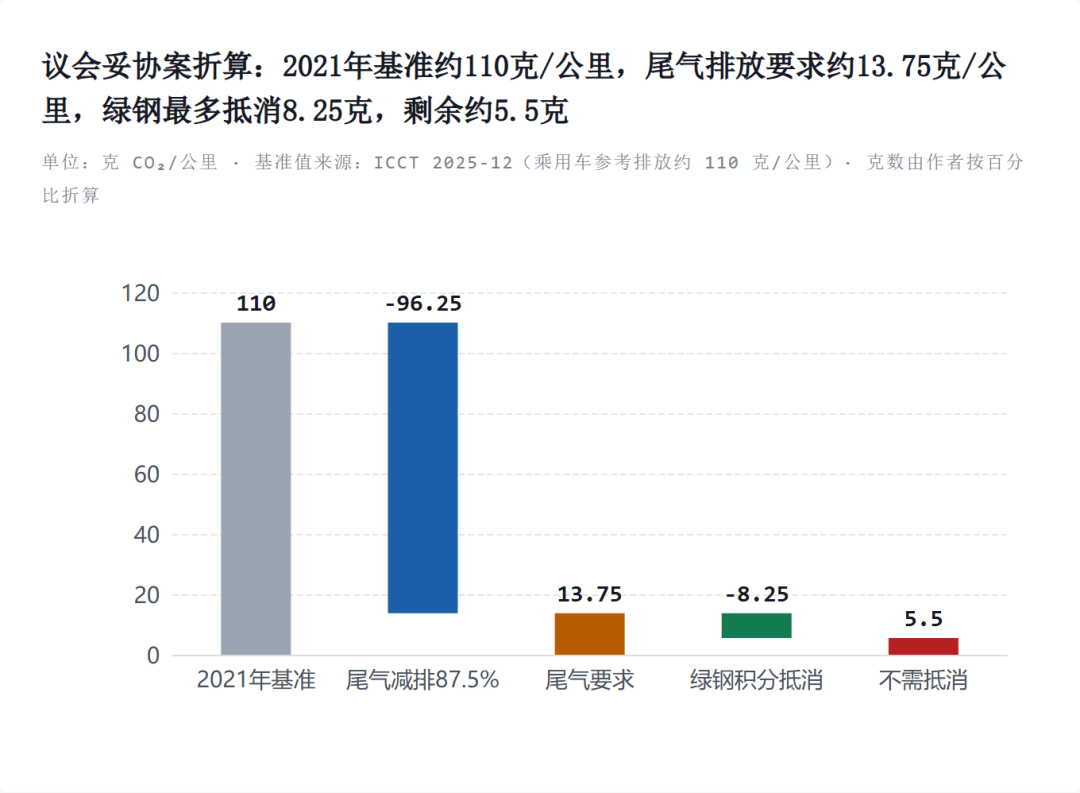
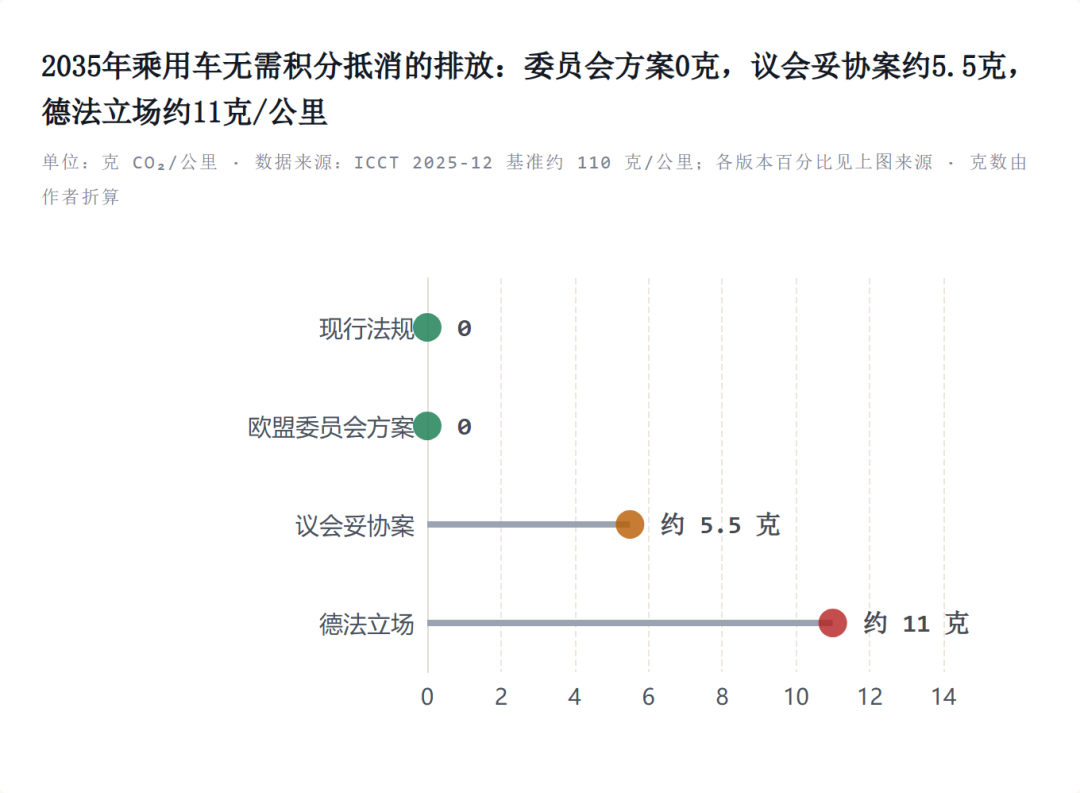
There are currently three proposals for the same 2035 target. Converted using the ICCT's 2021 passenger car baseline of roughly 110 g/km:
87.5% is the tailpipe floor after steel credits are fully used; nothing further can be deducted. All these figures are fleet averages; how many combustion vehicles they correspond to depends on each model's certified emissions.
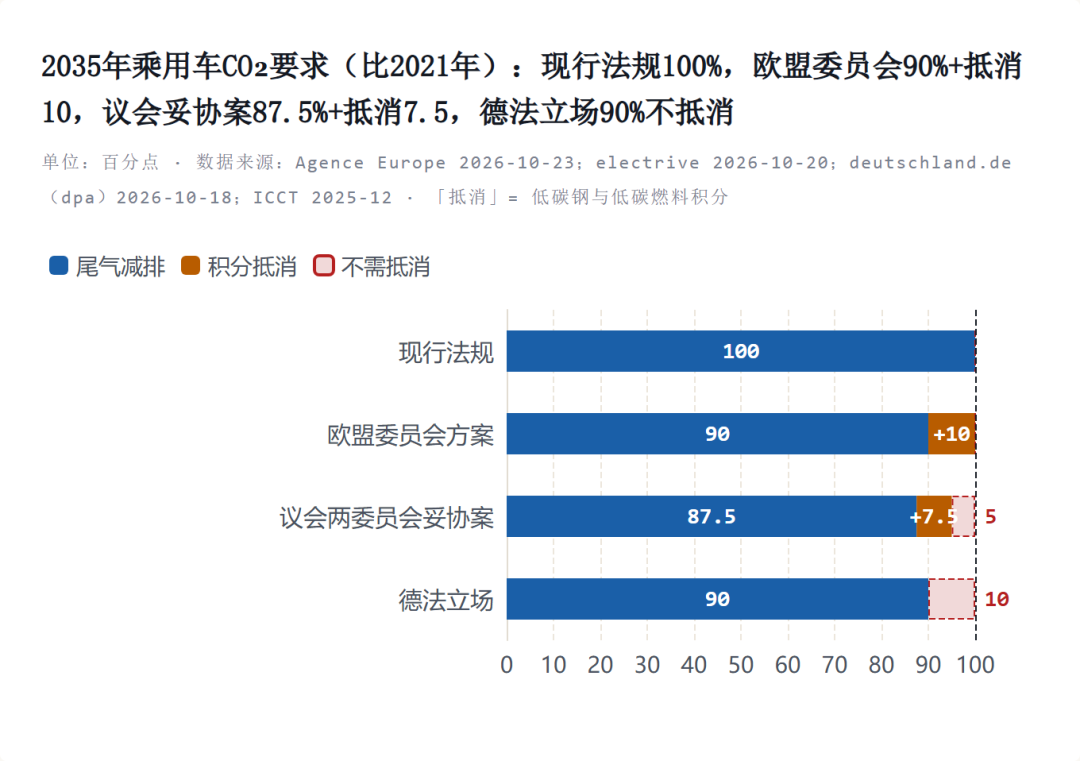
On tailpipe emissions, the Parliament's version is the most lenient. On compliance accounting, the Parliament requires offsetting up to 95%, while the Franco-German version leaves 90% with no offsetting requirement, making it the most lenient. A French MEP from the Renew Europe group said after the vote that the Parliament's version cuts emissions slightly more slowly than the Franco-German deal but creates demand for green steel, making it the better deal in terms of total emissions.
The Franco-German agreement matters more for the Council. Germany and the auto industry have long called for the 2035 target to be relaxed, but until now France and six other member states had enough votes to block this. With France's shift, a majority could now form in the Council. German Chancellor Merz said this ends the debate on phasing out conventional vehicles. In return, France secured a "European preference" in public procurement and public funding. According to Euronews, the agreement requires 70% of auto parts (excluding batteries) to be made in Europe and 10% of battery content to come from Europe.
Green steel
The steel credit is the most significant element of the compromise, and also the least detailed.
The Parliament's rapporteur, an Italian EPP MEP, explained that once the regulation takes effect, automakers can use European-made low-carbon steel to offset up to 3%, with the cap rising to 7.5% by 2035. A statement from the European Steel Association (EUROFER) in Oct 21 gave the same figures. It added that only steel melted and cast in the EU counts, and steel produced elsewhere and merely processed in the EU does not.
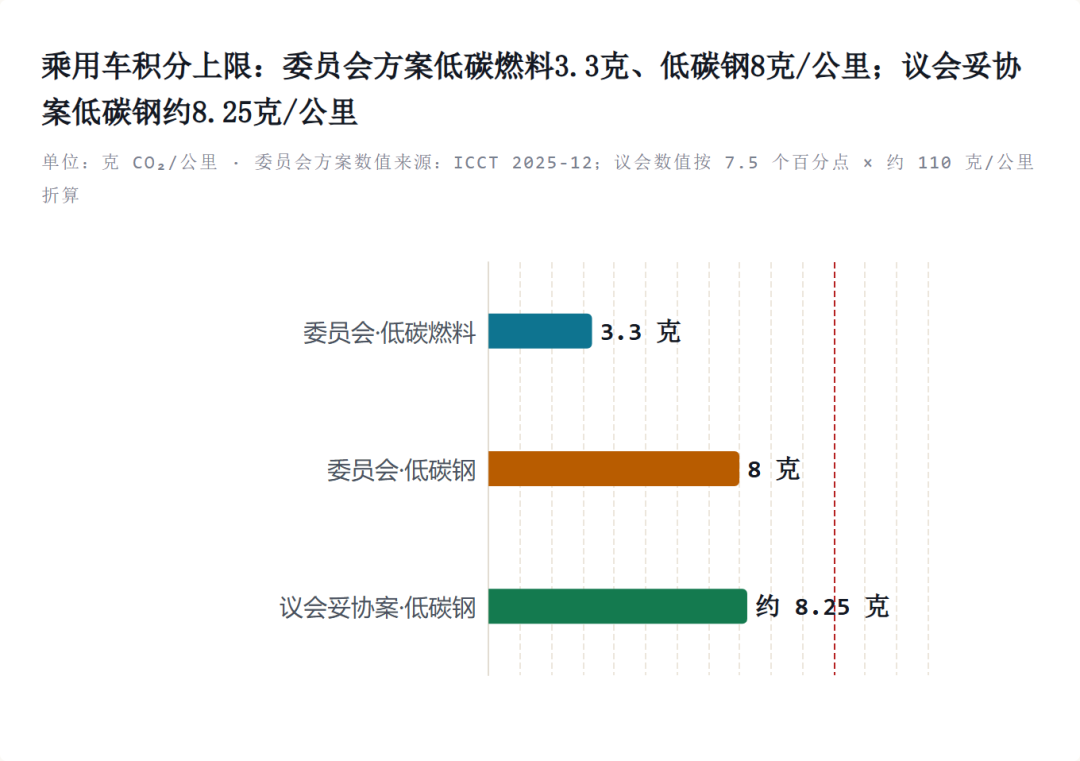
Under the Commission's original proposal, steel credits were capped at 7% of the baseline, which the ICCT converts to at most about 8 g/km for passenger cars, and they would only apply from 2035 onwards. The size of the credit depends on how much lower the emissions intensity of the steel used is than the baseline and how many tonnes are used, spread per kilometre according to the automaker's new vehicle volume that year and average lifetime mileage. The baseline value and the definition of "low-carbon steel" will be set by the Commission through delegated acts after the regulation is adopted.
The definition will decide which production process gets the orders. ICCT data show that coal-fired blast furnace steel in the EU emits about 2.1 t CO₂e per tonne on average. The direct reduced iron plus electric arc furnace route cuts emissions by 95% with renewable hydrogen and green power, but by only 11% with natural gas and average grid electricity.
On supply and demand, the ICCT estimates that about 8.9 million passenger cars and vans are produced and sold in the EU. Assuming 800 kg of steel per vehicle and 40% production losses, demand for steel eligible for steel credits comes to about 12 million tonnes a year. Announced direct reduced iron capacity due to start production by 2035 totals about 37.7 million tonnes a year, of which about 17.3 million tonnes would use renewable hydrogen or an undecided hydrogen source. EUROFER says more than 20 million tonnes of low-carbon automotive steel capacity could be added by 2030. This announced capacity still needs final investment decisions and must be built and brought into operation before it becomes steel that automakers can actually buy.
For OEMs, compliance in 2035 will extend from the powertrain to the purchasing department: how much European low-carbon steel they can secure, its emissions intensity, and whether suppliers can provide data in line with the delegated act will all feed into the g/km calculation, while the premium paid for this steel counts as a compliance cost.
Made in Europe
According to reports, the amendment writes the "Made in Europe" provisions of the EU's Industrial Accelerator Act (IAA), currently in the legislative process, into the CO₂ regulation, with super-credits being one of them. Parliament must first agree on the automotive part of that act before the CO₂ revision can go to plenary.
The Commission's original proposal counted battery-electric cars up to 4.2 m long and produced in the EU before 2034 as 1.3 vehicles when calculating average emissions. The compromise raises the super-credit for small cars produced in Europe to 1.4, until 2034; for small vans produced in the EU it is 1.2 until 2035, rising to 1.4 thereafter. Affordable small EVs and particularly energy-efficient EVs can also earn super-credits.
The scope of "Made in Europe" has not yet been settled. Under the Franco-German agreement, products from Norway, Iceland, Switzerland and the UK could also count as made in Europe. An EPP MEP from Croatia said the starting point should be the European Economic Area and Switzerland. Including other partners should be conditional on reciprocity and regulatory alignment, while preventing third countries from being used as a back door.
If implemented along these lines, small BEVs imported from China would still count towards an automaker's zero-emission vehicles but would not earn super-credits; the European-built version of the same car would carry more compliance value for the automaker. Chinese brands building plants in Europe or seeking contract manufacturing need to factor this in when evaluating production locations.
Light commercial vehicles
Vans get more relief than passenger cars. Current rules require vans to cut emissions by 50% in 2030 compared with 2021, and by 100% in 2035. The Commission's proposal changes this to 40% in 2030 and 90% in 2035. Parliament's compromise lowers it again to 35% in 2030 and 80% in 2035, and the clause that lets steel credits make up the gap to 95% applies only to passenger cars.
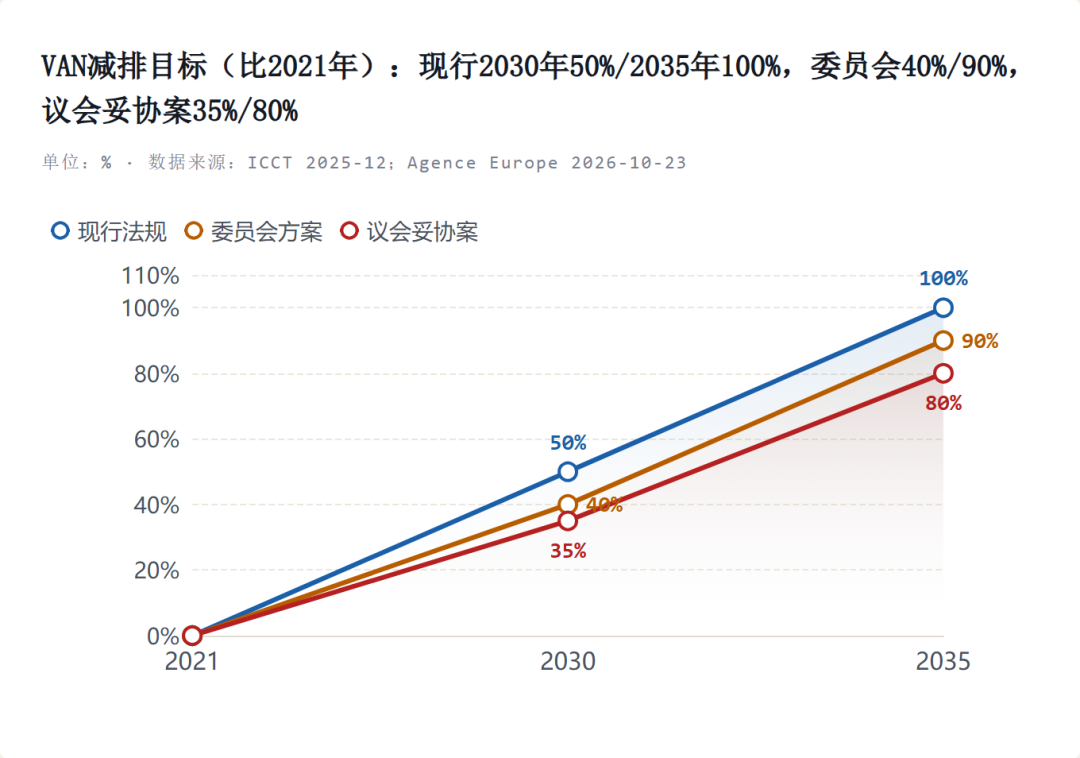
Based on ICCT figures, a 50% reduction in 2030 corresponds to 91 g/km and 40% to 109 g/km; on the same baseline, 35% works out to about 118 g/km, roughly 27 g looser than the current requirement.
The compliance period is also being relaxed: vans would be assessed on averages over two five-year periods, 2025–2029 and 2030–2034. Lower targets plus averaging let manufacturers delay ramping up electric van supply.
Markets
ACEA reported on Oct 22 that EU new passenger car registrations in January–September 2026 reached 8.517 million, up 5.7%; BEVs totalled 1,931,465, up 48.5%, for a 22.7% share versus 16.1% a year earlier; petrol and diesel combined took 28.2%, versus 36.9% a year earlier.
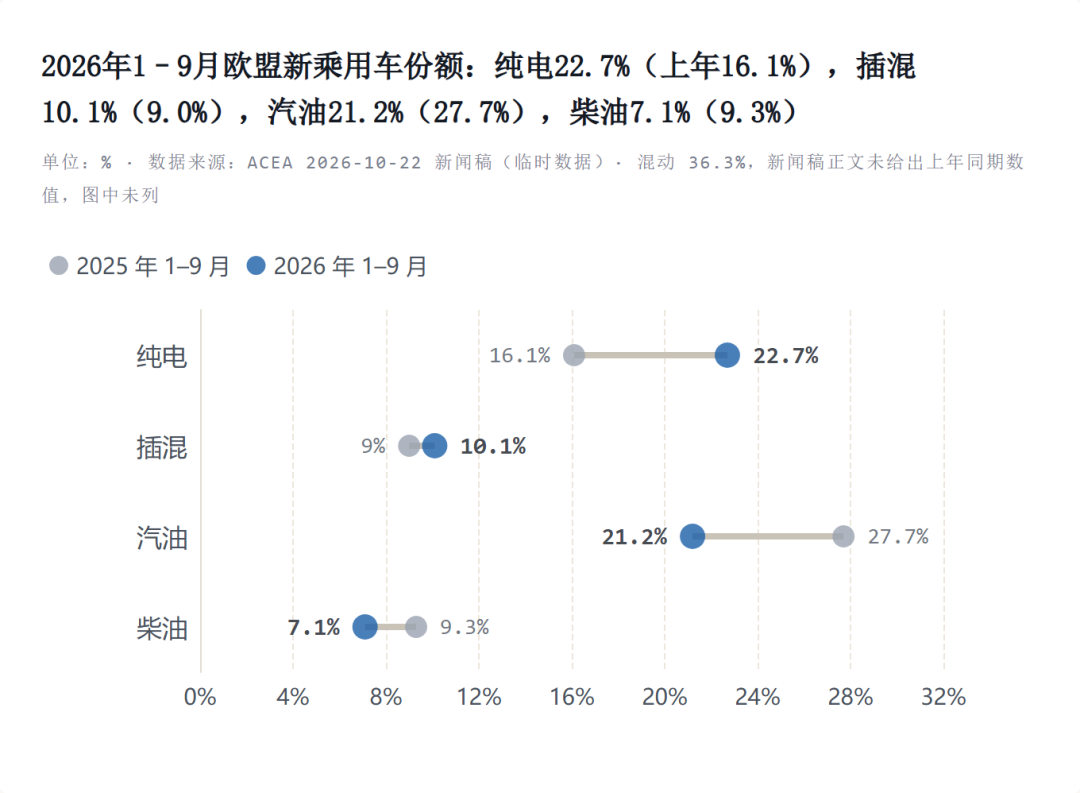
Source: Chart by AutoMusic based on the public sources listed in the article; first published on the AutoMusic WeChat account.
ICCT used its own model to estimate the impact of the Commission proposal: under current rules, the BEV share would be about 61% in 2030 and 100% in 2035; under the Commission proposal, about 44% in 2030 and about 83% in 2035. Thereafter, 1.3 million to 2.6 million fewer EVs would be sold each year, and cumulative passenger car tailpipe emissions from 2028 to 2050 would rise by about 1 billion tonnes, an increase of more than 18%. The Commission's own estimate is that 27% to 29% of new cars after 2035 would still have combustion engines. The Parliament compromise loosens both the tailpipe cap and the offsetting obligations; ICCT has not yet published an assessment of it.
Timeline
According to EUnews, Parliament's environment committee will vote on Nov 4. When the European Parliament's Legislative Train page was updated in month 9, it listed the expected plenary vote as Nov 23; the latest from Germany's Der Spiegel is that the plenary vote will likely come in month 12.
Adopting a Council position requires a qualified majority: at least 15 member states representing at least 65% of the EU population. Once Parliament and Council have each set their positions, they enter trilogue negotiations with the Commission, the standard EU legislative procedure. Whether the figure ends up at 87.5% or 90%, whether the remainder can be offset, and how "made in Europe" is defined could all still change.