MAN electric truck customer TCO case calculations
MAN's report says electric trucks can have a five-year TCO up to 13% lower than diesel. Using the report's own European benchmark customer, the two cost 219 vs 220 euro cents per km, with the electric truck's higher leasing cost recouped through cheaper energy and toll exemptions, each saving 18 euro cents.
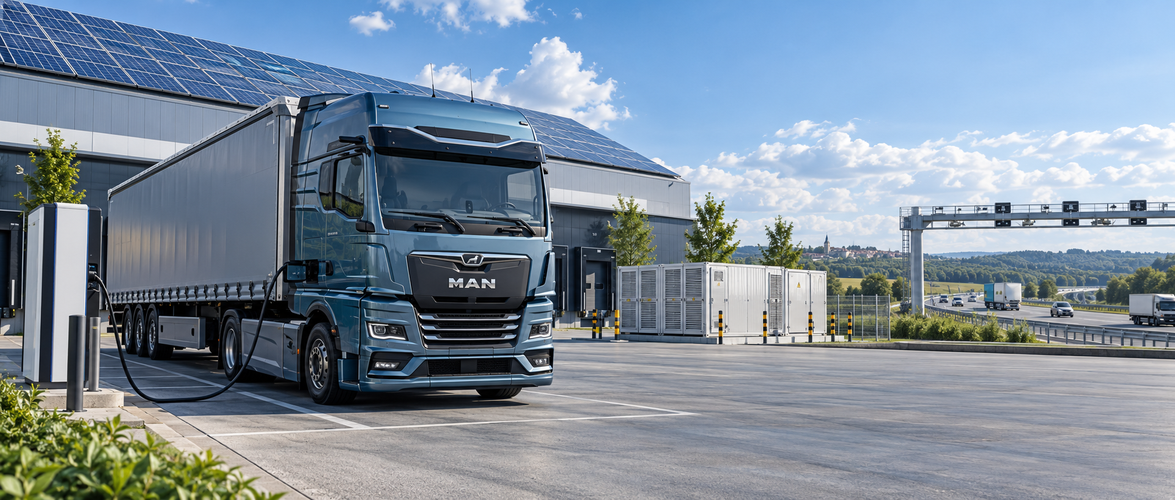
In early month 9, MAN Truck & Bus published its strategy report "Beyond Diesel", saying the five-year total cost of ownership (TCO) of electric trucks can be up to 13% lower than diesel, and that 15% to 35% of new trucks (over 6 t) registered in Europe (the EU-27 plus the UK, Norway and Switzerland) in 2030 will be battery-electric.
The 13% figure comes from one of the report's three customer cases: Betonwerk Bad Lausick, a concrete plant near Leipzig, Germany. The current estimate puts the electric heavy truck's costs 9.4% lower; the 13.3% figure is the expected value after further integrating and optimizing energy use with the existing solar PV and storage. The report also includes a calculation for a hypothetical "European benchmark customer", under which a diesel truck costs 220 euro cents per kilometre and an electric truck 219 euro cents.
Benchmark customer
The baseline customer is defined as follows: a fleet of five trucks, each running 100,000 km a year, on a five-year lease, with 70% of mileage on tolled roads. The diesel truck consumes 30 litres per 100 km, with diesel at EUR 1.50 per litre. The electric heavy truck consumes 100 kWh per 100 km, with 70% charged at the company's own depot at EUR 0.26 and 30% charged externally at EUR 0.40. Tolls are EUR 0.34 per km for diesel trucks and EUR 0.09 for electric trucks.
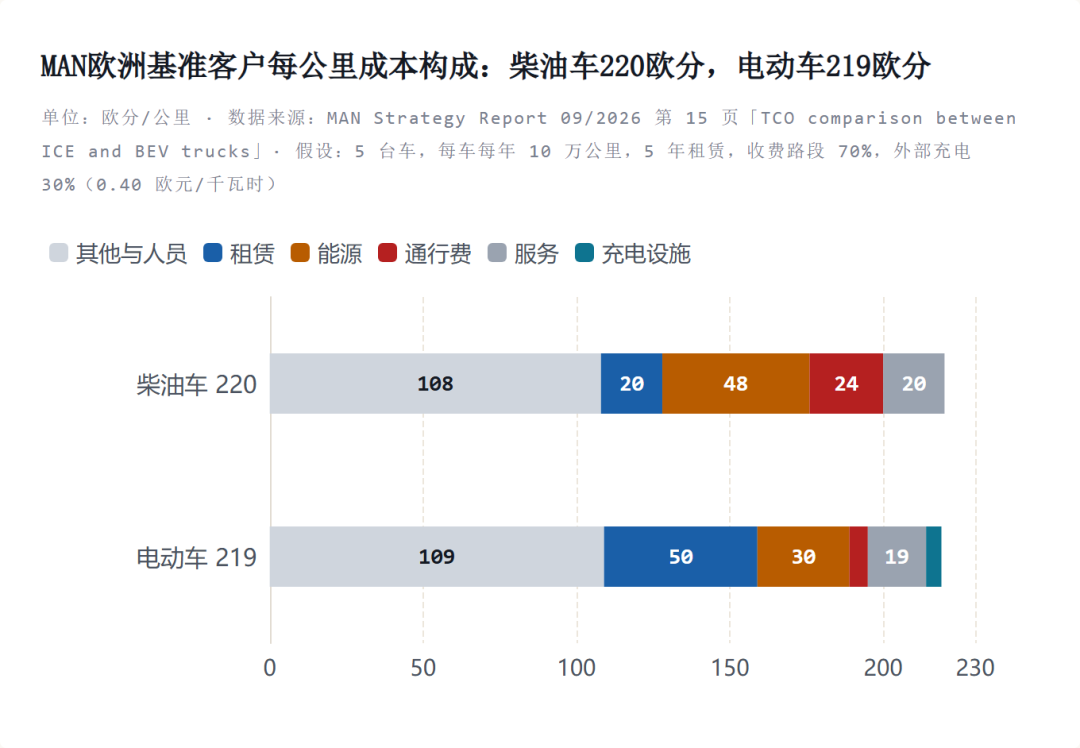
The per-kilometre cost gap between the two vehicles comes down mainly to three items:
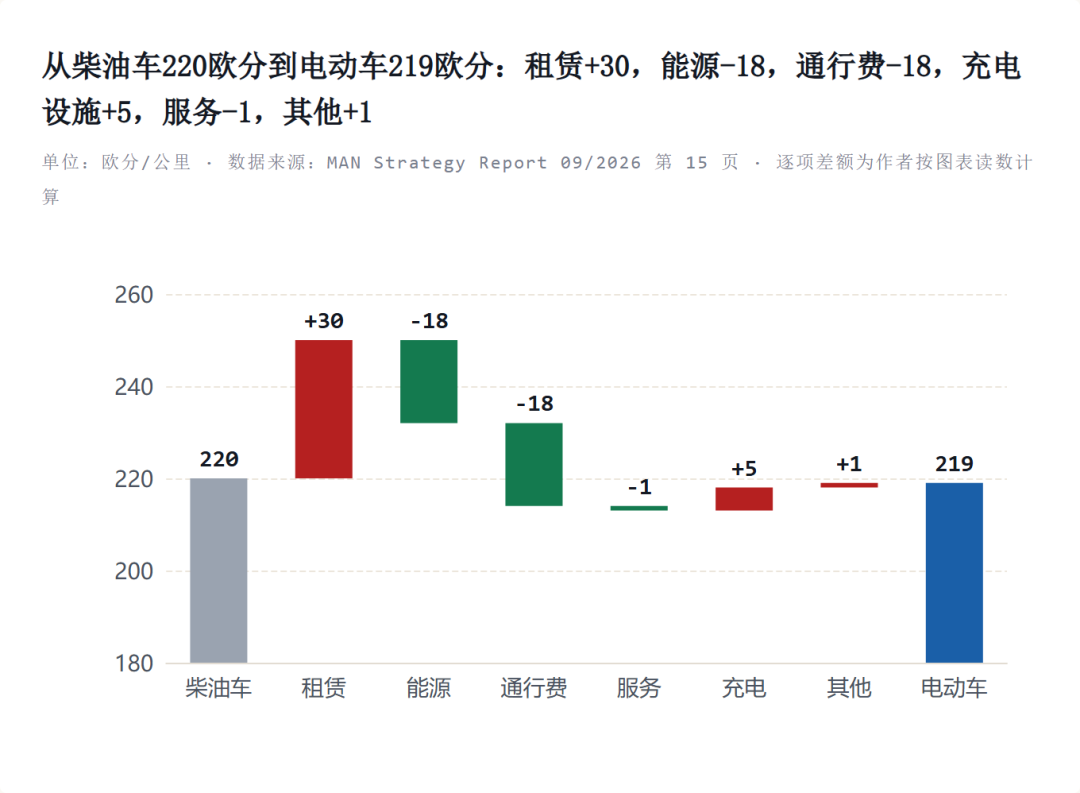
Leasing costs 2.5 times as much for an electric heavy truck, driven by the price gap and residual value risk: the report puts the price of a European-brand 4×2 electric tractor at about EUR 250,000 to 300,000, against EUR 100,000 to 120,000 for an equivalent diesel. The used electric truck market is still young, and many fleets opt to lease, leaving residual value risk with the manufacturer. According to the table, the extra 30 euro cents in leasing for the electric truck is offset by 18 cents saved on electricity and another 18 cents on tolls; adding 5 cents for charging infrastructure and small differences in other items, it ends up 1 cent cheaper than diesel.
On tolled roads, the rate difference between the two vehicle types is 25 euro cents per km; assuming 70% of mileage is tolled, this works out to about 17.5 cents, rounded to 18 cents in the table. At 100,000 km per vehicle per year, this 18-cent toll saving amounts to about EUR 18,000 a year and about EUR 90,000 over five years, close to the price of a new diesel tractor.
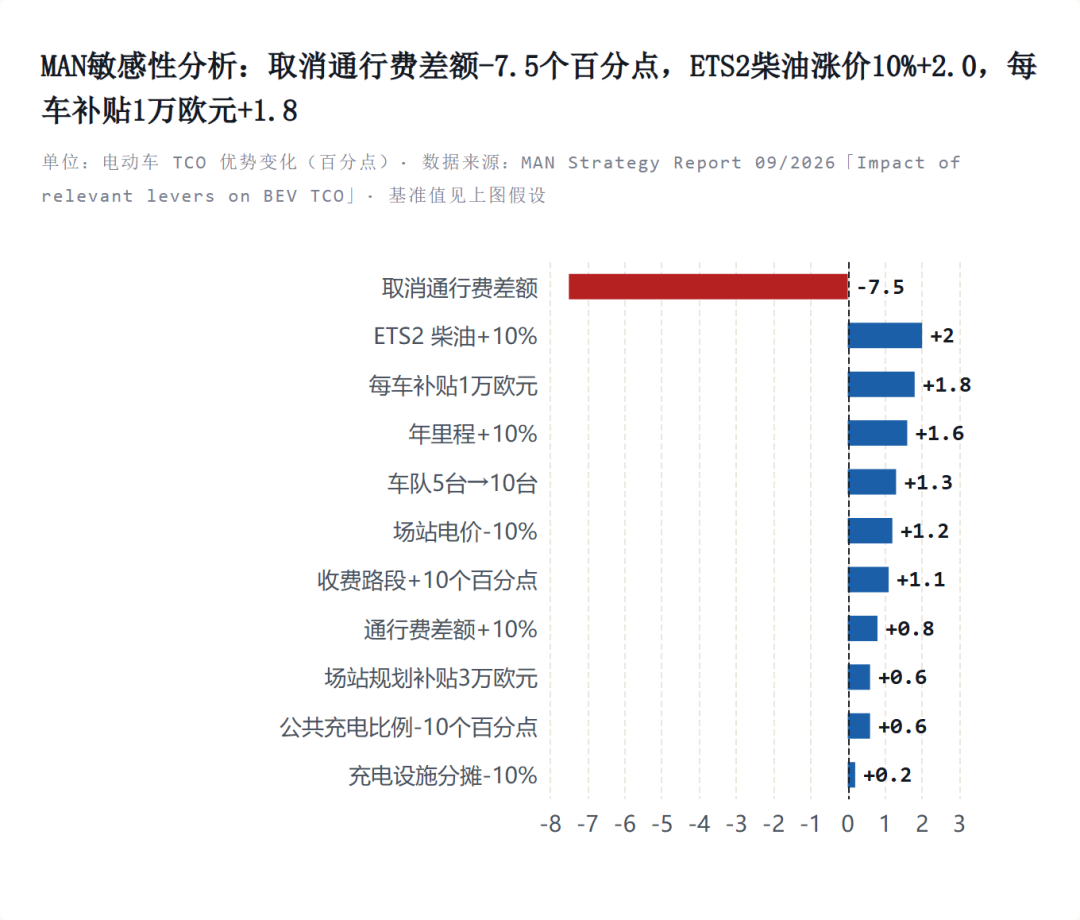
The report also includes a sensitivity analysis. Removing the toll differential between diesel and electric trucks cuts the electric trucks' cost advantage by 7.5 percentage points. ETS2, the EU's upcoming second emissions trading system covering road transport fuels, would raise diesel prices by 10% but add only 2.0 percentage points to the electric advantage. A subsidy of €10,000 per vehicle adds 1.8 points; a 10% increase in annual mileage adds 1.6 points; growing the fleet from 5 to 10 vehicles adds 1.3 points; a 10% cut in depot electricity prices adds 1.2 points; and raising the share of tolled road from 70% to 80% adds 1.1 points. The report concludes that ETS2 is not enough to close the gap left by scrapping the toll discount.
The gap between 219 and 220 euro cents amounts to only about EUR 5,000 per vehicle over five years at 100,000 km a year. Spread across total mileage, narrowing the per-kilometre toll difference by just over 1 euro cent would reverse the cost ranking of the two vehicles in the benchmark table. The sensitivity table shows that raising any one of tolled-road share, annual mileage or fleet size on its own widens the electric truck's advantage.
Three customers
The three cases are ordered from least to most electrified. Italy's Foppiani is a third-generation family haulier in Milan running the Milan–Brescia–Bergamo trunk route. Its three trucks each cover 90,000 km a year, 85% of it on motorways, and all charge at the depot.
It currently has two MAN eTGX trucks, with a third on order. On current figures, diesel is still 2% cheaper. Italian motorway tolls vary by vehicle type and operator, not by emissions, so electric trucks gain no toll advantage. The report finds that if Italy introduced CO₂-based tolls like Austria's, electric trucks would be about 7.5% cheaper; for now, Foppiani's approach is to renegotiate freight rates with customers.
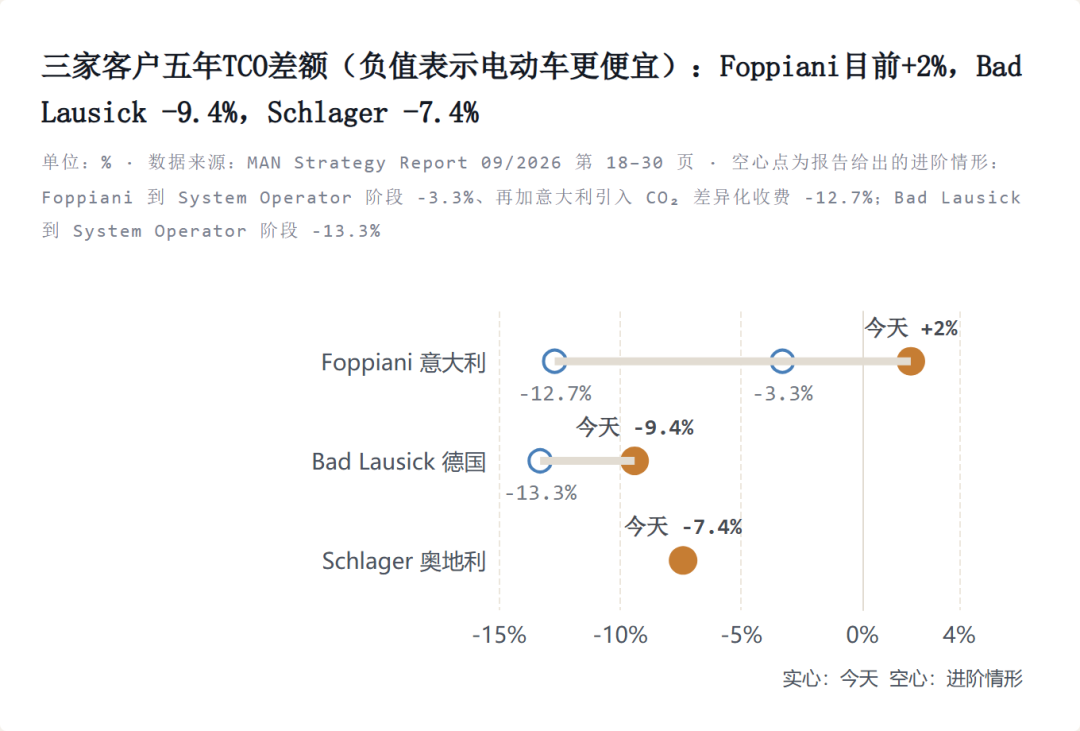
Bad Lausick in Germany is the case in the report where the cost advantage of electric vehicles is most pronounced. Each of the five eTGX trucks has 6 battery packs and covers about 110,000 km a year. One daily route already electrified is a 500 km cement delivery loop carrying 14 tonnes, with a range of about 400 km in winter and about 500 km in summer. The trucks top up with depot fast charging while loading and unloading at both ends and need no public chargers en route; one of the five runs irregular long-haul routes, using pre-selected public charging points. The three sites have dual-connector 400 kW chargers and a total of 1.8 MW of solar capacity, and each site has its own 430 kWh storage system. The self-consumption rate is about 70%, and the depot electricity price is calculated at EUR 0.20. Over five years, savings versus diesel trucks total about EUR 500,000, or roughly EUR 20,000 per truck per year.
Austria's Schlager runs domestic long-haul routes of 300 to 500 km. Half of its fleet is already electric, and it plans to go fully electric from 2030. Its depot in Saxen, Upper Austria, has about 765 kWp of solar and 1.6 MWh of battery storage. The storage holds average grid draw at around 300 kW. More than 95% of charging is done at the company's own depot, priced at EUR 0.16 per kWh. The depot is also open to outside users for a fee, and the report counts this charging revenue against the cost of the facility. Over five years for 15 trucks, the electric trucks come out 7.4% cheaper. Energy savings are more than EUR 2 million and toll savings more than EUR 1.3 million. That works out to over EUR 17,000 per truck per year, roughly in line with EUR 18,000 for the benchmark customer.
The two operators with the largest cost advantage are in Germany and Austria. Both countries grant large toll reductions for zero-emission trucks: Germany exempts them entirely and Austria cuts tolls by 75%, explicitly retained until 2030. Both operators also have lower depot electricity prices and larger fleets.
Germany's exemption period
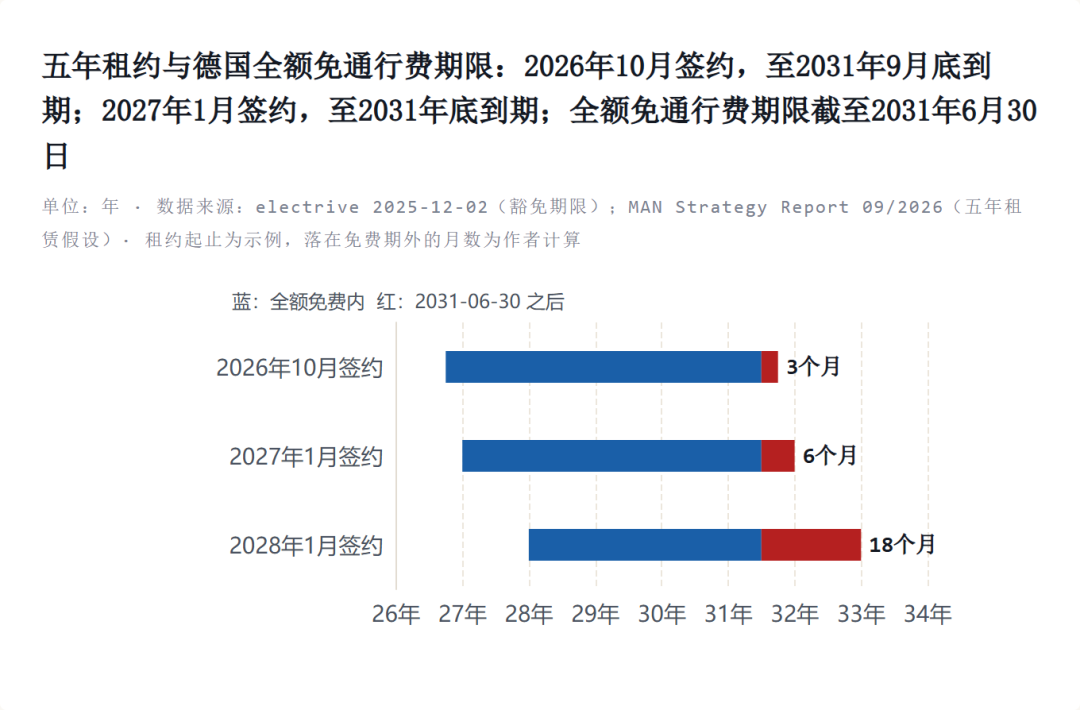
Electric trucks have long been exempt from road tolls in Germany. After a CO₂ charge was added to tolls in Dec 2023, the rate gap between diesel and electric trucks widened. The exemption was originally due to expire on Dec 31, 2025; only in Nov 2025 did the Bundestag decide to extend it to Jun 30, 2031, using the full period allowed by the EU tolling directive. Under the revised directive, after mid-2031, member states may grant zero-emission trucks a reduction of no more than 75%.
All of MAN's calculations assume a five-year lease. Any five-year lease signed after Jun 30, 2026 runs past the end date of Germany's full toll exemption, and the later the signing, the more months fall outside the exemption period. Averaging mileage evenly over five years, a lease signed in Oct 2026 has about 5% of its mileage outside the full exemption period, and a lease signed in Jan 2028 about 30%. In 2025, the Bundestag did not decide on the extension until month 11, and it was not officially published until month 12, just weeks before the original expiry date, drawing industry criticism.
Germany's gas trucks went through a similar policy deadline. From Jan 1, 2019, CNG and LNG trucks were exempt from tolls, later extended to the end of 2023. By mid-2020, 4604 trucks were toll-exempt for alternative drivetrains, of which only 31 were electric. In 2021, the president of DSLV, the German freight forwarding and logistics association, told German logistics magazine trans aktuell that ending the exemption on a fixed year rather than by vehicle service life was a legislative mistake: orders spiked and then dried up. His company had ordered 20 CNG trucks but, with no clarity on policy beyond 2023, cancelled part of the order and bought Euro VI diesel trucks instead.
Country differences
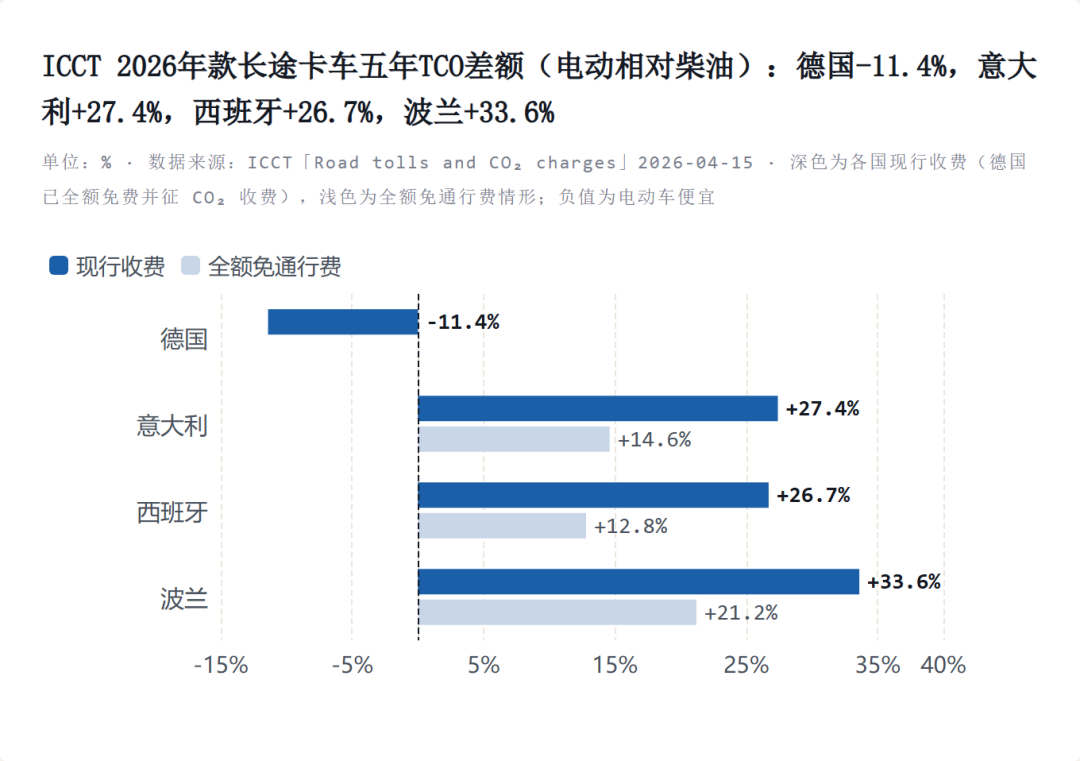
Independent estimates point in the same direction as MAN's, but rest on different assumptions. ICCT used a depot electricity price of EUR 0.316/kWh for Italy, while MAN's Foppiani case uses EUR 0.26. At 100 kWh per 100 km, electricity price alone accounts for a difference of about 5.6 euro cents per km. In April 2026, the International Council on Clean Transportation (ICCT) modeled 2026 model-year vehicles country by country over a five-year service life. Under Germany's current tolls, diesel trucks pay EUR 0.19 per km in road tolls plus EUR 0.158 in CO₂ charges, and the TCO of electric trucks is 10.1% lower than diesel for regional distribution and 11.4% lower for long haul.
Results differ in other countries. In Italy, a long-haul electric truck costs 27.4% more than a diesel truck, and still 14.6% more even with a full road toll exemption. In Poland it costs 33.6% more, and still 21.2% more with a full exemption. In Spain it costs 26.7% more. In Italy and Spain, electric long-haul trucks only become cheaper than diesel when the top CO₂ charge band applies on top of a full toll exemption. In Poland they remain 1% more expensive even with both.
A study published at the end of September by European transport and environment group Transport & Environment (T&E) covered nine markets and found that electric trucks are already cheaper than diesel in six of them, which together account for 46% of new heavy truck sales in the EU. Five-year savings come to about EUR 85,000 in Germany and about EUR 100,000 in the Netherlands. With a Chinese-made electric truck, five-year savings in the Netherlands could reach EUR 128,000, mainly due to the lower purchase price.
Sales are also concentrated in a handful of countries. According to the European Automobile Manufacturers' Association (ACEA), new truck registrations in the EU totaled 171933 units in the first half of 2026; battery-electric and plug-in hybrid trucks accounted for 4.8%, about 8250 units, versus 3.6% a year earlier. Germany, the Netherlands and France together made up 74% of these, with Germany up 88.5% year on year. Diesel still accounted for 92.1%.
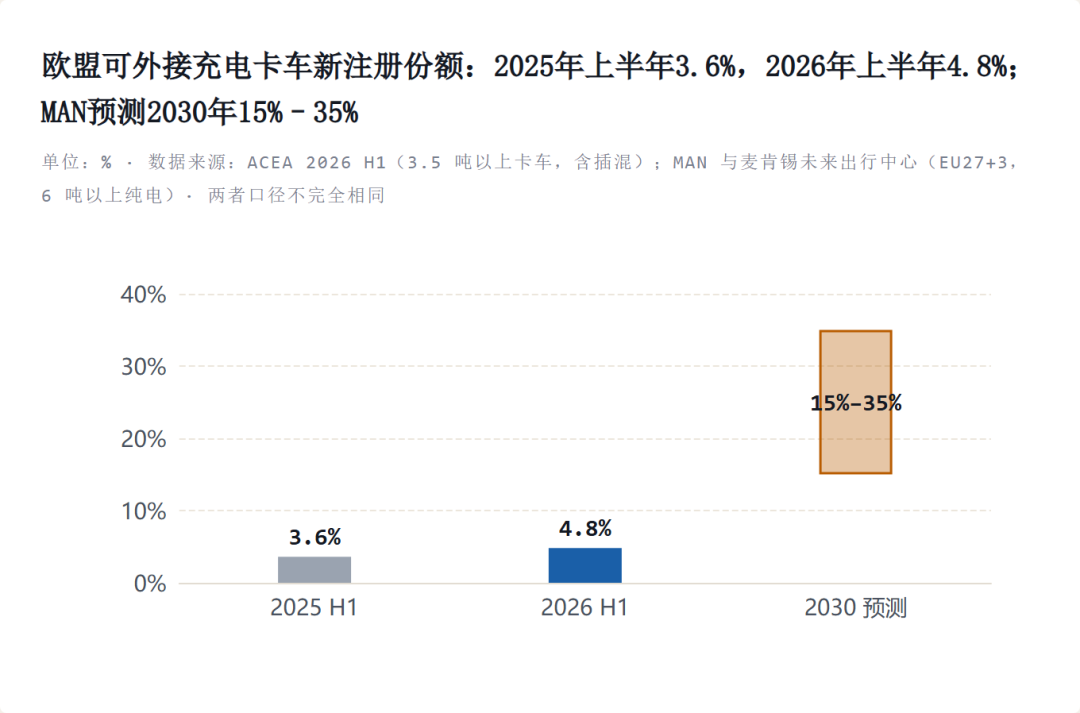
MAN's forecast covers battery-electric trucks over 6 tonnes. MAN's Munich plant has built electric and diesel trucks on the same line since Jun 2025, producing about 1300 heavy electric trucks in the first year; total plant capacity is about 100 vehicles a day.
Shippers and charging
In 2025, about 5,000 companies in Europe used battery-electric trucks, around 1% of 500,000 transport companies; more than 15,000 electric trucks were on the road, an average of three per company. The report expects 90,000 companies to be using battery-electric trucks by 2030.
Charging is another condition. Europe currently has more than 1700 public fast-charging points confirmed as usable by trucks, plus 800 truck-dedicated charging points. Almost all of them use CCS, today's standard for DC fast charging. ACEA estimates the EU will need about 35000 MCS (megawatt charging standard) points by 2030. High-power charging projects at depots and along corridors usually take 6 to 18 months to connect to the grid. By 2030, up to 90% of charging points will be at companies' own depots. All three case studies describe their solar and storage in detail. Depot electricity prices can come down from about 40 euro cents per kWh at public fast chargers to 26, 20 and 16 euro cents. These are also the electricity prices assumed in the cost calculations for the Foppiani, Bad Lausick and Schlager cases.
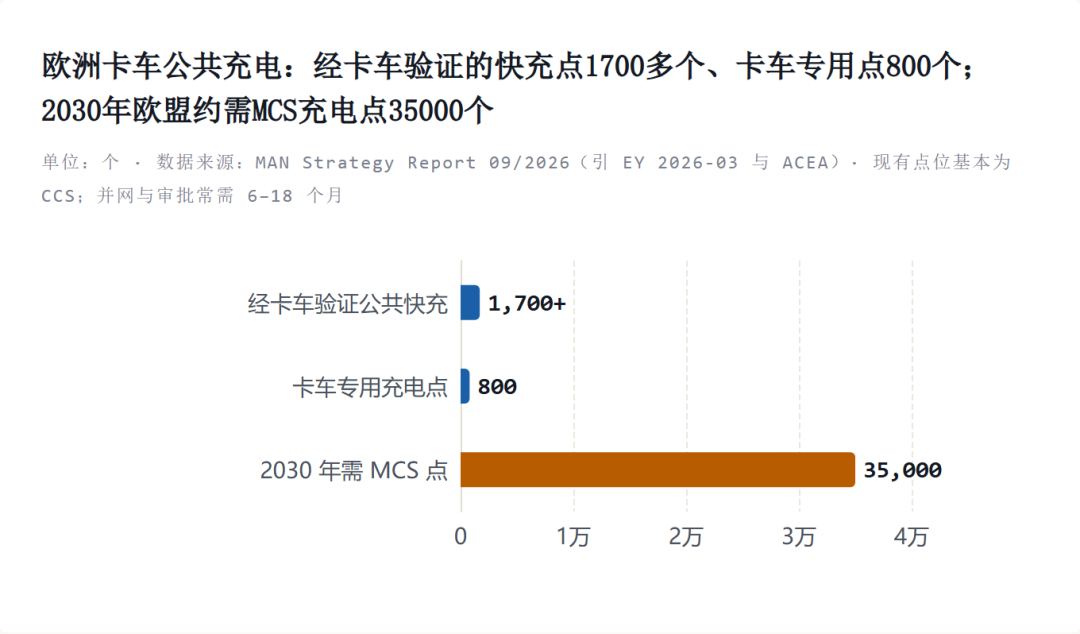
Source: Chart by AutoMusic based on the public sources listed in the article; first published on the AutoMusic WeChat account.
Final thoughts
At the IAA Transportation show in Hanover in September 14, MAN's CEO joined the heads of six other European truck makers in calling on the EU to delay the compliance deadline for the 2030 heavy-duty CO₂ targets by three years. They argued that charging, grid and cost conditions are at least three years behind schedule, and their demands included CO₂-based road tolls. Under current EU rules, truck makers must cut CO₂ emissions from new heavy trucks by 43% by 2030 or pay fines. The targets bind truck makers, but it is hauliers and shippers who buy the vehicles and build the chargers.
Under the respective assumptions of MAN, the ICCT and T&E, electric trucks are already cheaper than diesel in Germany. Where in the 15% to 35% range 2030 ends up depends on the pace of charger and grid connection rollout, but also on how Germany levies tolls after 2031 and whether Italy, Poland and Spain follow with CO₂-based tolling, all of which will shape fleets' purchasing expectations.