EU commercial vehicle market in 2025: trucks down 6.2%, electrification grows in isolated pockets
According to the latest ACEA data, the EU commercial vehicle market had a challenging year in 2025. Truck registrations fell 6.2% to 307,460 units, …
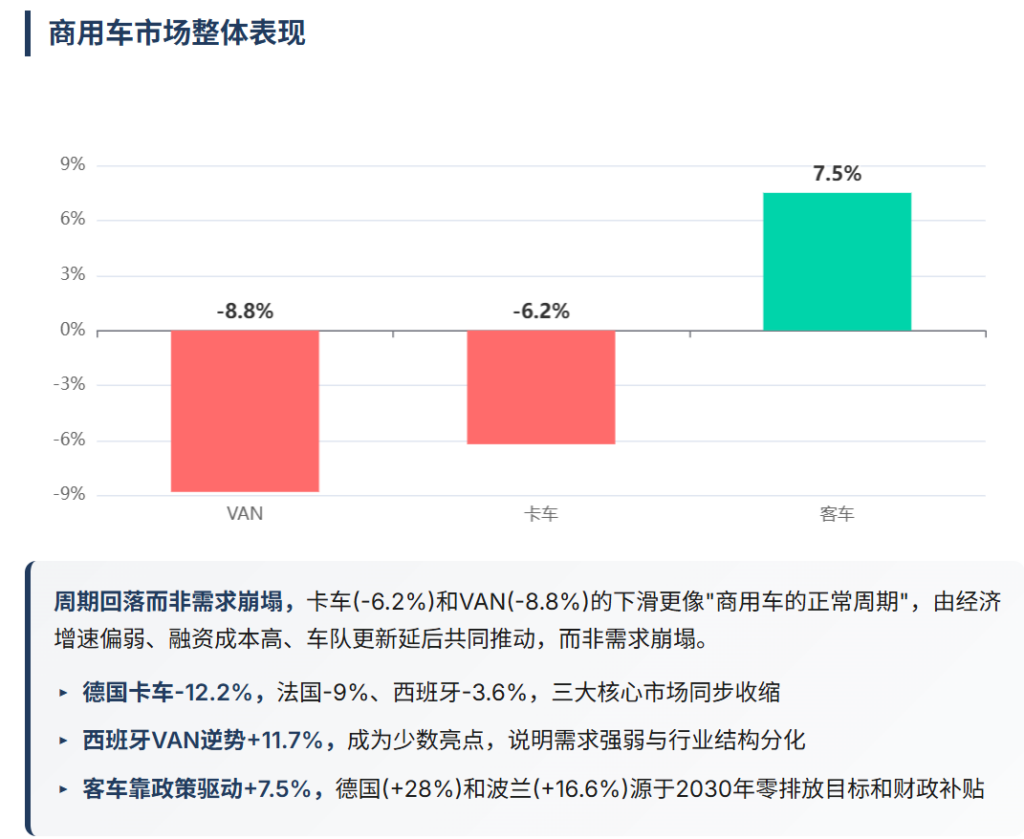
The latest ACEA data show that 2025 was a challenging year for the EU commercial vehicle market. Truck registrations fell 6.2% to 307,460 units and vans declined 8.8%, while only the bus market grew, up 7.5%. Notably, electrification is moving at "two speeds": electric buses have reached a 23.8% market share, while electric trucks are at just 4.2%, with growth confined to isolated pockets.
Weak economy drives broad contraction in conventional commercial vehicle demand
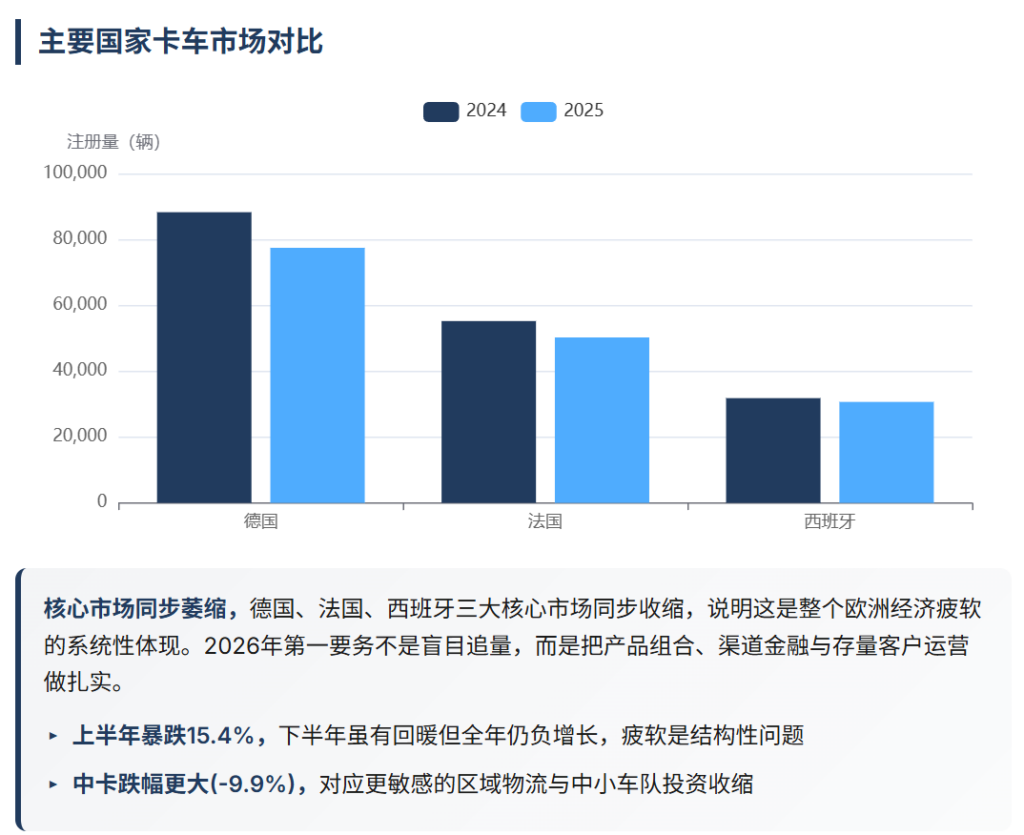
The decline in the EU commercial vehicle market in 2025 is a direct reflection of Europe's economic weakness. In Germany, the largest market, truck registrations fell from 88240 to 77431 units, a drop of 12.2%. France and Spain fell 9% and 3.6% respectively. The simultaneous contraction of the three core markets reflects systemic challenges across the European economy.
The van market is not encouraging either: France -5.6%, Germany -5.4%, Italy -5%, with only Spain growing 11.7%. Vans are usually tied to SME activity, and the broad decline shows that Europe's real economy remains under heavy pressure.
The timing of the divergence shows the pressure is persistent: truck registrations plunged 15.4% in the first half and vans 13.2%. Despite a recovery in the second half, the full year still declined. The weakness in the commercial vehicle market is not a short-term fluctuation but a structural problem that persisted all year.
By contrast, buses were the only growing segment (+7.5%), also driven by policy-led electrification. Strong growth in Germany (+28%) and Poland (+16.6%) reflects the 2030 zero-emission target for city buses and national subsidy support.
Diesel dominates; electrification penetration creeps up slowly
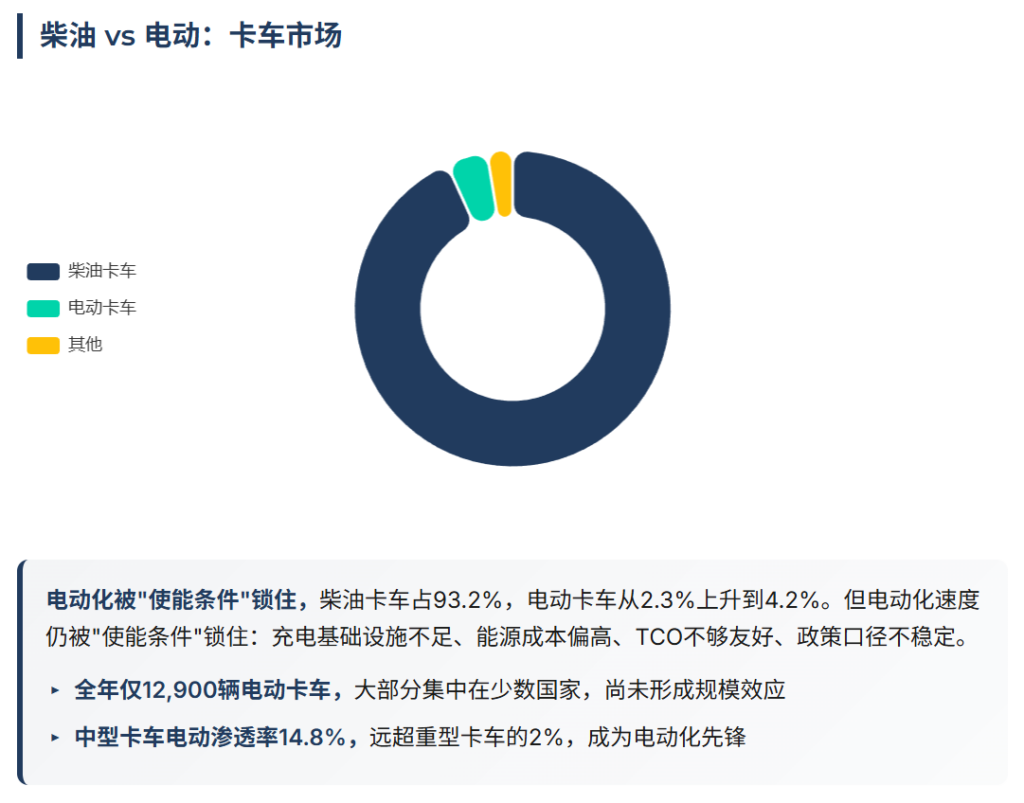
Although electrification is inevitable, diesel's dominance in the commercial vehicle market remains unshaken. In 2025, diesel accounted for 93.2% of new truck registrations, 62.1% of buses and 80.7% of vans. Behind these numbers lie the practical constraints of European logistics: long-haul freight needs high energy density and fast refueling, urban distribution needs high reliability and low total cost of ownership, and diesel is still the best way to meet these needs today.
Electric trucks rose from 2.3% to 4.2%, doubling. That may not look high, but with only around 12900 electric trucks registered in all of 2025, any growth is a breakthrough from zero to one.
Electric buses performed even more strongly, jumping from 18.5% to 23.8%. Electric bus registrations exceeded 1,000 units in the UK (2856), Germany (1808) and Italy (1371), showing that public transport electrification has moved from the pilot stage to large-scale deployment.
Medium trucks lead electrification, with the Netherlands and Switzerland setting the pace
In the electric commercial vehicle market, the segment most worth watching is medium trucks (3.5–16 tonnes).
In 2025, medium electric truck registrations reached 7867 units, up 87% year on year, with electric penetration of 14.8%, above heavy trucks' 2%, suggesting medium trucks are currently the most pragmatic entry point for electrification.
For medium trucks, the first factor is a good fit with use cases. Medium trucks are mainly used for urban distribution and regional haulage, typically covering less than 200 km a day, well within the range of electric trucks. Second, they need relatively little charging infrastructure: fleets can install chargers at their own depots rather than rely on the public fast-charging network. Policy support is also strong. Many cities' low-emission zones (ULEZ) bar diesel goods vehicles outright, which pushes logistics companies to electrify.
Germany is the most representative case. In 2025, Germany registered 3368 medium electric trucks, 43% of the EU total. But growth was only 40%, below the EU average of 87%. As an early adopter of electric trucks, Germany has a large base but slowing growth.
By contrast, the Netherlands, Sweden and Italy posted growth rates of 523%, 407% and 174% respectively, showing signs of catching up. The Netherlands stands out in electric trucks: although total truck registrations plunged 40.8%, electric truck registrations soared 205.4%, lifting electric penetration to 18.2%, second only to Switzerland's 21.3%.
Switzerland, a small European country, registered 942 electric trucks in 2025, an electric penetration rate of 21.3%, the highest in Europe. Its success comes from a clean power mix (hydropower at 60%+), relatively compact geography and long-term policy stability — all prerequisites for scaling up electric trucks.
Battery-electric buses overtake hybrids
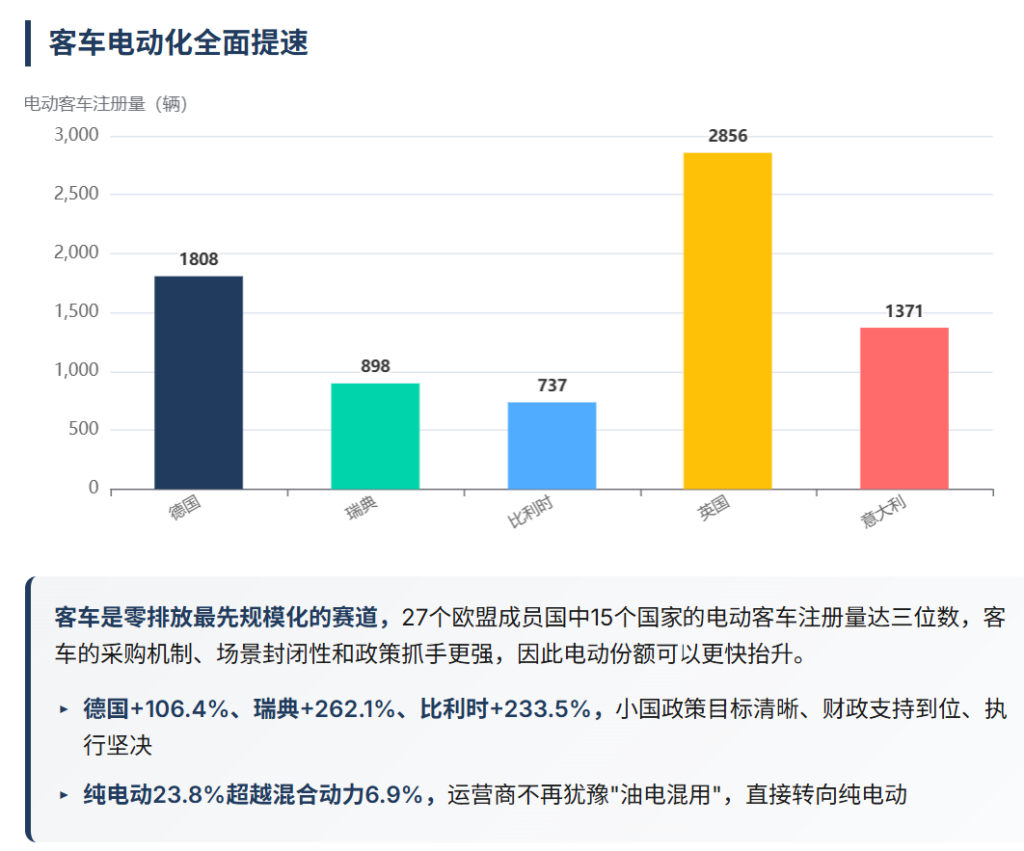
15 of the 27 EU member states recorded three-digit electric bus registrations. German electric bus registrations rose from 877 to 1808, up 106%. Smaller countries performed even more strongly: electric buses +262.1% in Sweden, +233.5% in Belgium and +196% in Lithuania.
In 2025, EU registrations of hybrid buses fell 25%, with market share dropping to 6.9%. Meanwhile, battery-electric buses rose to 23.8%. The trend shows that public transport electrification is past its "wavering phase": operators are no longer hesitating over mixed diesel-electric fleets and are moving straight to battery-electric.
The UK, Europe's largest bus market, registered 2856 electric buses in 2025, up 56% year on year. This shows that electric bus growth remains strong even as the overall market declines. The core reason electric buses are spreading quickly is the closed nature of their operations: fixed routes, fixed depots and clear public procurement direction. Freight, by contrast, is more open, with greater uncertainty around charging and operations.
2026–2027 will be the critical window for electric trucks
ACEA summed up 2025 as "a challenging year." The verdict refers both to the decline in the traditional commercial vehicle market and implicitly to concerns that electrification is not moving fast enough. Electric trucks reached a 4.2% penetration rate and 12900 annual registrations, mostly concentrated in a handful of countries. This "island-style growth" means electric trucks have yet to achieve economies of scale: supply chain costs are high, the charging network is incomplete, and total cost of ownership remains higher than for diesel trucks.
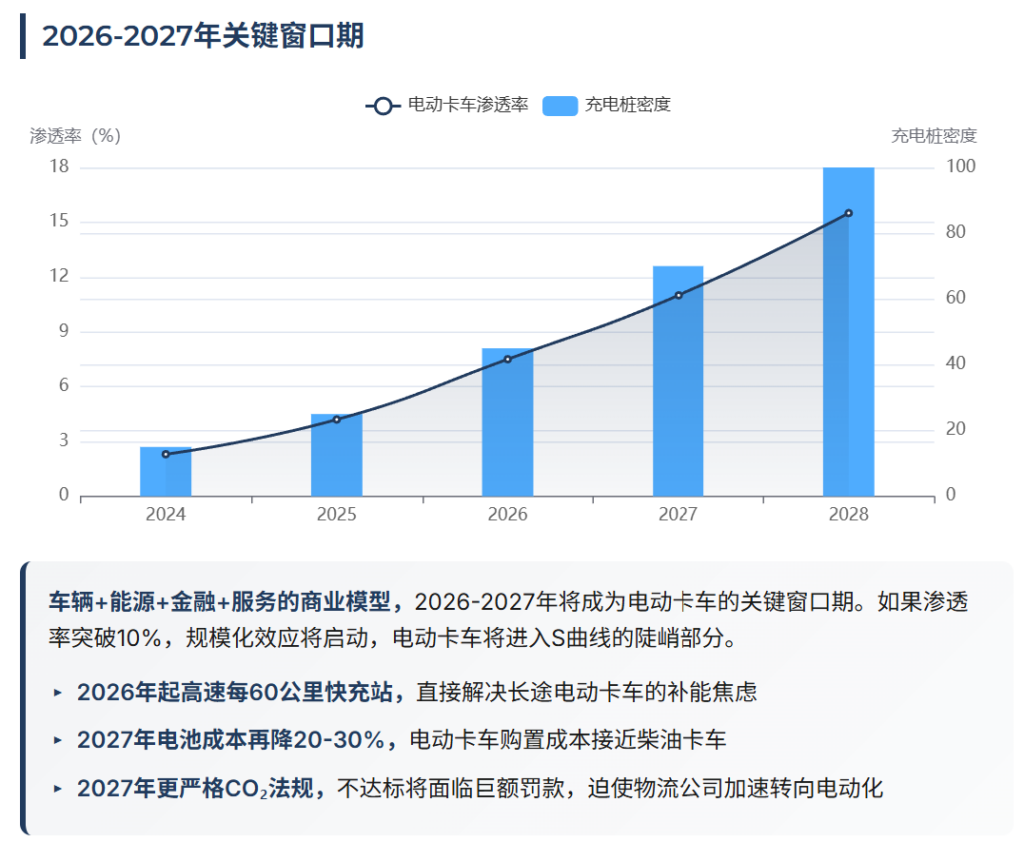
2026–2027 will be a critical window for electric trucks. If electric truck penetration breaks through 10% in these two years, economies of scale will kick in and electric trucks will enter the steep part of the S-curve.
Final thoughts
The EU commercial vehicle market in 2025 presented a complex picture of "conventional markets declining, electric markets climbing". Diesel still dominates, but structural substitution by electric vehicles has begun. Medium trucks' lead in electrification, the small-country leadership model of the Netherlands and Switzerland, and the full electrification of public transport all offer replicable paths for electrifying Europe's commercial vehicles.
The next 2–3 years will decide whether electric trucks can reach the tipping point for scale, and whether Europe can achieve deep electrification of commercial vehicles by 2030–2035.
**Reproduction or excerpting without permission is strictly prohibited.** Questions and comments are welcome. Follow us for ongoing analysis of the latest developments in China and abroad.