Chinese buses localizing in Europe
YES-EU signs preliminary contract to buy former Maserati plant in Turin; STRABAG takes stake in charging operator R:loaded. Italy registered 1818 electric buses in months 1–10, with four Chinese brands taking 31.7%.
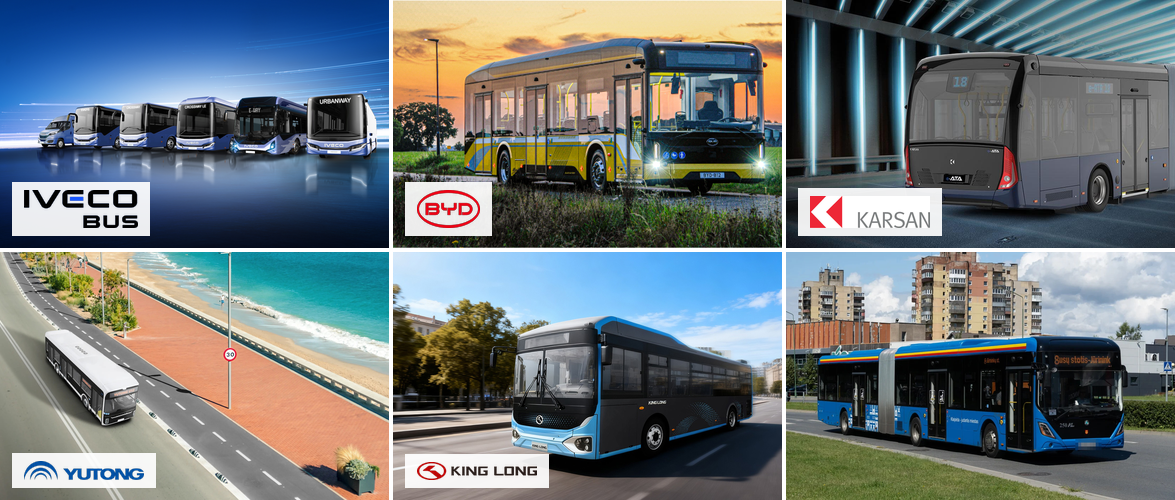
On Nov 12, Swiss bus importer YES-EU signed a preliminary agreement with Stellantis to acquire the idle Maserati plant in Grugliasco, near Turin, and build electric buses and battery packs there from 2028. The company bids in Italy with vehicles from CRRC Electric. A day later, German transport infrastructure builder STRABAG bought a 50% stake in charging operator R:loaded. Both moves reflect the same procurement model: European public transport operators and motorway authorities tender vehicles or chargers together with multi-year maintenance and operation, so importers and engineering firms that want these contracts need local capacity for after-sales, battery repair or operations, and some are starting to buy plants or take stakes. Only part of this has turned into contracts so far; the rest consists of preliminary agreements, framework shortlistings and tender rankings.
Italian market
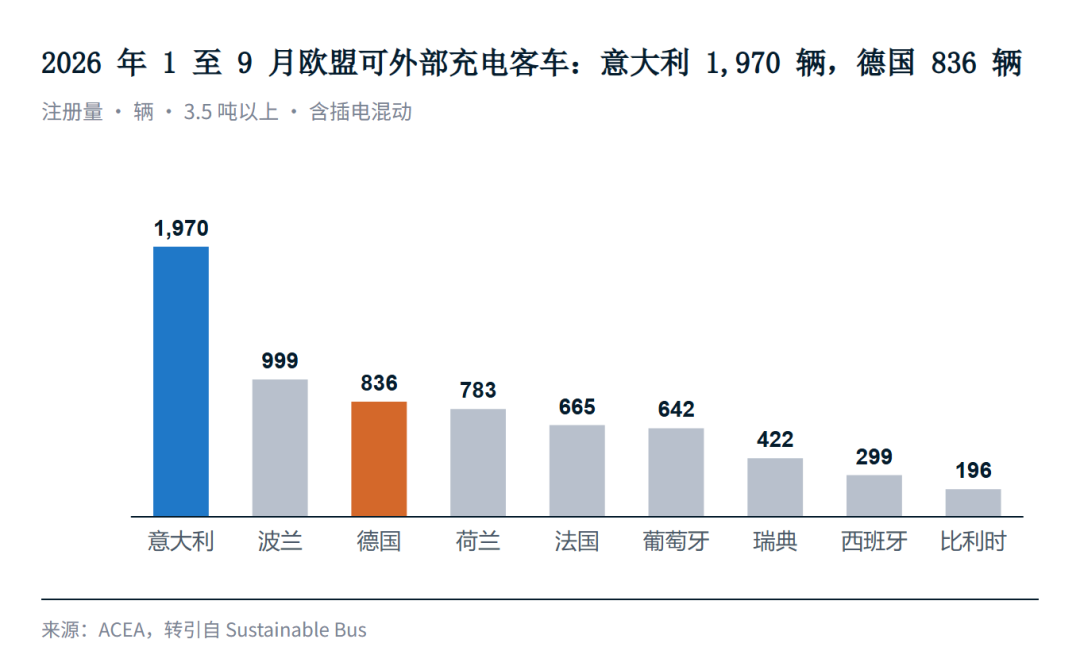
Italy is the largest EU market for bus registrations this year. ACEA figures show Italy registered 5338 buses in the first nine months, of which 1970 were externally chargeable, more than double the same period last year. On the same basis, Germany registered only 836, down 30.4% year on year.
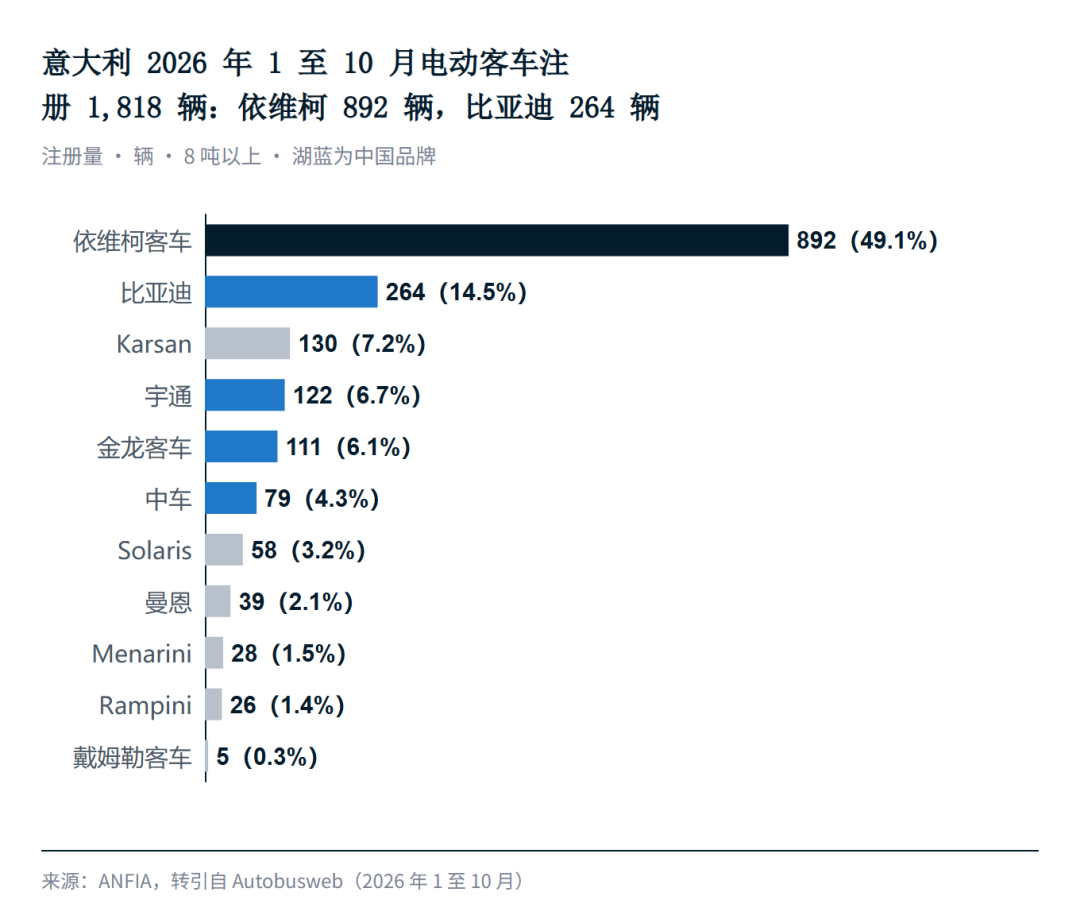
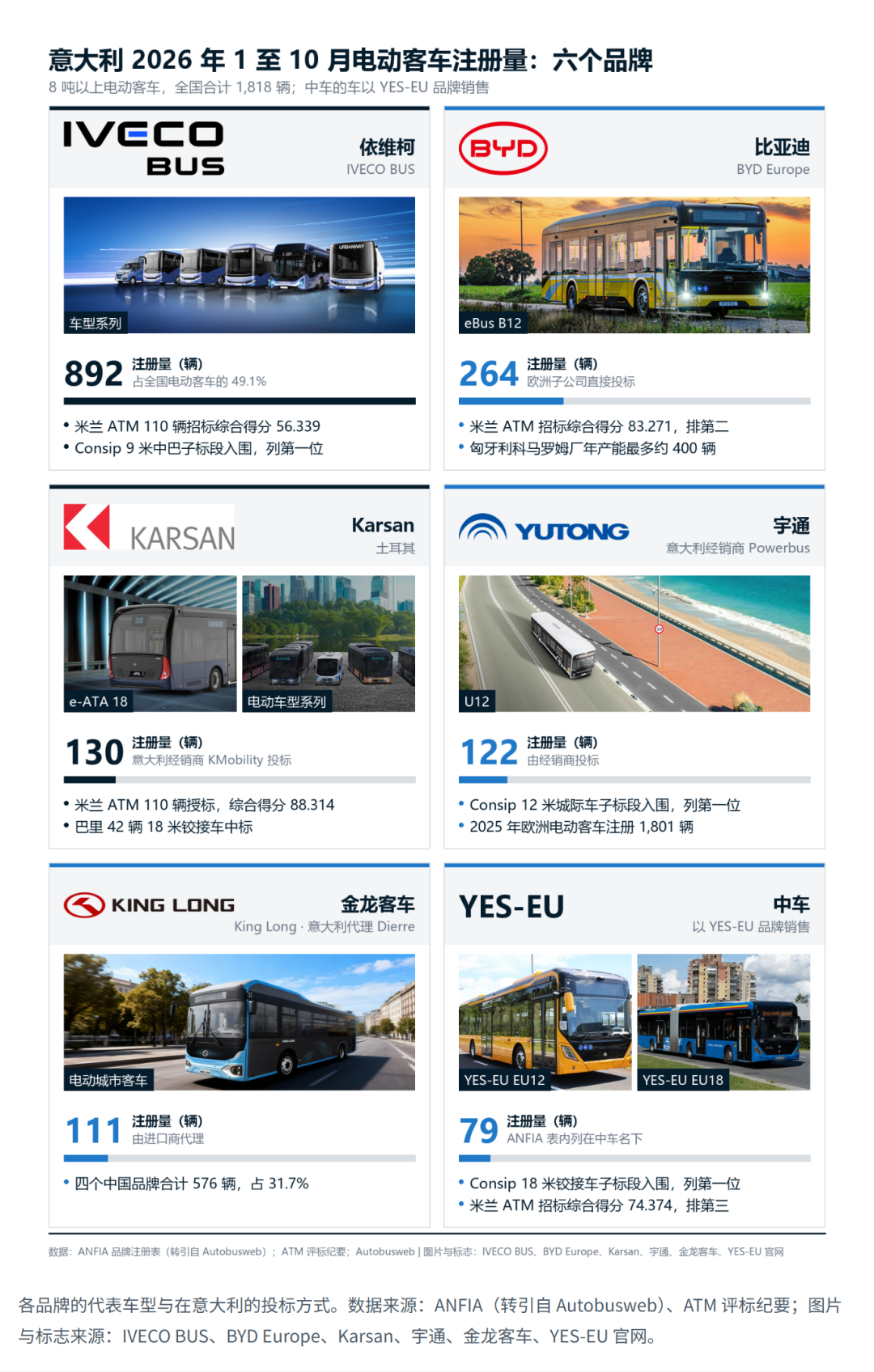
Italian automotive industry association ANFIA tallied electric buses over 8 tonnes by brand: 1818 units in months 1–10, up 85.7% year on year. Among city buses, about 8 in every 10 new vehicles are electric.
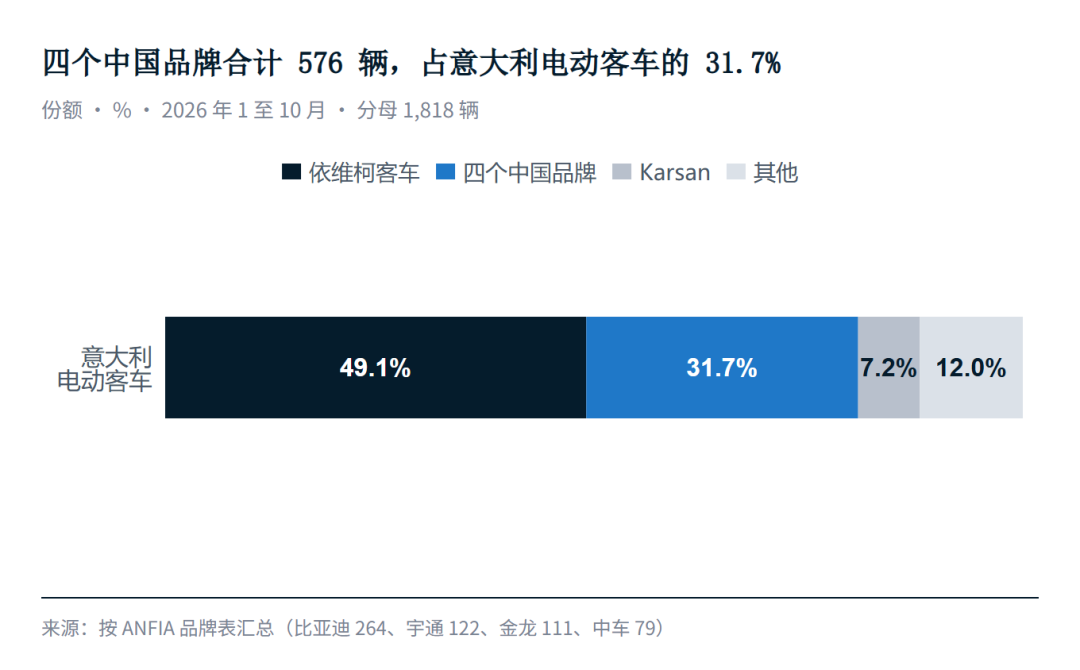
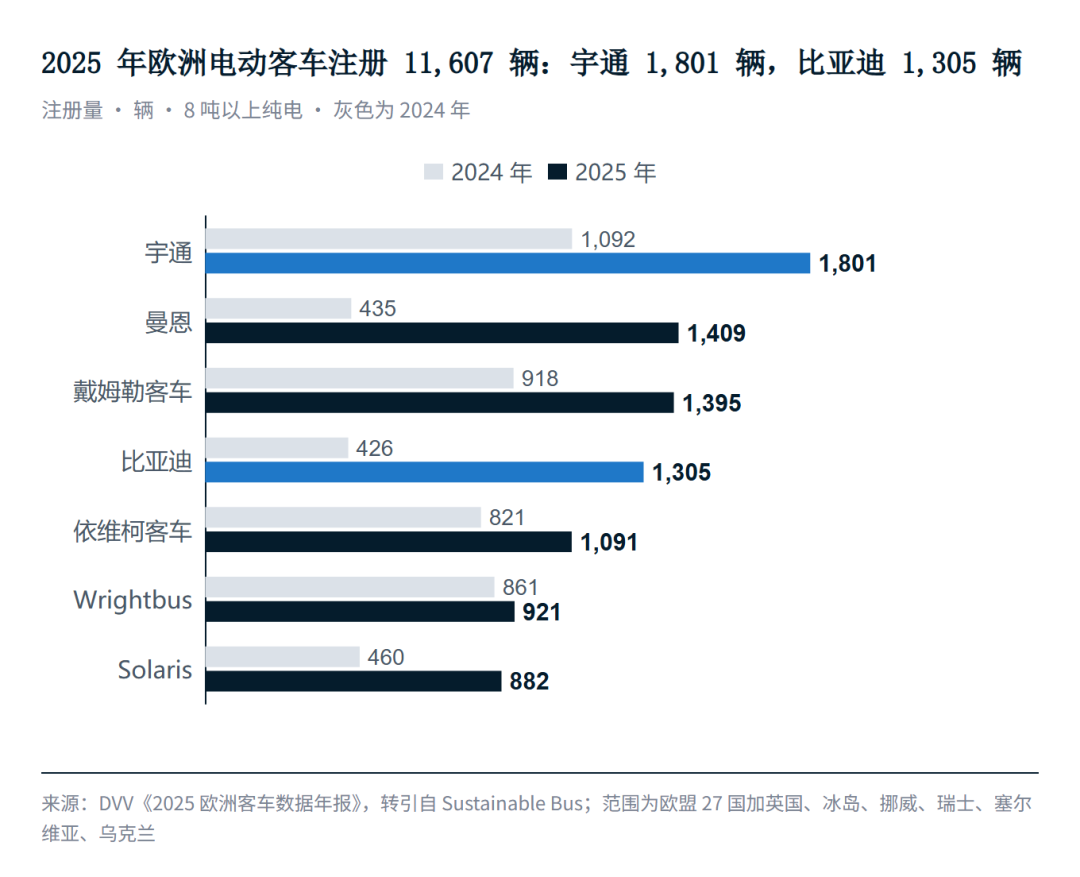
BYD, Yutong, King Long and CRRC together account for 576 units, or 31.7%. The benchmark for Europe as a whole comes from the DVV Media Group annual report, which covers electric buses over 8 tonnes in the EU plus the UK, Norway, Switzerland and other countries. In 2025, 11607 units were registered. Yutong led with 1801, followed by BYD with 1305, and the two together took about 26.8%.
Domestic maker Iveco took nearly half of Italy's electric buses. Chinese brands took 60% of the remaining half.
Bidder
In Italy, most bids come from importers and dealers, while BYD bids directly through its European subsidiary. Yutong vehicles are bid by the dealer Powerbus, CRRC vehicles appear under the YES-EU brand, King Long is represented by Dierre, and Golden Dragon and Zonson are represented by Pagliani.
Italy's central purchasing body Consip launched a framework agreement tender for 600 electric buses last July. Including options, it is worth about €652 million and is split into nine sub-lots. According to Consip's website, all nine sub-lots were awarded on 9 October this year, with two to five suppliers shortlisted for each:
Under the framework agreement, higher-ranked suppliers get priority to supply and larger guaranteed volumes, but actual orders materialize only once local bus operators place them.
Milan and Bari
Milan transit operator ATM tendered for 110 12-meter electric buses in March this year, with an estimated value of about EUR 103 million including full-service maintenance. The seven bidders' overall scores are as follows:
ATM awarded the contract to KMobility for more than EUR 76 million, including maintenance and future battery replacement. According to a stock-exchange filing Karsan published in Turkey, the framework agreement fixes a firm batch of 34 vehicles plus options on 76 more. Signing must also wait out a 30-day statutory standstill period, during which unsuccessful bidders can lodge objections.
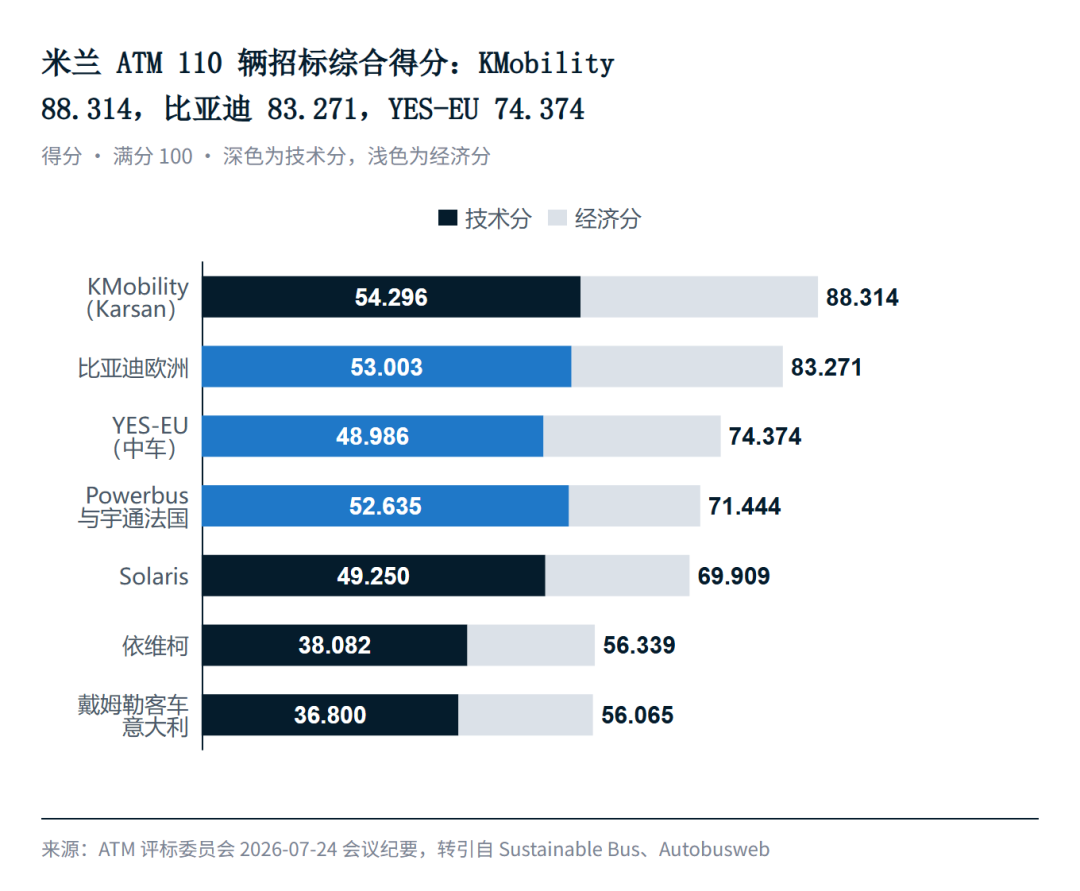
Earlier, in Jul 2025, the city of Bari bought 42 18-metre articulated buses for its bus rapid transit system, also awarded to KMobility, for about EUR 31.88 million, or roughly EUR 759,000 per bus. Consortia involving BYD, YES-EU and Yutong all bid and lost. In both city orders, the winners were dealers for Turkish brands, with Chinese brands ranking behind them.
Three-stage progress
Recent reports fall into three categories by degree of certainty:
Framework admission, rankings and reservation contracts are not orders, let alone production volumes; even the awarded Milan project has a firm batch of only 34 vehicles. What parts and service suppliers can plan production on is the firm quantity in signed contracts.
Turin plant
YES-EU has annual revenue of about EUR 150 million. It began as Yutong's electric bus distributor in the Nordics and later added its own-brand models, built in China by CRRC. Its seven models range from 6.99 m to 25.9 m in length. Battery aftersales is its other business: it has serviced CATL batteries in Europe since 2018, and this October it opened a battery service center of more than 10,000 square meters near Oslo.
The plant in question is in Grugliasco and covers about 230,000 square metres. It was built in 1959 by coachbuilder Bertone, became part of the Fiat group in 2009 and produced the Maserati Ghibli and Quattroporte, employing about 1,400 people at its peak. Maserati production moved to Mirafiori in 2022, after which the plant was put up for sale; two buyers held talks in the meantime, but neither deal closed.
The Hungarian precedent
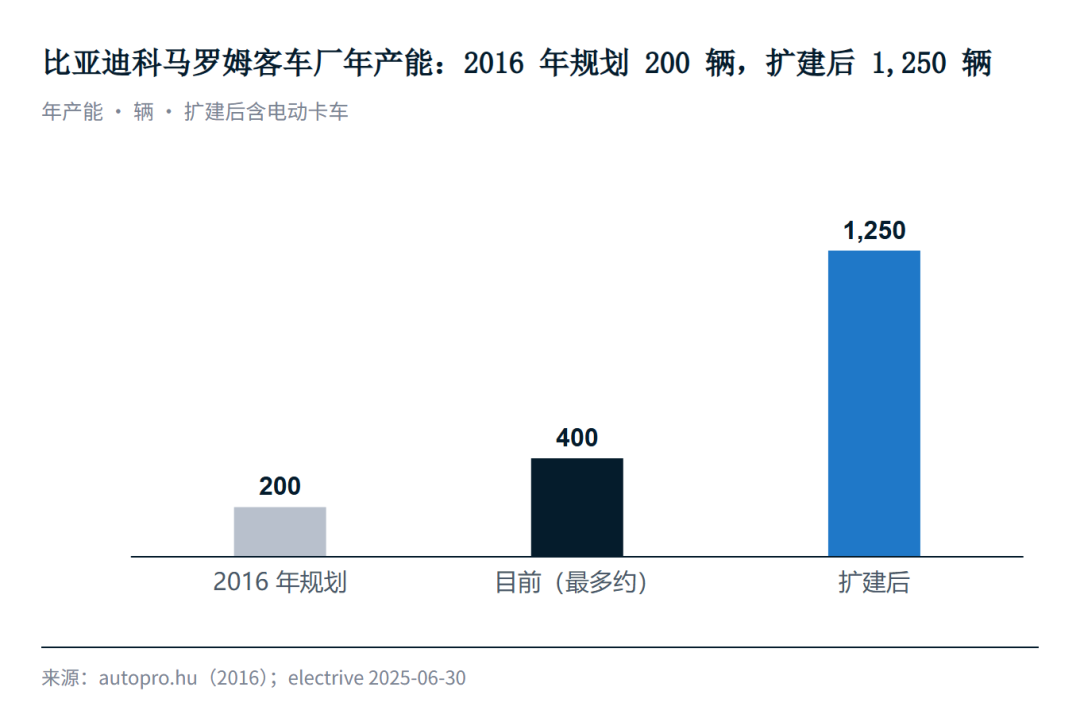
BYD already builds buses inside the EU. It announced its plant in Komárom, Hungary, in 2016 with an investment of about EUR 20 million and planned output of 200 units a year. Production began in 2017, and the plant can now build up to about 400 units a year. Ground was broken on an expansion last June, with about EUR 80 million in new investment, targeting 1,250 electric buses and trucks a year, about 3.1 times current capacity.
Passenger car makers are already doing this: BYD is building a passenger car plant in Szeged, Hungary, and Geely is set to assemble two models at Ford's plant in Valencia, Spain, from 2028.
European peers are also emphasizing origin. Daimler Buses showcased the next-generation eCitaro on Nov 10, launching in 2028, with production in Germany, France and the Czech Republic, and voiced support for the EU's proposed Industrial Accelerator Act to promote European manufacturing.
Bundled tender
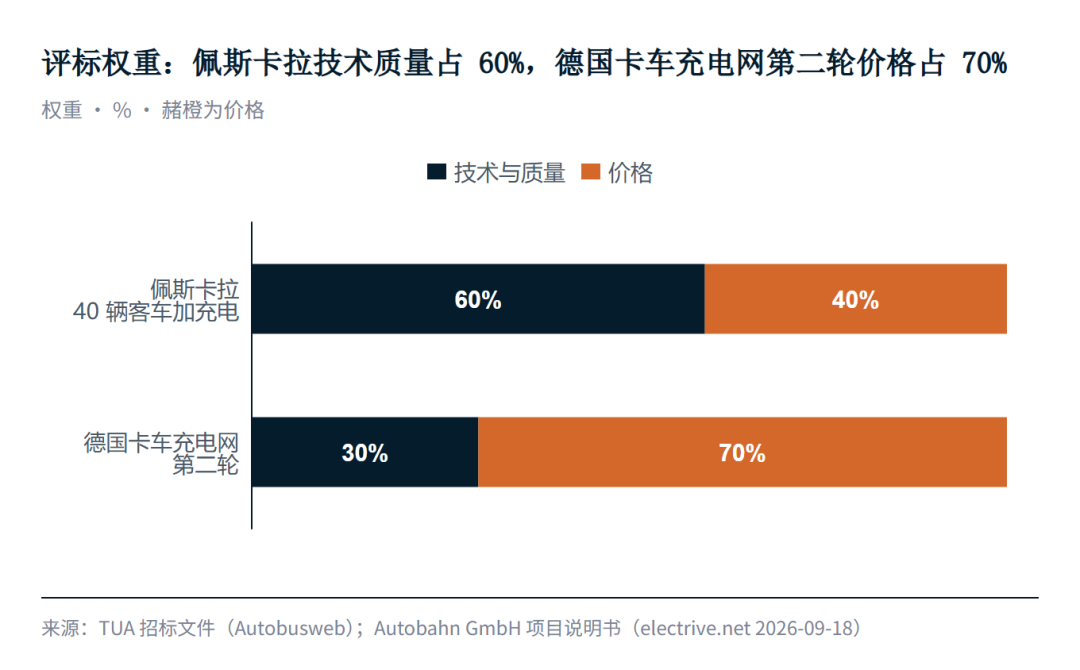
Pescara's tender covers not only 40 vehicles but also the design and construction of depot charging infrastructure, plus 8 years of full-service maintenance for vehicles and infrastructure; scoring weights technical, quality and organisational criteria at 60% combined and price at 40%. Milan's contract includes maintenance and battery replacement in the total price. Bari's tender covers vehicles only.
The winning bidder is responsible for the vehicles and facilities for several years, so battery repair, spare parts stock and service staff must all be available locally and on time. YES-EU's battery service centre in Oslo, along with its planned battery pack and recycling operations in Turin, could support contracts of this kind.
Germany's truck charging network
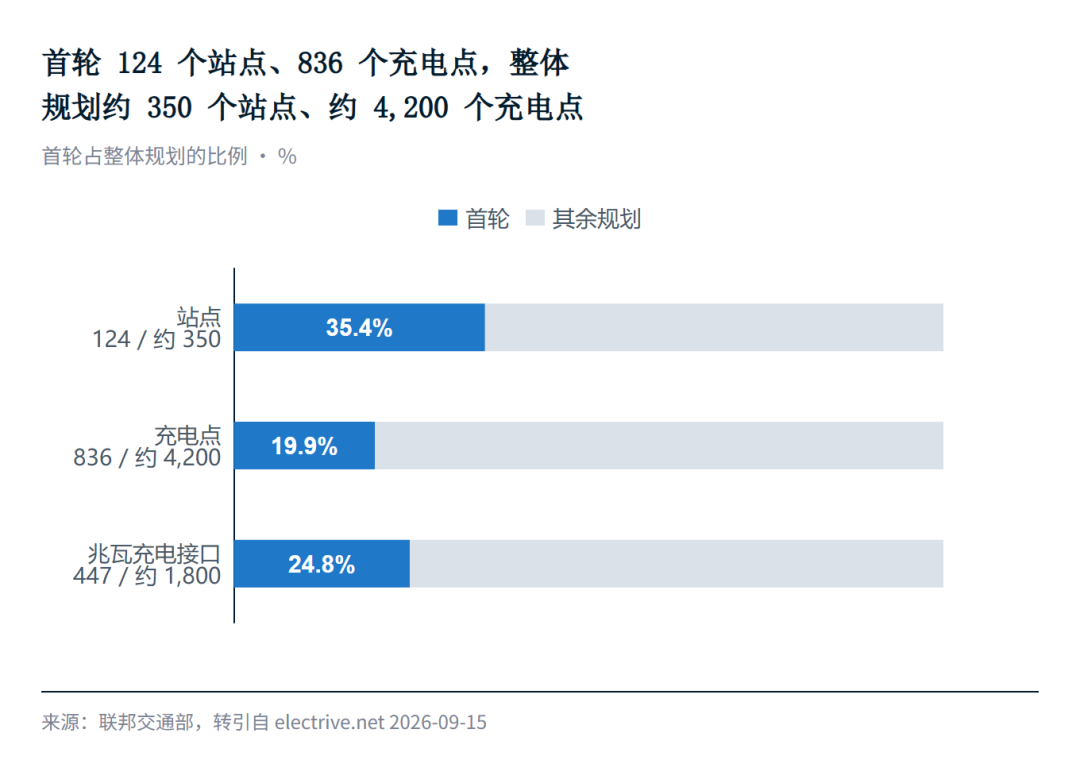
On the charging side, Germany is taking the same approach. At the end of June, federal motorway company Autobahn GmbH awarded the first round of contracts for the federal truck fast-charging network, covering 124 unserviced parking areas with 836 charging points in total, of which 447, more than half, are megawatt charging (MCS); that averages about 6.7 charging points per site. The full network is planned at about 350 sites and about 4,200 charging points, with roughly EUR 1 billion in federal funding; the first round accounts for about 20% of total charging points.
The first round is split into five lots, with one winning bidder responsible for planning, building and operating each lot:
Lot 4 accounts for 16.7% of the first-round charging points, with 5.6 per site, and R:loaded will operate it until mid-2034. STRABAG's German transport infrastructure division has about 15,000 staff and annual output of about €4 billion, and in charging projects it previously handled only construction. Holding half of R:loaded, it can now include operation in its bids for public tenders and for industrial and logistics customers.
None of the five winning bidders is a pure charging equipment supplier; they come from construction and concession groups, energy companies and site operators, and three of them are consortia.
Source: Chart by AutoMusic based on the public sources listed in the article; first published on the AutoMusic WeChat account.
Charging standards and the next round
In 11, the EU-funded research project MACBETH published design guidelines for multi-point megawatt charging stations, written by the charging interface initiative CharIN and VTT, the Technical Research Centre of Finland. The guidelines describe two site layouts (drive-through and with a waiting area) and two power architectures (shared power cabinets and modular multi-cabinet), set a target of more than 97% charger availability, and map the design item by item against 40-plus existing standards. They will guide the design of pilot stations in Belgium and Sweden.
Germany's second tender round covers about 225 sites with service areas, roughly 1.8 times as many as the first round. According to Autobahn GmbH's project brief, the tender is set to launch in month 11 of this year. It again combines planning, construction and operation, split into five lots of about 45 sites each. Bids are scored 70% on price and 30% on quality. Operating contracts run 8 years, with an extension of up to 4 years. With price weighted at 70%, construction and operating costs directly decide the ranking.
Final thoughts
These Italian bus contracts all come with multi-year maintenance or battery replacement obligations, so after-sales and battery services have to be based locally. YES-EU plans to go a step further and move assembly locally as well. However, YES-EU has yet to announce its formal purchase contract, models or capacity. The Milan contract cannot be signed until the 30-day standstill period ends, actual orders under the Consip framework agreement depend on local transit operators, and Germany's second truck charging network tender is set to launch in month 11.