European electric bus shake-out: Ebusco raises funds at a 57% discount, Bluebus halts production, Yutong takes 20% share in H1
European battery-electric bus registrations reached 8141 units in the first half of this year, up 49%, yet Ebusco is raising capital from existing shareholders at a 57% discount, and Bolloré's Bluebus has halted production.
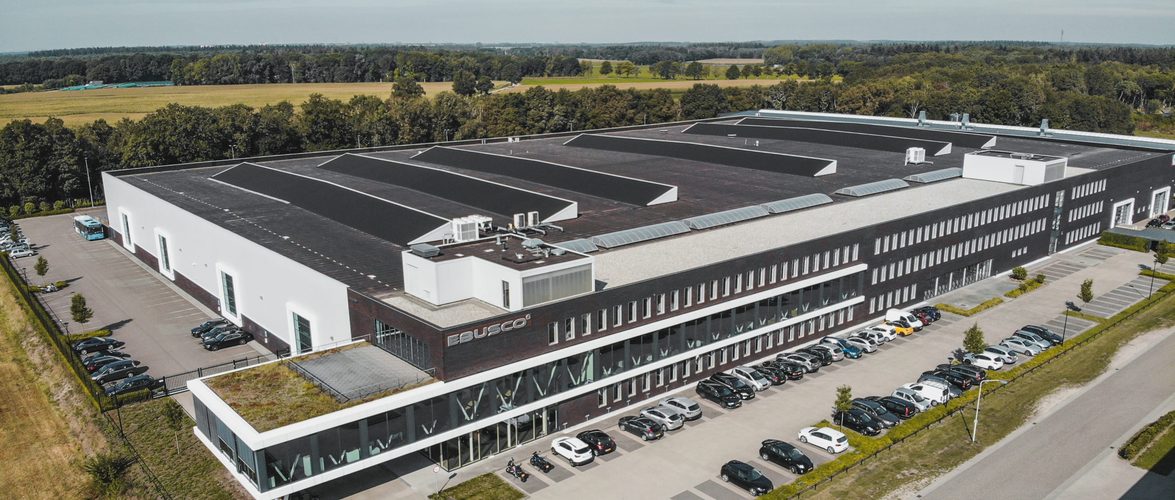
On Nov 4, Dutch electric bus maker Ebusco announced that five existing shareholders had committed to subscribe for EUR 12 million in new shares at EUR 0.05 per share, about 57% below the previous day's closing price of EUR 0.117. The day before, Ebusco had announced it was delaying payment of October wages. Two months earlier, France's Bolloré Group had announced plans for its Bluebus unit to permanently stop producing electric buses.
Over the same period, electric bus registrations in Europe grew rapidly. According to DVV Media Group, 8141 battery-electric buses over 8 t were registered in Europe in H1 2026, up 49% year on year and already equal to 69% of the 11819 registered in full-year 2025. Among city buses, BEVs accounted for 61.2%.
The market is expanding, yet one European electric bus maker is raising funds at a discount and another has halted production. New registrations are concentrated among Yutong, Iveco and Solaris; Bluebus, despite being backed by the Bolloré Group, did not survive. Whether these companies can keep operating depends on who is willing to keep absorbing losses in the bus business and deliver orders on time.
Ebusco's troubles
Ebusco is headquartered in Deurne, the Netherlands, and listed on Euronext Amsterdam. Its main business is electric buses, with energy storage and battery management accounting for about 13.6% of revenue in the first half of 2026. Both orders and deliveries reflect its difficulties.
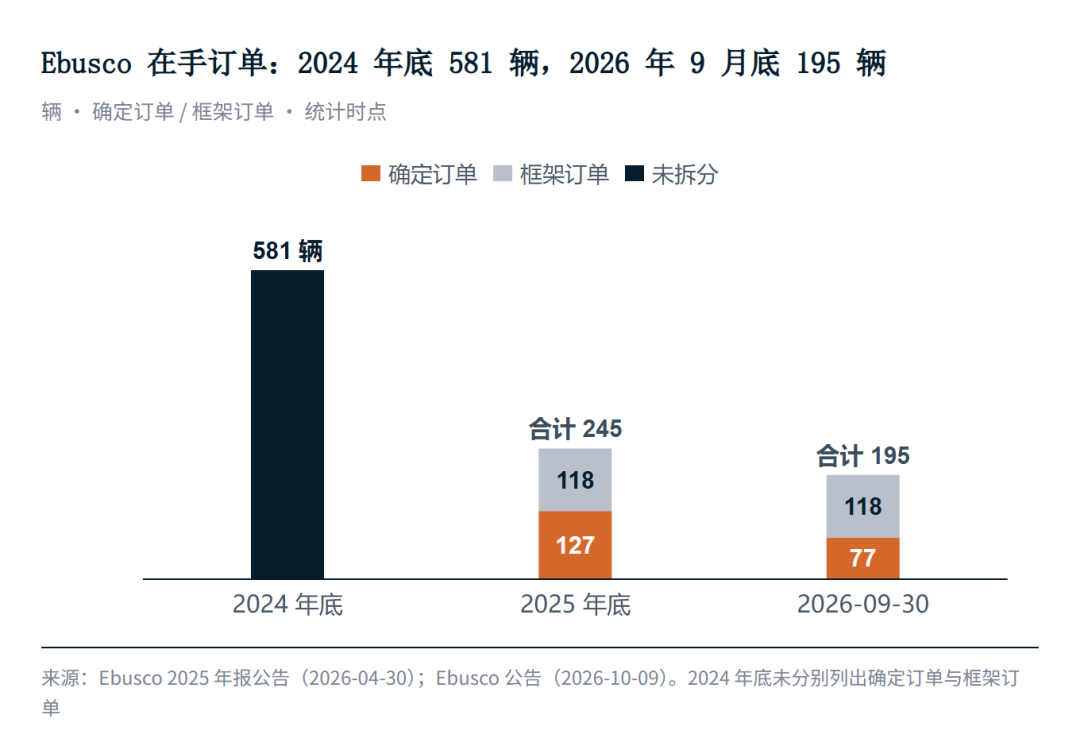
At the end of 2024, Ebusco had an order backlog of 581 vehicles; this fell to 245 by the end of 2025, and by Sep 30, 2026 only 195 remained, including 77 firm orders and 118 framework units awaiting call-off, a drop of about two-thirds in under two years. The framework options run until Mar 2027, and the company said in its half-year report that there is no guarantee they will convert into firm orders. In 8, Potsdam's public transport operator cancelled an order for 23 new buses, which Ebusco disputes. Deliveries are also shrinking: 157 in 2024, 123 in 2025, and only 19 in the first three quarters of 2026, including 3 in the third quarter.
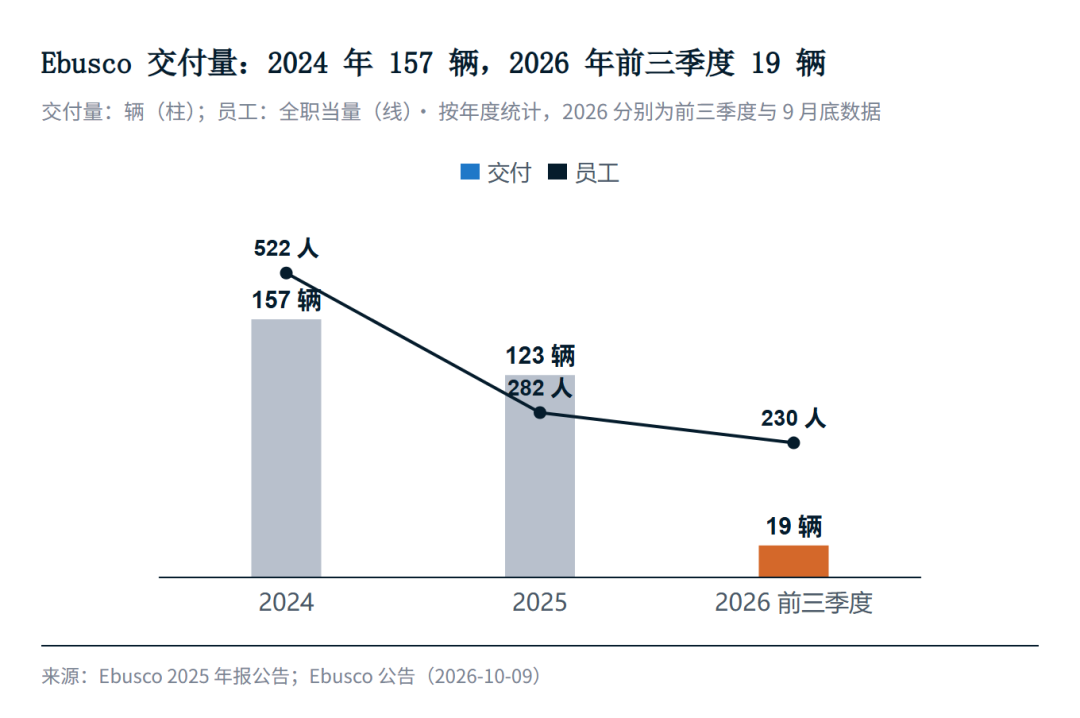
At end-2025, net assets stood at EUR 3.3 million and cash at EUR 7.4 million; by end-Jun 2026, cash had fallen to EUR 2.1 million and net assets had turned negative at EUR −14.8 million. On a full-time-equivalent basis, headcount fell from 522 at end-2024 to 282 at end-2025, and further to 230 by end-Sep 2026.
The company has shifted to a design-plus-contract-manufacturing model (which Ebusco calls OED, original equipment design): vehicle assembly goes to contract manufacturers while Ebusco handles design and integration. First-half gross margin was 27.8%, or about 16.3% excluding a battery management system contract. Manufacturing gross margin has turned positive, but delivery volumes are still too low to cover the company's costs.
One of the contract manufacturers is China's King Long (Jinlv) Bus. On Jul 7, Ebusco and King Long celebrated in Xiamen the completion of the first 18-metre Ebusco 3.0 built entirely at King Long's Longhai plant. The bus will be delivered to Rouen, France. None of the 49 Ebuscos the Rouen metropolitan area has received so far were built at the Cléon plant in Normandy; King Long will produce the remaining 68 in China, with completion planned by Feb 2027, and even the chassis previously made in Cléon has moved to China. When the Cléon plant opened in May 2024, it targeted annual output of 500 units; it now only installs screens, on-board radios and ticketing equipment.
The EUR 12 million announced on Nov 4 comes from five existing shareholders: strategic investors Rhein Holding and Green Innovation International are contributing EUR 8 million, while De Engh, CVI Investments and founder Peter Bijvelds' holding company are contributing EUR 4 million. The funds arrive in tranches, with the last EUR 1 million due in Feb 2027; the company expects that, if the money arrives in full and on schedule, it can fund operations into Q2 2027. Each later tranche falls due only once earlier ones have been paid in full. The money must also repay a EUR 7.1 million bridge loan before Apr 30, 2027, and the company still needs to negotiate a similar extension for a convertible loan of about EUR 9.64 million from Gotion that matures on Dec 1.
Bluebus production halted
Bluebus is the electric bus plant the Bolloré Group set up in 2011 at Ergué-Gabéric in Brittany. Its buses used lithium metal polymer (LMP) solid-state batteries made by sister company Blue Solutions. By the time production stopped, it had delivered nearly 700 electric buses of 6 m and 12 m, the vast majority in France.
Bolloré's stated reasons: demand in France was weaker than expected, competition is intense, price pressure is high, and Bluebus lacks the scale to compete with other manufacturers. The shutdown plan involves cutting 74 jobs, with a small team kept on for after-sales and support for buses in service. Blue Solutions will cut another 41 jobs.
On Apr 4, 2022, and again on Apr 29, two Bluebus vehicles of the same model operated by Paris transit operator RATP caught fire. Both were destroyed and no one was hurt. RATP immediately took all 149 of its Bluebus vehicles out of service. Including units delivered later, 232 buses sat in depots for a long period and only gradually returned to service after repairs in 2024. France's land transport accident investigation bureau (BEA-TT) found that the most likely direct cause was a short circuit between cells in the high-voltage battery that triggered thermal runaway, rooted in the battery manufacturing process. The manufacturer then launched a recall. This was a heavy blow for Bluebus, whose positioning rests on battery technology.
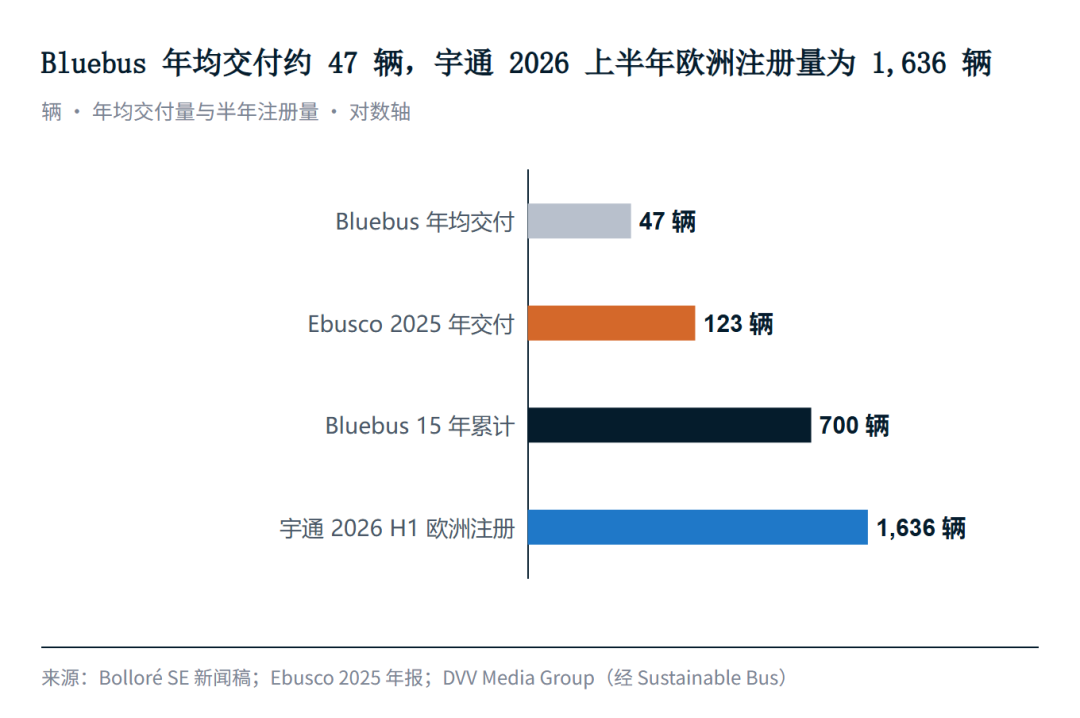
Calculated over 15 years, Bluebus delivered fewer than 50 vehicles per year on average. By comparison, Yutong registered 1636 units in Europe in H1 2026.
On disposal of assets after production ends, Bolloré said only that "a European industrial company" is studying a partial takeover, covering the R&D business and involving 17 employment contracts. French media reported that Škoda Electric, part of the Czech Škoda Group (not the same company as Volkswagen's Škoda Auto), registered a new subsidiary, Škoda Group Bus France SAS, on Oct 20 at the same address as the former Bluebus site, with share capital of EUR 10,000. It plans to start operations on Nov 1, with a business scope covering engineering, design, development, integration and technical support for bus systems. Publicly available information so far shows no plans to restart Bluebus vehicle production or acquire production equipment. Škoda Electric supplies electric drive systems for trolleybuses and battery-electric buses, and Škoda Group also holds a stake in Turkish bus maker Temsa.
Despite its group resources, Bolloré did not continue funding Bluebus's vehicle business. The takeover arrangements made public so far cover only the R&D team; no one has taken over Bluebus's vehicle production.
Share shifts
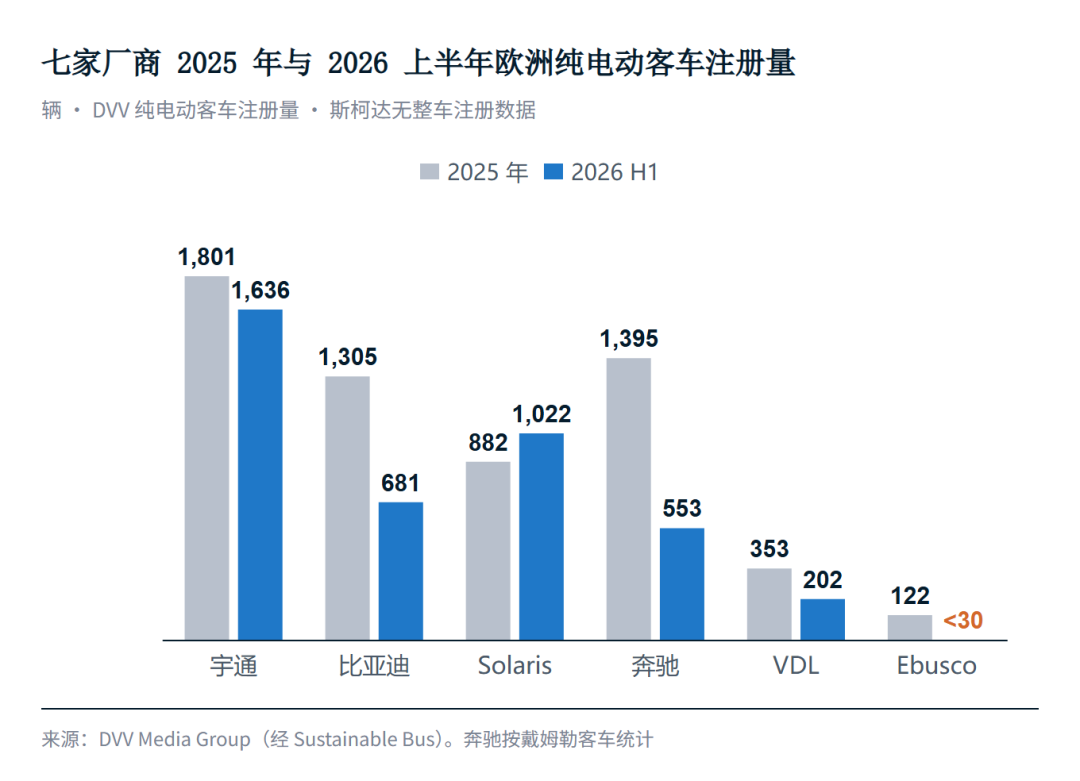
DVV's scope covers the EU-27 plus the UK, Iceland, Norway and Switzerland, counting battery-electric buses over 8 tonnes and excluding trolleybuses. The full-year 2025 total was 11607 units (later revised to 11819). The top four were Yutong with 1801, MAN with 1409, Daimler Buses (Mercedes-Benz eCitaro) with 1395 and BYD with 1305; on a base of 11607 units, the four together held about 51%. MAN and BYD both more than tripled their volumes from the previous year.
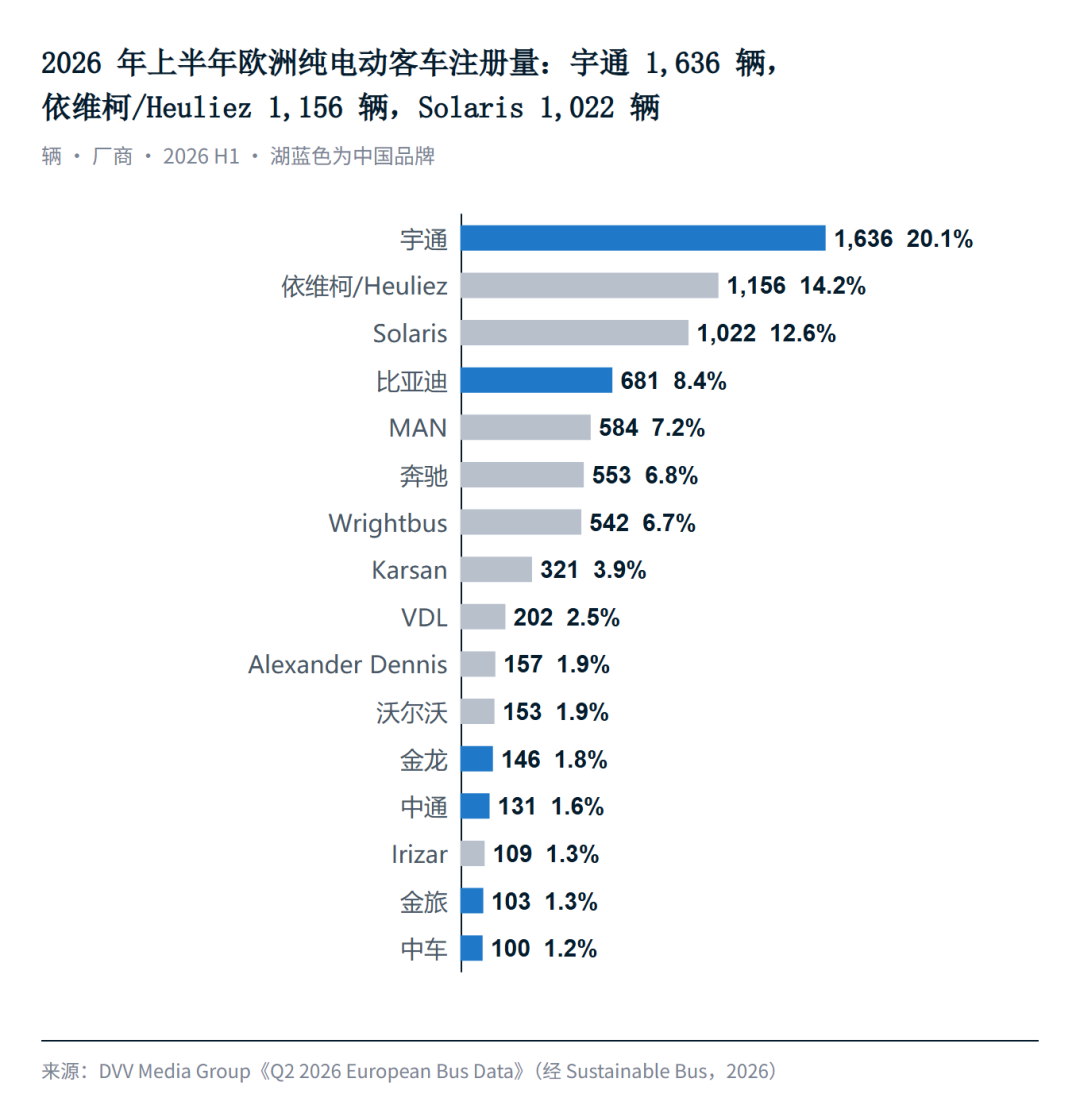
In the first half of 2026, Yutong had 1636 units (20.1%); Iveco/Heuliez combined 1156 units (14.2%); Solaris 1022 units (12.6%); BYD 681 units (8.4%); MAN 584 units (7.2%); Mercedes-Benz 553 units (6.8%). The top four together held about 55%, roughly 4 percentage points more concentrated than the top four for full-year 2025.
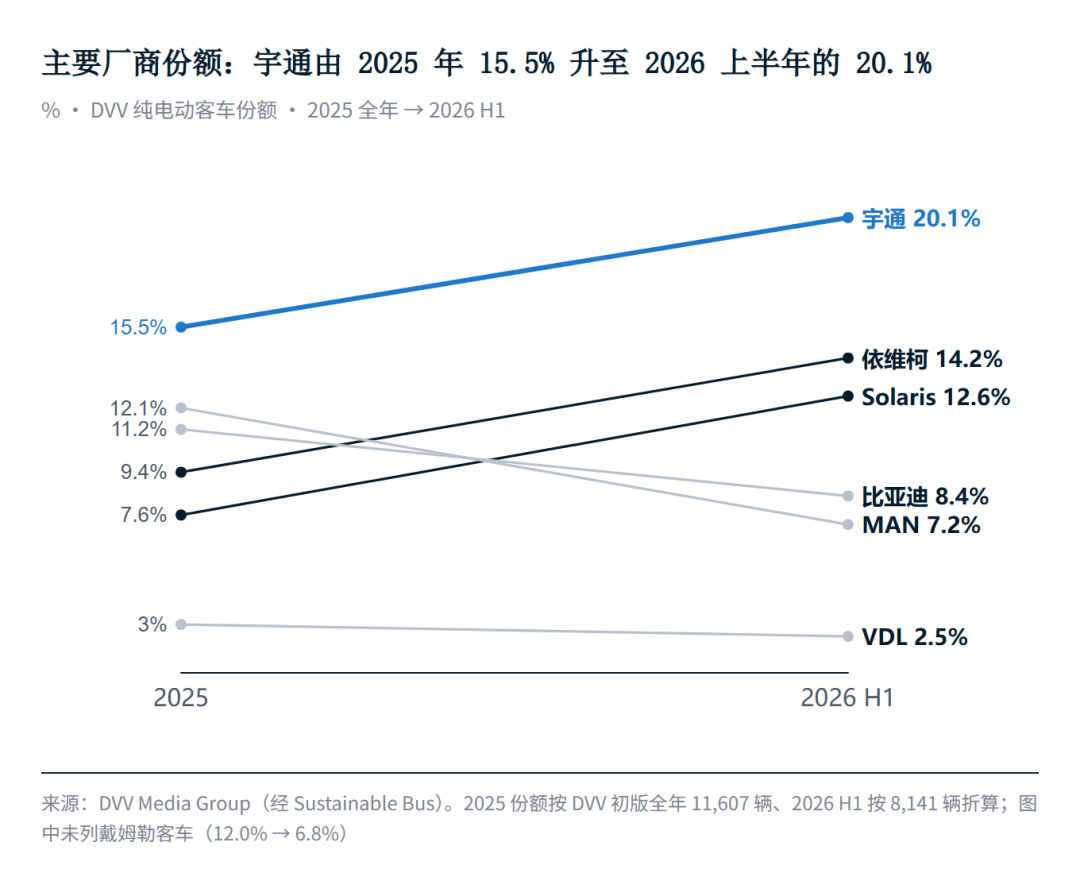
Yutong and BYD together held about 26.8% in 2025 and about 28.5% in H1 2026. Adding up all Chinese brands on the list (Yutong, BYD, King Long, Zhongtong, Golden Dragon, CRRC) gives 2797 units in the first half, about 34.4%. That excludes vehicles Golden Dragon builds under contract for Ebusco and sold under the Ebusco brand, so Chinese manufacturing's actual involvement in European buses is higher than the brand share suggests.
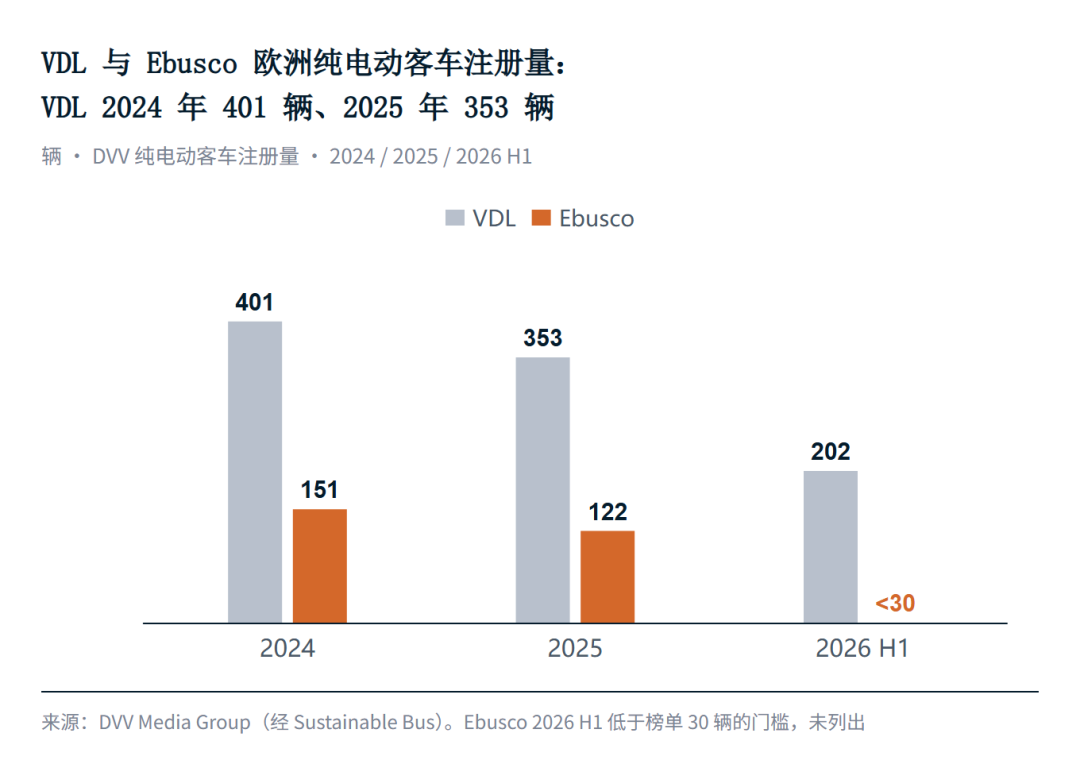
VDL and Ebusco lost share. VDL registrations fell from 401 in 2024 to 353 in 2025, with share dropping from 5.2% to 3.0%; in the first half of 2026 it registered 202, about 2.5%. Ebusco registered 151 in 2024 and 122 in 2025, a share of about 1%; in the first half of 2026 it did not appear in DVV's manufacturer ranking, which lists only makers with more than 30 registrations.
Daimler Buses, maker of the Mercedes-Benz eCitaro, registered 1395 units in 2025 for a 12.0% share, roughly flat on the previous year. In H1 2026 it registered 553 units and fell to sixth place. Besides battery-electric buses, Solaris also registered 256 hydrogen fuel cell buses in H1. If hydrogen is counted as zero-emission, Solaris ranks second with 1278 units.
The market is growing, but share is concentrating among the top few players, and registrations at smaller manufacturers are still falling.
Two rankings
The International Council on Clean Transportation (ICCT) used Dataforce data to track zero-emission buses and coaches above 3.5 tonnes in the EU-27 (excluding Malta). In the first half of 2026, 22,600 buses and coaches were registered in the EU, of which 6,400 were zero-emission, a share of about 29%, up from about 23% a year earlier.
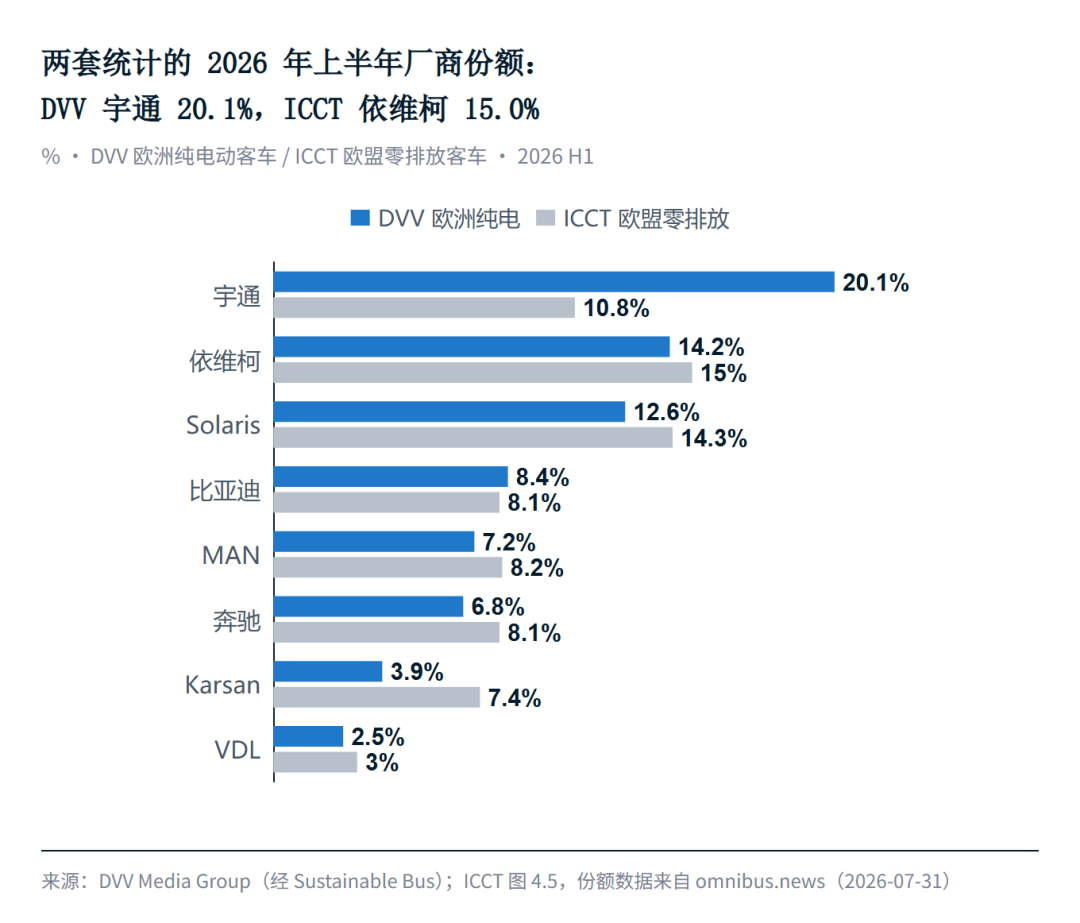
The ICCT report identifies Iveco Bus as the EU's largest zero-emission bus maker in the first half. Iveco 15.0%, Solaris 14.3%, Yutong 10.8%, MAN 8.2%, BYD and Mercedes-Benz 8.1% each, Karsan 7.4%, VDL 3.0%.
DVV includes the UK, Norway and Switzerland; the UK and Norway registered 1075 and 660 battery-electric buses respectively in the first half. ICCT counts only the EU, but includes hydrogen fuel cell buses and coaches as zero-emission.
Iveco's top ranking came mainly from Italy. DVV data show that Italy registered 1559 battery-electric buses in the first half, up from 369 a year earlier, or 4.2 times the prior-year figure, making it Europe's largest single market. According to ICCT, Iveco alone sold about 700 electric buses in Italy in the second quarter, 10 times the figure a year earlier.
Under the EU Recovery and Resilience Facility (RRF), Italy's national recovery plan allocated €34.5 billion to sustainable transport. ICCT states this money must be spent by Aug 2026, which may explain the concentrated procurement in the first half. For the line item dedicated to bus purchases, the European Commission's project page lists €1.65 billion for at least 3,000 zero-emission low-floor buses and at least 1,000 charging points.
Iveco's rise to the top in the EU owes much to this batch of Italian public procurement with fixed deadlines. Whether it holds first place in the second half depends on new orders once these projects have been delivered.
Acquirer
In this shake-up, those taking over assets and expanding capacity are mostly manufacturers backed by large groups or industrial capital.
Iveco Group is now part of India's Tata Motors. At a press conference in Turin on Nov 3, the two sides gave combined figures of about EUR 21 billion in annual revenue, 590,000 units in annual sales, 73,000 employees and 27 plants, and pledged to keep Iveco's Turin headquarters, its Italian plants and its brands. The press conference did not say whether Iveco Bus will next introduce Tata's bus products.
Solaris belongs to Spanish rolling stock group CAF. In Apr 2024, VDL took over the bus business of bankrupt Belgian veteran bus maker Van Hool, while German trailer maker Schmitz Cargobull and South Africa's GRW acquired its industrial vehicle business. In 2025, VDL's electric bus registrations fell 12% from the previous year.
Source: Chart by AutoMusic based on the public sources listed in the article; first published on the AutoMusic WeChat account.
On Nov 3, at Euro Bus Expo in Birmingham, UK, BYD celebrated the rollout of its "3000th electric bus built for the UK". This B11 was completed at the Hangzhou plant; 3000 is the cumulative production figure, not the UK fleet in service. BYD also launched the C12 DUO electric coach: 12 m, two axles, up to 57 seats, with Blade batteries of 429 or 495 kWh.
According to the announcement, none of the subscribers in Ebusco's latest offering will hold 30% or more once the subscription is completed. Ebusco's annual report says that since Apr 2026, strategic parties have expressed interest in acquiring a controlling stake in its bus business, but no binding agreement has been reached. On the demand side, for example, Frankfurt currently operates 109 zero-emission buses, 26% of the city's 418 buses, and aims for a full switchover by 2033.
In this shake-out, every manufacturer still standing has backers willing to keep investing. Bluebus also shows that a parent company with deep pockets is not necessarily willing to keep funding.
Year-end milestone
Next, Ebusco must hold an extraordinary general meeting before the end of 2026 to approve a EUR 12 million share issue; the EUR 7.1 million bridge loan, originally due Dec 1, must be repaid by Apr 30, 2027; the final financing tranche comes in Feb 2027. Whether Škoda's new company in Ergué-Gabéric has taken on the 17 R&D staff will depend on subsequent official announcements. DVV's full-year data will show where Iveco and Yutong each stand once Italy's current procurement window closes.
With Bluebus production ended, Bolloré must keep a small dedicated team to support the nearly 700 vehicles still in service. For European transit operators, choosing an electric bus supplier is not just about price; it also depends on whether the manufacturer can survive a fleet's service life of a decade or more. Contracts need to state clearly who is responsible for spare parts, repairs and recalls.