Toyota Europe posts record sales for first nine months
Toyota sold 936,000 vehicles in Europe in the first nine months, which it calls a record for the period; on ACEA figures, however, its share in the EU, EFTA and the UK fell from 7.1% to 6.7%, and BYD, SAIC Motor, Chery and Leapmotor took 70% of the 627,000-unit market growth…
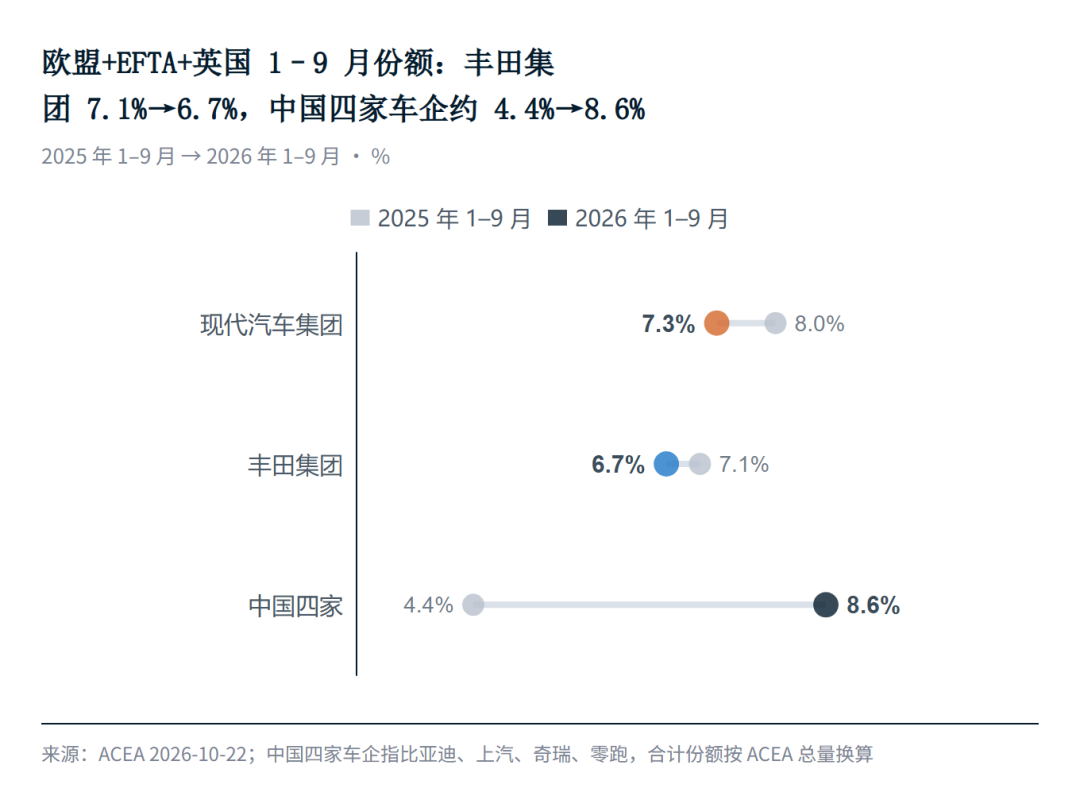
On Oct 22, Toyota Motor Europe (TME) reported sales of 936,042 units for the first nine months, up 0.6% year on year, which it called a record for the period, with a 7.1% share. The same day, registration data published by the European Automobile Manufacturers' Association (ACEA) showed that across the EU, EFTA and the UK, Toyota group (including Lexus) registrations in the first nine months were 705,000 units, with share falling from 7.1% a year earlier to 6.7%, and September share down from 7.0% to 6.5%. Both sets of figures are correct; the difference lies in scope. TME covers 53 countries, including markets such as Turkey, Israel, the Caucasus and Kazakhstan in addition to the EU, UK and EFTA, and its sales also include the Toyota Professional business, i.e. the Hilux and Proace ranges (Proace includes some passenger versions), at 113,000 units in the first nine months. ACEA counts only new passenger car registrations.
Market growth
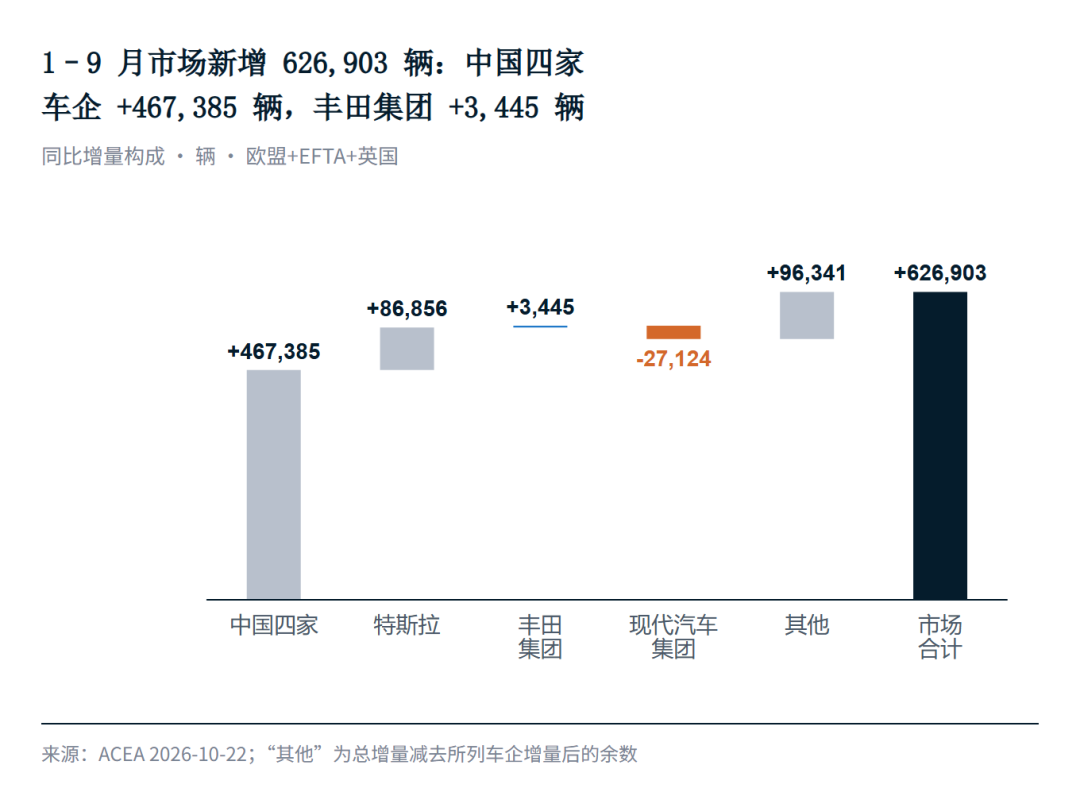
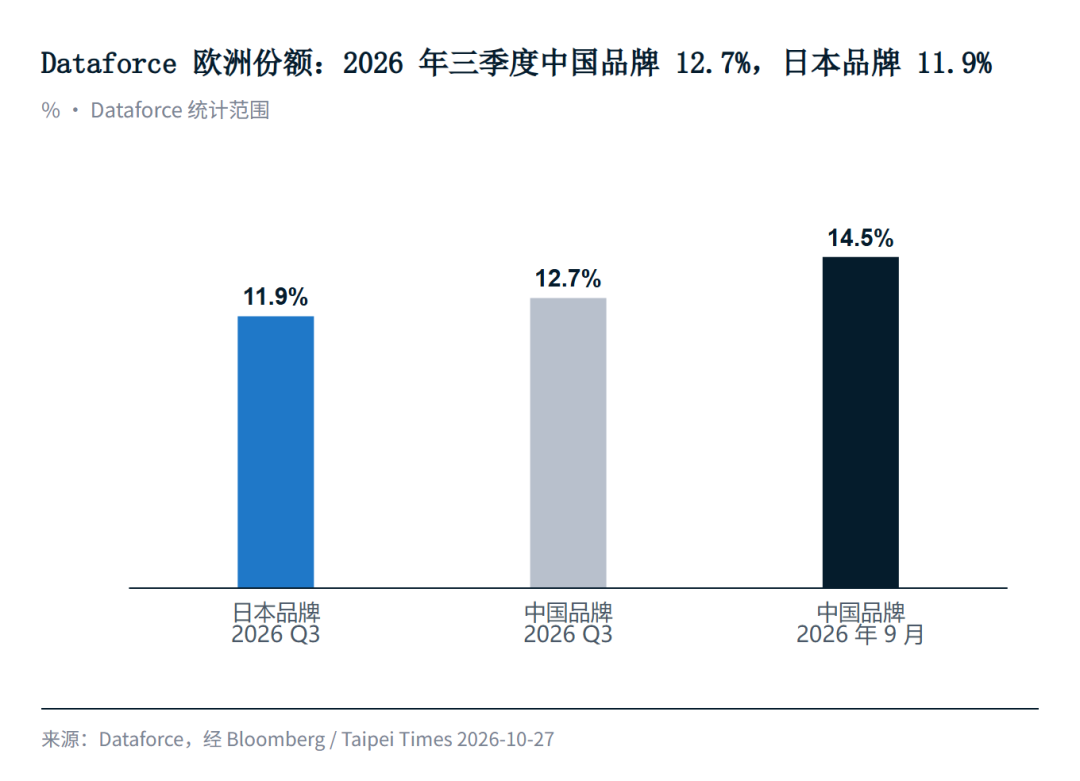
On ACEA figures, the market registered 10.555 million units in the first nine months, 627,000 more than a year earlier, up 6.3%. Toyota Group grew just 0.5%, adding 3,445 registrations: the Toyota brand registered 650,000 units, up 1.0%, and Lexus 55,000, down 5.7%. BYD, SAIC Motor, Chery and Leapmotor together registered 905,000 units, versus 437,000 a year earlier, lifting their share from about 4.4% to about 8.6%.
Of the four, BYD sold 284,000 units, up 134.6%; Chery (including Jaecoo, Omoda and Jetour) 261,000, up 255.9%; Leapmotor 88,000, up 424.2%; and SAIC Motor 272,000, up 20.3%. Together they added about 467,000 units, more than 70% of total market growth, while Toyota's increase was only 3,445 units. Geely Group is not counted among the four because it includes Volvo.
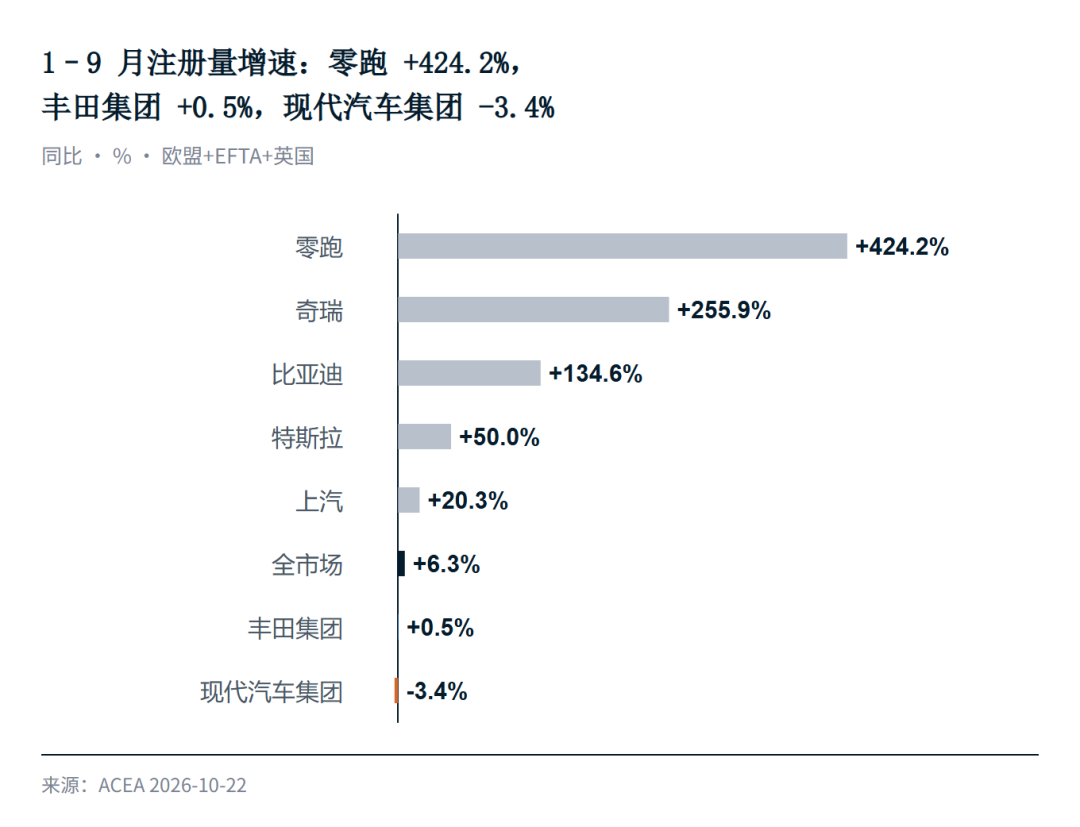
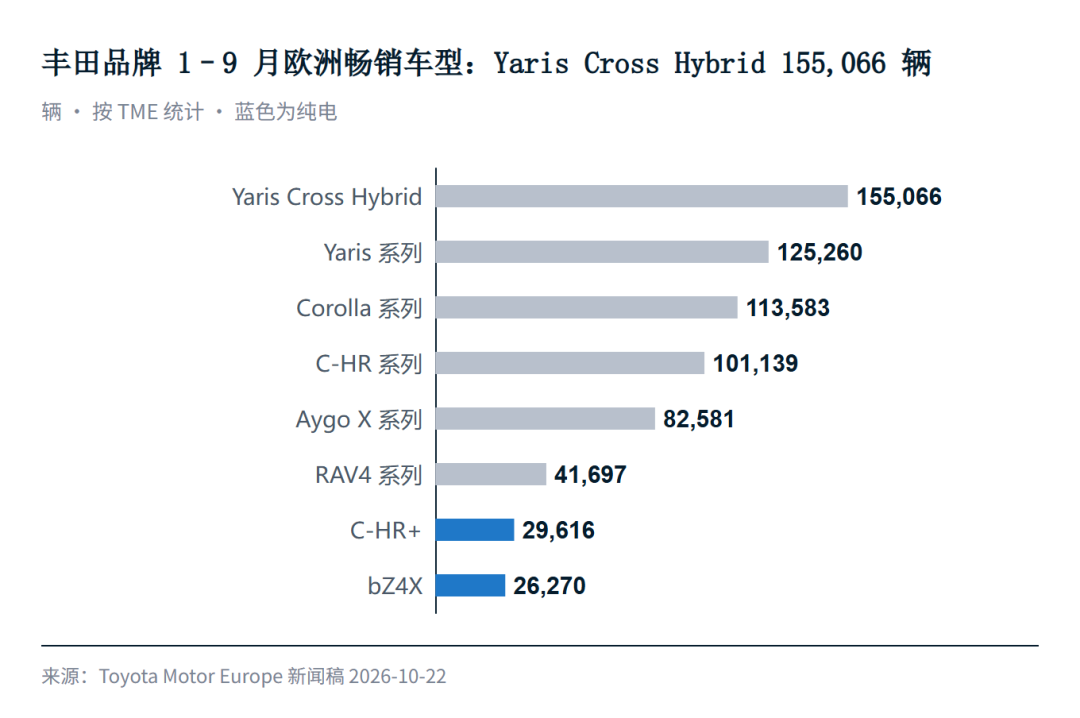
Toyota is not the only one losing share. Hyundai Motor Group sold 771,000 units in the first nine months, down 3.4%, with share falling from 8.0% to 7.3%; within that, the Hyundai brand fell 13.2% while Kia grew 6.6%. Nissan fell 15.6% in September alone, with share dropping from 2.4% to 1.8%. Toyota itself was also affected by model cycles: it held share in almost every segment except midsize SUVs, where RAV4 sales fell due to the model changeover, with the RAV4 family selling only 41,697 units in the first nine months.
Discounts and residual values
Toyota tries to avoid price wars, because they benefit neither customers nor dealers, and discounts ultimately have to be borne by the manufacturer. Toyota competes on total cost of ownership and stable residual values, and says outright that Chinese brands' discounts of more than EUR 10,000 and their sales through non-retail channels are ill-advised. BYD's pricing in Germany offers an example of such discounting. In February this year, the BYD Atto 2 Boost PHEV started at EUR 22,990 in Germany, including a EUR 11,500 manufacturer discount and a EUR 4,500 government subsidy. Working backwards, that implies a list price of about EUR 38,990, with the manufacturer discount accounting for roughly 30%. Some German dealers worried at the time that steep discounts would depress residual values; BYD self-registered 2,887 vehicles in Germany last year, and dealers have also reported inventory pressure.
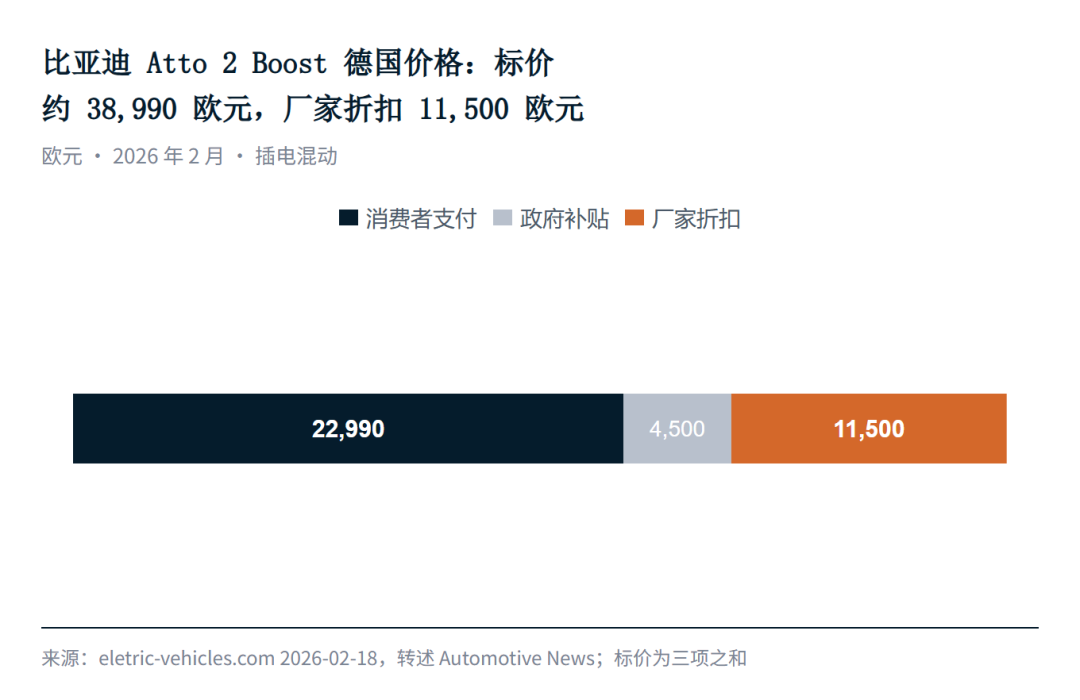
German dealers' concerns about BYD relate directly to the link between discounting and residual values. How far Toyota's efforts to avoid a price war are connected to its falling share cannot yet be analysed, as no transaction price or residual value data is available. The harder issue is that the doubling of Chinese brands' sales in the third quarter was driven by hybrids. The EU's earlier anti-subsidy duties apply only to China-made BEVs, not to PHEVs or hybrids, and hybrids are precisely Toyota's strength: in the first nine months, Toyota sold 814,000 electrified vehicles in Europe, 87% of its total, with its best-seller, the Yaris Cross Hybrid, at 155,000 units. In October the EU agreed in principle to restrict imports of Chinese hybrids; meanwhile, Chery is preparing to start production in Barcelona, BYD's Hungarian plant is nearing completion, and the Leapmotor B10 is already being built at Stellantis's Zaragoza plant in Spain, with Leapmotor's European sales handled by Leapmotor International, a joint venture 51% owned by Stellantis.
BEV progress
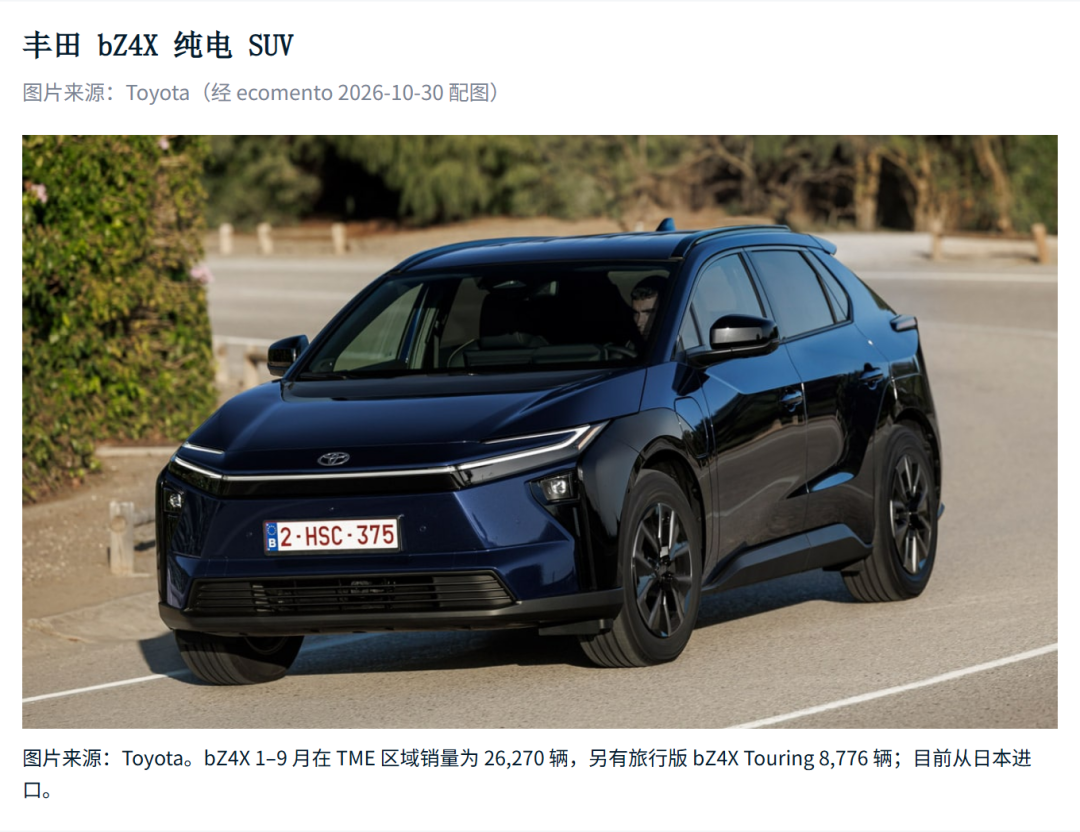
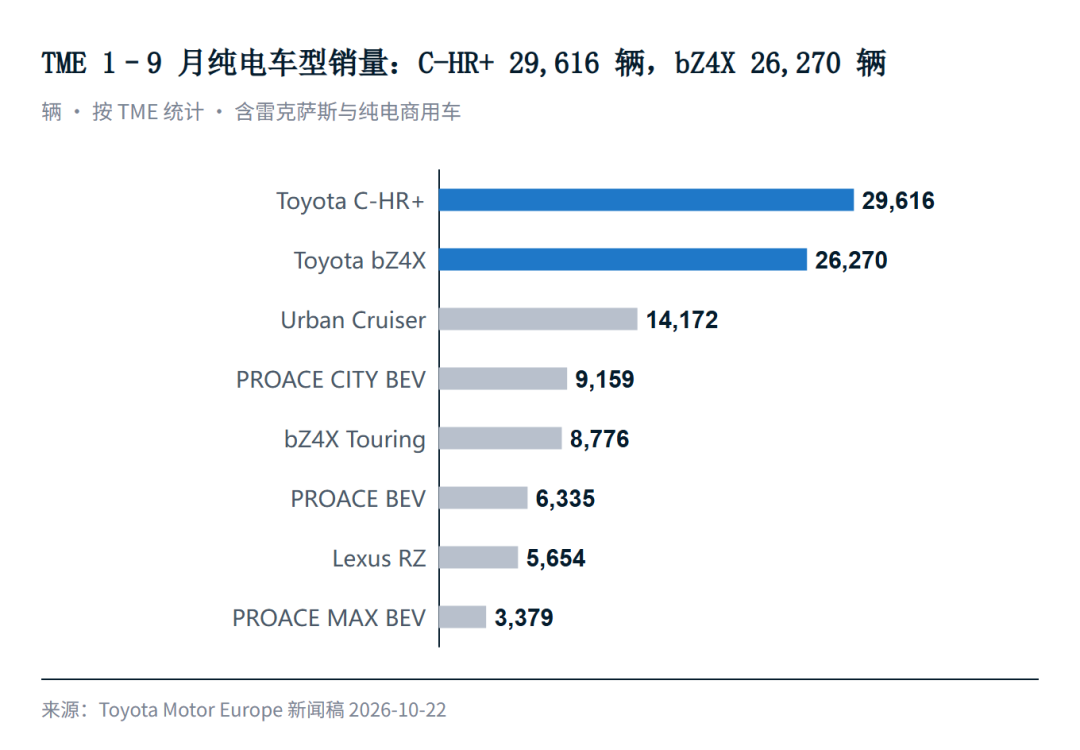
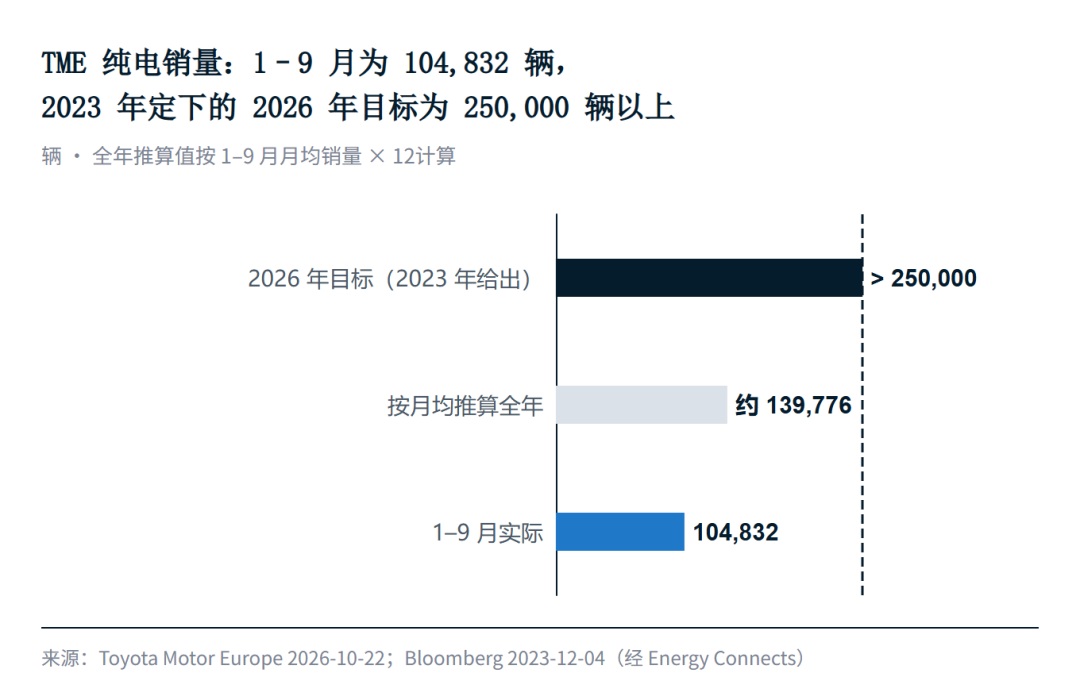
Toyota Europe sold 104832 BEVs in the first nine months, up 136% year on year, including 98148 under the Toyota brand, up 151%. The best seller was the C-HR+ at 29616 units, followed by the bZ4X at 26270, the Urban Cruiser at 14172 and the bZ4X Touring at 8776; last year the Toyota brand sold only 51919 BEVs in total. Popular models such as the C-HR+ currently have delivery waits of several months.
In December 2023, Toyota's Europe president said in Brussels that by 2026 the Toyota brand would have about 15 zero-emission models in Europe and deliver more than 250,000 BEVs. On a Toyota brand basis, BEV sales in the first nine months were 98,148 units; at that monthly rate, the full year would come to about 130,000. Reaching 250,000 would require about 50,000 sales a month in Q4, more than four times the monthly average of the first nine months. The C-HR+, bZ4X and Urban Cruiser BEVs are currently imported from Japan and India. Toyota's BEV margins are still lower than those of its hybrids and combustion cars, and Toyota expects production costs to equalize fairly quickly once battery prices fall.
On local production, Toyota announced in September 2025 an investment of about EUR 680 million at its Kolín plant in the Czech Republic to build a new BEV line and a battery assembly shop. The Czech government is providing up to EUR 64 million in incentives, and the project will create 245 jobs. The plant currently builds the Yaris and Aygo X, at about 220,000 units a year. At the time of the announcement, Toyota did not say which model it would build there, in what volumes or when production would start, saying only that this would depend on the market and demand. Toyota's hybrids in Europe followed a similar path: it first imported the Prius, and only in 2010, a decade later, did it build its first hybrid model in Europe.
Source: Chart by AutoMusic based on the public sources listed in the article; first published on the AutoMusic WeChat account.
Two points in time
Toyota is also developing a new-generation hybrid system, in which a new 1.5-liter four-cylinder engine is more compact and lighter than the current three-cylinder; the fuel efficiency target is reportedly 15% higher. Two milestones are worth watching: first, when EU restrictions on Chinese hybrid imports take effect and how large the quota will be, which will shape Chinese brands' growth in the hybrid market; second, when Toyota announces the models and start of production for its BEV line in Kolín, Czech Republic.