Mercedes-Benz moves production to Hungary: European auto industry's "cost anxiety" and a "window of opportunity" for Chinese companies
At the start of 2026, Mercedes-Benz confirmed it will move A-Class production from Rastatt, Germany, to Kecskemét, Hungary (Kecs…
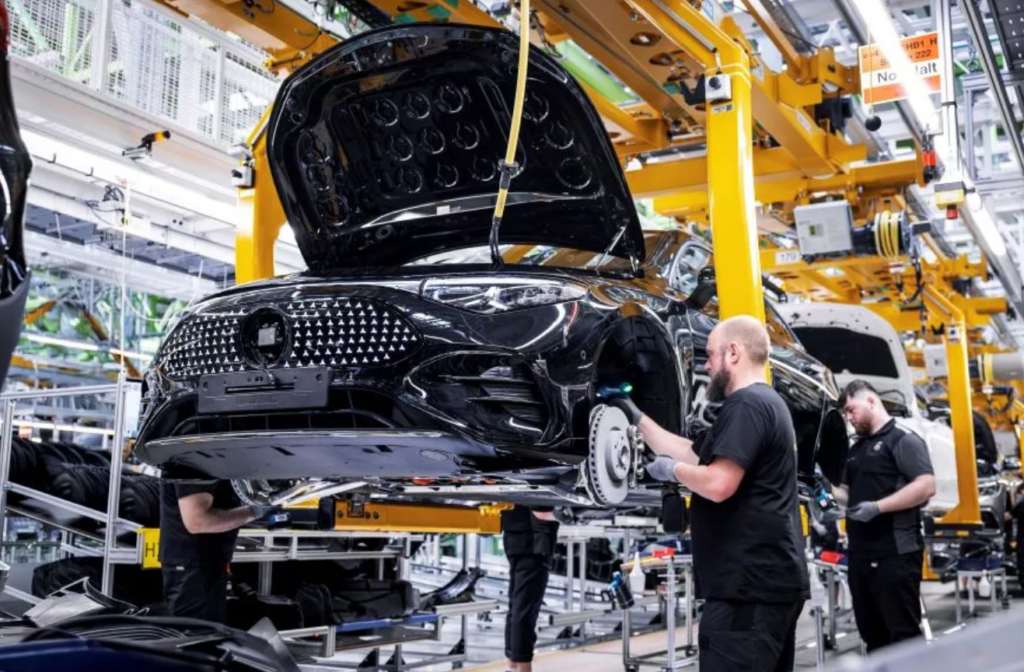
At the start of 2026, Mercedes-Benz confirmed it will move A-Class production from Rastatt, Germany, to Kecskemét, Hungary, starting in Q2 2026, while extending the current A-Class lifecycle to 2028. Premium brands are beginning to systematically move "margin-sensitive models" abroad, and "Made in Germany" is being repriced.
While Mercedes-Benz is moving entry-level models to Hungary, China's new energy supply chain is expanding on the same soil. BYD is both enlarging its commercial vehicle base in Hungary and pushing ahead with a passenger car plant; CATL's giga battery project in Debrecen plans to start ramping up mass production between late 2025 and early 2026. Same country, different plays: one is cutting costs to defend its position, the other is betting on a ticket in.
A tactical retreat forced by costs
Mercedes-Benz's official explanation is fairly restrained: to free up space at the Rastatt plant for future models, and to shift capacity between plants through its flexible European production network.
Behind this, however, the general view in the industry is that an entry-level product like the A-Class is finding it harder and harder to keep enough profit margin under Germany's domestic cost structure. Spending on electrification keeps rising, European demand is shifting, and uncertainty over trade and tariffs is growing. Under these conditions, premium brands protect the models and platforms with the biggest profit pools first. They push the pressure onto the "more sensitive" parts of the business, which means entry-level cars and the places where they are built.
The policy–cost–identity combination Europe still lacks
Hungary's popularity as a European manufacturing base did not come out of nowhere. Within the EU it offers a rare combination: an attractive tax regime, regional aid tools, and the institutional certainty that comes with EU membership.
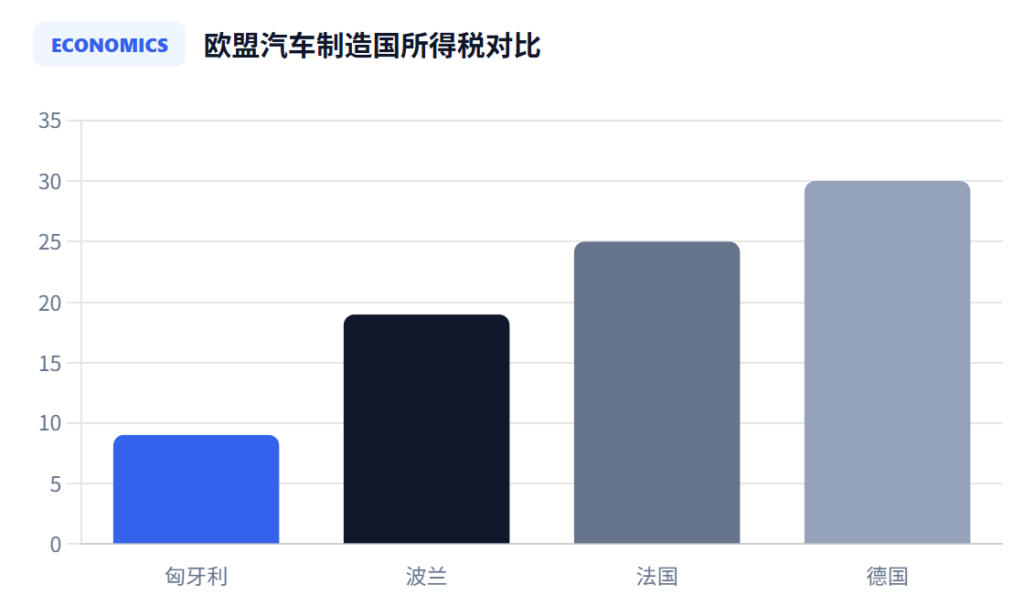
First, the tax system. Hungary has long kept a flat 9% corporate income tax (CIT) rate, among the lowest in the EU. More important are tools such as the Development Tax Allowance: for qualifying investment projects, it can offset up to 80% of tax payable and can be applied for several consecutive years after production starts. This makes the numbers easier to justify for large manufacturing projects during the early cash-flow phase and makes it easier to turn cost advantages into lower unit manufacturing costs.
The second is regional aid. The EU has a clear framework for regional aid intensity in each member state, and Hungary's regional aid map for 2022–2027 has been approved by the European Commission, allowing set investment aid intensities by region and company size. The "key value" of such policies lies not only in the subsidy itself but in speeding up project delivery, easing the burden of initial fixed-asset investment and letting companies move faster into capacity ramp-up and supply chain onboarding.
Third is status and rules: Hungary is inside the EU. For OEMs, this means more stable supply chain compliance, market access and internal circulation rules. For Chinese companies, it shifts potential future changes in trade policy and tariff friction as far as possible from "export-side risk" to "local operating risk", and the latter can at least be managed.
BYD: Hungary is a "European operating entity"
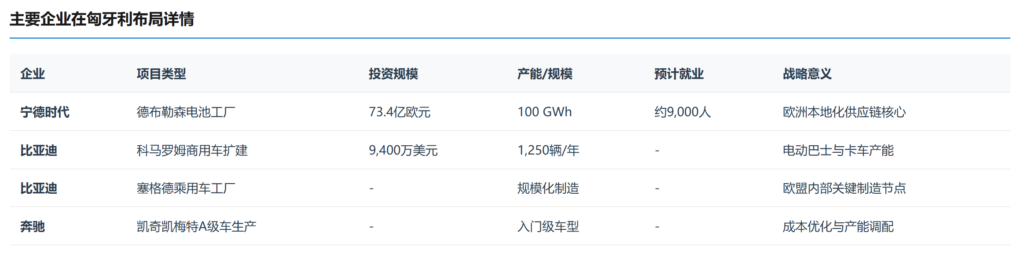
On one hand, BYD is expanding electric bus and truck capacity in Komárom, with investment of about USD 94 million and a subsidy from the Hungarian government; after the expansion, annual capacity is targeted at about 1,250 electric buses and trucks. On the other hand, the Szeged passenger car plant is the bigger long-term bet, widely seen by the market as the key node for BYD to build large-scale manufacturing capacity inside the EU.
The trade environment for China-made EVs in the EU has become markedly more complex, and companies need a stronger "local identity" and "local supply chain" to reduce uncertainty. In 2024, Hungary attracted nearly a third of Chinese investment into Europe, totalling about USD 16 billion across 64 major projects.
Hungary is not the "right answer" for everyone. It is better seen as a location that maximises the advantages of status and cost in the short term. Whether that foothold becomes a sustainable operation depends on ramp-up speed, talent supply, supply chain localisation and social acceptance.
CATL's "strategic gamble"
CATL's investment in Hungary better reflects the "entry ticket" mindset. CATL announced in 2022 that it would invest about EUR 7.34 billion in a 100 GWh battery plant in Debrecen. The project is scheduled to begin its production ramp-up in late 2025 or early 2026 and is expected to employ about 9,000 people.
Europe is using regulation and industrial policy to drive supply chain localisation, and batteries, as a key component of the electrification era, will sooner or later need "verifiable local capacity and a compliance system" in Europe. So failing to build sufficient capability in Europe could mean being shut out of key customer supply chains in the next phase.
Chinese automakers' "brief Hungary window"
Seen from the start of 2026, Hungary does offer a real window for China's auto supply chain: a relatively favorable cost structure, clear policy tools, faster project delivery than some Western European countries, and institutional stability within the EU. But for now, this window appears to be closing quickly.
First, the global minimum tax is redrawing the boundaries of the "low-tax advantage". Hungary has legislated global minimum tax rules (applicable to large multinational groups meeting the EUR 750 million revenue threshold) and introduced mechanisms such as a qualified domestic minimum top-up tax, meaning that for very large groups, the advantage gained purely from a low statutory rate will be partly "topped up".
Second, EU-level scrutiny of state aid and industrial policy will not ease. Regional aid comes with frameworks, caps and approval logic, and it is more likely to face magnified scrutiny when the political climate is tense. Companies should not build their business models on the assumption that subsidies will definitely materialise.
Finally, talent and social acceptance will increasingly become a "hard threshold". Whether for vehicles or batteries, companies ultimately face local recruitment, training, labour mobility and community relations. Localization in Europe is not just supplier certification but a system-level undertaking spanning "employment systems + environmental compliance + social communication". Companies that see Hungary only as an "assembly site" rather than an "operating business" are unlikely to go far.
Final thoughts
Mercedes-Benz moving the A-Class to Hungary is a strategy driven by cost pressure. BYD and CATL betting heavily on Hungary marks the starting point of a strategic offensive. On one side, European OEMs are re-tiering their manufacturing networks; on the other, China's NEV supply chain is trading localization for certainty and standing.
What is certain is that 2026–2028 will be the key test period. How Mercedes-Benz redefines the role of its German plants, whether BYD can turn its European plant into a business with a steady ramp-up, and whether CATL can reach volume production under social-licence and compliance pressure will all determine how the "Hungary model" actually performs.
For Chinese automakers, gaining a foothold depends not on which country they choose, but on whether they can build regulation, supply chain, talent and trust into a coherent system.
**Reproduction or excerpting without permission is strictly prohibited.** Questions and comments are welcome. Follow us for ongoing analysis of the latest developments in China and abroad.