Switzerland launches tender for high-power charging for electric heavy trucks on motorways: no subsidies
Switzerland's Federal Roads Office (ASTRA) has issued a tender to build 32 dedicated fast-charging sites for heavy trucks at motorway and traffic-management nodes nationwide, open to private operators…
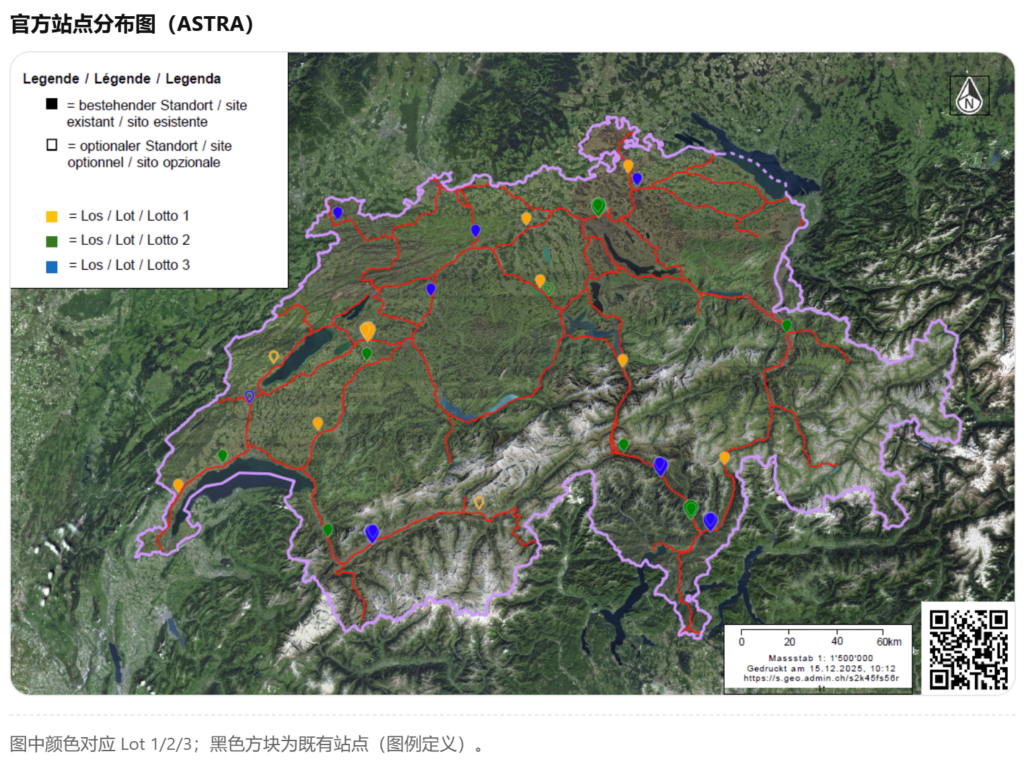

The Swiss Federal Roads Office (ASTRA) has recently issued a tender for 32 dedicated heavy-truck fast-charging sites at motorway and traffic-management nodes across the country. Construction and operation are open to private operators.
No subsidies, but concessions
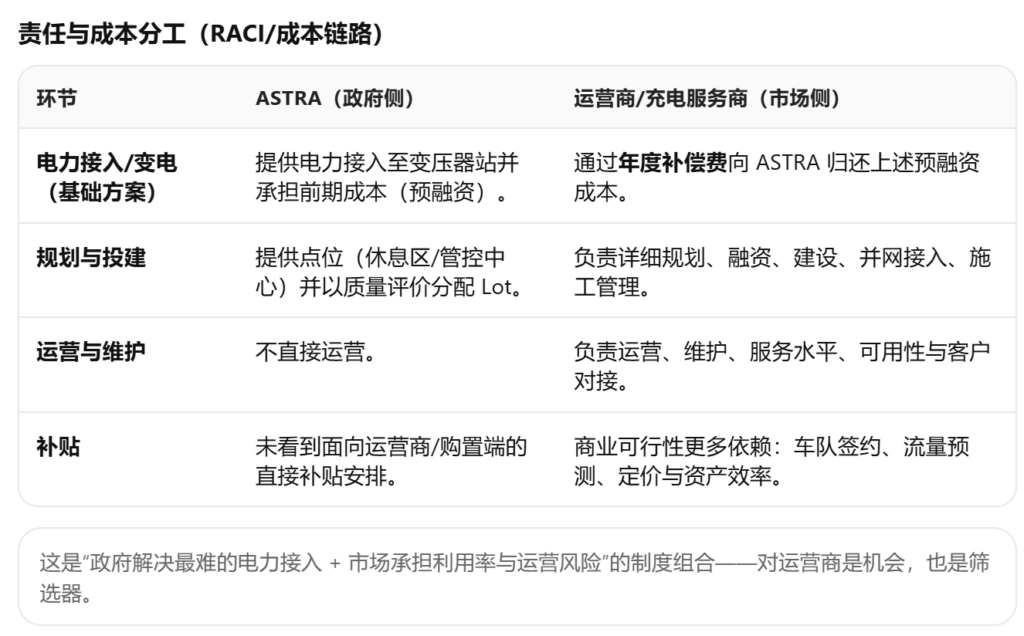
Under Switzerland's rules, ASTRA, on behalf of the government, handles grid connection and substation facilities and bears the upfront costs. Operators handle planning, construction, grid connection, operation and maintenance. They pay the government an annual fee to recover the connection costs. So the tender does not include any direct subsidy.
The Swiss government is taking on grid connection, the hardest, slowest and least market-driven part, and leaving the commercial risk to the market. A "cautious" MCS rollout
Of the 32 sites, only 7 have at least one MCS (megawatt charging) connector; the rest mainly use CCS. Individual sites range from 2 CCS chargers to 2 MCS plus 10 CCS.
At government level, Switzerland accepts MCS as the long-term direction. On engineering and commercial grounds, however, it remains cautious about power levels, grid connection and utilisation.
Compared with Germany: different paths, same goal
Switzerland's plan can be compared with the motorway heavy-truck charging network Germany is building. The differences:
Germany's programme is larger, with deeper public funding, and aims for about 350 motorway heavy-truck charging parks by 2030. Switzerland's is smaller with stricter rules, focusing on operational viability and risk sharing. The former resembles a national infrastructure project, the latter a public concession.
Opportunities and barriers
For charge point operators, without subsidies as a safety net, site selection, load forecasting and fleet partnerships all have to be rock-solid. The companies that survive will be the ones that truly understand heavy-truck operations.
For OEMs and fleets, building chargers first under clear rules helps electrification decisions for cross-border trunk routes and fixed routes. It will not, however, force every stakeholder to switch immediately.
Chinese heavy-truck OEMs
Opportunities exist for Chinese OEMs, but the barriers to entry are high: compliance, grid-connection experience and local operating capability are all essential.
Switzerland is trying to make electric heavy-truck infrastructure work without subsidies. If it succeeds, the model could be readily copied by other small, densely networked European countries. If it fails, the problems will show up in utilisation and payback periods, and the answer will not be to keep adding budget.