Germany's company car market: opportunities for Chinese automakers
In Germany, core decision-making power in the new car market has long and systematically rested with corporate fleets. Dienstwagen (company cars) form a highly institutionalized structural system, locked in by tax law, employment relations, leasing finance and environmental policy. For Chinese EV brands, this is not an "easy market," but it is the most logical, least emotion-driven market, and the one where a breakthrough through institutional arbitrage is most likely.
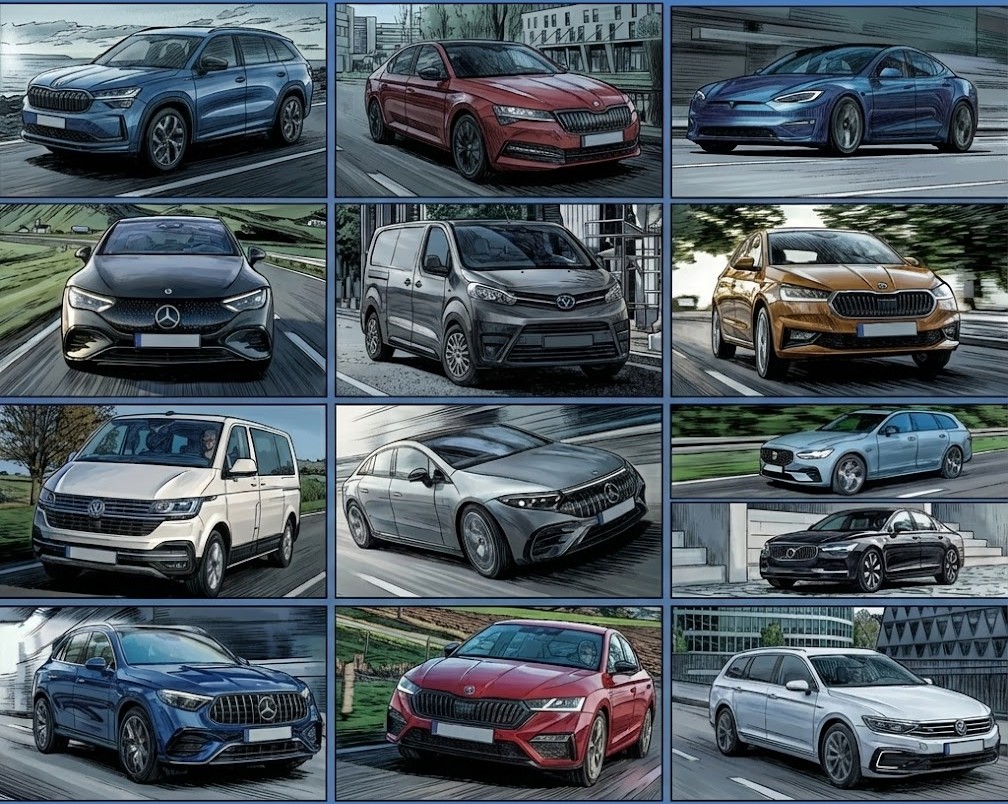
Who really buys cars in Germany
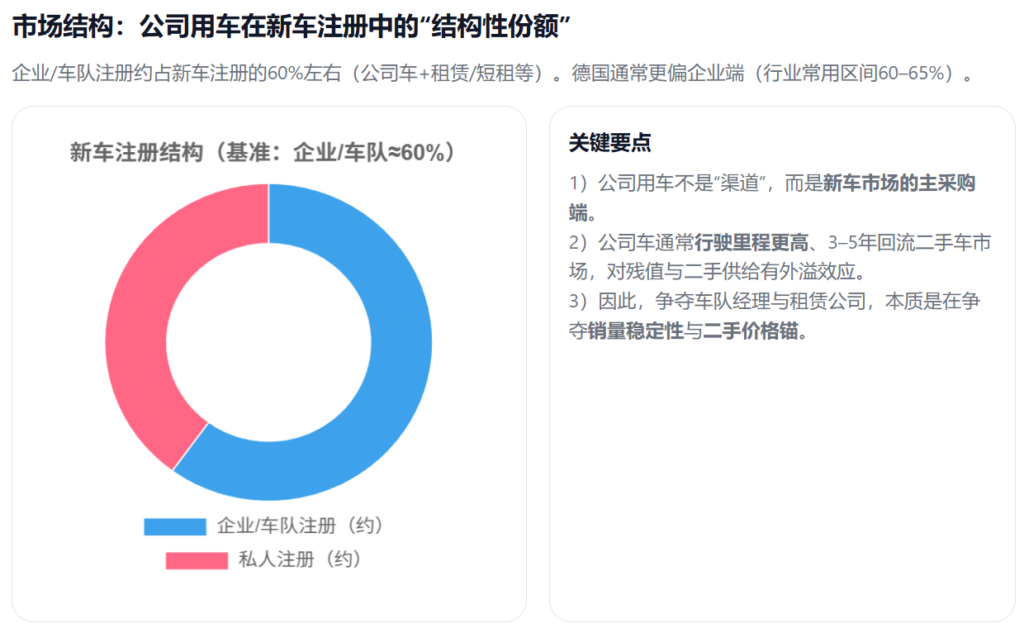
Estimates based on combined public data from the ICCT, ACEA and Germany's Federal Ministry of Transport (BMV):
- Around 60%–65% of new car registrations in Germany are company cars
- Large and mid-sized company fleets together control millions of vehicles in service
- Company cars cover roughly 1.8–2.2 times the annual mileage of private cars
- Company cars account for more than 70% of lifecycle carbon emissions from newly registered vehicles
So any brand that cannot get onto corporate fleet approved lists will only have a "marginal presence" in German sales. The real force behind Germany's EV transition is not consumer subsidies but the choices of corporate fleets.
Taxation that serves TCO
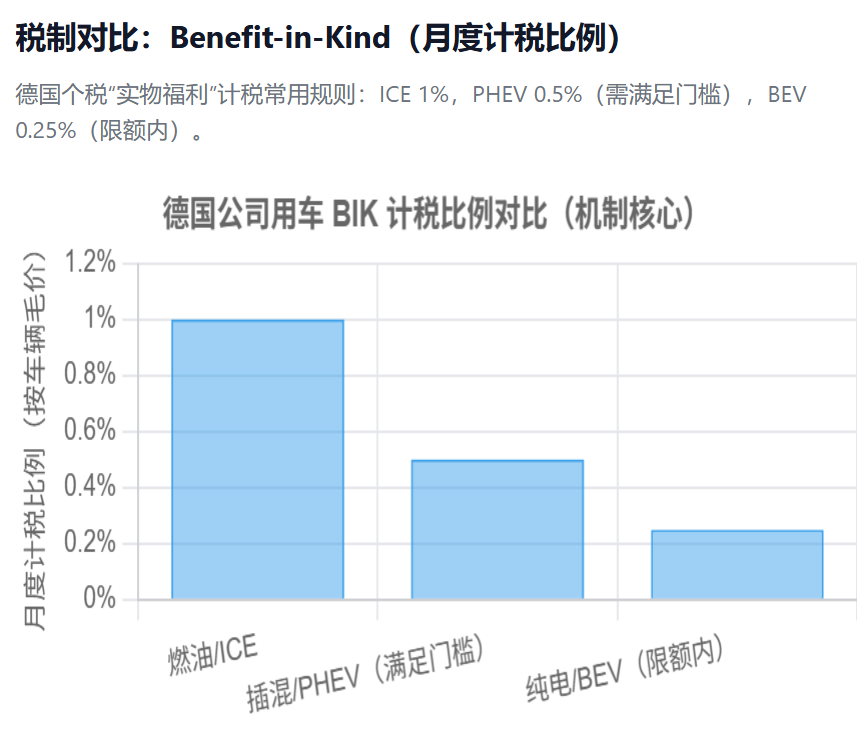
The core of Germany's company car system is the so-called Benefit-in-Kind taxation. It is not a subsidy but a rule written into tax law and applied consistently over the long term.
ICE and conventional hybrids: the rigid cost of the 1% rule
- Each month, employees must add 1% of the vehicle's gross price to their taxable income
- If used for commuting, add 0.03% × gross list price × one-way distance in km
Take, for example, a mid-size combustion sedan with a gross price of €60000:
- Base taxable amount: €600 / month
- For a one-way commute of 20 km: an extra €360 / month
- At a 42% marginal tax rate, an employee's actual tax burden can easily exceed €300/month
Within German companies, therefore, company car choice is a tax question.
BEVs: 0.25% institutional bias in their favour
Since 2019, German tax law has applied a 0.25% taxation rule to zero-emission battery-electric vehicles (BEVs). From 2025, the gross list price cap for this rule has been formally raised to €100,000. The effect is clear:
- The same €55000 BEV
- Monthly taxable amount for employees just €137.5
- Tax burden about 20%–25% of a comparable combustion car
This gap is thus a structural TCO gap created directly by tax law.
PHEV: the 0.5% rule, but being sidelined
PHEVs can still qualify for the 0.5% rule, but only if their electric range is ≥ 80 km (WLTP) or their CO₂ is ≤ 50 g/km. As standards keep tightening, many PHEVs struggle to meet these requirements in real-world use. Since 2024, several large German companies have voluntarily cut back or even dropped PHEVs in their fleet policies.
Corporate TCO calculations
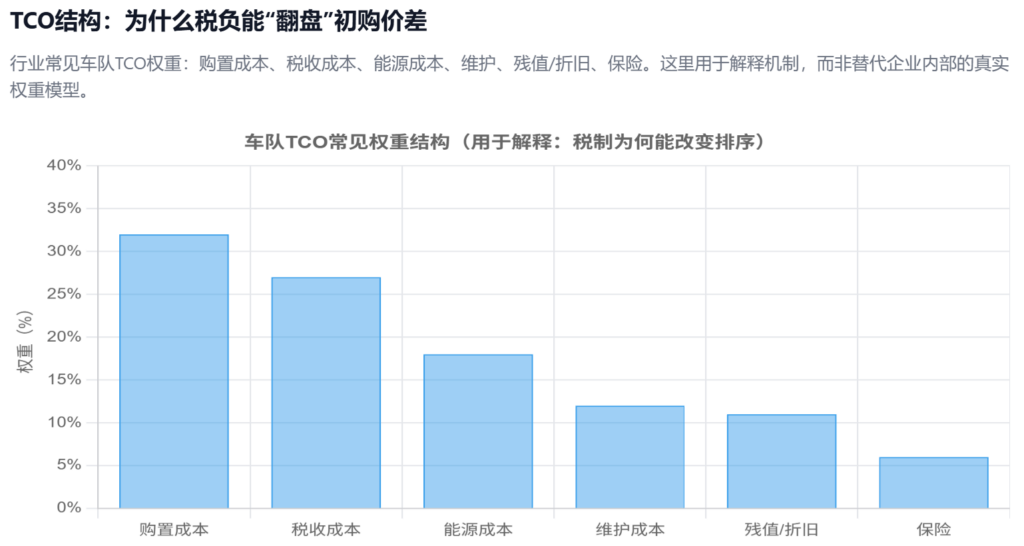
Company car decisions in Germany are highly process-driven and typically follow a three-tier path:
The first layer is the fleet whitelist (Fleet Policy)
Set by corporate fleet managers, the core evaluation model covers purchase cost, employee tax burden (heavily weighted), energy and maintenance, depreciation and residual value, and insurance and downtime risk. At many companies, tax burden and depreciation together can account for more than 40% of the weighting**.**
Tier two: employee choice (within the list)
Employees choose only from a whitelist, and what they actually care about tends to be the monthly impact on net pay, fit with commuting and family use, and whether a car "looks too expensive" or "too niche". Brand preference only comes in at this stage, and by then it has already been filtered by the policy.
The third layer is implementation by leasing companies
In Germany, about 85%–90% of company cars are provided through operating leases. Leasing companies do more than carry out orders. They negotiate bulk purchases, carry the residual value risk and set prices in the used car market. If leasing companies won't take a vehicle on, a whitelist means nothing.
Residual value is the "life-or-death line"
For leasing companies, the biggest EV risk is residual value uncertainty. Over the past three years, the German market has seen several failed residual value models. For example, the three-year residual value of some models fell from over 60% to below 50%, forcing lessors to raise monthly rates or refuse renewals. In the end, new brands were simply excluded from approved lists.
As a result, the German market has very specific requirements for new entrants: whether a new brand offers a long-term warranty, whether it has a clear official residual-value guarantee or buyback scheme, and whether it has a stable, predictable service network. No residual-value plan means no fleet orders.
Company car choices will be more rational in 2026
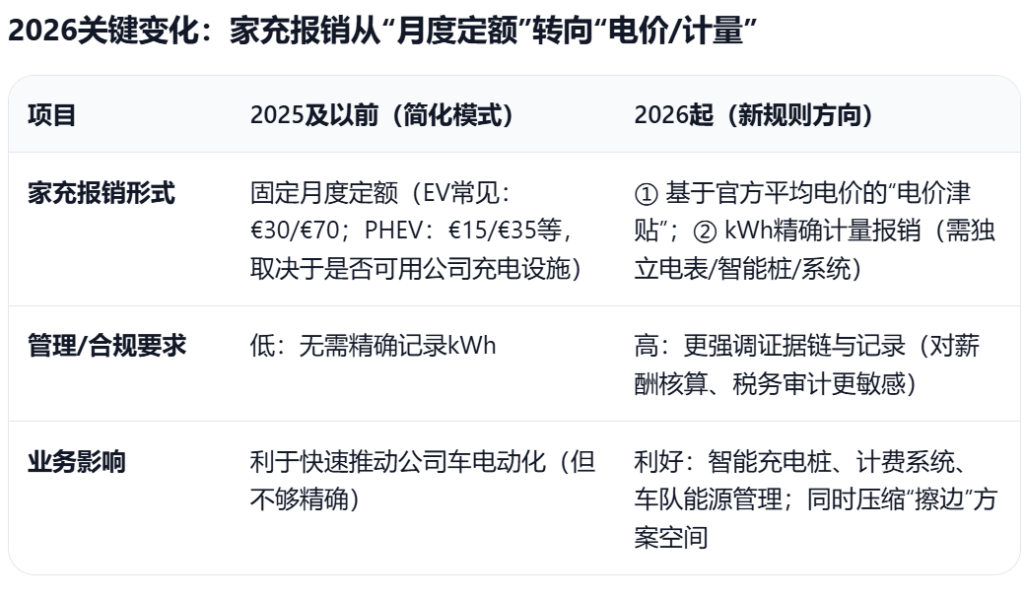
From Jan 2026, Germany's new charging reimbursement rules take effect: the flat monthly reimbursement will be abolished, and companies can only choose a "flat-rate method" based on the official average electricity price or precise kWh metering via a separate meter or smart charger. The new rules mean higher administrative costs for companies and greater demand for IT and energy management systems, further eroding the regulatory advantage of PHEVs. This is good news for battery-electric vehicles.
Many large German companies' fleet whitelists enter a new review cycle in 2025–2026. This coincides with the extension of the 0.25% tax rule, corporate ESG and Scope 3 pressure, and the recent upward shift in German domestic EV price bands.
Chinese brands: Germany ≠ Europe
Public data show Chinese brands steadily gaining share across Europe, but Germany is clearly lagging. The reasons are brand loyalty, the demands of high-speed driving and the lack of residual-value history. Within company-car fleets, however, these factors carry far less weight.
B2B-oriented brands such as Zeekr target corporate fleets in the B2B segment: using the tax system to cut employees' tax burden directly, TCO models to win over fleet managers, and warranty and service packages to convince leasing companies.
By contrast, BYD has broader coverage in Europe but still needs to overcome brand inertia in Germany. SAIC Motor's MG has had a relatively smooth run thanks to its historical brand recognition, while the premium-positioned NIO faces the strongest structural resistance in Germany.
Institutional rivalry
The German company car market is in essence a competition in which tax law sets the rules, TCO determines the ranking and leasing finance delivers the outcome. For Chinese EVs, the real questions are whether they can get onto approved lists, whether leasing companies will accept them and whether they can show a stable three-year residual value curve. If they can secure a steady foothold in several large corporate fleets around 2026, company cars will become Chinese brands' most realistic, most replicable and least sentiment-dependent route to a breakthrough in Germany.
**Reproduction or excerpting without permission is strictly prohibited.** Questions and comments are welcome. Follow us for ongoing analysis of the latest developments in China and abroad.