BEVs reach 95.9% of new passenger car registrations in Norway in 2025
In 2025, Norway's new car market all but completed its historic phase-out of combustion cars. According to Norwegian road traffic authority data, of all new passenger cars registered that year, battery-electric…
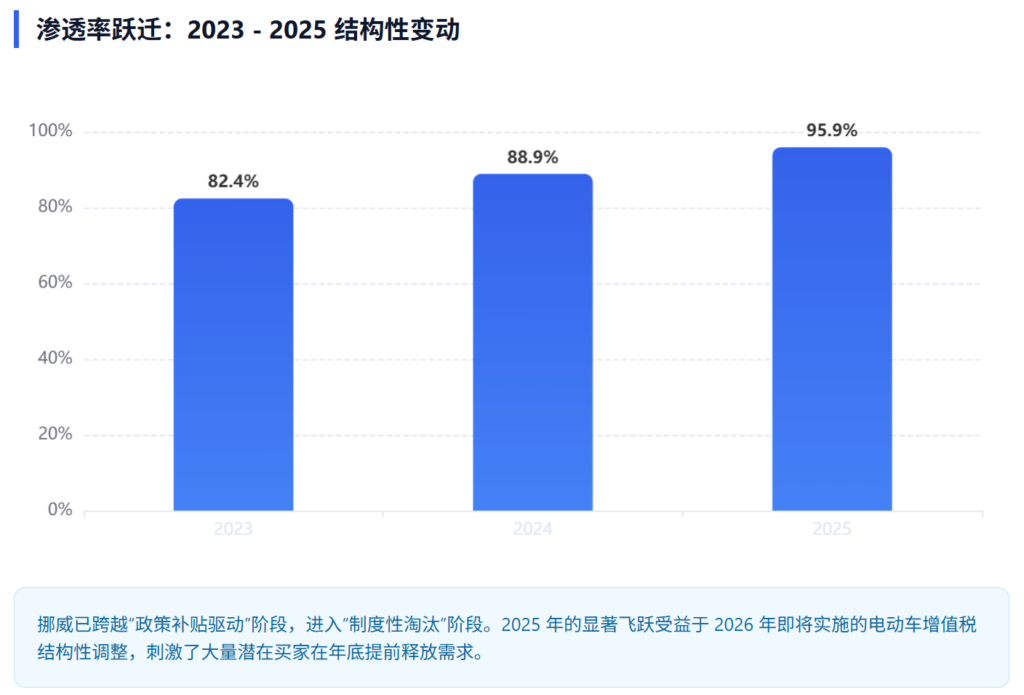

In 2025, Norway's new car market all but completed a historic clearout of combustion-engine vehicles. According to Norwegian road traffic authority data, battery-electric vehicles accounted for 95.9% of all new passenger car registrations for the year, and nearly 98% in December alone. While EV demand across Europe is still slowing,
The answer is not "more subsidies"
In Norway's case, it is not just that EVs enjoy "incentives"; the key mechanism is a systematic increase in the cost of keeping combustion cars on the road. Norway has not actually banned combustion cars by law, but has built a highly targeted set of policies:
– At purchase, combustion cars are subject to a high registration tax of up to around EUR 10,000; the larger the displacement, weight and emissions, the heavier the tax
– In use, petrol and diesel taxes keep rising, and urban access, parking and toll policies clearly favor EVs
– A clear long-term direction that "combustion cars will become ever more expensive and inconvenient", so businesses and consumers do not need to guess where policy is heading
The make-up of the 96%
In an almost "all-electric" market, competition has actually become more concentrated.
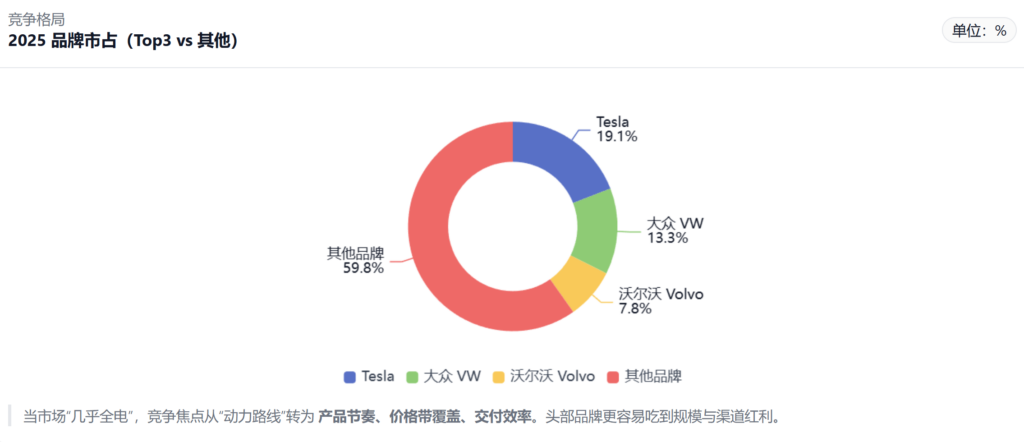
– Tesla was Norway's best-selling brand for the fifth year in a row, with a market share of around 19%. The Model Y alone sold 27,621 units
– Volkswagen Group holds a share of about 13%, with the ID series steadily penetrating the family and corporate markets
– Volvo is close to 8%, with an edge in safety and trust as a home-region brand
Notably, the remaining less than 4% of combustion vehicles are almost all special-purpose vehicles such as police cars, ambulances and accessibility conversions.
Norway "claws back" subsidies
At the end of 2024, the Norwegian government announced that from 2025, VAT would be reinstated on some EVs, and only models priced below NOK 300,000 (about EUR 25,000) would remain exempt after 2026. The policy directly triggered a buying rush at the end of 2024, with several automakers urgently adjusting global allocations to prioritize deliveries to Norway.
Norway may not be an "exception"
Norway is often considered "impossible to replicate": it has a small population, high incomes and plentiful hydropower. But what really put the Norwegian market so far ahead is:
– Years of policy consistency
– Systematic penalties on combustion cars rather than symbolic restrictions
– Long-term certainty for the market
By contrast, some EU countries are currently slowing the pace of combustion phase-outs, discussing exemptions and arguing over technology pathways, which has instead reinforced consumers' wait-and-see attitude.
Norway's 96% electrification rate is actually simple: policy determined the outcome. EVs were not "propped up"; combustion cars were "squeezed out". When a choice becomes expensive, troublesome and futureless, the market will naturally give its answer.