Demand side will decide Europe's zero-emission heavy trucks
Over the past two years, the debate on zero-emission trucks (ZET) in Europe has been undergoing a fundamental shift. As…
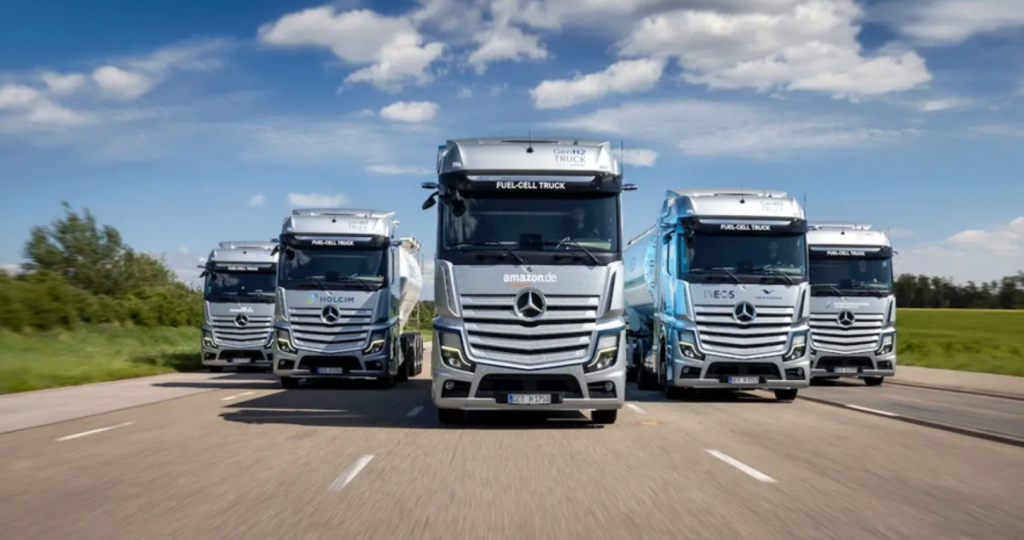
Over the past two years, the debate around zero-emission trucks (ZET) in Europe has undergone a fundamental shift. Three years ago, the industry was still arguing over whether batteries were good enough, whether hydrogen was viable and whether long-haul was feasible. Now a study by the Smart Freight Centre (SFC), cited by ACEA, reaches what is close to a unified conclusion: technology issues have taken a back seat, and what is really holding back the scale-up of zero-emission trucks in Europe is stalling demand.
The supply side has been forced to deliver
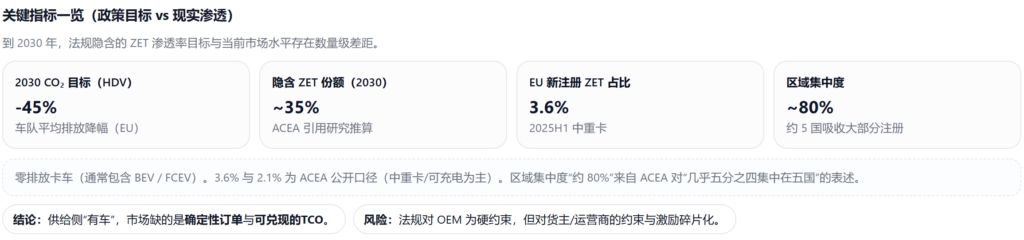
At the end of 2025, Europe actually had no structural "the vehicles aren't ready" problem on the supply side. The EU's heavy truck CO₂ regulation requires average emissions to fall 45% from the baseline by 2030. The upshot: zero-emission models will need to make up close to 35% of new heavy truck registrations in 2030. For OEMs this is a **hard constraint**: miss it and you pay fines, with no room to negotiate. Under that pressure, European OEMs have little choice: either move or be squeezed out. So what we see is a full rollout of new-generation BEV/FCEV platforms. Products already cover urban delivery, regional haulage and some long-haul use cases, and large-scale investment in production lines, supply chains and certification is already done. They have done everything they were supposed to do.
The market is lagging far behind the pace of policy
The problem lies on the demand side. According to registration data compiled by ACEA:
- In 2024, zero-emission models accounted for only about 2.1% of new medium and heavy truck registrations in the EU
- In H1 2025, this share rose to about 3.6%
- whereas the policy-driven demand target for 2030 is around 35%
So the growth curve and the policy curve have completely different slopes. Distribution across European countries is also highly uneven: about 80% of zero-emission heavy truck registrations are concentrated in five European countries: Sweden, the Netherlands, Austria, Denmark and France. Orders only appear where "demand conditions are systematically put in place".
Structural imbalance
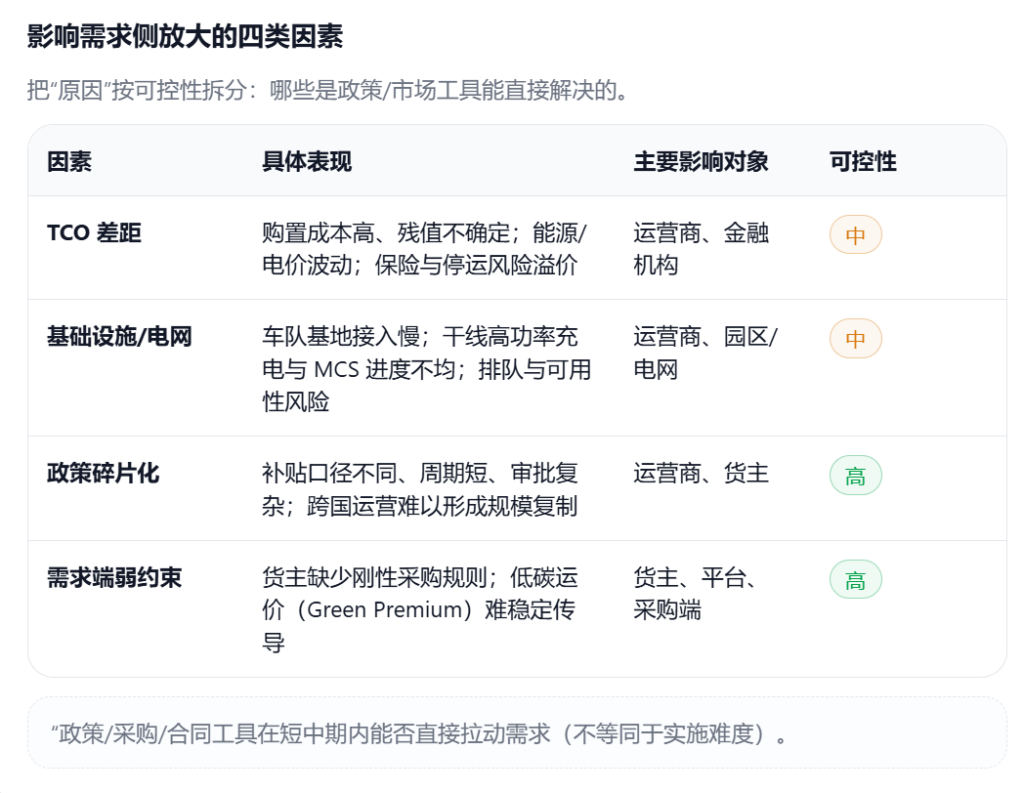
SFC's research points to a severe mismatch between responsibility and incentives. OEMs are locked in by regulation, while other key market players are not. Judging by the actual binding force of current policy:
- OEMs face mandatory targets, explicit fines and an irreversible timeline
- Operators (logistics companies) receive subsidies, but these are highly fragmented, and operators still bear infrastructure, electricity price and residual value risks themselves
- Shippers mostly make voluntary ESG commitments, with almost no external mandatory procurement requirements
So the result is actually quite "distorted": those who invest earliest and most heavily are not the ones who ultimately decide whether to buy.
How to strengthen the demand side

The SFC study sets out **three actionable demand-side levers,** which together form the factors that can genuinely drive scale.
Public procurement: creating the "first wave of guaranteed demand"
Public procurement is currently the most underestimated yet fastest-acting tool. Governments and public bodies are themselves major buyers of logistics and transport. Their purchasing sends signals to the market and sets an example, specifically:
- Government direct procurement of zero-emission heavy trucks
- Mandate or give extra weight to zero-emission transport in public investment projects (infrastructure, urban works, public services)
- Add emissions and energy-efficiency weightings to tender scoring instead of deciding on price alone
The value of public procurement lies not in "volume" but in certainty: it can provide projects operators are willing to invest in.
Shipper procurement rules: turning ESG into contract terms
What really decides whether zero-emission heavy trucks can scale is the shippers themselves, but only if their emissions targets move from slide decks into contracts. Effective approaches include:
- Long-term capacity contracts (3–5 years, rather than annual tenders)
- A clear low-carbon premium or CO₂ pricing mechanism
- Build Scope 3 targets into supplier qualification and KPIs
Finance and infrastructure synergy
Ultimately, the key issue is not technology but risk allocation: residual value guarantees or buy-back schemes, sharing of insurance and downtime risk, pay-per-km / pay-per-service (TaaS) models, and finally coordinated planning with charging networks and the grid.
Demand management in Europe
Europe's zero-emission heavy truck market today is a textbook case of failed demand governance.
If the demand side remains a matter of voluntary buyer choice, with fragmented policy and weakly binding regulation, then even the most aggressive CO₂ targets can ultimately be sustained only through postponements, revisions and compromises. The real question still comes from the market side: who is willing to pay for low-carbon transport, systematically, and take responsibility for it?
Reproduction or excerpting without permission is strictly prohibited. Questions and comments are welcome. Follow us for ongoing analysis of the latest developments in China and abroad.