German Association of the Automotive Industry (VDA) publishes heavy truck roadmap
As Europe keeps tightening its 2030 and 2035 emissions targets, the German auto industry has issued a rare policy warning. Recently, the VDA (German Association of the Automotive Industry)…
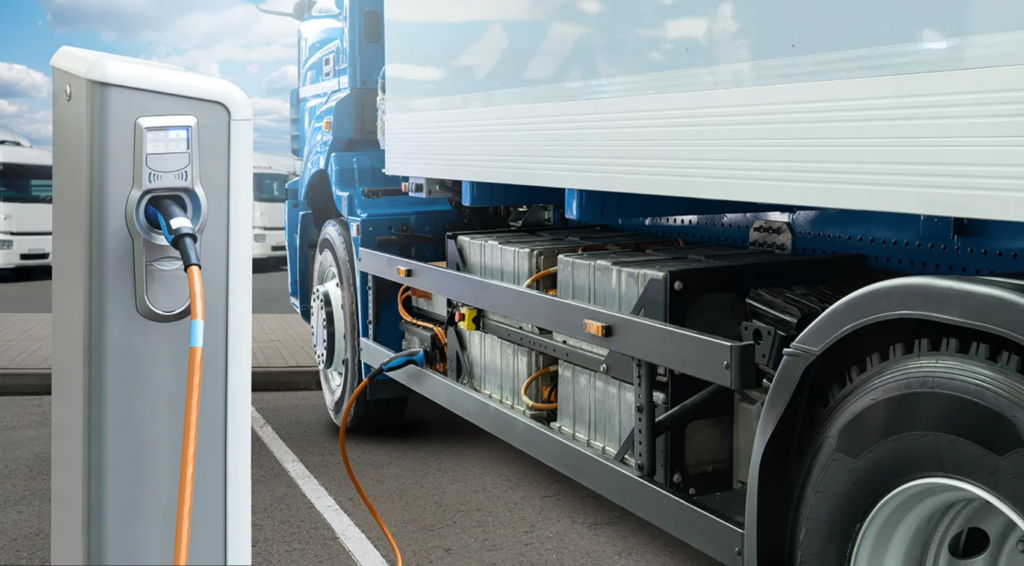
While Europe keeps tightening its 2030 and 2035 emissions targets, the German auto industry has issued an unusual policy warning. VDA (the German Association of the Automotive Industry) recently published its "Roadmap for the High-Quality Ramp-Up of Climate-Friendly Light and Heavy Commercial Vehicles". It states plainly that what will really decide whether road transport cuts its emissions is not passenger cars but commercial vehicles, especially heavy trucks. In the document, the VDA managing director gives the figure directly: ****heavy road transport accounts for about 30% of road transport CO₂ emissions. If electrification and zero-emission policies cannot take hold in commercial vehicles, Europe's climate targets may turn out to be "correct only on paper".
What is really missing is "operability"
Over the past five years, Europe's mainstream OEMs, from Daimler Truck, MAN and Volvo to Scania, have completed full product-line rollouts of electric light commercial vehicles, electric heavy trucks, hydrogen fuel-cell trucks and electric/hydrogen buses. At trade shows and prototype launches, the "zero-emission future" of European commercial vehicles has all but taken shape. The problem is still infrastructure:
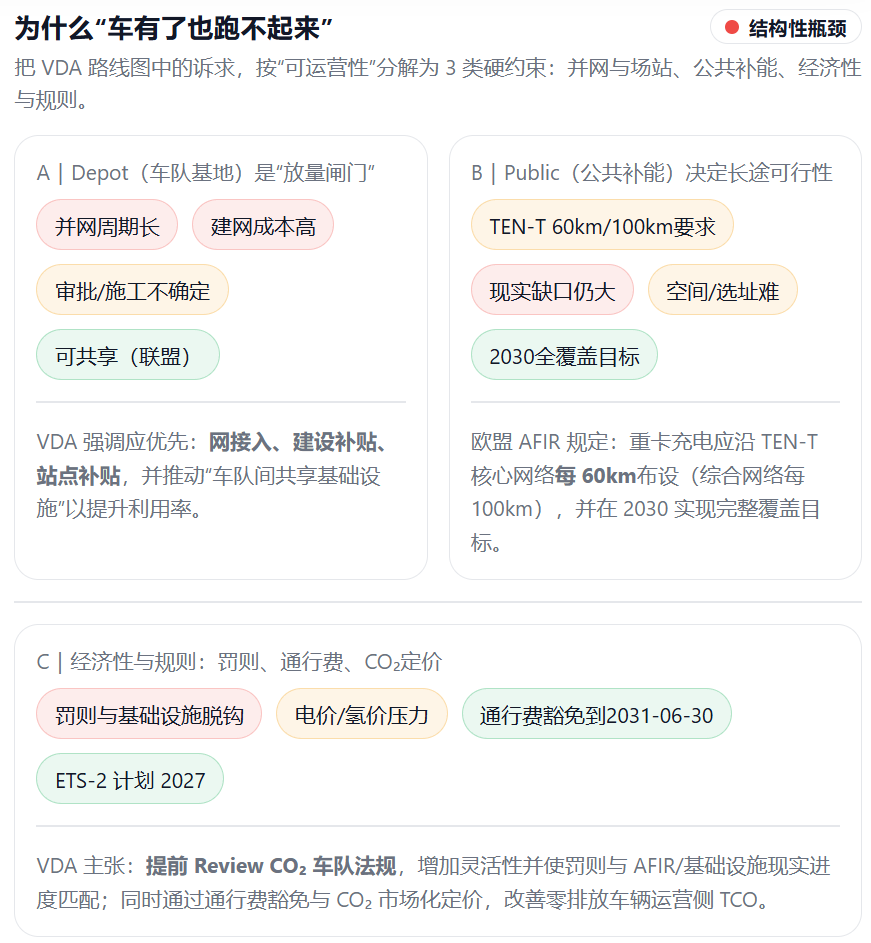
- In core markets such as Germany, France and Italy, many logistics companies often wait 12–36 months for a medium- or high-voltage grid connection
- High-power charging for heavy trucks along motorways is severely lacking, leaving night-time, cross-border and long-haul operations almost entirely uncovered;
- Hydrogen fares even worse: H₂ refuelling stations are sparse, prices are high and operational reliability is lacking.
So any policy requiring logistics companies to "accelerate electrification" will hit bottlenecks.
VDA objects to "punitive logic"
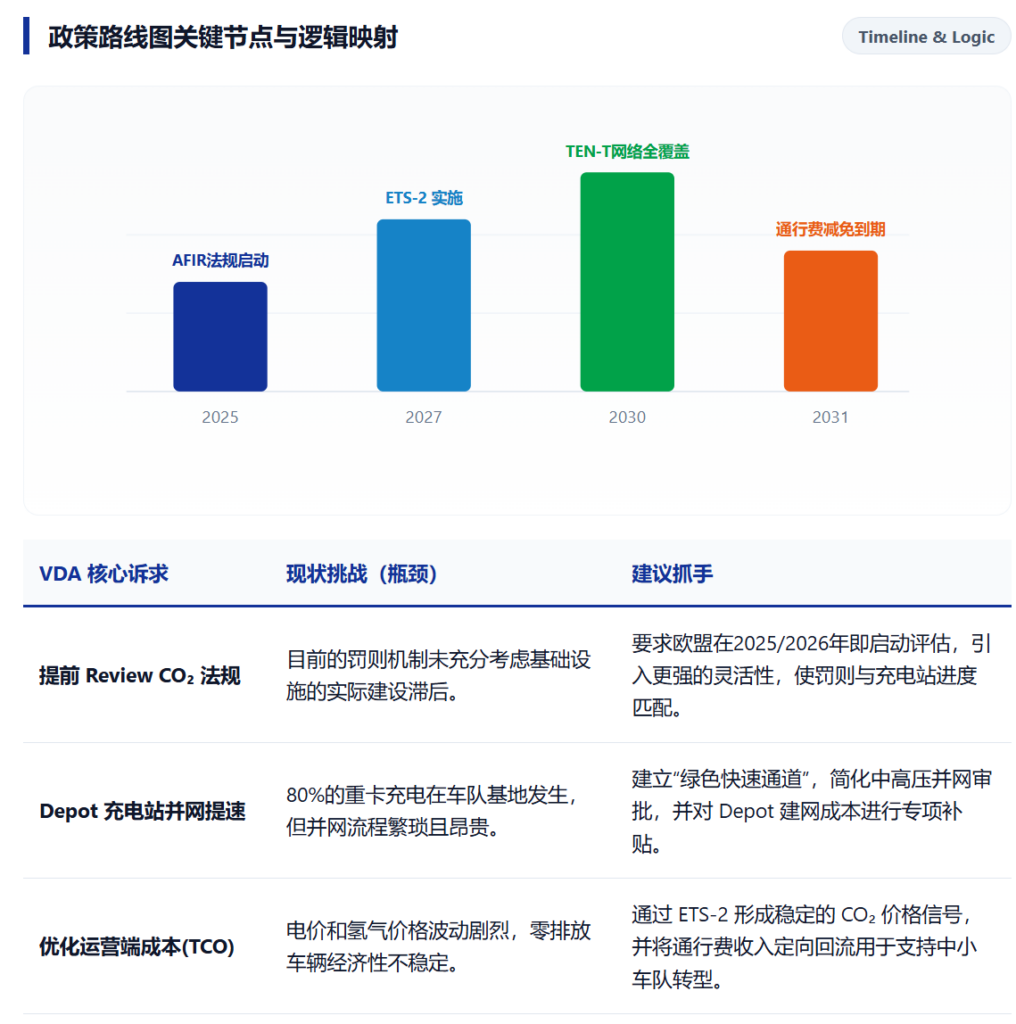
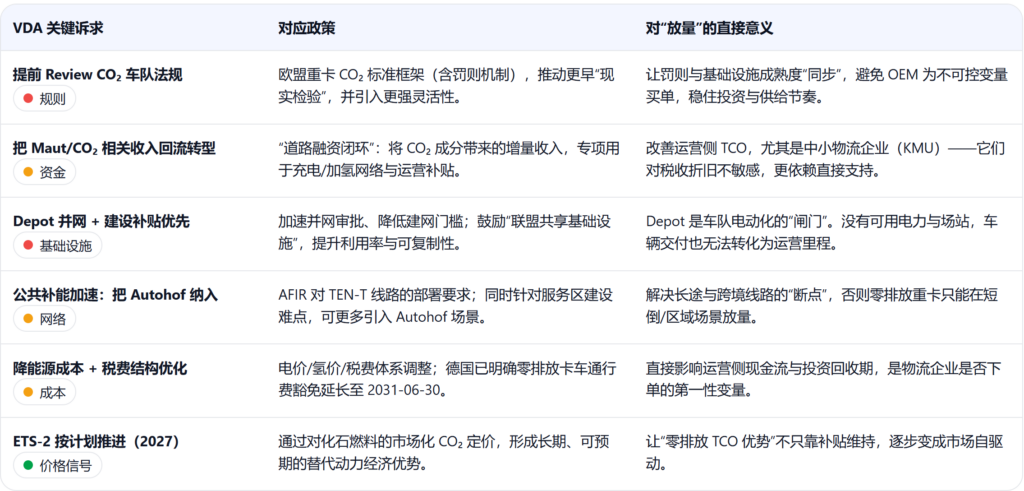
The most contentious part of the roadmap is the VDA's direct challenge to the penalty system of the CO₂ fleet regulation. Under the current EU heavy-duty vehicle CO₂ regulation (EU Regulation 2019/1242), truck manufacturers that miss interim reduction targets face fines significantly higher than those for passenger cars. But the system presupposes that the market has adequate infrastructure and operating conditions, so that manufacturers "just need to build the vehicles". The VDA's view is the exact opposite: infrastructure build-out is not controlled by OEMs, energy prices, grid connection timelines and local permitting are highly fragmented, yet the fines are immediate and rigid. OEMs are thus bearing financial liability for "failure conditions they cannot determine". The VDA therefore explicitly calls for bringing forward the review of the heavy-duty CO₂ fleet regulation, introducing greater flexibility mechanisms, and redesigning the penalty system to be "proportionate and realistic", a very direct and forceful stance.
The key blind spot in Germany's commercial vehicle policy
VDA repeatedly stresses the **"Finanzierungskreislauf Straße" (road financing loop). What this means is** that the extra revenue from CO₂-related road tolls must flow back into decarbonising commercial vehicles themselves. In reality, however, the CO₂ component has pushed up heavy truck tolls, and logistics companies bear higher operating costs. Yet this new fiscal revenue has not been systematically used for charging networks, hydrogen stations or fleet electrification subsidies. For small and medium-sized logistics companies (KMU) in particular, tax depreciation models are almost useless; what they need more is direct, predictable purchase and operating subsidies, clear energy price expectations and workable application procedures.
The real bottleneck is the "depot"
Unlike many policy discussions, the VDA focuses on a more "foundational" scenario: fleet depots. For heavy trucks and buses, more than 80% of charging or refueling takes place at operating depots. Without high-capacity grid connections and construction subsidies, no amount of public fast charging can support fleet transition. The roadmap's demands are very specific: faster approval of grid connections, higher subsidy rates for grid connection and construction, encouraging infrastructure sharing between fleets, and finally clearer obligations for local governments and grid operators.
Technology neutrality is a pragmatic compromise
Throughout its roadmap, the VDA repeatedly stresses Technologieneutralität (technology neutrality), explicitly calling for regulation to include battery-electric, hydrogen fuel cell and renewable fuels (RFNBO, biofuels). Its core demand is to introduce a correction mechanism in CO₂ accounting for the "emissions reduction contribution of fuels", rather than looking only at the vehicle itself. This approach is not really about "extending the life" of the combustion engine, but about taking real-world conditions into account: in long-haul, heavy-load and cross-border transport, no single technology pathway is fully viable, and if regulation becomes overly technology-specific, the likely result is slower rather than faster emissions reduction.
Buses are underestimated
VDA's position on electric and hydrogen buses is arguably the clearest: this is the segment where technical, operational and policy conditions are most mature. Yet intercity and long-distance coach services have long been excluded from the subsidy system, and procurement rules have not made zero-emission the "default option." If even the public sector cannot lead with large-scale procurement of zero-emission buses, demands on private logistics companies will lack credibility.
VDA risk warning
The real constraint on decarbonising European commercial vehicles is no longer the technology. It is regulation and infrastructure. For Chinese OEMs, Europe is not the market with the highest technical barriers. It is the market with the highest system complexity. Those who understand and adapt to this earliest stand the best chance of securing a position in the coming window. VDA's roadmap is in effect a warning to EU policymakers: emission targets without the infrastructure and economics to support them will only exhaust the industry's patience, not speed up the transition.
**Reproduction or excerpting without permission is strictly prohibited.** Questions and comments are welcome. Follow us for ongoing analysis of the latest developments in China and abroad.
VDA, Commercial vehicle electrification, Infrastructure bottlenecks, German auto industry, European climate policy, Logistics decarbonization, Electric buses, Electric heavy trucks