Australia's New South Wales (NSW) formally opens a new round of fleet electrification subsidies, including commercial vehicles for the first time
The New South Wales (NSW) government in Australia has officially opened a new round of its electric fleet subsidy programme, worth more than AUD 5 million in total, and for the first time includes 3.…
The New South Wales (NSW) government in Australia has launched a new round of its electric fleet subsidy programme worth more than AUD 5 million, systematically including 3.5–23-tonne electric heavy commercial vehicles for the first time.
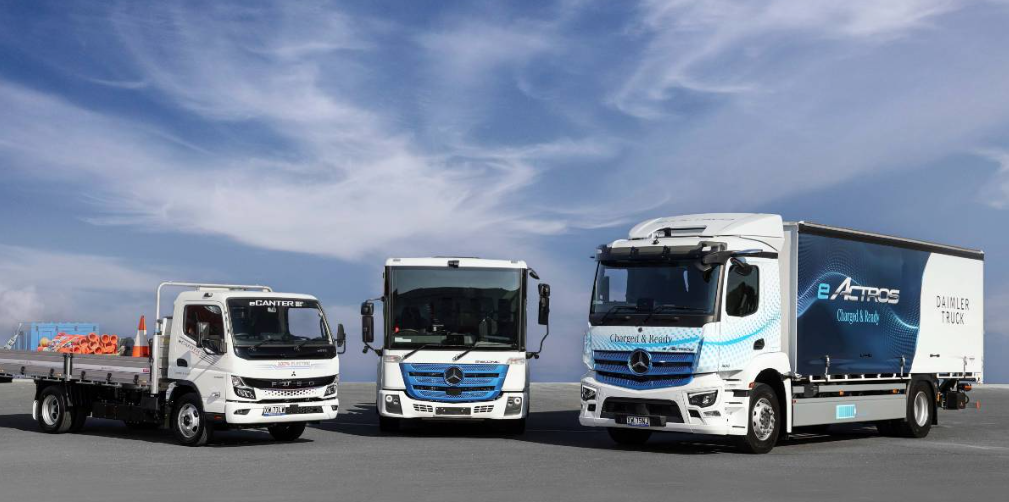
Fleet subsidy scope
NSW's latest subsidy round is fairly practical in design. Its core aim is to lower the real decision threshold for businesses switching to EVs. For the first time, the government has explicitly acknowledged that electric heavy trucks are "infrastructure-type assets that deserve subsidies".
Vehicle subsidies
- Passenger cars & SUVs priced at AUD 40,000 or more: subsidy of AUD 5,000 per vehicle
- Light commercial vehicles (2.5–3.5 t): subsidy of AUD 5,000–8,000 per vehicle
- Heavy commercial vehicles (3.5–23 t, included for the first time): subsidy of AUD 10,000–50,000 per vehicle
Charging infrastructure subsidies
NSW does not treat EVs as a "car sales policy"; it explicitly treats them as a systems project. On the infrastructure side, the subsidy covers 50% of the cost per charging connector, up to AUD 60,000, across AC, DC and high-power commercial use cases.
Heavy trucks included in subsidies for the first time
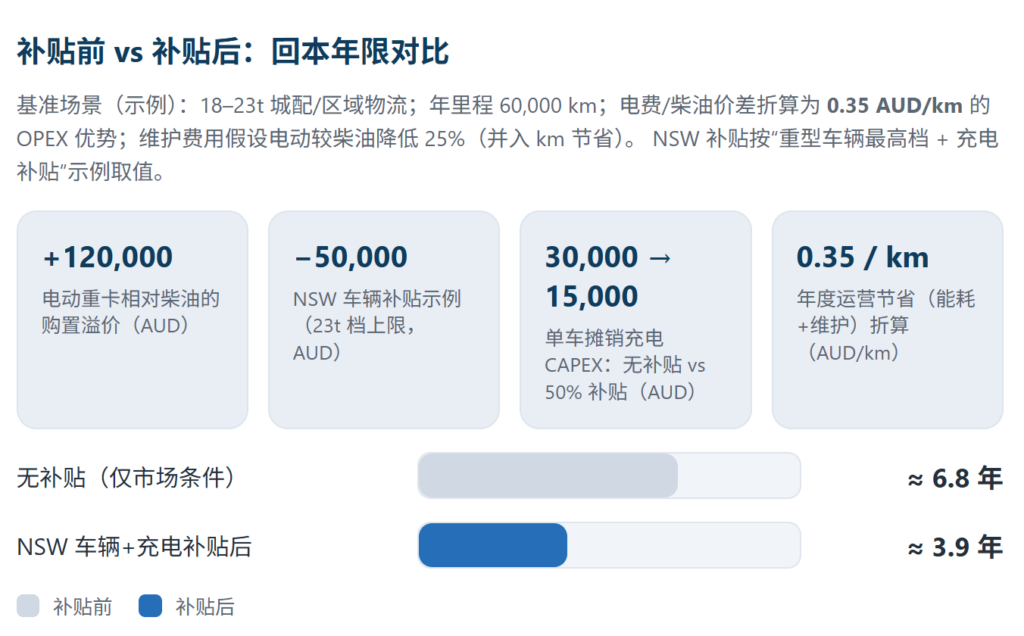
The pain point for electric heavy trucks is cash flow, not technology. For logistics companies, the question with electric heavy trucks has never been whether they are good. The problems are high upfront purchase costs, heavy upfront CAPEX for charging infrastructure, and uncertainty over residual values & policy. The electric heavy truck sector in Europe faces the same pain points. NSW's approach targets exactly these issues. It does not subsidise the full vehicle price, but it clearly covers one critical funding gap, subsidises both trucks and chargers, and sets a clear, predictable policy period running to May 2026.
This round is essentially an operational subsidy, not a consumer stimulus. The policy targets only business fleets and caps each company at 15 vehicles. This shows NSW does not care about absolute BEV sales, but about whether there is real operating mileage and real emissions reduction. That is entirely different from the logic in many countries of "subsidising private consumers and chasing penetration".
Australia overall: NSW most aggressive
To avoid looking at just one state, NSW needs to be placed within Australia's overall policy framework. Comparison of EV / commercial vehicle subsidies in Australia's main states
| State | Passenger cars | Light commercial vehicles | Heavy commercial vehicles | Charging subsidies | Policy features |
|---|---|---|---|---|---|
| NSW | ✅ | ✅ | ✅ (up to 50,000) | ✅ | Clearest focus on commercial vehicles |
| VIC | ✅ | ⚠️ (limited) | ❌ | ⚠️ | Private-car focused |
| QLD | ✅ | ❌ | ❌ | ⚠️ | Mainly tax cuts |
That makes NSW currently the only Australian state systematically treating electric heavy trucks as an emissions-reduction tool.
Who benefits first?
- For now, this round of subsidies appears aimed first at logistics & municipal fleets: urban delivery, municipal sanitation and utility vehicles. These use cases have fixed routes and manageable mileage, making them the easiest to "unlock" with subsidies.
- The Australian market has three defining traits: right-hand drive, a relatively independent regulatory regime, and less reliance on brand heritage than Europe. This makes it a natural "low-friction market" for Chinese electric commercial vehicles going global.
- Finally, charging and systems integrators: once the government starts subsidising "every charging point", the focus of competition will shift from "selling chargers" to "who can package vehicles, chargers, power and operations and maintenance into one solution".
A stark contrast with Europe
Put NSW's policy side by side with the current situation in Europe, and the contrast is stark:
- Europe's targets are clear but its path is muddled, leaving heavy truck subsidies fragmented and approvals complex
- By comparison, NSW's targets are pragmatic and its tools simple, making the calculations very easy for companies.
That is why more and more non-European OEMs, including Chinese OEMs, see Australia as a "second battlefield" for electric commercial vehicles.
Final thoughts
When policy starts subsidising heavy assets, it shows the government has concluded the direction is irreversible. For companies, the real value of such policies lies not in the subsidy amount itself, but in the fact that the risk of not acting starts to outweigh the risk of acting.
Reproduction or excerpting without permission is strictly prohibited. Questions and comments are welcome. Follow us for ongoing analysis of the latest developments in China and abroad.