European passenger car market: month 11 summary
According to the latest ACEA statistics, EU new car registrations through Nov 2025 grew only +1.4% year on year, with overall volume…

According to the latest ACEA statistics, as of Nov 2025, EU new car registrations grew only +1.4% year on year, with overall volumes still well below pre-pandemic levels. On the surface, the NEV share keeps rising, but breaking down powertrain mix, country distribution and OEM behavior shows that Europe has not yet entered a "BEV-dominant phase".
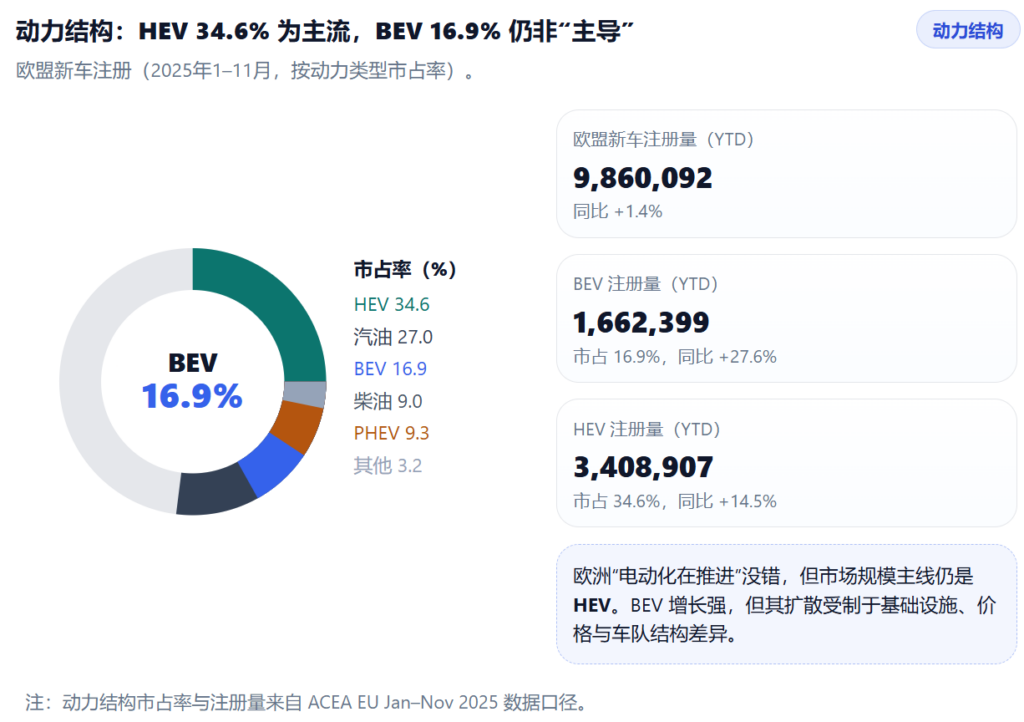
HEVs are what really steadied the European market
In 1–11 2025, the EU's new-car powertrain mix had settled into clear tiers:
- HEV (incl. mild hybrids) share: 34.6%
- BEV share 16.9%
- PHEV rises to 9.3%
- Petrol and diesel combined fall to 36.1%
European consumers are systematically moving away from conventional combustion engines, but they are not embracing battery-electric vehicles at the same pace or across the board. HEVs have become the practical mainstream not out of technological conservatism but as a rational choice: they do not depend on public charging networks, carry no range anxiety, still offer a compliance advantage under CO₂ regulation, and their TCO is more controllable for households and corporate fleets. Europe's electrification path therefore looks more like a risk-minimisation strategy.
BEV growth is highly concentrated
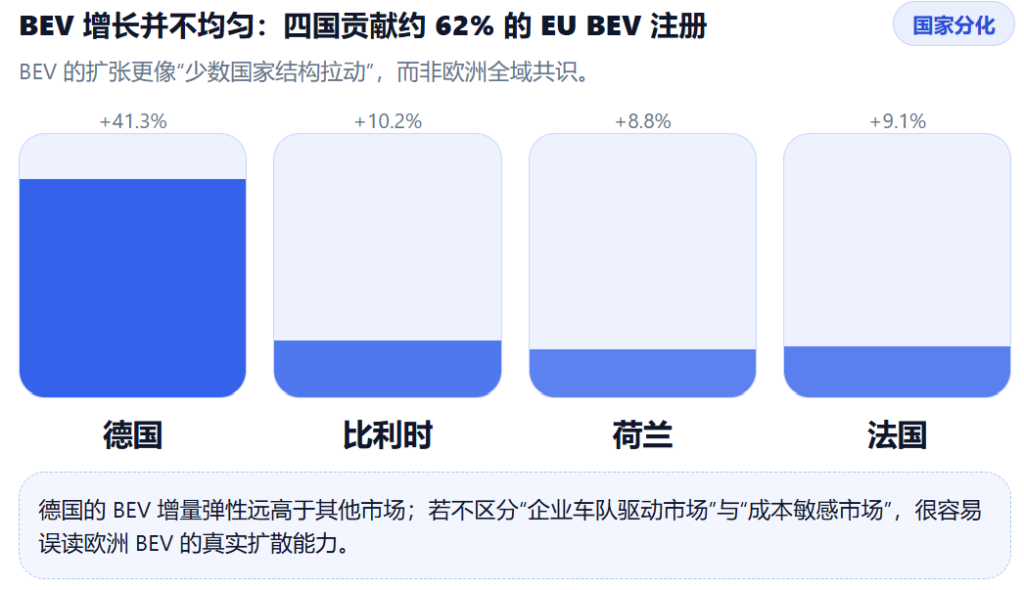
In Nov 2025, BEV registrations rose +44.1% year on year, but the growth was highly concentrated in a few countries:
- Germany +41.3% (YTD)
- France +9.1%
- Belgium +10.2%
These four countries together account for about 62% of EU BEV registrations (60% of battery-electric heavy truck sales also come from Germany, while France and the Netherlands contribute 60%).
Excluding Germany and a handful of markets with "strong policy and dominant corporate fleets", BEVs lack the foundation to spread naturally across Europe. In southern Europe, eastern Europe and some smaller markets, HEVs/PHEVs remain the more realistic and affordable mainstream option.
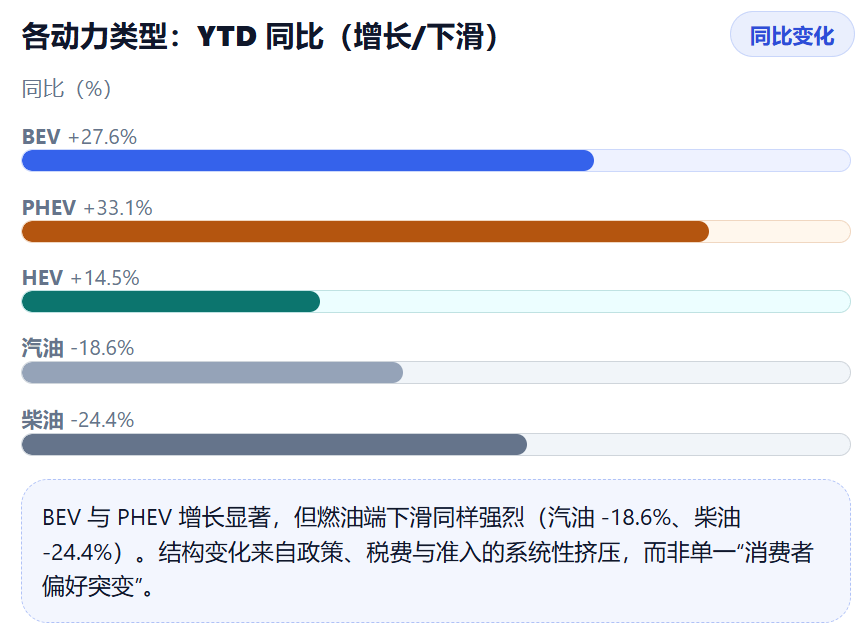
Combustion cars are not being phased out naturally
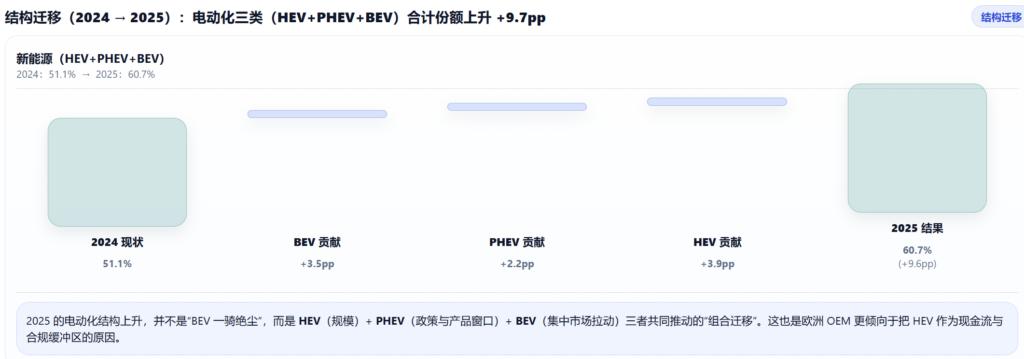
In the year through 11, petrol car registrations were down 18.6% year on year and diesel down 24.4%. Core markets including Germany, France, Italy and Spain all declined. But this does not mean consumers have actively turned against combustion cars. More precisely, combustion cars are being pushed out of the mainstream market by a combination of CO2 regulations, tax structures, urban access restrictions and OEM product strategies. For OEMs, this is a forced structural transition: combustion profitability is declining while the BEV profit model has yet to stabilise, so HEVs have become a safety buffer between cash flow and compliance.
Same Europe, different approaches
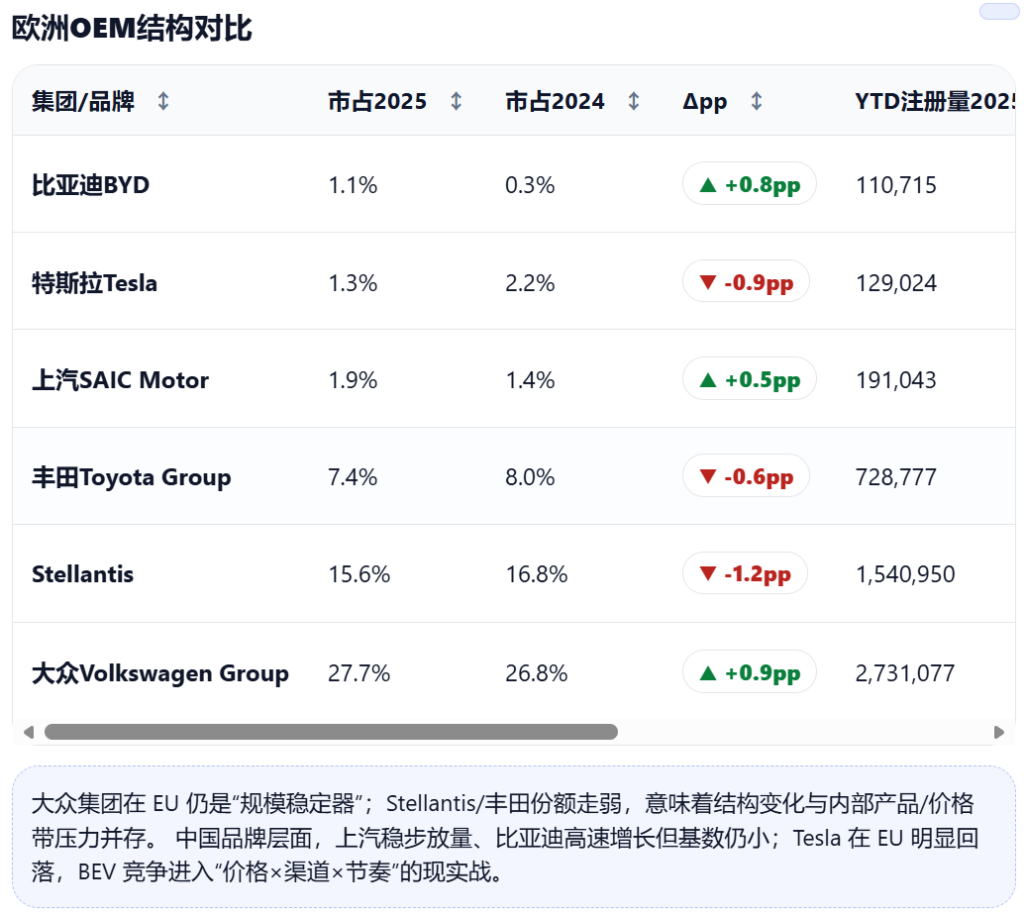
Volkswagen Group remains the most aggressive in its rhetoric but is clearly cautious in its product and sales mix. BEVs are the long-term direction, but until the profit model fully works, HEVs/PHEVs still play a key role in generating stable cash flow. For Volkswagen, Europe is the core base where it must hold on to scale and jobs.
Stellantis draws its strength from a diversified structure. Small BEVs, HEVs/PHEVs and combustion models run side by side, which spreads risk across countries and policy environments. Its transition is not fast, but it is highly resilient to shocks.
Toyota is the OEM most closely attuned to the real market. Until charging infrastructure, energy prices and consumer acceptance mature at the same time, HEVs offer the highest efficiency and the lowest risk. Judged by sales stability and profit resilience, the strategy has worked very well in Europe. By contrast, some Chinese brands are more prone to misreading the European market.
Betting solely on BEVs and assuming that "Europe = a premium BEV market" tends to underestimate price sensitivity, differences in energy costs and the real-world acceptance of HEVs among policymakers and consumers, leaving products technologically ahead but struggling to reach stable scale.
Final thoughts
In 2025, BEVs did not go mainstream in the European car market. It looked more like HEVs held the core market steady while BEVs were pushed along by policy.
OEMs, especially Chinese OEMs, need to judge precisely:
- Betting solely on BEVs is risky in Europe
- Ignoring HEVs/PHEVs is a systematic misreading of Europe's demand structure
- The core tension in Europe's electrification is not technology, but balancing cost, policy and user compromise
This also neatly explains a highly contradictory phenomenon: Europe is extremely aggressive in its policy narrative but extremely cautious in its market choices.
Source: ACEA, New Car Registrations – November 2025