UK automotive R&D: 87% carried out by foreign-owned companies, 5 Chinese-controlled R&D centres
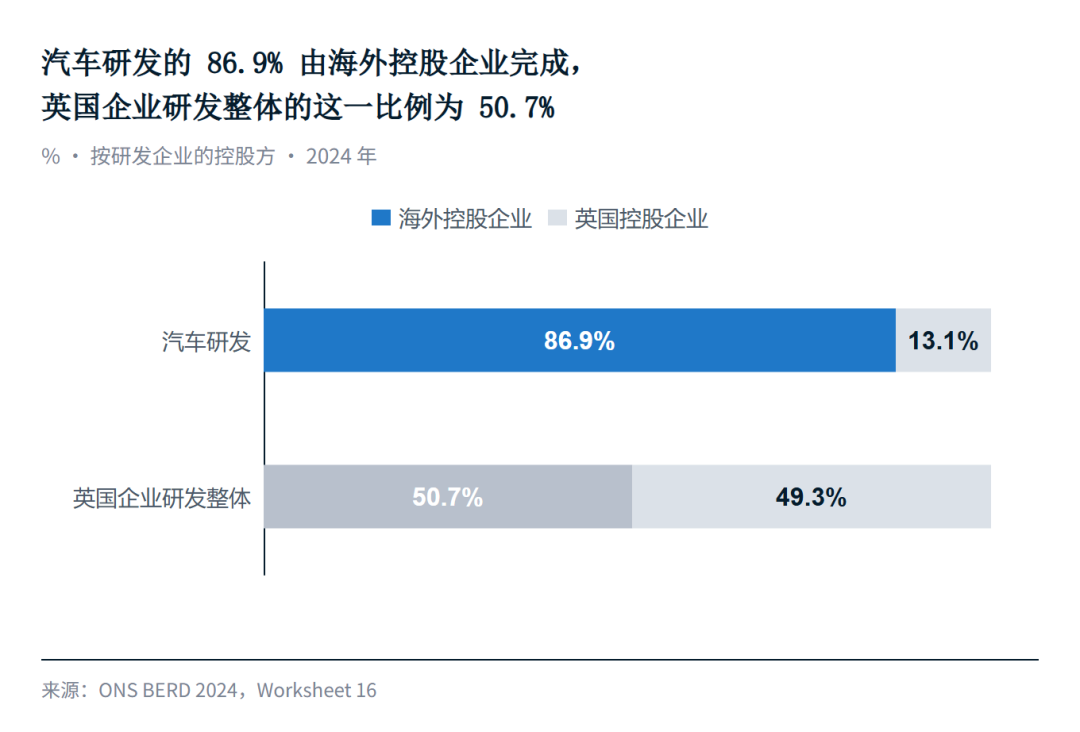
UK automotive R&D spending totaled GBP 5.278 billion in 2024, 86.9% of it carried out by foreign-owned companies, with government funding accounting for only 0.68%.
According to business R&D statistics from the UK Office for National Statistics (ONS), R&D spending in the UK motor vehicles and parts sector was GBP 5.278 billion in 2024, 9.5% of total UK business R&D, up from GBP 4.106 billion in 2022. Of this, GBP 4.586 billion was carried out by foreign-owned companies and GBP 692 million by UK-owned companies. In an industry survey published by the Society of Motor Manufacturers and Traders (SMMT) on Nov 4, 31 member companies named "moving from R&D to commercialisation in the UK" as their top R&D barrier.
UK automotive R&D funding comes mainly from foreign-owned companies investing their own money, and these companies decide where R&D takes place based on their global program plans. Unless electricity prices and access to scale-up financing improve, the UK will mostly retain engineering, calibration and testing teams, while pilot lines and initial series production will still go to locations with lower costs and better funding. Chinese automakers setting up R&D centers in the UK face the same conditions.
Funding and ownership
Of the £5.278 billion in 2024, £3.967 billion came from companies' own funds and £1.261 billion from overseas. UK government funding, as recorded by the ONS, was £36 million, or just 0.68%. By the ownership of the company performing the R&D, foreign-owned companies accounted for 86.9%. Across all UK business R&D, foreign-owned and UK-owned companies each account for roughly half. Automotive R&D therefore depends on foreign capital far more than UK business R&D as a whole.
The type of research is also skewed downstream. In 2024, current expenditure on automotive R&D was £4.832 billion, of which experimental development accounted for £4.007 billion (82.9%), applied research £746 million and basic research just £79 million, plus £446 million in capital expenditure. Experimental development is the stage that turns existing technology into specific products, components and processes; it is closest to models and production lines, and the most likely to move between countries along with projects.
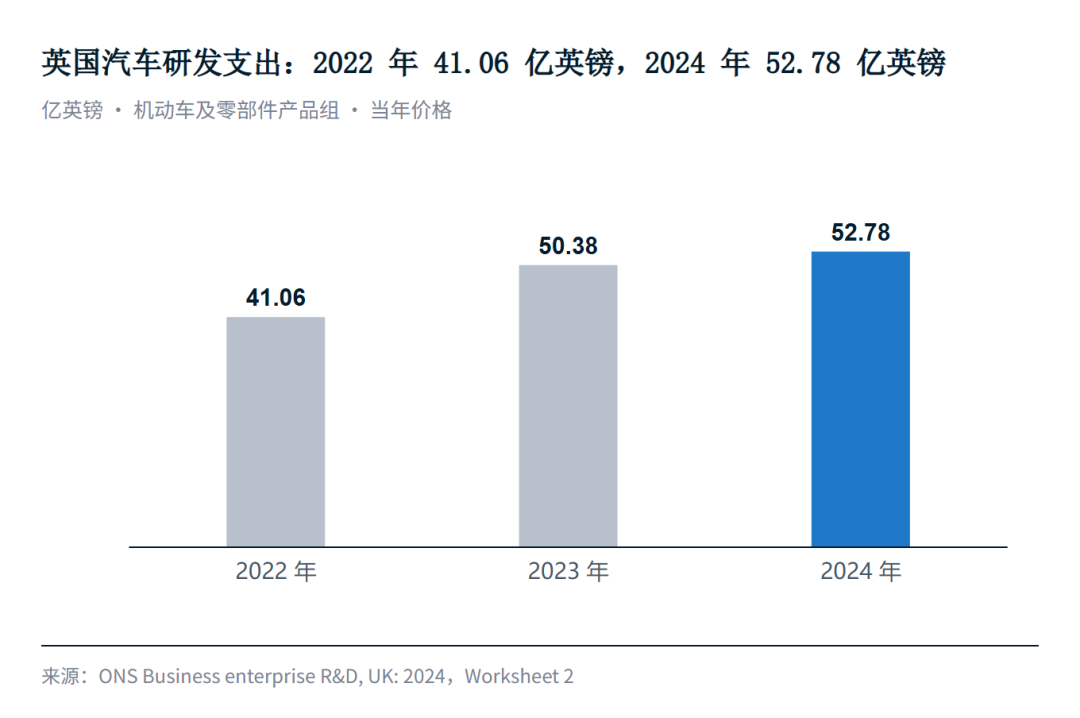
R&D spending is growing, but growth is slowing. It reached £5.038 billion in 2023, and 2024 came in at 104.8% of the prior year, an increase of 4.8%.
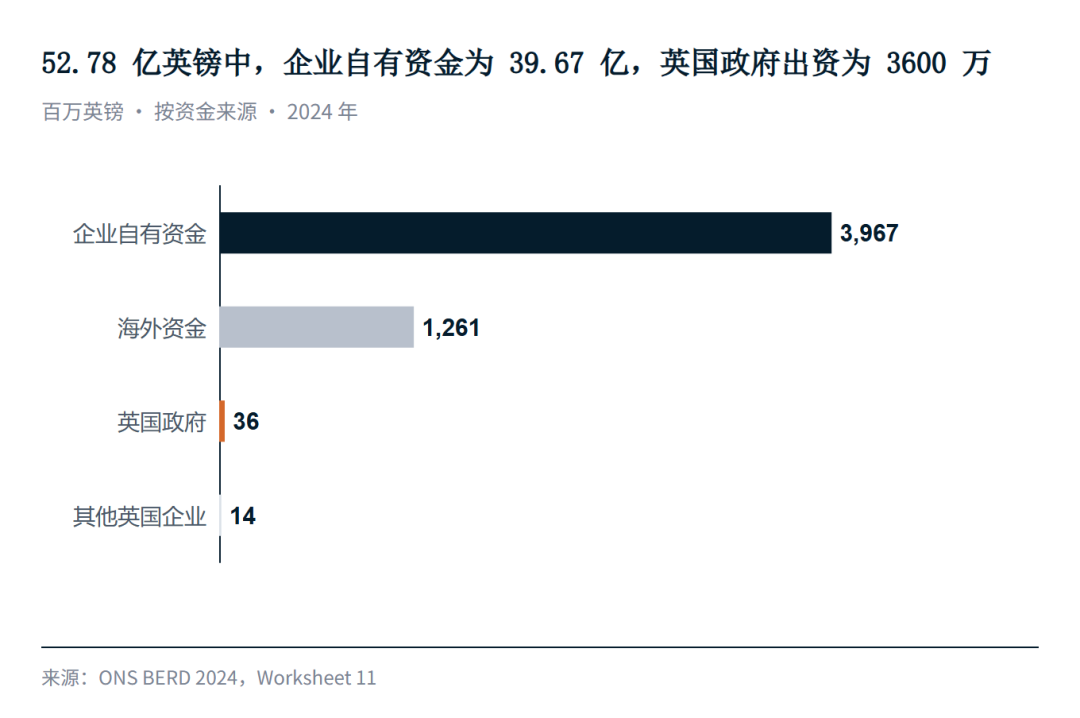
R&D budgets are allocated project by project by overseas parent companies, and little of the funding is directly within the UK government's influence. To retain more R&D, the UK has to win when companies compare locations.
Barriers for businesses
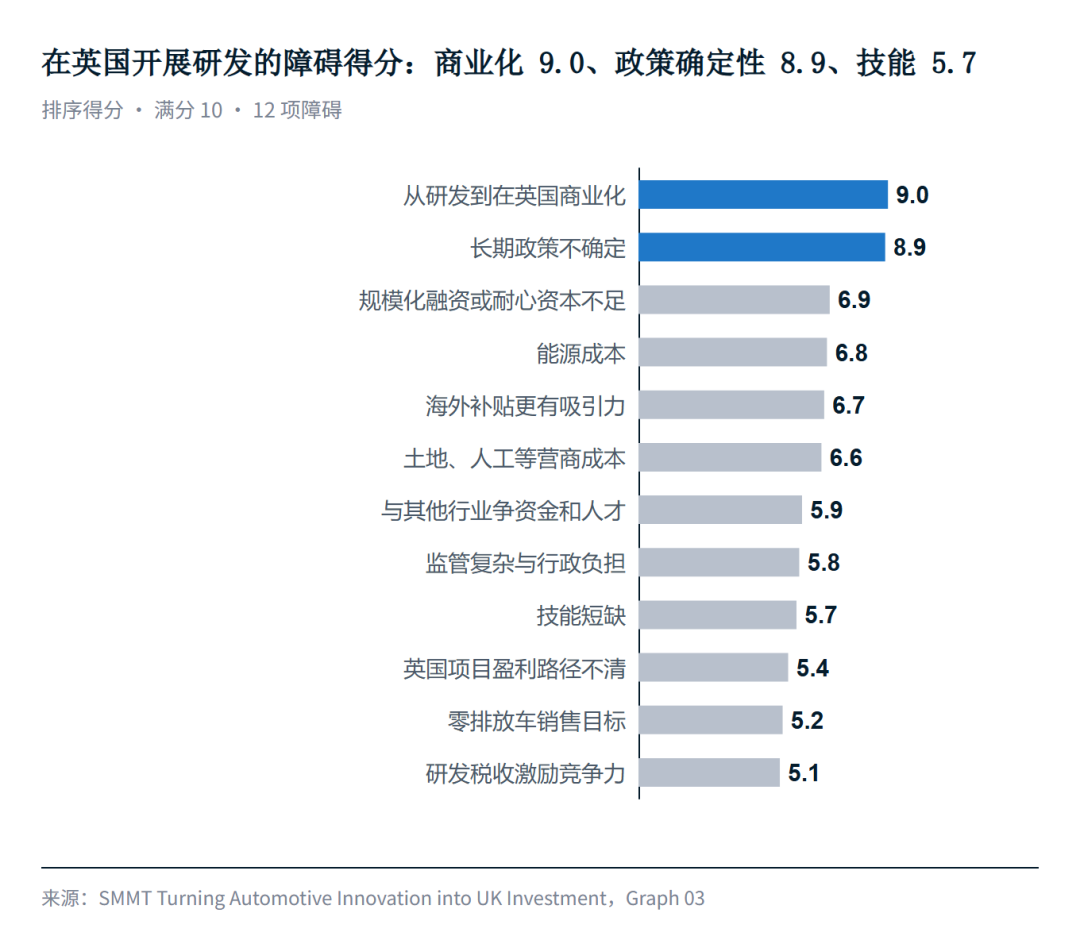
The survey was conducted from Jul 2026 to month 9. Of the 31 companies that responded, 6 were high-volume vehicle manufacturers, 14 were component and powertrain technology suppliers, 7 were software and service providers, and 4 were luxury, performance or low-volume carmakers. Ranked by score, the main barriers to doing R&D in the UK are:
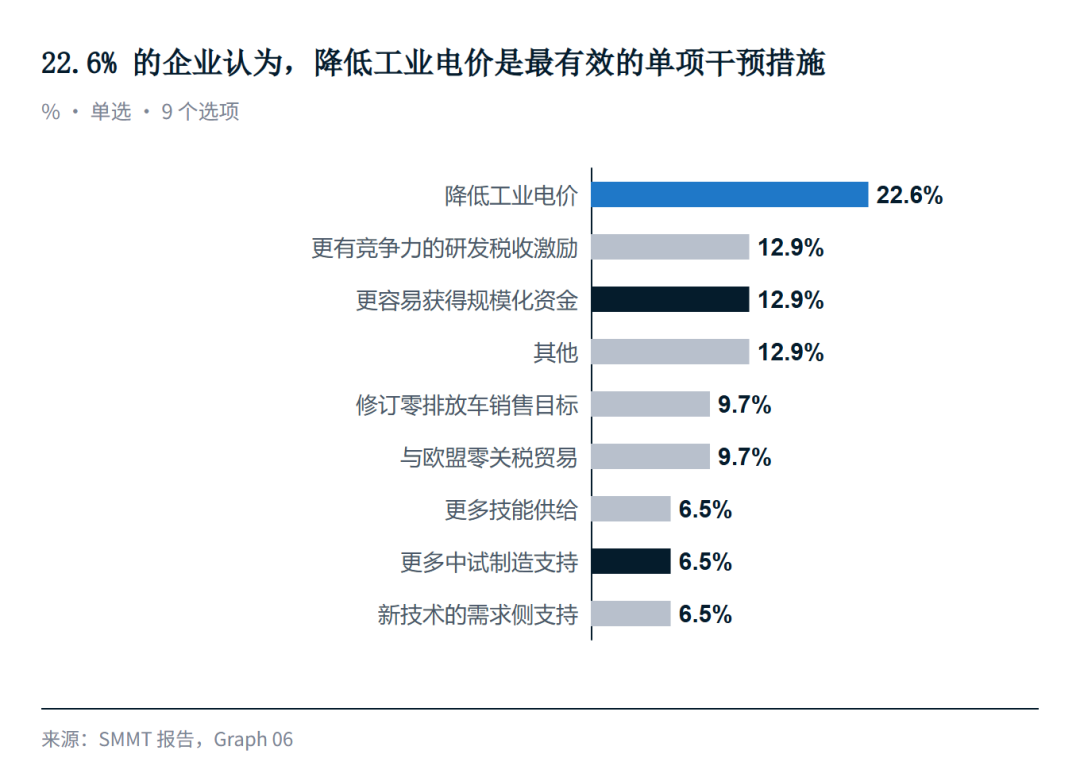
The low ranking of skills shortages is consistent with how companies rate the UK's strengths: 74.2% of respondents named available talent and engineers as the UK's biggest advantage, with grant funding and university partnerships at 58% each. Asked about the most effective single intervention, 22.6% chose lower industrial electricity prices, 12.9% each chose R&D tax incentives and scale-up funding, 9.7% each chose revising the ZEV sales targets and zero-tariff trade with the EU, and only 6.5% chose pilot manufacturing support. A further 19.3% of companies listed the ZEV sales targets among their top three challenges; weak domestic sales would also affect R&D investment.
The policy's boost to confidence has been limited. Over the past 12 months, 51.6% of companies became more confident about doing R&D in the UK, of which 41.9% only slightly; 12.9% became slightly less confident, and none reported a significant decline.
For companies doing R&D in the UK, the difficulty comes after R&D: once prototypes and processes are developed, pilot lines and initial mass production need to go where electricity is cheap and funding is available, and the UK currently lacks an advantage at this stage.
Chinese-owned R&D centres
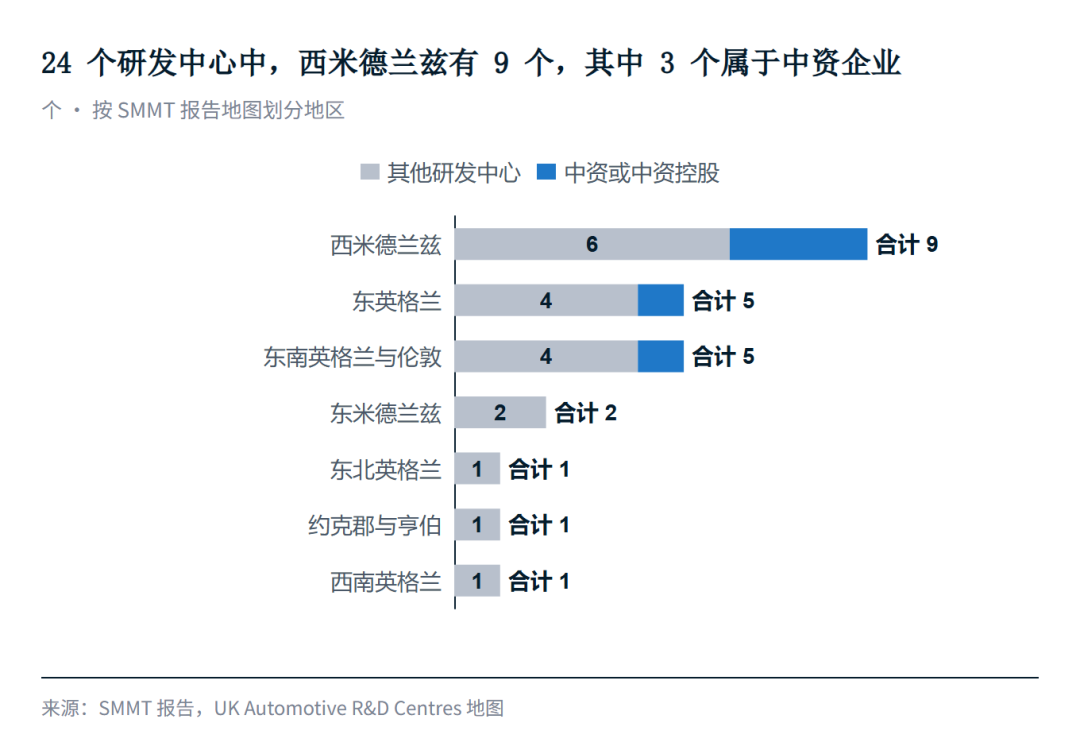
Of the 24 R&D centres listed by SMMT, 5 belong to Chinese-owned or Chinese-controlled companies: Chery, NIO, Changan, Lotus Tech and SAIC. Public details are available for three of these centres, each handling different work.
Chery's R&D centre at the UTAC Millbrook proving ground is due to open in Q4 this year. It will start with chassis dynamics and ADAS development for UK-market models, tuned for Britain's narrow roads, roundabouts, tight bends and varied road surfaces, and will later expand into autonomous driving and AI. The centre has access to more than 70 km of test tracks at the proving ground. Chery Commercial Vehicles also announced in month 1 this year that it would set up its European headquarters in Liverpool for engineering, software and R&D work.
Changan's UK R&D centre was founded in Nottingham in Jun 2010 and moved to Birmingham in 2015. It now has four office buildings and a test centre, and is responsible for powertrain development and European model engineering. According to media visits, the centre has more than 100 engineers handling validation and calibration of UK and European models; one of their tasks is using a four-wheel independent dynamometer to meet Euro 7 real driving emissions requirements.
In 6 this year, NIO opened a new R&D centre in Witney, Oxfordshire, consolidating its two former facilities in Begbroke and Bicester. The centre has a CAE workspace and a vehicle laboratory; NIO's UK R&D team has been in place for 10 years.
All three focus on powertrain, chassis tuning, ADAS calibration, simulation and full-vehicle testing, the steps that adapt models to UK and European road conditions and regulations. These require local roads, proving grounds and engineers, giving a practical reason to locate them in the UK.
For Chinese automakers, UK R&D centres currently focus mainly on adapting products for the UK and European markets, with team sizes tracking local sales. Platform-level R&D remains in China.
The German comparison and policy funding
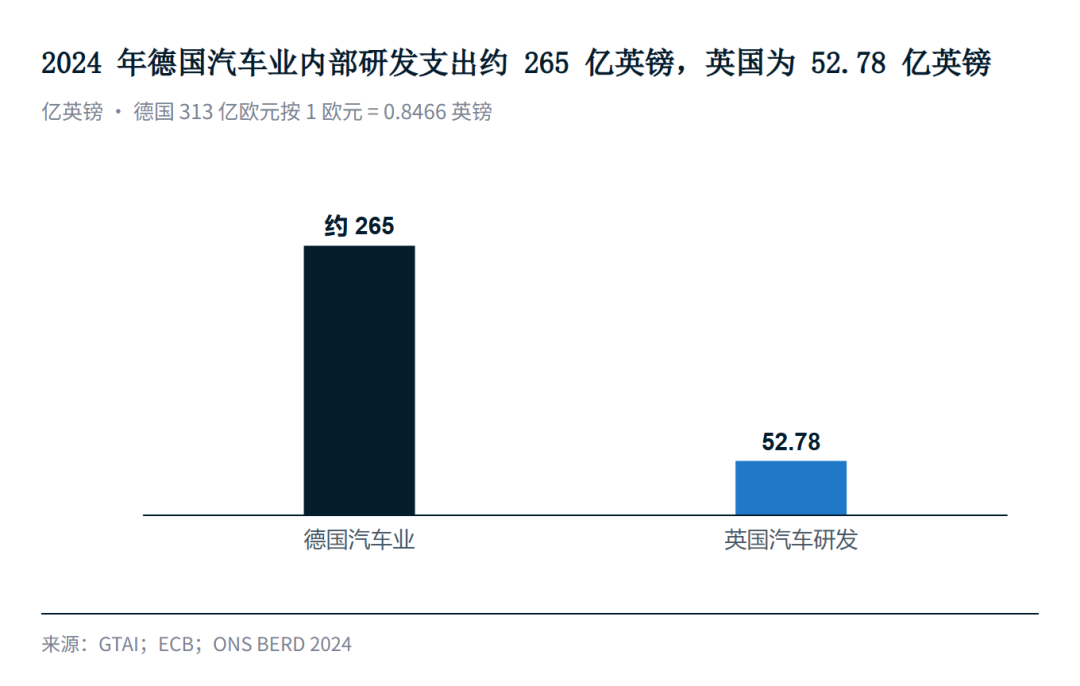
Germany's auto industry spent EUR 31.3 billion on in-house R&D in 2024, or about GBP 26.5 billion at the 2024 average rate of roughly EUR 1 = GBP 0.8466. The UK figure is about one-fifth of Germany's.
UK government public funding for the auto sector is mainly project grants. According to data cited by SMMT, DRIVE35 and other programmes will provide a combined £4 billion over the next decade. In Aug 2026, DRIVE35 awarded £47 million to 33 projects, expected to leverage £90 million in total project investment, about 1.9 times the grant. The grant equals about 0.89% of annual UK automotive R&D spending. The industrial strategy targets UK production of 1.3 million vehicles a year by 2035.
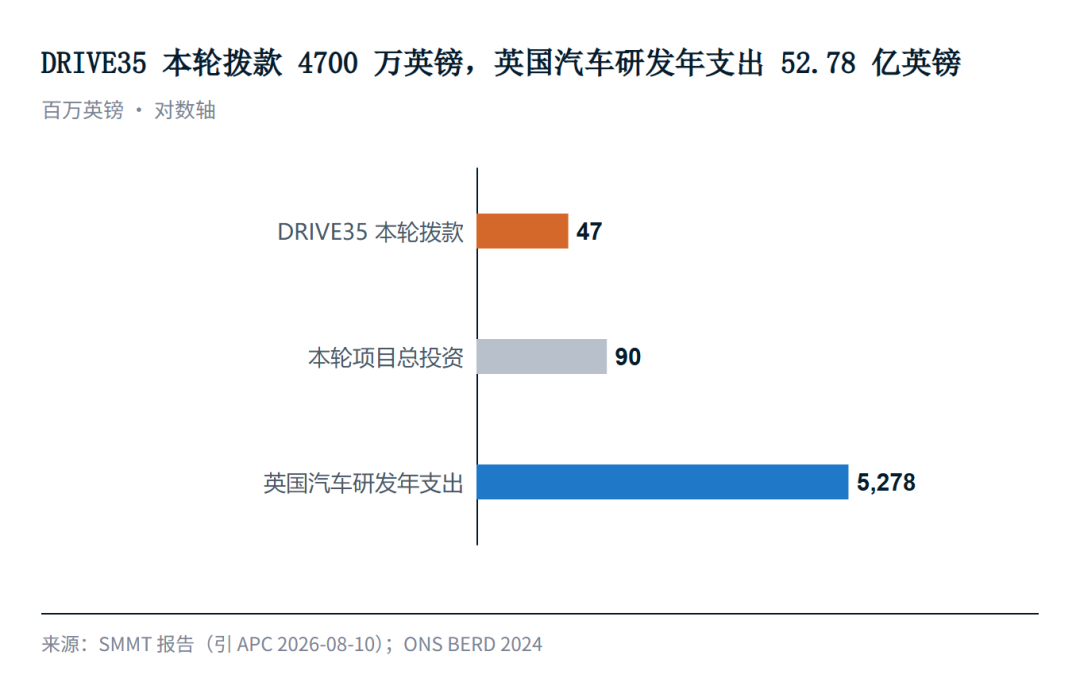
Source: Chart by AutoMusic based on the public sources listed in the article; first published on the AutoMusic WeChat account.
Corporate investment is following. In September, UK carmakers announced investment plans exceeding GBP 1 billion, including GBP 350 million from Bentley, GBP 500 million from McLaren and GBP 170 million from Nissan. Public funding can lower the risk of specific projects and draw in corporate co-investment, but it cannot change the gap in R&D scale between the UK and Germany. What the UK can compete for is specialist technology and model adaptation.
R&D and mass production
Chery is currently the most direct example of whether R&D can lead to production. Chery has signed a non-binding agreement with Nissan to explore producing Chery passenger cars at Nissan's Sunderland plant; no production decision has been made.
In the SMMT survey, if UK competitiveness improved, 38.7% of companies said they would be significantly more likely to increase R&D and engineering investment in the UK over the next five years and 45.2% said somewhat more likely, a combined 83.9%, or roughly 26 in 31; 16.1% said it would make no difference, and no company said less likely. This is a conditional intention; companies did not commit to amounts or timelines.
For Chinese automakers that already have R&D centers in the UK, there is now a case for keeping their teams there. Whether production follows depends on whether contract manufacturing talks such as those in Sunderland can be finalized, and whether UK electricity prices and financing conditions make pilot production and initial series production pencil out.