Behind Germany's "record" EV sales: the turning point lies in the demand structure
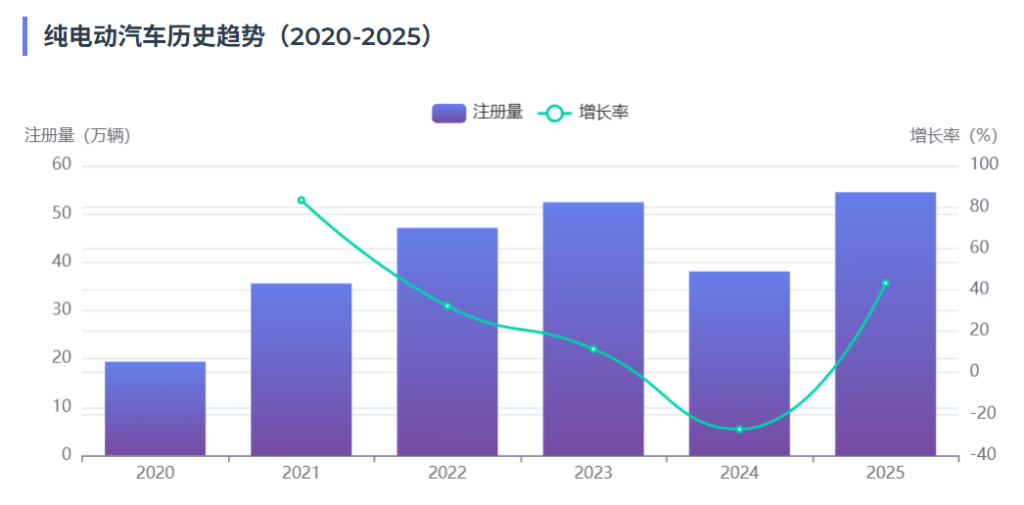
In 2025, new battery-electric vehicle (BEV) registrations in Germany reached 545142 units, up 43.2% year on year and a record high, with market share rising from 20…
In 2025, new battery-electric vehicle (BEV) registrations in Germany reached 545142 units, up 43.2% year on year and a record high, with market share jumping from 13.5% in 2024 to 19.1%. Germany's EV market is moving from policy-driven "sharp swings" into a new phase centered on fleets, with channel structure as the variable.
Germany's new passenger car market was essentially flat in 2025 at about 2.9 million units, up a modest 1.4% year on year. Growth in German EV sales therefore did not come from an "overall market boom" but from a redistribution of powertrains and sales channels within a saturated market.
Corporate fleets are driving the market
207000 battery-electric vehicles went to the fleet market, 38% of total EV sales in Germany, as companies speed up their switch to electric. Corporate buyers are adopting EVs faster than private consumers. For fleet operators, the total cost of ownership advantage of EVs is already clear. Even without purchase subsidies, EVs remain attractive on running and maintenance costs. Nov 2025 was a milestone: for the first time, electric became the most popular powertrain among fleet customers.
Private market returns: 43% growth
The private consumer market took delivery of 195000 EVs in 2025, up 43% year on year. This shows that private demand has not disappeared but has found new growth momentum after a period of adjustment. After subsidies ended abruptly at the end of 2023, private demand hit a clear low in 2024, and the market long lacked a definitive answer to whether people would still buy EVs without subsidies. The rebound in 2025 suggests that pricing, product supply and charging conditions have re-established an acceptable balance for at least some consumer groups.
But the private market's recovery has not returned to the explosive growth of 2020-2021; instead it has entered a steadier growth path. It remains short of the peak of about 237,000 private BEV purchases reached in 2022 with purchase incentives.
Tactical registrations: manufacturers' "last mile" strategy
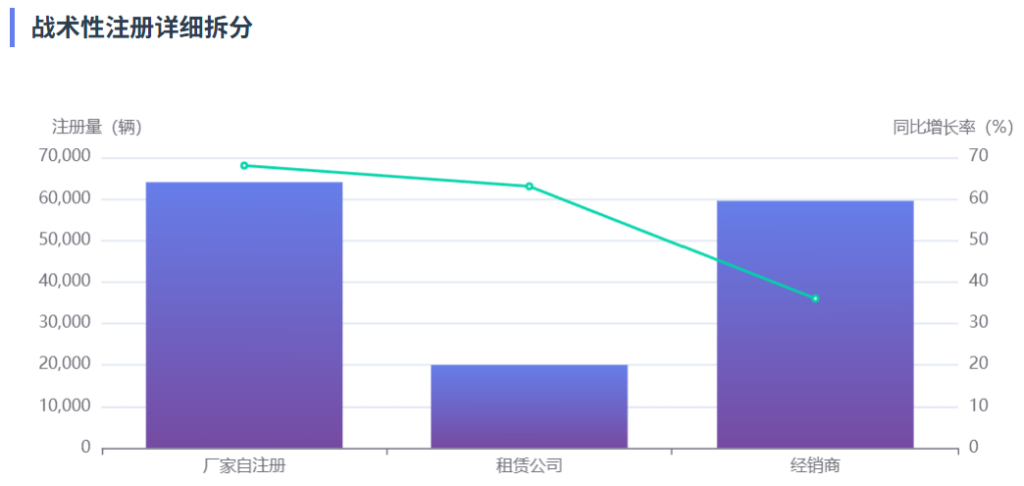
143000 EVs were classified as tactical registrations, including bulk purchases by manufacturers themselves, rental companies and dealers. When market demand slows, manufacturers have to absorb capacity through their own channels.
Broken down, manufacturer self-registrations were about 64000 units, up a sharp 68% year on year; rental companies about 20000 units, +63% YoY; and dealers (trade channel) about 59500 units, +36% YoY. Together the three roughly match the 143000-unit total.
Tactical registrations account for about 36% of the overall passenger car market, and their center of gravity is shifting from dealers to manufacturers. This is essentially an inventory management strategy: in a weak market, vehicles are moved into captive fleets or affiliates, ready for later sale in the used-car market or through direct sales. It is both a sign of pressure and a tool manufacturers use to manage the market cycle. So when looking at Germany's EV market, the question is not just "how many were sold" but also "to whom, through which channel and how they were registered."
Powertrain shift: PHEV boom and combustion decline
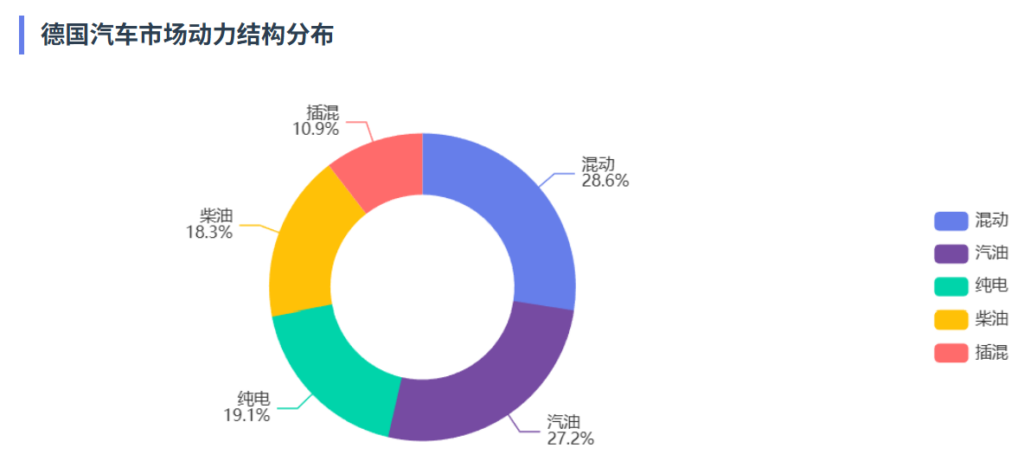
While BEVs grew 43.2%, plug-in hybrids grew even faster at 62%. The figures point to one conclusion: in markets where charging infrastructure is still incomplete and consumer use cases are diverse, PHEVs offer a transitional solution.
Hybrids (HEV) rose 8% year on year; diesel and petrol fell about 16% and 10% respectively. Full-year new combustion-engine (ICE) cars came to only about 2 million, around 500,000 fewer than in 2020 and about 1.5 million fewer than in 2019.
By share, the 2025 passenger car market breaks down roughly as follows: hybrids 28.6%, petrol 27.2%, BEV 19.1%, diesel 18.3%, PHEV 10.9%. Even allowing for rounding, Germany is no longer a market where combustion cars dominate absolutely and EVs are a fringe experiment; it has entered a new normal in which multiple powertrains are close to parity and the combined share of combustion cars is being steadily eroded.
Based on the German auto industry's total output of 6–7 million vehicles a year, combustion-engine models have lost about a quarter of the market in six years. This reflects a switch in the underlying technology path of the entire auto industry: from engine manufacturing to transmission suppliers, from fuel systems to exhaust systems, the whole supply chain is going through a painful but necessary transformation. Tens of thousands of engineers and skilled workers need to reskill, hundreds of millions in equipment investment face impairment risk, and the advantages European carmakers have built up are being reassessed in the electric era.
The rise of electric light commercial vehicles
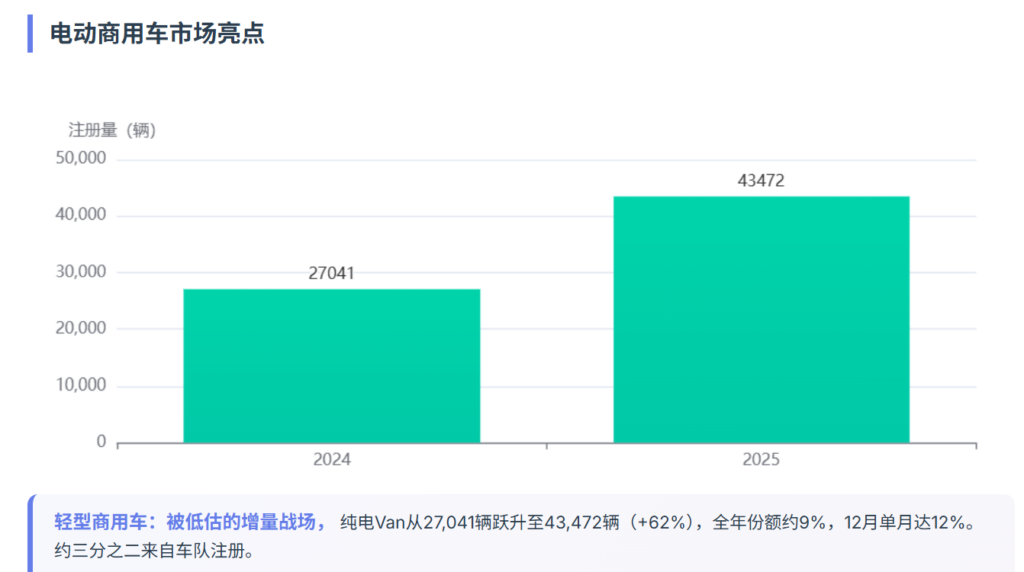
43472 electric light commercial vehicles, up 62% year on year. This shows electrification is spreading across the entire transport sector. In 2025, Germany's van market was roughly flat at about 499,035 units overall, but BEV vans jumped from 27041 units in 2024 to 43472 units in 2025. BEV vans took about 9% of the full-year market, with a monthly share of 12% in 12. Around two-thirds of BEV LCV registrations came from the fleet market.
Large-scale deployment of electric commercial vehicles creates a demonstration effect. As consumers see more and more electric vans, electric street sweepers and electric construction vehicles on the streets, their "perception of reliability" of EVs gradually improves. This subtle shift in perception is an important foundation for growth in the private market.
Restructuring of market demand and product mix
Germany's EV market is undergoing a restructuring of demand and product mix in 2025. The proportions and growth trends of fleet sales, private sales and tactical registrations show that businesses are leading electrification, private buyers are steadily following, and manufacturers are adjusting the market's pace through tactical registrations.
The shifting balance between BEVs, PHEVs and combustion-engine vehicles shows that the competitive advantages of different technology paths across different use cases are being reordered. No single technology can dominate every use case, and a diversified powertrain mix will be the long-term picture. Combustion-engine car sales have fallen by 1.5 million units in six years, and the entire automotive value chain is going through a painful but necessary transition. The competitive advantage of Europe's auto industry is being redefined.
From subsidy cliff to demand recovery
Looking at the timeline, after the subsidy ended abruptly, BEV registrations fell from 54654 units in Dec 2023 to 22464 units in Jan 2024. Demand only gradually stabilised at around 35000 BEVs a month in the second half of 2024. Q1 2025 was still weak, but growth kicked in from month 3, dipped seasonally in month 8, strengthened again in month 9, and kept climbing in months 10 and 11; BEV registrations reached 54774 units in month 12, close to the Dec 2023 peak.
The German market remains highly sensitive to policy and expectations, but it is also correcting itself. For outsiders, especially Chinese automakers planning to expand in Europe, the opportunity lies not only in product strength but in "whether you can keep up as the rhythm shifts". As the market relies more on fleets and channels, you need a strong B2B sales operation, residual value management, the ability to bundle finance and services, and risk control over tactical registrations. "Low price + high spec" alone will hardly carry a brand through the cycle.
Can growth continue in 2026?
In 2026, corporate fleet electrification will continue to underpin the core market, and whoever has healthier sales channels will have more pricing power. Whether the private market recovery continues depends on price band coverage and the stability of financing products. Subsidy expectations alone can create a "wait-and-see" effect, which directly affects momentum in the first half. Germany's EV purchase subsidies were phased out gradually after 2023, so the 2025 growth was achieved against a backdrop of reduced subsidies. This suggests growth is coming more from better products and greater market acceptance, which is more sustainable than subsidy-driven growth. PHEVs may be a "transitional moat" for legacy brands, or a short-term choice under policy and compliance pressure. Germany currently has about 90,000 public charging points, but to take market share from 19.1% to 30% or higher, the charging network needs to become denser. Especially along motorways and in small and medium-sized cities, charging convenience remains a key factor for consumers choosing an EV.
What comes next
The German government has set a target for EVs to account for more than 50% of new car sales by 2030. Going from 19.1% in 2025 to more than 50% in 2030 means market share needs to rise by an average of 5–6 percentage points a year over the next five years. Achieving this target depends on several preconditions: first, charging infrastructure rollout must accelerate, especially fast-charging networks; second, EV costs need to fall further to reach "parity" with combustion cars; third, breakthroughs in battery technology are needed to address pain points such as winter range loss; fourth, the power system must be decarbonised so that EVs genuinely deliver on emissions reduction targets.
The real significance of Germany's record EV market growth in 2025 is that the electrification of Europe's auto industry has moved from the "trial phase" to the "acceleration phase", from "policy-driven" to "market-driven", and from "fringe innovation" to "mainstream replacement".
**Reproduction or excerpting without permission is strictly prohibited.** Questions and comments are welcome. Follow us for ongoing analysis of the latest developments in China and abroad.