Parts of this page are still being translated from Chinese.
Original report · 2026-11-19
Chinese automakers in markets outside Europe: how they enter depends on each country's tariffs and localization requirements
Market entry conditions in Malaysia, India, Argentina, Canada, Southeast Asia and Japan, and how Chinese automakers are approaching them
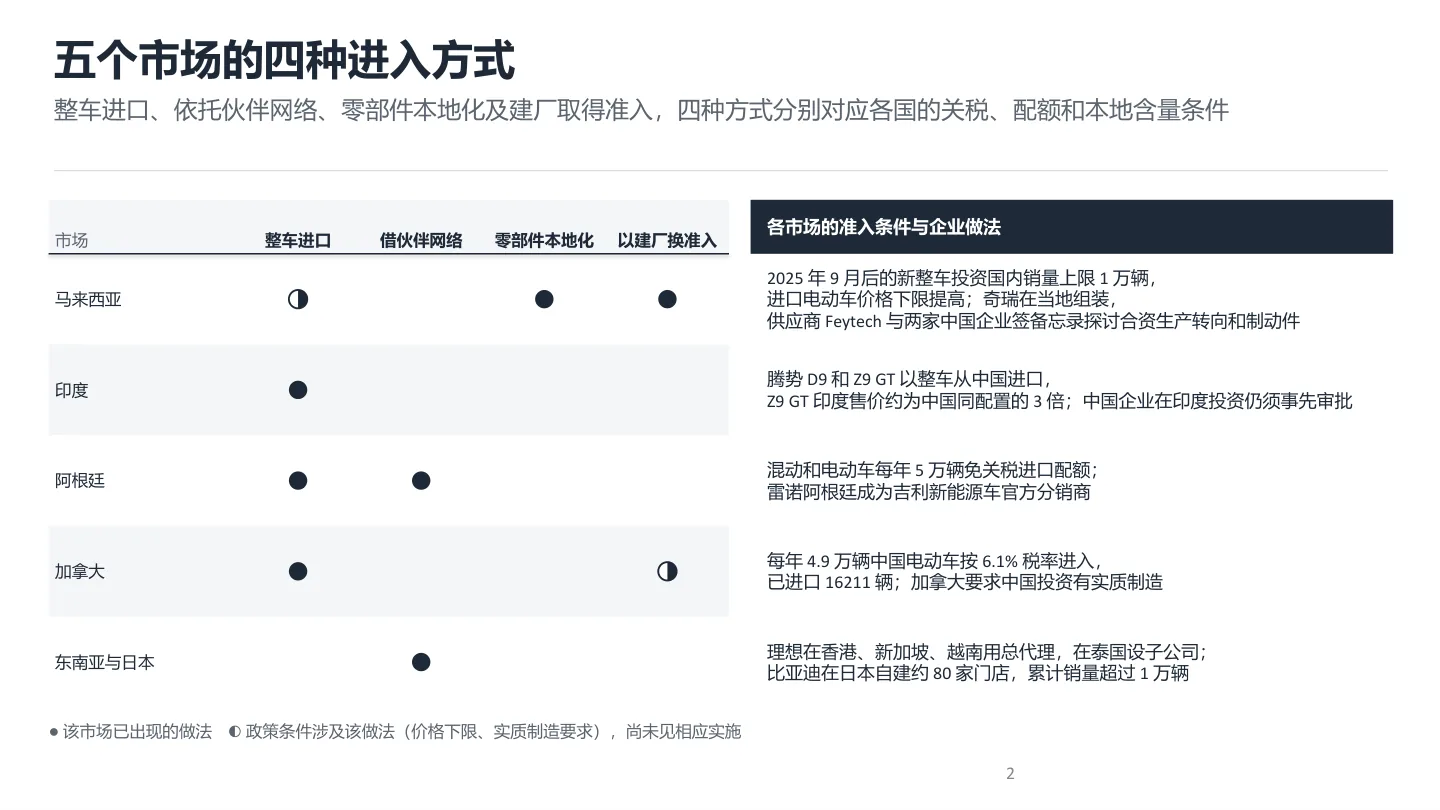
This report compares four market entry models used by Chinese automakers in Malaysia, India, Argentina, Canada, Southeast Asia and Japan: fully built imports, leveraging partner networks, localizing components, and trading local production for market access. For each country it lists tariffs, quotas, volume caps and local content requirements, along with the specific approaches of Chery, Geely, Denza, Li Auto, BYD and others, and the next milestones to watch. Data as of Nov 17, 2026.
If it won't open in WeChat, tap "…" at the top right and choose "Open in browser", or visit automusic123.cn/r/494 on a computer.
Key findings
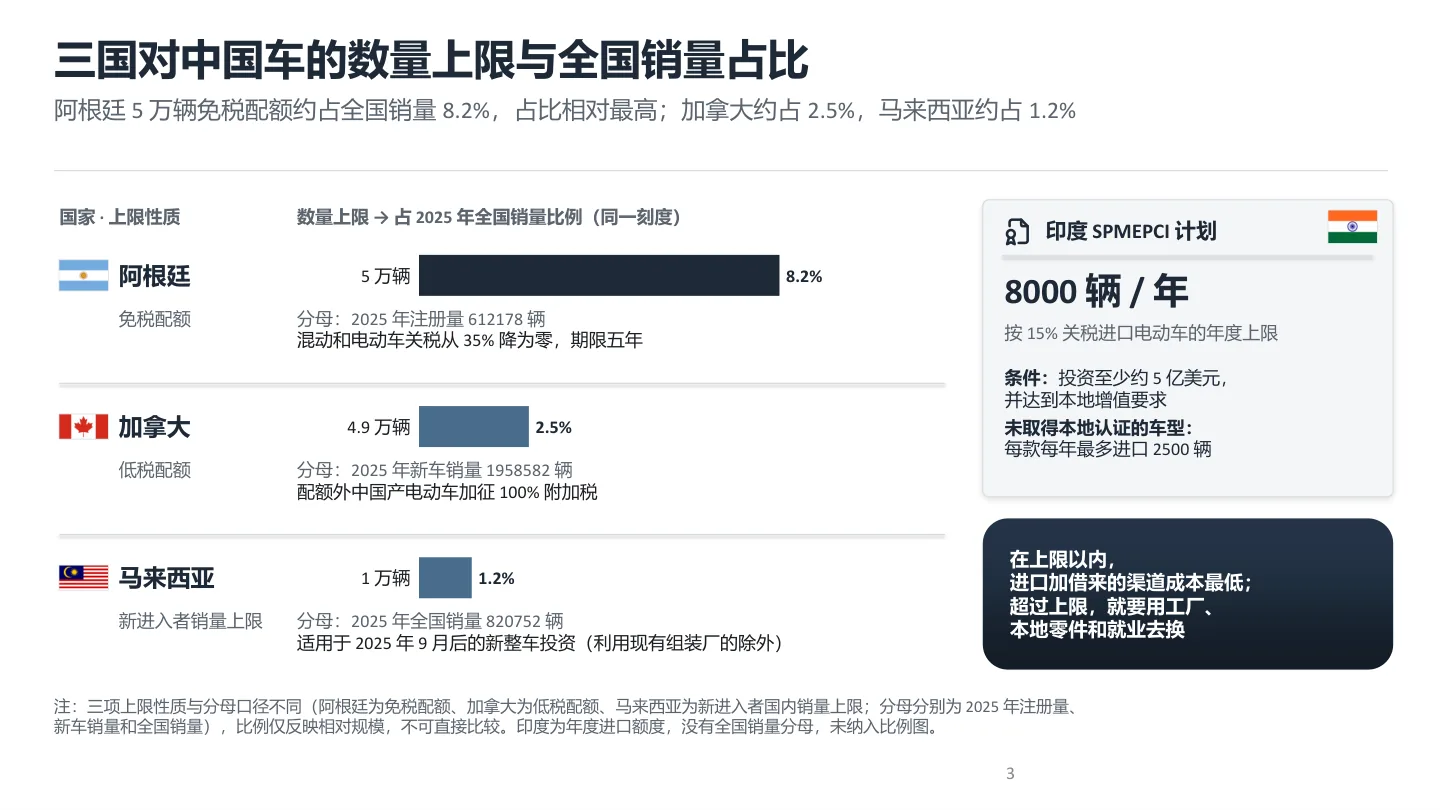
- Argentina's annual tax-free quota of 50,000 hybrid and electric vehicles is about 8.2% of national registrations in 2025. Canada's low-tariff quota of 49,000 vehicles is about 2.5% of national new vehicle sales. Malaysia's cap of 10,000 domestic sales for new entrants is about 1.2%. The three caps differ in nature and in the base they are measured against.
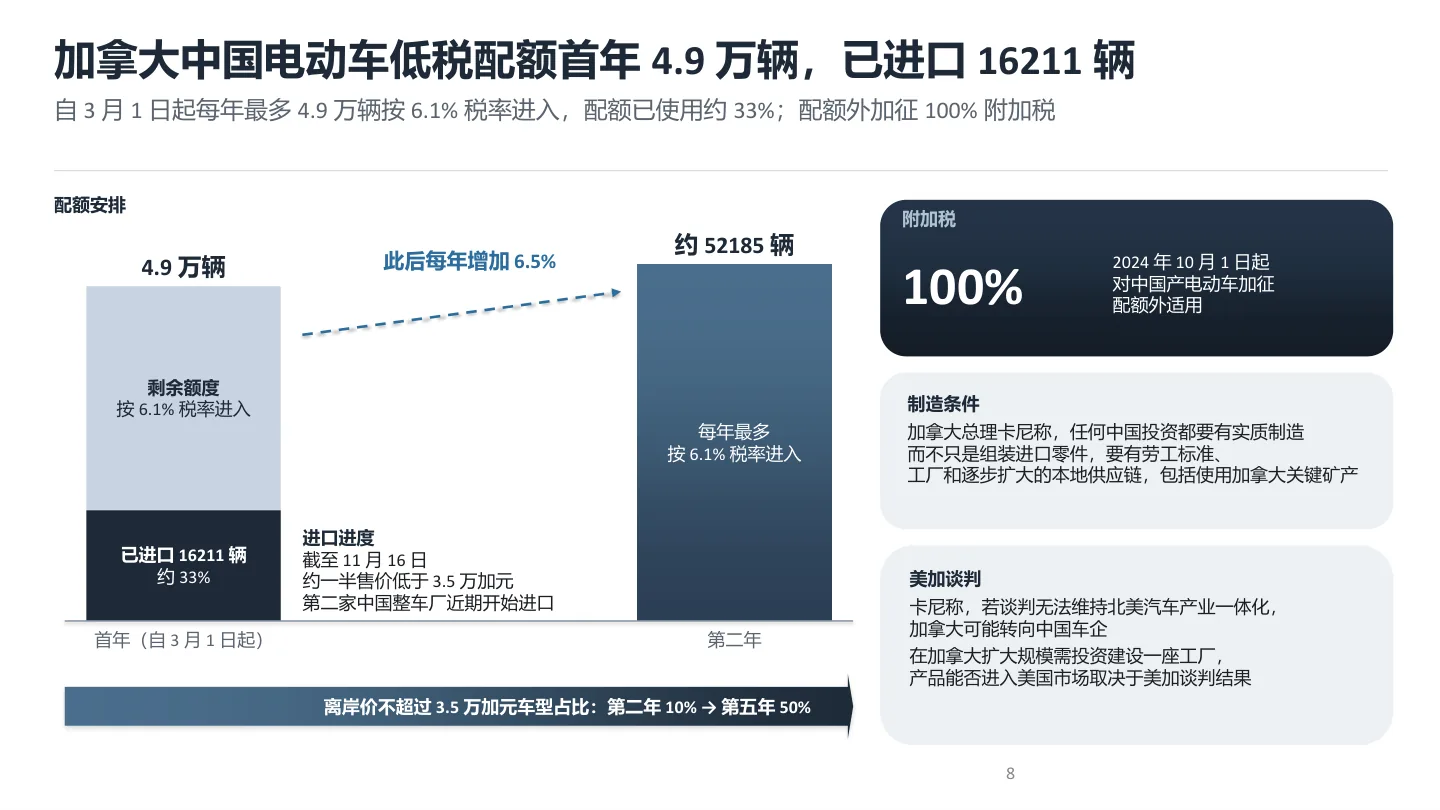
- In the first year of Canada's quota (from Mar 1), up to 49,000 Chinese EVs a year can enter at a 6.1% tariff; as of Nov 16, 16,211 had been imported, using about a third. Vehicles outside the quota face a 100% surtax.
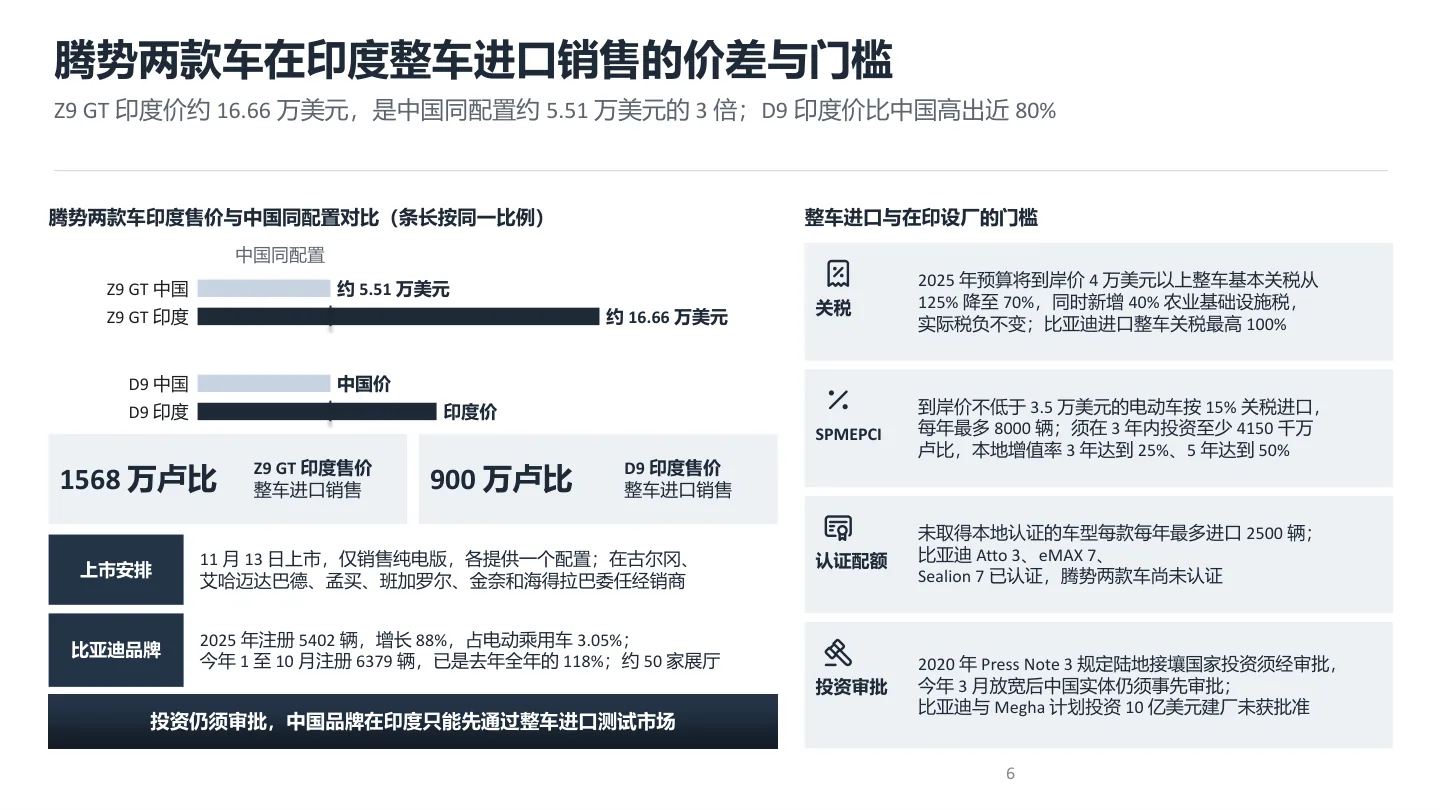
- The Denza Z9 GT is sold in India as a fully built import at about $166,600, three times the roughly $55,100 for the same spec in China. Chinese investment in India still requires prior approval.
Page preview
Click an image to enlarge; download the PDF for all 10 pages.
Contents
- Four entry modes across five markets2
- Caps on Chinese vehicles in three countries and their share of national sales3
- Malaysia's entry conditions for new vehicle assembly investment and imported EVs4
- Two localisation paths: Chery and Geely in Malaysia5
- Price gap and entry thresholds for two Denza models sold as fully built imports in India6
- Argentina's duty-free quota for hybrids and EVs, and the Renault–Geely partnership7
- Canada's low-tariff quota for Chinese EVs: 49,000 units in year one, 16,211 imported so far8
- Li Auto and BYD: channel strategies in Southeast Asia and Japan9
- Next milestones to watch for Chinese automakers in five markets10
Read the article version first
An article version on the same topic is available to read online, with the full argument and links to data sources.
More original reports
- 中国车企在北美和欧洲:美国走向立法禁售,欧洲以本地化设条件 →2026-11-21
- 捷豹路虎与比亚迪在荷兰的两宗诉讼:钛7 欧盟临时禁令成立,证据扣押被撤销 →2026-11-21
- 欧洲公共招标中的中国品牌:客车大单多挂在代理商名下,乘用车只拿到框架资格 →2026-11-19
Report update alerts
-

WeChat official account
Chexun Zongheng RZ
Search for "Chexun Zongheng RZ" on WeChat and follow us
On a computer, scan the code with WeChat; if you opened this page in WeChat, long-press the code to scan it.
-

Work WeChat
AutoMusic
Add WeChat ID Frontline_vehicle
On a computer, scan the code with WeChat; if you opened this page in WeChat, long-press the code to scan it.
Also available via RSS: ArticlesWeek in review