London is becoming a new battleground for Chinese and US autonomous driving
In early 2026, Chinese and US autonomous driving technology will compete head-to-head in the same city for the first time. Waymo's modified Jagu…
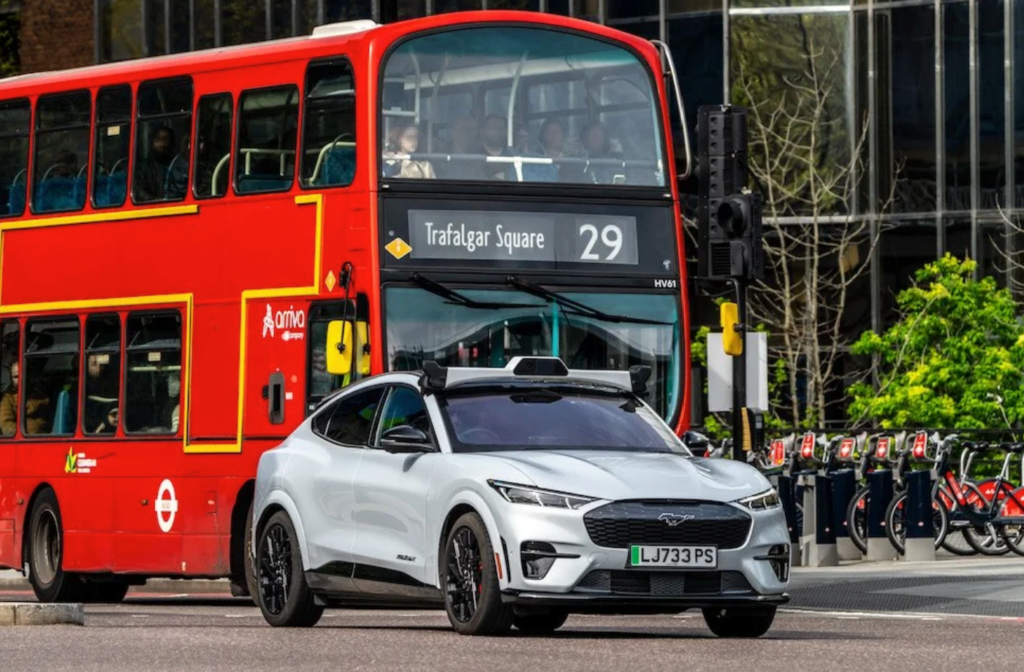
In early 2026, Chinese and US autonomous driving technology will compete head-to-head in the same city for the first time. Waymo's converted Jaguar I-PACE and Baidu Apollo Go's RT6 will face off in London, in a contest that goes beyond technology.
China and the US compete in London
In terms of operating scale and real-world data accumulation, Waymo remains the leader of the global robotaxi industry. According to figures it disclosed at the end of 2025, Waymo's fully driverless service was approaching 1 million rides per week, and full-year 2025 trips exceeded 14 million, roughly a twofold increase year on year. Its fleet grew from about 1,500 vehicles at mid-year to about 2,500 by year-end. It runs regular commercial operations in San Francisco, Los Angeles, Phoenix, Atlanta and Austin, and has explicitly targeted entry into 20+ cities worldwide by the end of 2026.
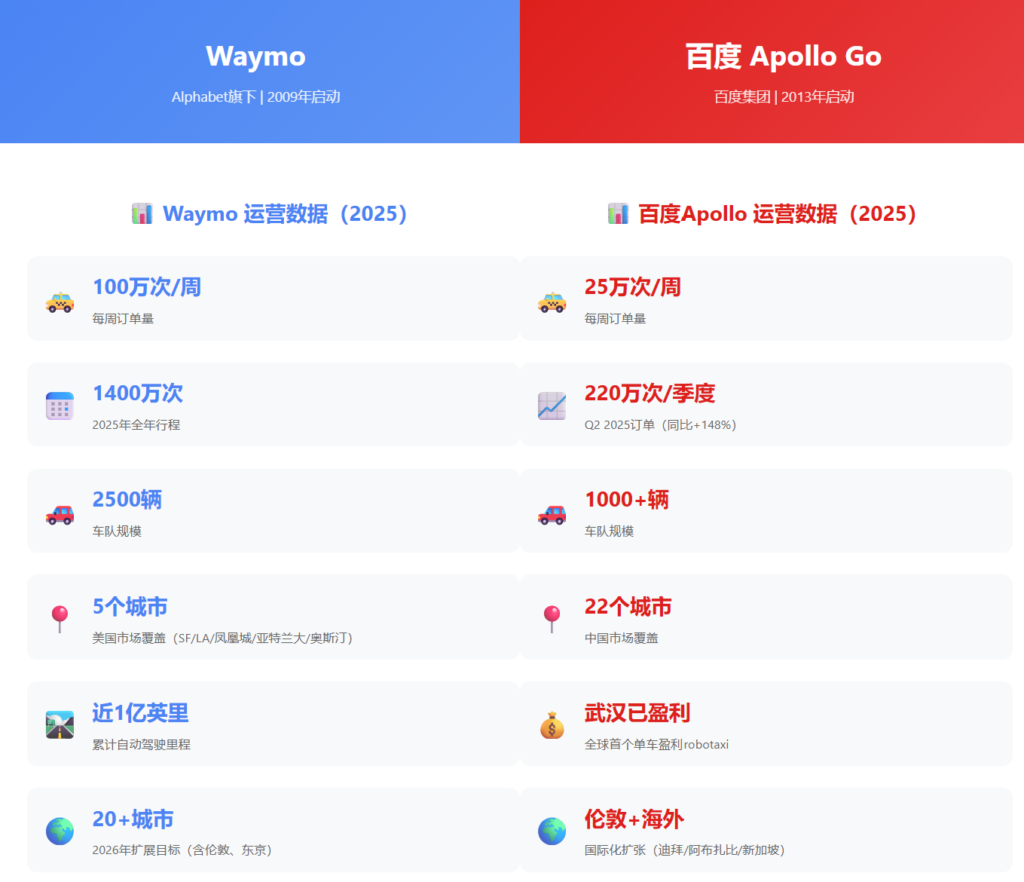
Baidu's Apollo Go lacks international profile, but it is not behind in operating density or unit economics. As of Nov 2025, Apollo Go had deployed 1,000+ fully driverless vehicles across 22 cities in China, with weekly orders of about 250,000. More importantly, it has achieved per-vehicle profitability in Wuhan alone, making it one of very few companies in the global robotaxi industry with publicly verified profitability.
For Waymo, this is its first systematic expansion beyond the US; for Baidu, with the US market effectively closed, Europe has become its only Western foothold with scale potential.
UK: a rare window of openness
London can compete as a location chiefly because of the UK's regulatory regime. In May 2024, the UK Parliament formally passed the Automated Vehicles Act, explicitly allowing commercial pilots provided safety and liability requirements are met. Under the official timetable, approved companies may carry passengers on public roads from spring 2026. Unlike the long wait-and-see stance at US federal level and fragmented state-level regulation, the UK has taken an incremental approach of "framework first, details later".
On Dec 2025, the UK government launched another public consultation, covering:
- Legal distinction between unsupervised and supervised systems
- Vehicle type approval and liable parties
- Data compliance and privacy protection
The consultation runs until Mar 2026. This approach lets companies help shape the rules, but it also brings a high degree of uncertainty.
Competition between business models
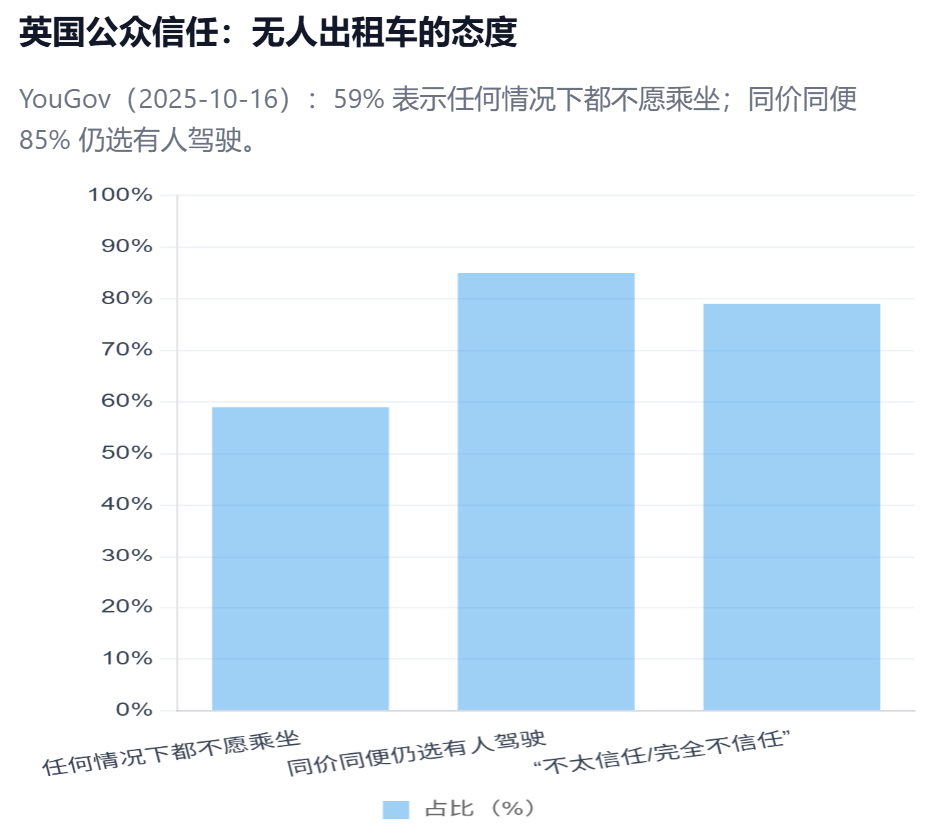
Baidu: platform-embedded B2B2C
Baidu does not face consumers directly as an "operator"; instead, it partners with Uber and Lyft, embedding itself in existing mobility platforms as a technology supplier. This strategy lets Baidu lower political and public-opinion sensitivity, tap demand-side scale through the platforms and avoid heavy upfront capital investment. Waymo: asset-heavy
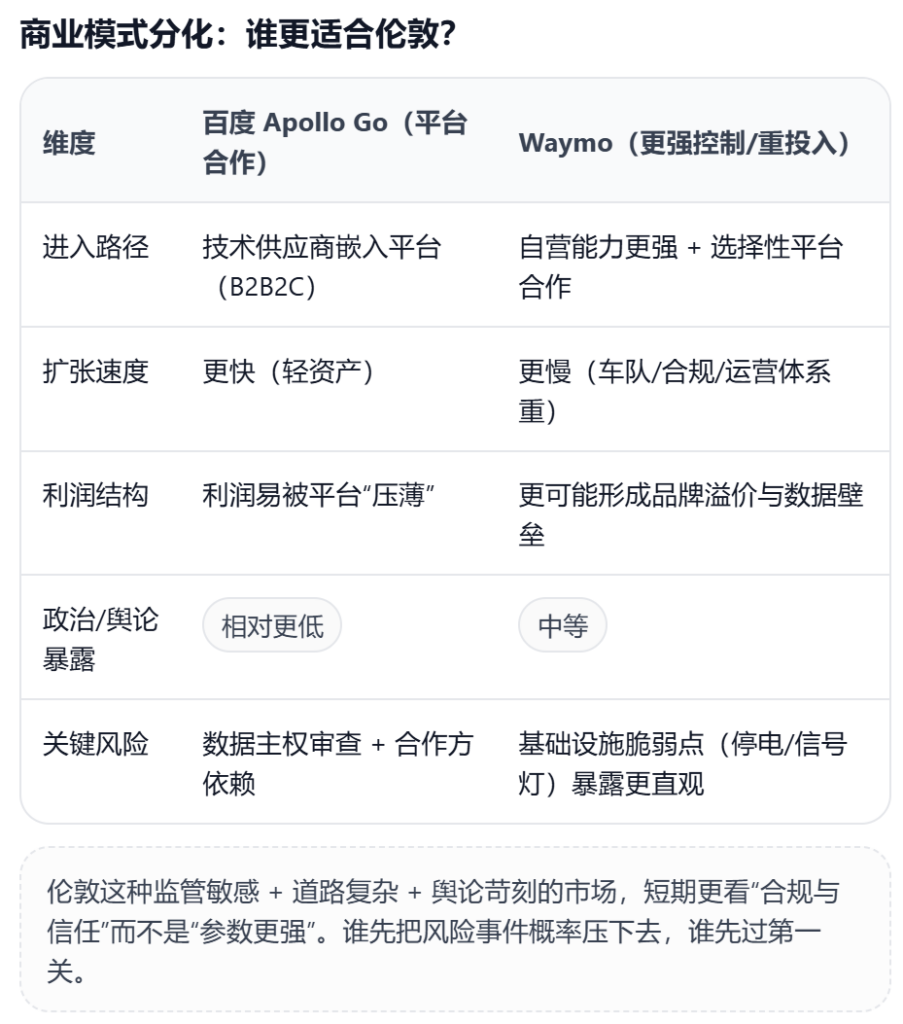
Waymo has taken a path closer to vertical integration, partnering with Uber-backed Moove while retaining tight control over vehicles, systems and data. Its core strengths are nearly 100 million miles of real-world driverless data and the financial firepower of Google parent Alphabet. In London's highly mature mobility market, whether consumers accept it will be a harsh test.
A double test of technology and trust
London is in fact unfriendly to autonomous driving systems. Its narrow roads, complex junctions and legacy traffic layout, along with the UK's distinctive rule of absolute pedestrian priority, require algorithms with decision logic quite different from that used in US cities. Add frequent rain and fog, and sensor reliability is put under considerable strain.
Data challenges
A robotaxi is essentially a mobile node of dense sensors plus high-performance AI computing. What it touches is not just mobility efficiency, but city-wide traffic data, behaviour and location tracks, and ultimately information on potentially sensitive areas. That is why the UK's draft regulation explicitly requires all autonomous driving pilots to work closely with local authorities and Transport for London, and to undergo separate review of data storage, access and control.
A test before the rules take shape
The UK may be one of the few Western markets still willing to "trial first, regulate later," but its regulatory window is closing fast. Geopolitics, data security and supply chain transparency have become equally important variables. For Chinese companies, this is a rare chance to prove themselves in a high-standards environment. The real challenge for autonomous driving has never been "can it drive," but whether it will be permitted, trusted and accepted over the long term.
Reproduction or excerpting without permission is strictly prohibited. Questions and comments are welcome. Follow us for ongoing analysis of the latest developments in China and abroad.