↑Back to top
Denza enters the Philippine market – data analysis

Denza begins operations in the Philippines

A key step in the Southeast Asian expansion of BYD's premium brand | Jan 2026

Premium electric brand
4 core cities
D9 MPV debut
PHEV strategy
4
First dealer cities
Alabang, Makati, etc.
58,905
2025 xEV sales (units)
About 12% of the new-car market
+142.5%
YoY growth
Rapid growth in xEV penetration
26,122
BYD sales in the Philippines (units)
2025 retail sales

Car market size in three Southeast Asian countries compared (2025)

Difference in market size,

At 491,000 units, the Philippine market is about 60% the size of Thailand's and 50% of Indonesia's, and the pool of potential premium EV buyers is smaller. Thailand and Indonesia are larger markets with better infrastructure. The Philippines' EV penetration of 5-7%, compared with Thailand's 15%, leaves plenty of room to grow.

  • Market segmentation evolves: Denza's entry into the Philippines marks a shift in the market from "does electrification work?" to "which kind of electrification, at which price point, works best?", as competition enters a "second curve" phase
  • The core question has shifted from "do you have EVs" to "who can make electrification more usable, more respectable and more hassle-free"

EV penetration in three Southeast Asian countries compared (2025)

Penetration gap,

The Philippines' EV penetration of 5–7% is mid-range for Southeast Asia, leaving plenty of room for growth compared with Thailand's 15%. Thailand's 15% penetration is driven by government subsidies and a rapid charging infrastructure rollout; the Philippines' 900+ public charging stations are concentrated mainly in Metro Manila.

  • xEV market expands overall: in 2025, xEV sales in the Philippines reached 58,905 units, about 12% of the new-car market, up from about 5.5% in 2024, with year-on-year growth of 142.5%
  • PHEVs go mainstream: consumers are not just choosing "BEV" but an electrified package that is "more fuel-efficient, lower-cost and less stressful", and PHEVs/hybrids have become the main source of growth

Denza lineup: performance specs compared

Differentiated product positioning,

The B5 and B8 complement each other in power and seating layout. The B8's 3500 kg towing capacity fills a gap in the electrified towing market, and all three models are offered as PHEVs to suit markets where charging infrastructure is still lacking.

  • PHEVs' certainty advantage: in markets where charging gaps persist, plug-in hybrids are not a compromise but the higher-certainty product: easier to sell, easier to use and quicker to build word of mouth
  • A strategic choice: turning uncertainty over whether a vehicle is usable into certainty that it is good enough. This is the strategic answer to inadequate charging infrastructure.

State of charging infrastructure in the Philippines

Centralized infrastructure,

Of the country's 900+ public charging stations, 80% are concentrated in major metropolitan areas; the V-Green network's 123 sites cover Manila, Cebu and Davao. Metro Manila alone has 720 charging stations, while coverage elsewhere is sparse.

  • Core logic of the dealer network: Denza's first stores are in Alabang, Makati, Greenhills and Cebu, a typical early-stage footprint built around purchasing power and charging access
  • Secure first, then expand: the signal is clear — secure sales efficiency and after-sales accessibility first, then talk about the pace of expansion

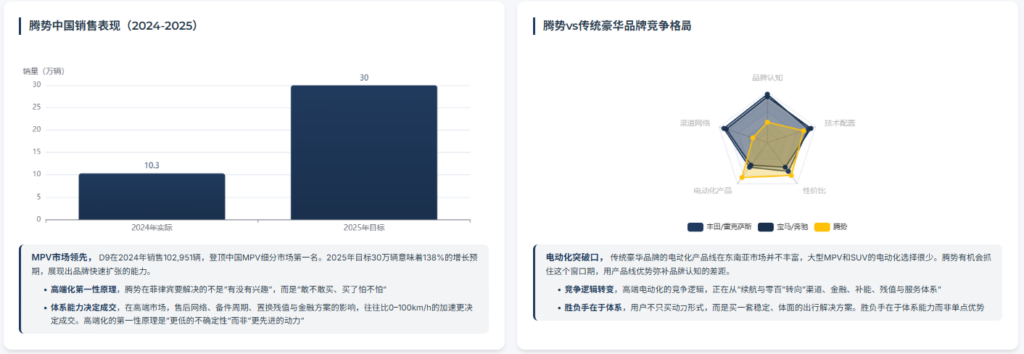
Denza sales performance in China (2024–2025)

MPV market leader,

The D9 sold 102,951 units in 2024, topping China's MPV segment. The 2025 target of 300,000 units implies expected growth of 138%, demonstrating the brand's capacity for rapid expansion.

  • First principles of premiumisation: Denza's challenge in the Philippines is not "is there interest" but "will buyers dare to buy, and will they worry afterwards"
  • System capability closes the deal: in the premium market, the after-sales network, spare parts lead times, trade-in residual values and financing often matter more to closing a sale than 0–100 km/h acceleration. The first principle of going premium is "less uncertainty", not "more advanced powertrains"

Denza vs. traditional luxury brands: competitive landscape

Breakthrough point for electrification,

Traditional luxury brands offer few electrified models in Southeast Asia, with very limited electric options among large MPVs and SUVs. Denza has a chance to seize this window and use its product-line advantage to offset its gap in brand awareness.

  • The competitive logic is shifting: in premium electrification, competition is moving from "range and 0–100" to "dealer network, financing, charging, residual values and service"
  • The system decides the outcome: users are not just buying a powertrain but a stable, respectable mobility solution. Winning depends on system capability, not single-point advantages