↑Back to top
EU Jan 2026 dual-carbon policy analysis

EU dual-carbon policy takes effect Jan 2026

CBAM and 100% EU ETS compliance for shipping take effect simultaneously, marking a systematic expansion of EU carbon pricing

📅 Effective Jan 1, 2026
🌍 Covers global trade
⚡ Shipping 100% compliance
💰 Carbon cost pricing
📊
Core data overview
EU ETS carbon price
€89.56
Per tonne of CO₂, Jan 2026
Shipping emissions
89.8 million tonnes
2024 CO₂ emissions
EU ETS revenue
€38.8 billion
2024 auction revenue
UK impact
£7 billion
Potential export costs
🏭
CBAM scope
Current scope (Jan 2026)
6 product categories
Steel, cement, aluminium, fertilisers, hydrogen, electricity
Future expansion (from 2028)
Downstream products
Machinery, electrical appliances and other manufactured goods
🚢
EU ETS shipping compliance timeline
2024
Shipping is included in the EU ETS for the first time, covering ships of 5000 GT and above. For 2024 emissions, 40% of allowances must be purchased in 2025; compliance rate above 99%
2025
Compliance share rises to 70%. Ice-class ships get a 5% emissions reduction. CH₄ and N₂O emissions set to be brought under regulation
Jan 2026
100% compliance takes effect. CH₄ and N₂O emissions formally brought into the EU ETS. Cap adjustment: reduced by 27 million to align with the 2030 target, and increased to cover the new shipping greenhouse gases
100%
Intra-EEA voyages
50%
Voyages into/out of the EEA
5000GT
Minimum tonnage requirement
💹
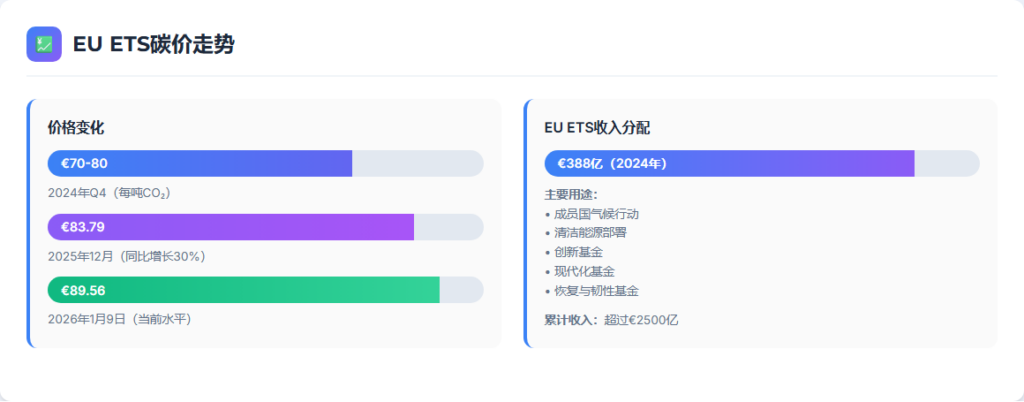
EU ETS carbon price trend
Price change
€70-80
Q4 2024 (per tonne of CO₂)
€83.79
Dec 2025 (up 30% YoY)
€89.56
Jan 9, 2026 (current level)
EU ETS revenue allocation
€38.8 billion (2024)
Main uses:
• Member state climate action
• Clean energy deployment
• Innovation Fund
• Modernisation Fund
• Recovery and Resilience Facility
Cumulative revenue: over €250 billion
🇨🇳
Impact on Chinese companies
Steel industry
Chinese steel has enjoyed a price advantage in the EU thanks to low carbon costs. Once CBAM takes effect, it will have to pay the same carbon cost as European steel, eroding that advantage. Upward pressure on export costs is clear.
Aluminium
Aluminium exports to the EU face carbon costs, making high-carbon aluminium products less competitive. Green aluminium production technology is becoming a new investment focus and a competitive advantage.
Green opportunities
Forcing investment in green technologies: hydrogen-based direct reduced iron (H₂-DRI), carbon capture and storage (CCS) and green aluminium smelting are moving faster towards commercialisation.
Shipping industry
Chinese shipping companies operating EU routes must pay 100% of emission costs. This drives ship energy-efficiency improvements, investment in alternative fuels and the development of green shipping services.
Source: